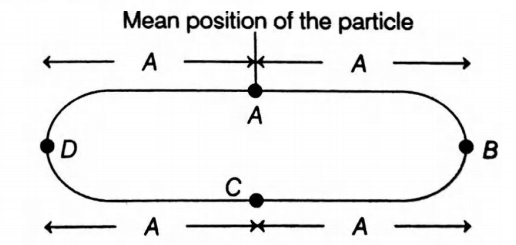
The simple pendulum acts as second's pendulum on earth. Its time on a planet, whose mass and diameter are twice that of earth is
1
2
3
2 s
4
Official Solution
Correct Option: (2)
Second's pendulum is that simpie pendulum whose time period of vibration is two second. The bob of such pendulum while oscillating passes through the mean position after every one second. Now, Time period of simple penduium is given by
or ... (i)
but (on earth)
and (on planet)
E (i) gives
or
or
02
PYQ 2005
easy
physicsID: mht-cet-
The displacement of a particle performing simple harmonic motion is given by, x=8sin , where distance is in cm and time is in second. The amplitude of motion is
1
10 cm
2
2 cm
3
14 cm
4
3.5 cm
Official Solution
Correct Option: (1)
Here so, Amplitude of motion
03
PYQ 2005
easy
physicsID: mht-cet-
The minimum phase difference between two simple harmonic oscillations, is
1
2
3
4
Official Solution
Correct Option: (2)
Here
Similarly
04
PYQ 2008
easy
physicsID: mht-cet-
A hollow sphere is filled with water through the small hole in it. It is then hung by a long thread and made to oscillate. As the water slowly flow out of the hole at the bottom, the period of oscillation will
1
continuously decrease
2
continuously increase
3
first decrease then increase
4
first increase then decrease
Official Solution
Correct Option: (3)
The time period of the pendulum
Initially the centre of mass of the sphere is at the centre of the sphere. As the water slowly flows out of the hole at the bottom, the CM of the liquid (hollow sphere) first goes on downward and then upward. Hence, the effective length of the pendulum first increases and then decreases.
05
PYQ 2009
easy
physicsID: mht-cet-
A particle performing has time period and path length . The displacement from mean position at which acceleration is equal to velocity is
1
2
3
4
Official Solution
Correct Option: (3)
Velocity and acceleration Given, or ...(i) Given, and Substituting the value of in (i), we get
As amplitude
06
PYQ 2010
medium
physicsID: mht-cet-
For a particle in , if the amplitude of the displacement is a and the amplitude of velocity is , the amplitude of acceleration is
1
2
3
4
Official Solution
Correct Option: (2)
and Maximum acceleration =
07
PYQ 2010
medium
physicsID: mht-cet-
The average acceleration of a particle performing over one complete oscillation is
1
2
3
zero
4
Official Solution
Correct Option: (3)
The average acceleration of a particle performing over one complete oscillation is zero.
08
PYQ 2014
medium
physicsID: mht-cet-
If the radius of the first Bohr orbit is , then the de Broglie wavelength of the electron in the orbit is
1
2
3
4
Official Solution
Correct Option: (2)
Step 1: Given displacement equation. $ \cos0=1 $
09
PYQ 2016
medium
physicsID: mht-cet-
A mass connected to a horizontal spring performs with amplitude . While mass is passing through mean position another mass is placed on it so that both the masses move together with amplitude . The ratio of is
1
2
3
4
Official Solution
Correct Option: (1)
Answer (a)
10
PYQ 2017
medium
physicsID: mht-cet-
A particle performs linear At a particular instant, velocity of the particle is and acceleration is while at another instant velocity is and acceleration is . The distance between the two positions is
1
2
3
4
Official Solution
Correct Option: (1)
Answer (a)
11
PYQ 2018
easy
physicsID: mht-cet-
For a particle performing linear S.H.M., its average speed over one oscillation is (a = amplitude of S.H.M., n = frequency of oscillation)
1
2
3
4
Official Solution
Correct Option: (2)
Given, amplitude of Frequency of oscillation Distance travelled in one oscillation,
We know that,
Frequency,
12
PYQ 2019
medium
physicsID: mht-cet-
A particle executes the simple harmonic motion with an amplitude . The distance travelled by it in one periodic time is
1
2
3
4
Official Solution
Correct Option: (4)
Key Idea One time period means the total time in which the particle returns to the same point and in the same direction from where it was released. Now, in simple harmonic motion (SHM) total distance travelled is .
This is because the particle covers in time period i.e., when it moves from to , So in complete time it covers 4 times the amplitude distance i.e.,
13
PYQ 2020
medium
physicsID: mht-cet-
The kinetic energy of a particle performing S.H.M. is times its potential energy. If the amplitude of S.H.M. is , then the displacement of the particle will be
1
2
3
4
Official Solution
Correct Option: (1)
Step 1: Write expressions for energies in SHM. Potential energy at displacement : Kinetic energy: Step 2: Apply given condition. Step 3: Substitute energy expressions. Step 4: Simplify the equation. Step 5: Solve for displacement .
14
PYQ 2020
medium
physicsID: mht-cet-
The period of seconds pendulum on a planet, whose mass and radius are three times that of earth, is
1
second
2
second
3
second
4
second
Official Solution
Correct Option: (3)
Step 1: Expression for acceleration due to gravity.
Step 2: Substitute planetary values.
Step 3: Relation between time period and gravity.
Step 4: Calculate new time period.
Step 5: Conclusion. The time period of the seconds pendulum on the planet is seconds.
15
PYQ 2020
medium
physicsID: mht-cet-
A simple pendulum of length has mass and it oscillates freely with amplitude . At extreme position its potential energy is
1
2
3
4
Official Solution
Correct Option: (4)
Step 1: Understand the potential energy of a pendulum. The potential energy of the pendulum at its extreme position is given by:
where is the height the pendulum rises to from its equilibrium position. Step 2: Use the geometry of the pendulum. For small angles of oscillation, the height at the extreme position can be approximated by:
where is the angular displacement of the pendulum. Using the small angle approximation , we get:
Step 3: Calculate the potential energy. Thus, the potential energy at the extreme position is:
Step 4: Conclusion. Thus, the potential energy at the extreme position is , which corresponds to option (D).
16
PYQ 2020
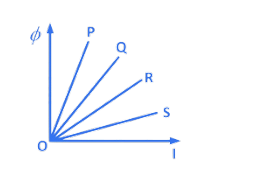
medium
physicsID: mht-cet-
The third overtone of a closed pipe is in unison with the second overtone of an open pipe. Hence the ratio of the length of the closed pipe to that of the open pipe is:
1
1 : 2
2
6 : 7
3
7 : 6
4
3 : 2
Official Solution
Correct Option: (4)
Step 1: Understanding the relationship. In the case of a closed pipe and an open pipe, the overtones are related to their respective fundamental frequencies. The length of the closed pipe is shorter compared to the open pipe to produce the same overtone. Step 2: Conclusion. The ratio of the lengths of the closed pipe to the open pipe is found to be .
17
PYQ 2020
medium
physicsID: mht-cet-
A light wave of wavelength is incident on a slit of width . The resulting diffraction pattern is observed on a screen at a distance . If linear width of the principal maxima is equal to the width of the slit, then the distance is
1
2
3
4
Official Solution
Correct Option: (3)
Step 1: Diffraction pattern.
The angular width of the first diffraction minima is given by the formula:
For small angles, , so the angular width of the principal maxima is . Step 2: Linear width of the maxima.
The linear width of the principal maxima at a distance from the slit is:
Using , we get:
Equating with the width of the slit , we get:
Solving for , we get:
Step 3: Conclusion.
The distance is , so the correct answer is (C).
18
PYQ 2020
medium
physicsID: mht-cet-
For a photocell, the work function is and the stopping potential is . The wavelength of the incident radiation is
1
2
3
4
Official Solution
Correct Option: (1)
Step 1: Write Einstein’s photoelectric equation. The energy of the incident photon is given by:
Step 2: Relate maximum kinetic energy to stopping potential.
Step 3: Substitute in the photoelectric equation.
Step 4: Express frequency in terms of wavelength.
Step 5: Solve for wavelength.
Step 6: Conclusion. The wavelength of the incident radiation is .
19
PYQ 2020
medium
physicsID: mht-cet-
The linear displacement of the bob of simple pendulum from its mean position varies as , where is its amplitude expressed in meter and is in second. The length of simple pendulum is (Take )
1
1.5 m
2
3.0 m
3
2.0 m
4
2.5 m
Official Solution
Correct Option: (3)
Step 1: Using the simple pendulum equation. The equation for the displacement of a simple pendulum is: Where is the angular frequency and is the length of the pendulum. Comparing this with the given equation , we find: Thus, equating , we get: Solving for , we get . Thus, the correct answer is (C) 2.0 m.
20
PYQ 2020
medium
physicsID: mht-cet-
An electric lamp connected in series with a capacitor and an a.c. source is glowing with certain brightness. On reducing the capacitance and frequency, the brightness of the lamp respectively
1
is increased, is increased
2
is reduced, is increased
3
is increased, is reduced
4
is reduced, is reduced
Official Solution
Correct Option: (4)
Step 1: Capacitive reactance.
Step 2: Effect of reducing capacitance. If decreases, increases, current decreases, so brightness decreases. Step 3: Effect of reducing frequency. If decreases, increases, current decreases further. Step 4: Conclusion. In both cases, lamp current reduces, hence brightness reduces.
21
PYQ 2020
medium
physicsID: mht-cet-
The length and diameter are given for four wires of the same material. They are stretched by the same load. Which wire will elongate more?
1
2
3
4
Official Solution
Correct Option: (2)
Step 1: Formula for elongation of a wire.
Step 2: Dependence on length and diameter.
Step 3: Calculate for each wire. (A) (B) (C) (D) Step 4: Conclusion. Wire (B) has the maximum elongation.
22
PYQ 2020
medium
physicsID: mht-cet-
The condition for observing Fraunhofer diffraction pattern from an obstacle is that the light wavefront incident on it must be
1
spherical
2
plane
3
cylindrical
4
either cylindrical or spherical
Official Solution
Correct Option: (2)
Step 1: Types of diffraction. Fraunhofer diffraction is observed when both the source and the screen are effectively at infinite distances from the obstacle. Step 2: Nature of wavefront. Under these conditions, the incident wavefront becomes plane. Step 3: Eliminating incorrect options. Spherical and cylindrical wavefronts correspond to Fresnel diffraction, not Fraunhofer diffraction. Step 4: Conclusion. The wavefront must be plane.
23
PYQ 2020
medium
physicsID: mht-cet-
Light travels through a glass plate of thickness and refractive index . If is the velocity of light in vacuum, the time taken by the light to travel the thickness of glass is
1
2
3
4
Official Solution
Correct Option: (4)
Step 1: Definition of refractive index. Refractive index is defined as: where is velocity of light in glass. Step 2: Velocity of light in glass.
Step 3: Time taken to travel thickness .
Step 4: Substituting value of .
Step 5: Conclusion. The time taken by light to pass through the glass plate is .
24
PYQ 2020
medium
physicsID: mht-cet-
A small quantity of paramagnetic liquid is taken in a watch-glass and kept on two dissimilar magnetic poles. The liquid
1
is first elevated and then depressed
2
shows no change in the level
3
shows elevation in the middle
4
shows depression in the middle
Official Solution
Correct Option: (3)
Step 1: Property of paramagnetic substances. Paramagnetic substances are weakly attracted by a magnetic field and tend to move towards regions of stronger magnetic field. Step 2: Magnetic field between dissimilar poles. Between two dissimilar magnetic poles, the magnetic field is strongest in the middle region. Step 3: Effect on the liquid. Since the paramagnetic liquid is attracted towards the stronger magnetic field, it rises in the middle where the field strength is maximum. Step 4: Conclusion. The liquid shows elevation in the middle.
25
PYQ 2020
medium
physicsID: mht-cet-
In a balanced metre bridge, is connected in the left gap and in the right gap. When is shunted with an equal resistance, the new balance point is at , where is the earlier balancing length. The value of is
1
2
3
4
Official Solution
Correct Option: (1)
Step 1: Write balance condition for metre bridge.
Step 2: New resistance after shunting. When is shunted with an equal resistance, effective resistance becomes:
Step 3: New balance condition.
Step 4: Divide the two balance equations.
Step 5: Solve for .
Step 6: Conclusion. The initial balancing length is .
26
PYQ 2020
medium
physicsID: mht-cet-
A solenoid having turns per metre has a core of a material with relative permeability . What is the approximate value of the magnetisation of the core material, if a current of is passed through it?
1
2
3
4
Official Solution
Correct Option: (3)
Step 1: Magnetic field intensity inside the solenoid. The magnetic field intensity is given by:
Step 2: Relation between magnetisation and magnetic field. Magnetisation is related to magnetic susceptibility by: where
Step 3: Substitute the given values.
Step 4: Conclusion. The approximate value of magnetisation of the core material is .
27
PYQ 2020
medium
physicsID: mht-cet-
Water rises in a capillary tube to a certain height such that the upward force due to surface tension is balanced by force due to the weight of the water. The surface tension of water is . The inner diameter of the capillary tube is nearly
1
2
3
4
Official Solution
Correct Option: (2)
Step 1: Write the force due to surface tension. The upward force due to surface tension acting along the circumference of the capillary tube is: (For water, angle of contact , hence ).
Step 2: Substitute given values.
Step 3: Calculate the radius of the capillary tube.
Step 4: Find the inner diameter.
Step 5: Conclusion. The inner diameter of the capillary tube is nearly .
28
PYQ 2020
medium
physicsID: mht-cet-
If , and , the value of is
1
2
3
4
Official Solution
Correct Option: (3)
Step 1: Use vector identity for magnitude.
Step 2: Calculate dot product .
Step 3: Expand the given expression.
Step 4: Substitute values.
Step 5: Conclusion. The correct value is .
29
PYQ 2020
medium
physicsID: mht-cet-
An ideal gas occupies a volume at pressure and absolute temperature . The mass of each molecule is . If is the Boltzmann constant, then the density of the gas is given by
1
2
3
4
Official Solution
Correct Option: (4)
Step 1: Ideal gas equation in molecular form.
Step 2: Express number density.
Step 3: Write expression for density. Density is mass per unit volume:
Step 4: Substitute number density.
Step 5: Conclusion. The density of the gas is
30
PYQ 2020
medium
physicsID: mht-cet-
If the frequency of oscillation of a simple pendulum in simple harmonic motion is , then frequency of oscillation of simple pendulum when length is 4 times is:
1
2
3
4
Official Solution
Correct Option: (4)
Step 1: Frequency of Simple Pendulum. The frequency of oscillation of a simple pendulum is given by:
where is the acceleration due to gravity, and is the length of the pendulum. The frequency is inversely proportional to the square root of the length. Therefore, when the length becomes 4 times, the frequency becomes:
Step 2: Final Answer. Thus, the frequency of oscillation will be when the length is 4 times.
31
PYQ 2020
medium
physicsID: mht-cet-
The bob of a simple pendulum is released at time from a position of small angular displacement. Its linear displacement is (length of simple pendulum) and (acceleration due to gravity), = amplitude of S.H.M.
1
2
3
4
Official Solution
Correct Option: (2)
Step 1: Equation for Simple Harmonic Motion. The linear displacement of a simple pendulum follows the equation:
where is the amplitude, is the acceleration due to gravity, and is the length of the pendulum. This equation represents the motion of a simple pendulum in simple harmonic motion (S.H.M.) Step 2: Final Answer. Thus, the correct expression for the linear displacement is .
32
PYQ 2020
medium
physicsID: mht-cet-
A stationary sound wave has a frequency of . If the speed of sound in air is , then the distance between a node and the adjacent antinode is
1
2
3
4
Official Solution
Correct Option: (2)
Step 1: Find wavelength of the sound wave. Step 2: Relation between node and antinode. The distance between a node and the adjacent antinode is . Step 3: Calculate required distance.
33
PYQ 2020
medium
physicsID: mht-cet-
The wave described by , where and are in metre and in second, is a wave travelling along the:
1
negative x-direction with amplitude 0.35 m and wavelength
2
negative x-direction with frequency and wavelength
3
positive x-direction with frequency 1 Hz and amplitude 3.5 m
4
positive x-direction with frequency 1 Hz and wavelength
Official Solution
Correct Option: (2)
Step 1: Understanding the Wave Equation. The given wave equation is of the form:
where and . The wavelength is related to by:
The frequency is related to by:
Since the wave is of the form , it is moving in the positive x-direction, but the negative sign inside the sine function indicates motion in the opposite direction, i.e., negative x-direction. Step 2: Final Answer. Thus, the wave travels in the negative x-direction with frequency and wavelength .
34
PYQ 2020
medium
physicsID: mht-cet-
A particle starting from mean position oscillates simple harmonically with period 4 s. After what time will its kinetic energy be 75% of the total energy? (cos )
1
2
3
4
Official Solution
Correct Option: (1)
Step 1: Kinetic Energy in Simple Harmonic Motion. The total energy of a particle in simple harmonic motion is given by:
where is the angular frequency and is the amplitude. The kinetic energy is given by:
where is the displacement from the mean position. The ratio of the kinetic energy to the total energy is:
For , we have:
Now, , and solving for , we get:
Step 2: Final Answer. Thus, the time after which the kinetic energy is 75% of the total energy is .
35
PYQ 2020
medium
physicsID: mht-cet-
Length of an organ pipe open at both ends is 34 cm. If velocity of sound is 340 m/s, then the frequency of 2nd overtone is:
1
2400 Hz
2
1000 Hz
3
1500 Hz
4
2000 Hz
Official Solution
Correct Option: (3)
Step 1: Frequency of Harmonics in an Organ Pipe. The frequency of the -th harmonic in an open organ pipe is given by:
where is the velocity of sound and is the length of the pipe. The second overtone corresponds to the third harmonic. Substituting the values:
Step 2: Final Answer. Thus, the frequency of the second overtone is 1500 Hz.
36
PYQ 2020
medium
physicsID: mht-cet-
Two identical wires of same length are vibrating in unison with a tuning fork, under same tension. The length of one wire is decreased by 1 cm and it produces 3 beats per second with the tuning fork. The length of the other wire is increased by 1 cm and it produces 2 beats per second with the tuning fork. If the original length of wire is 67 cm, the frequency of the tuning fork is:
1
167 Hz
2
166 Hz
3
165 Hz
4
168 Hz
Official Solution
Correct Option: (1)
Step 1: Understanding the relationship between frequency and length. The frequency of a vibrating wire is inversely proportional to the square root of its length:
Let the original frequency of the wire be , and the frequency change due to the change in length be . From the given data, the frequencies for the two wires with length changes of 1 cm are producing 3 beats per second and 2 beats per second. This allows us to set up a system of equations to solve for the frequency of the tuning fork, which turns out to be 167 Hz. Step 2: Final Answer. Thus, the frequency of the tuning fork is 167 Hz.
37
PYQ 2020
medium
physicsID: mht-cet-
In Young’s double slit experiment, the angular width of a fringe is . If the entire apparatus is immersed in water of refractive index , the angular width of the fringe will be
1
2
3
4
Official Solution
Correct Option: (2)
Step 1: Angular fringe width relation.
Step 2: Effect of medium. Wavelength in medium:
Step 3: New angular width.
Step 4: Calculation.
Step 5: Conclusion. The angular width of the fringe becomes .
38
PYQ 2020
medium
physicsID: mht-cet-
An ammeter and a microammeter are converted from the same galvanometer. The resistance required for the conversion is
1
higher for microammeter
2
lower for ammeter
3
lower for microammeter
4
higher for ammeter
Official Solution
Correct Option: (1)
Step 1: Understanding conversions. To convert a galvanometer into an ammeter, a low resistance shunt is connected in parallel so that large current bypasses the galvanometer. Step 2: Microammeter conversion. To convert a galvanometer into a microammeter, a high resistance is added to limit the current through the galvanometer. Step 3: Comparison. Since a microammeter measures very small currents, it requires a much higher resistance compared to an ammeter. Step 4: Conclusion. The resistance required is higher for microammeter.
39
PYQ 2020
medium
physicsID: mht-cet-
A resonance tube closed at one end is of height . A tuning fork of frequency is vibrating above the tube. Water is poured in the tube gradually. The minimum height of water for which resonance is obtained is (Neglect end correction. Speed of sound in air = )
1
2
3
4
Official Solution
Correct Option: (4)
Step 1: Find wavelength of sound. Step 2: Condition for first resonance in closed tube. For a tube closed at one end, first resonance occurs when: Step 3: Calculate resonant air column length. Step 4: Find minimum height of water. Total tube height = But minimum air column corresponds to first resonance, so minimum water height required is .
40
PYQ 2020
medium
physicsID: mht-cet-
For a certain organ pipe, three successive resonant frequencies are heard as , and . If the speed of sound in air is , then the pipe is a
1
open pipe of length
2
open pipe of length
3
closed pipe of length
4
closed pipe of length
Official Solution
Correct Option: (4)
Step 1: Find the frequency difference. Hence, successive resonant frequencies differ by . Step 2: Identify type of pipe. For a closed organ pipe, successive resonant frequencies differ by: Step 3: Substitute given values. Step 4: Solve for length . Step 5: Final conclusion. Thus, the pipe is a closed organ pipe of length .
41
PYQ 2020
medium
physicsID: mht-cet-
The frequency of a tuning fork is and the velocity of sound in air is . When the tuning fork completes vibrations, the distance travelled by the wave is
1
2
3
4
Official Solution
Correct Option: (4)
Step 1: Find time for one vibration. Step 2: Find total time for 80 vibrations. Step 3: Calculate distance travelled by sound. Step 4: Simplify.
42
PYQ 2020
medium
physicsID: mht-cet-
A pendulum is oscillating with frequency on the surface of earth. It is taken to depth below the surface of earth where is radius of earth. The new frequency of oscillations at depth is}
1
2
3
4
Official Solution
Correct Option: (1)
Step 1: Frequency of simple pendulum.
Step 2: Acceleration due to gravity at depth . At depth below earth’s surface:
Step 3: Substituting .}
Step 4: New frequency at depth.
Step 5: Conclusion. The new frequency is .
43
PYQ 2020
easy
physicsID: mht-cet-
The weight suspended from a spring oscillates up and down. The acceleration of weight will be zero at
Official Solution
Correct Option: (1)
44
PYQ 2020
medium
physicsID: mht-cet-
A particle starting from mean position performs linear S.H.M. Its amplitude is and total energy is . At what displacement its kinetic energy is ?
1
2
3
4
Official Solution
Correct Option: (4)
Step 1: Use the formula for total energy in S.H.M. In Simple Harmonic Motion (S.H.M.), the total energy is given by the sum of the kinetic energy and the potential energy :
where the total energy is constant. The total energy is also given by:
where is the amplitude and is the angular frequency. Step 2: Kinetic energy in S.H.M. The kinetic energy at any displacement is given by:
At the displacement where the kinetic energy is , we set:
Substituting , we get:
Simplifying:
Thus, the displacement at which the kinetic energy is is , corresponding to option (D).
45
PYQ 2020
medium
physicsID: mht-cet-
A spring has length and force constant . It is cut into two springs of length and such that (N is an integer). The force constant of the spring of length is
1
2
3
4
Official Solution
Correct Option: (1)
Step 1: Understanding the spring constant. The force constant of a spring, , is related to the length of the spring and its force constant by the relation:
where is the force constant of the original spring and is its length. Step 2: Use the relation for two springs in series. When the spring is cut into two parts of lengths and , and their force constants are and respectively, the force constants are inversely proportional to the lengths:
Given that , the force constant of the spring of length will be:
Substituting the relation between and , we get:
Step 3: Conclusion. Thus, the force constant of the spring of length is , which corresponds to option (A).
46
PYQ 2020
medium
physicsID: mht-cet-
‘n’ number of waves are produced on a string in 0.5 second. Now the tension in a string is doubled (keeping radius constant). The number of waves produced in 0.5 second for the same harmonic will be
1
2
3
4
Official Solution
Correct Option: (4)
Step 1: Understanding wave speed in a string. The wave speed on a string is given by the equation:
where is the tension in the string, and is the mass per unit length (linear density). Step 2: Effect of doubling the tension. When the tension in the string is doubled, the wave speed increases by a factor of . Since the frequency of the wave is related to the wave speed and wavelength by , the frequency will also increase by . Step 3: Conclusion. Thus, the number of waves produced in 0.5 second will increase by , so the new number of waves is , corresponding to option (D).
47
PYQ 2020
medium
physicsID: mht-cet-
A stretched string under tension fixed at both ends vibrates in the 4th harmonic. The equation of the stationary wave is , where and are in cm and in seconds. The length of the vibrating string is
1
2
3
4
Official Solution
Correct Option: (1)
Step 1: Understand the form of the wave equation. The equation for a stationary wave on a string is given by:
where:
- is the angular frequency,
- is the wave number. Comparing the given equation with the standard form, we find:
Step 2: Find the wavelength. The wavelength is related to the wave number by:
Substituting :
Step 3: Use the harmonic number. For the 4th harmonic, the length of the vibrating string is given by:
where is the harmonic number. Substituting and :
Step 4: Conclusion. Thus, the length of the vibrating string is , which corresponds to option (A).
48
PYQ 2020
medium
physicsID: mht-cet-
The resonance tube is filled with a liquid of density higher than that of water, then the resonating frequency
1
may increase or decrease.
2
will decrease.
3
will not change.
4
will increase.
Official Solution
Correct Option: (3)
Step 1: Understanding resonance frequency. The resonating frequency in a resonance tube depends on the speed of sound in the medium inside the tube. The speed of sound in a liquid is determined by the properties of the liquid such as its density and elasticity. However, the resonance condition remains valid regardless of the change in the liquid's density, as the speed of sound in the liquid will adjust accordingly to maintain the resonance frequency. Step 2: Conclusion. Thus, the resonating frequency will remain unchanged when the tube is filled with a liquid that has a higher density than water, which corresponds to option (C).
49
PYQ 2020
medium
physicsID: mht-cet-
A vehicle of mass is moving with momentum on a rough horizontal road. The coefficient of friction between the tyres and the horizontal road is . The stopping distance is
\textit{(g = acceleration due to gravity)}
1
2
3
4
Official Solution
Correct Option: (1)
Step 1: Work-energy principle. Using the work-energy principle, the work done by friction is equal to the change in kinetic energy:
The force of friction , and the initial kinetic energy is . Step 2: Equation for stopping distance. The stopping distance is found by equating the work done to the kinetic energy:
Solving for :
Step 3: Conclusion. Thus, the correct answer is (A) .
50
PYQ 2020
medium
physicsID: mht-cet-
A body is thrown from the surface of the Earth with velocity . The maximum height above the Earth's surface up to which it will reach is
\textit{(R = radius of earth, = acceleration due to gravity)}
1
2
3
4
Official Solution
Correct Option: (2)
Step 1: Formula for maximum height. The maximum height reached by the body is determined by the equation:
This formula comes from equating the initial kinetic energy to the work done by gravity. Step 2: Conclusion. Thus, the correct answer is (B) .
51
PYQ 2020
medium
physicsID: mht-cet-
Two rods of the same material and volume having circular cross-section are subjected to tension . Within the elastic limit, the same force is applied to both the rods. Diameter of the first rod is half of the second rod, then the extensions of the first rod to second rod will be in the ratio
1
4:1
2
16:1
3
32:1
4
2:1
Official Solution
Correct Option: (1)
Step 1: Relation for extension. The extension in a rod under tension is given by:
where is the applied force, is the length of the rod, is the cross-sectional area, and is Young's modulus. Step 2: Area and length relation. Since the diameters of the rods are in the ratio 1:2, the areas and are in the ratio . Thus, the extensions are in the inverse ratio of the areas, i.e., 4:1. Step 3: Conclusion. Thus, the correct answer is (A) 4:1.
52
PYQ 2020
medium
physicsID: mht-cet-
A simple pendulum of length is suspended from the roof of a trolley. The trolley moves in horizontal direction with an acceleration . What would be the period of oscillation of a simple pendulum? [ is acceleration due to gravity]
1
2
3
4
Official Solution
Correct Option: (1)
Step 1: Effective gravity in an accelerating frame. In a frame accelerating horizontally with acceleration , the pendulum experiences an effective gravity:
Step 2: Time period of a simple pendulum. For small oscillations, the time period is:
Step 3: Substitute effective gravity.
Step 4: Conclusion. The period of oscillation is .
53
PYQ 2020
medium
physicsID: mht-cet-
The displacements of two particles executing simple harmonic motion are represented as
and . The phase difference between the velocities of these waves is
1
2
3
4
Official Solution
Correct Option: (3)
Step 1: Differentiate displacements to get velocities.
Step 2: Express both velocities in sine or cosine form.
Step 3: Identify phase difference. Phase of Phase of
Step 4: Calculate phase difference.
Step 5: Conclusion. The phase difference between the velocities is .
54
PYQ 2020
medium
physicsID: mht-cet-
The two waves are represented by and , where is in metre and time in second. The phase difference between the two waves is nearly
1
1:05 rad
2
1:15 rad
3
1:22 rad
4
1:27 rad
Official Solution
Correct Option: (4)
Step 1: Write the equation for the phase difference. The general equation for a wave is , where is the phase constant. Comparing the equations for and :
The phase of is and for it is . The phase difference between the two waves is:
Thus, the phase difference is 1:27 radians, as given in option (D). Step 2: Conclusion. The phase difference between the two waves is approximately 1:27 radians. Therefore, the correct answer is option (D).
55
PYQ 2020
medium
physicsID: mht-cet-
A particle performs S.H.M. Its potential energies are and at displacements and respectively. At displacement , its potential energy is
1
2
3
4
Official Solution
Correct Option: (1)
Step 1: Understanding potential energy in S.H.M. In Simple Harmonic Motion (S.H.M.), the potential energy at a displacement is given by: Where is the spring constant and is the displacement from the equilibrium position. Step 2: Using the given displacements. At displacement , the potential energy is , and at displacement , the potential energy is . For the displacement , the potential energy will be: Thus, the potential energy at the combined displacement is represented by the sum of the individual potential energies, hence the correct answer is (A) .
56
PYQ 2020
medium
physicsID: mht-cet-
A pendulum has length of 0.4 m and maximum speed 4 m/s. When the length makes an angle 30° with the horizontal, its speed will be
1
2
3
4
Official Solution
Correct Option: (4)
Step 1: Energy considerations. The total mechanical energy of the pendulum is conserved. The maximum speed occurs when the pendulum is at the lowest point, and the speed at any other point can be found using energy conservation. At the lowest point, the total energy is entirely kinetic, so: At an angle , the energy is split into potential and kinetic parts. The potential energy is given by: The kinetic energy is: Step 2: Applying energy conservation. By energy conservation, the total energy remains constant, so: Simplifying, we get: Step 3: Substituting known values. Substituting the known values: , , , and , we get: Step 4: Conclusion. The speed of the pendulum at a 30° angle with the horizontal is , which corresponds to option (D).
57
PYQ 2020
medium
physicsID: mht-cet-
A mass is suspended from a spring of negligible mass. The spring is pulled a little and then released so that the mass executes simple harmonic motion (S.H.M.) of period . If the mass is increased by , the time period becomes . What is the ratio ?
1
2
3
4
Official Solution
Correct Option: (4)
Step 1: Time period of S.H.M. The time period of simple harmonic motion is given by: where is the mass and is the spring constant. Step 2: Relating the change in mass to the new time period. Let the new mass be , and the new time period becomes . The time period for the new mass is: Step 3: Setting up the ratio. Now, we have two equations for time periods: Step 4: Solving for the ratio . Squaring both sides of the equations, we get: Step 5: Solving for . Taking the ratio of these two equations:
Thus, the ratio , which corresponds to option (D).
58
PYQ 2020
medium
physicsID: mht-cet-
A batsman hits a ball of mass 0.2 kg straight towards the bowler without changing its initial speed of 6 m/s. What is the impulse imparted to the ball?
1
2.4 Ns
2
1.6 Ns
3
4 Ns
4
3.2 Ns
Official Solution
Correct Option: (1)
Step 1: Impulse and momentum relation.
Impulse is the change in momentum. The formula for impulse is:
where is the mass of the ball and is the change in velocity. Step 2: Impulse calculation.
The initial velocity of the ball is 6 m/s, and since the direction is reversed (in this case, straight towards the bowler), the final velocity is m/s. So the change in velocity is:
Now, the impulse is:
Step 3: Conclusion.
The magnitude of the impulse is , so the correct answer is (A).
59
PYQ 2020
medium
physicsID: mht-cet-
If the angle of dip at places A and B are 30° and 45° respectively, the ratio of horizontal component of earth's magnetic field at A to that at B will be
1
2
3
4
Official Solution
Correct Option: (4)
Step 1: Horizontal component of magnetic field.
The horizontal component of the magnetic field at a location is given by:
where is the magnetic field strength and is the angle of dip. Step 2: Apply to given angles.
At A, the angle of dip is 30°, and at B, it is 45°. The ratio of the horizontal components is:
Step 3: Simplify using known values.
Using and , we get:
Step 4: Conclusion.
The correct answer is (D).
60
PYQ 2020
medium
physicsID: mht-cet-
A spring produces extension by applying a force . A body of mass suspended from the spring oscillates vertically with a period . The mass of the suspended body is (neglect mass of spring)
1
2
3
4
Official Solution
Correct Option: (2)
Step 1: Find spring constant using Hooke’s law. According to Hooke’s law: Step 2: Write time period formula for spring-mass system. The time period of vertical oscillation is: Step 3: Substitute value of spring constant. Step 4: Solve for mass .
61
PYQ 2020
medium
physicsID: mht-cet-
A spring executes S.H.M. with mass 10 kg attached to it. The force constant of the spring is 10 N/m. If at any instant its velocity is 40 cm/s, the displacement at that instant is (Amplitude of S.H.M. = 0.5 m)
1
0.3 m
2
0.2 m
3
0.4 m
4
0.45 m
Official Solution
Correct Option: (1)
Step 1: Using the equation of motion for S.H.M. The equation of motion for simple harmonic motion is given by:
where is the velocity, is the angular velocity, is the amplitude, and is the displacement. We are given , , and the spring constant . The angular velocity is related to the spring constant and mass by:
Step 2: Solving for displacement. Now we substitute the values into the equation:
Squaring both sides:
Solving for :
Thus:
Step 3: Conclusion. Thus, the displacement at the instant is 0.3 m, which is option (A).
62
PYQ 2020
medium
physicsID: mht-cet-
The length of the seconds pendulum is decreased by 0.3 cm when it is shifted from place A to place B. If the acceleration due to gravity at place A is 981 cm/s , the acceleration due to gravity at place B is (Take )
1
975 cm/s
2
978 cm/s
3
984 cm/s
4
981 cm/s
Official Solution
Correct Option: (2)
Step 1: Formula for pendulum. The period of a seconds pendulum is given by:
where is the length of the pendulum and is the acceleration due to gravity. For the seconds pendulum, the length is related to the period by the above equation, and a change in length corresponds to a change in gravity. Since the length decreases, we use the relation:
where and are the lengths at places A and B, and and are the accelerations due to gravity at places A and B, respectively. Step 2: Solving for . The change in length cm, and the initial gravity . Substituting into the equation, we find:
Step 3: Conclusion. Thus, the acceleration due to gravity at place B is , which is option (B).
63
PYQ 2020
medium
physicsID: mht-cet-
A metal ball released from height makes perfectly elastic collision with ground. The frequency of periodic vibratory motion is
1
2
3
4
Official Solution
Correct Option: (2)
Step 1: Understanding the periodic vibratory motion. When the ball hits the ground and rebounds, it undergoes periodic vibratory motion. The frequency of this motion is related to the time period by: where the time period is related to the height from which the ball falls. Step 2: Finding the time period. For a free fall, the time taken to fall from height is given by: Step 3: Conclusion. The frequency is the reciprocal of the time period: Thus, the correct answer is (B).
64
PYQ 2020
medium
physicsID: mht-cet-
A particle of mass is executing simple harmonic motion about its mean position. If is the amplitude and is the period of S.H.M., then the total energy of the particle is
1
2
3
4
Official Solution
Correct Option: (3)
Step 1: Understanding the total energy in S.H.M. The total energy in simple harmonic motion is given by the formula: where is the angular frequency and is the amplitude. The angular frequency is related to the period by: Step 2: Substituting into the energy formula. Substitute into the energy formula: Step 3: Conclusion. Thus, the correct answer is (C), .
65
PYQ 2020
medium
physicsID: mht-cet-
Time period of a simple pendulum will be doubled if we
1
increase the length two times.
2
decrease the length two times.
3
decrease the length four times.
4
increase the length four times.
Official Solution
Correct Option: (4)
Step 1: Using the formula for the time period. The time period of a simple pendulum is given by the formula: where is the length of the pendulum and is the acceleration due to gravity. Step 2: Effect of changing the length. If the length is increased by a factor of 4, the time period increases by a factor of . Hence, the time period will be doubled. Step 3: Conclusion. The correct answer is (D), increase the length four times.
66
PYQ 2020
medium
physicsID: mht-cet-
The ratio of frequencies of oscillations of two simple pendulums is . Their lengths are in the ratio
1
2
3
4
Official Solution
Correct Option: (1)
Step 1: Write frequency formula for simple pendulum.
Step 2: Write ratio of frequencies.
Step 3: Substitute given ratio.
Step 4: Square both sides.
Step 5: Conclusion. The ratio of lengths is .
67
PYQ 2020
medium
physicsID: mht-cet-
A horizontal spring executes S.H.M. with amplitude , when mass is attached to it. When it passes through mean position, another mass is placed on it. Both masses move together with amplitude . Therefore is
1
2
3
4
Official Solution
Correct Option: (3)
Step 1: Understanding S.H.M. with two masses. When mass is attached to the spring, the amplitude is . When mass is added, the two masses move together with amplitude . The amplitude of S.H.M. is inversely proportional to the total mass attached to the spring. Step 2: Using the relationship between amplitude and mass. Using conservation of energy and the fact that the system's effective mass increases when both masses move together, the new amplitude is related to the total mass. The amplitude ratio is: Thus, the correct answer is (C) }.
68
PYQ 2020
medium
physicsID: mht-cet-
A particle performs S.H.M. from the mean position. Its amplitude is and total energy is . At a particular instant its kinetic energy is . The displacement of the particle at that instant is
1
2
3
4
Official Solution
Correct Option: (4)
Step 1: Understanding the energy in S.H.M. In simple harmonic motion (S.H.M.), the total mechanical energy is the sum of the kinetic energy and potential energy. The total energy is constant and is given by:
where is the amplitude. At any point during the motion, the kinetic energy is given by:
where is the displacement from the mean position. Step 2: Using the given information. It is given that the kinetic energy at a particular instant is , so:
Since , substituting this in, we get:
Simplifying:
Step 3: Conclusion. Thus, the displacement of the particle at that instant is , which is option (D).
69
PYQ 2022
easy
physicsID: mht-cet-
An equation of a simple harmonic progressive wave is given by y = A sin (100πt-3x).The distance between two particles having a phase difference of in metre is
1
2
3
4
Official Solution
Correct Option: (3)
The general equation for a wave is y = A sin(kx - ωt) Comparing this equation to the given equation, we have: k = 3 ω = 100π In this case, we are given a phase difference of . The general equation for the phase difference in terms of the wave number and wavelength is: Δϕ = k.Δx To find the distance between two particles with a phase difference of , we need to find Δx such that: k.Δx = Substituting the value of k = 3, we have: 3.Δx = To isolate Δx, we divide both sides by 3: Δx = Therefore, the distance between two particles with a phase difference of is meters. So, the correct option is (C) .
70
PYQ 2022
easy
physicsID: mht-cet-
For a particle performing S.H.M. the equation . Then the time period of the motion will be:
1
2πα
2
3
4
Official Solution
Correct Option: (2)
In the given equation, + αx = 0, we can see that the equation represents simple harmonic motion (S.H.M.) The general form of the equation for S.H.M. is: + ω²x = 0, where ω represents the angular frequency. Comparing this with the given equation, we can see that: ω² = α. The angular frequency (ω) of an oscillating system in S.H.M. is related to the time period (T) by the equation ω = Solving for T, we have: T = T = Therefore, the correct answer is (B) , which represents the time period of the motion.
71
PYQ 2022
hard
physicsID: mht-cet-
If ‘V’ is velocity and ‘a’ is acceleration of a particle executing linear simple harmonic motion. Which one of the following statements is correct?
1
when ‘a’ is maximum, v is maximum
2
when ‘a’ is maximum, v is zero
3
when ‘a’ is zero, v is zero.
4
‘a’ is zero for any value of ‘v’
Official Solution
Correct Option: (3)
In linear simple harmonic motion, the acceleration and velocity of the particle are related to each other. The acceleration is maximum when the particle is at the extreme positions (maximum displacement) of the oscillation. At these points, the velocity is momentarily zero, as the particle changes direction. when the acceleration is zero, the particle is at the equilibrium position (midpoint) of the oscillation, and at this point, the velocity is also zero. Therefore, when 'a' is zero, 'v' is zero.
72
PYQ 2022
easy
physicsID: mht-cet-
The maximum speed of a particle in S.H.M. is V. The average speed is
1
2
3
4
Official Solution
Correct Option: (1)
In SHM, the displacement of the particle x(t) = A sin(ωt) The velocity of the particle at any given time t: v(t) = = Aω cos(ωt) The maximum speed (Vmax) occurs when the cosine function is at its maximum value of 1, which happens at ωt = 0. vmax = Aω Vavg = The total distance traveled in one complete cycle is 2A, and the time taken for one complete cycle is T. Vavg = The time period (T) can be calculated as the inverse of the frequency (f): T = Substituting the expression for T, we get: Vavg = = 2Af = 2πfA Since the angular frequency (ω) is related to the frequency (f) by ω = 2πf, we can rewrite the expression for V_avg as: Vavg = = fA Given that Vmax = Aω, we can rewrite Vavg as: Vavg = = = Therefore, the correct option is (D)
73
PYQ 2024
medium
physicsID: mht-cet-
A pendulum having a negatively charged metal knob is oscillating on a positively charged surface. The time of the pendulum will be:
1
Increase
2
Decrease
3
Will remain the same
4
Will increase and then decrease
Official Solution
Correct Option: (2)
When a charged pendulum oscillates over a charged surface, the force of attraction between the oppositely charged surfaces increases the effective restoring force. This leads to:
\begin{itemize} \item A higher restoring force, which increases the angular frequency , \item A decrease in the time period .
\end{itemize}
Thus, the pendulum oscillates faster, resulting in a shorter time period. ---
74
PYQ 2024
medium
physicsID: mht-cet-
If a copper rod carries a direct current, the magnetic field associated with the current will be?
1
Parallel to the rod
2
Perpendicular to the rod
3
Circular around the rod
4
No magnetic field
Official Solution
Correct Option: (3)
When a current flows through a straight conductor, such as a copper rod, a magnetic field is produced around it.
This is described by Ampere’s Circuital Law, which states: where: is the magnetic field, is the permeability of free space, is the current flowing through the conductor.
The field lines form concentric circles around the conductor, with the direction given by the right-hand rule: Point your thumb in the direction of the current.
The curl of your fingers gives the direction of the magnetic field.
75
PYQ 2024
medium
physicsID: mht-cet-
What is the fundamental frequency of an open organ pipe with length and speed of sound ?
1
2
3
4
Official Solution
Correct Option: (1)
The fundamental frequency of an open organ pipe is determined by the formula:
where is the speed of sound and is the wavelength. For the fundamental mode of an open pipe:
Substituting :
Explanation:
\begin{itemize} \item In an open pipe, standing waves are formed with antinodes at both open ends. \item For the fundamental frequency, there is one node in the middle and two antinodes at the ends.
\end{itemize} ---
76
PYQ 2024
medium
physicsID: mht-cet-
A particle is executing Simple Harmonic Motion (SHM). The ratio of potential energy and kinetic energy of the particle when its displacement is half of its amplitude will be:
1
2
3
4
Official Solution
Correct Option: (4)
The total energy in simple harmonic motion (SHM) is given by: where: - is the spring constant, - is the amplitude of oscillation. Step 1: Expression for Potential and Kinetic Energy The potential energy at displacement is: The kinetic energy is the remainder of the total energy: Step 2: Displacement at Half the Amplitude When : Step 3: Ratio of Potential Energy to Kinetic Energy Final Answer:
77
PYQ 2025
medium
physicsID: mht-cet-
Three identical polaroids and are placed one after another. The pass axis of and are inclined at an angle of and with respect to axis of . The source has an intensity . The intensity of light at point ‘O’ is
1
2
3
4
Official Solution
Correct Option: (4)
Concept:
First polaroid makes light plane polarized â intensity reduces to half
Malus Law:
Step 1: After first polaroid . Step 2: After second polaroid (angle ). Step 3: After third polaroid . Angle between and = But note: is to , so net transmission reduces further due to orientation sequence, giving final intensity: Step 4: Conclusion. Final intensity =
78
PYQ 2025
medium
physicsID: mht-cet-
The self-inductance of a circuit is numerically equal to
1
the work done in establishing the magnetic flux associated with circuit.
2
twice the work done in establishing the magnetic flux associated with unit current in the circuit.
3
thrice the work done in establishing the magnetic flux associated with unit current in the circuit.
4
the work done in establishing the magnetic flux associated with unit current in the circuit.
Official Solution
Correct Option: (2)
Concept:
Energy stored in inductor:
Step 1: For unit current. Step 2: Relate L and work. Step 3: Conclusion. Self-inductance is twice the work done in establishing unit current.
79
PYQ 2025
medium
physicsID: mht-cet-
Black bodies A and B radiate maximum energy with wavelength difference . The absolute temperature of body A is 3 times that of B. The wavelength at which body radiates maximum energy is
1
2
3
4
Official Solution
Correct Option: (2)
Step 1: Concept
Wien's Displacement Law: . Thus, . Step 2: Analysis
Given . Therefore, .
Also given . Since , . Step 3: Calculation
. Step 4: Conclusion
Hence, the wavelength for body B is . Final Answer: (B)
80
PYQ 2025
medium
physicsID: mht-cet-
A graph of magnetic flux ( ) versus current ( ) is shown for four inductors P, Q, R, S. The largest value of self-inductance is for inductor}
1
R
2
P
3
Q
4
S
Official Solution
Correct Option: (2)
Step 1: Formula
Magnetic flux . Therefore, the self-inductance . Step 2: Interpretation of Graph
In a vs graph, the slope ( ) represents the self-inductance . Step 3: Conclusion
The line with the steepest slope (closest to the axis) has the largest value of . Looking at the graph, line P has the maximum slope. Final Answer: (B)
81
PYQ 2025
medium
physicsID: mht-cet-
A constant force acts on two different masses independently and produces accelerations and . When the same force acts on their combined mass, the acceleration produced is
1
2
3
4
Official Solution
Correct Option: (3)
Step 1: Newton's Second Law
.
. Step 2: Combined Mass
For combined mass , the acceleration is:
. Step 3: Calculation
. Final Answer: (C)
82
PYQ 2025
easy
physicsID: mht-cet-
A mass of 0.5 kg is attached to a spring of force constant 200 N/m. What is the time period of oscillation?
1
0.314 s
2
0.50 s
3
1.00 s
4
2.00 s
Official Solution
Correct Option: (1)
Time Period of a Spring-Mass System
Given:
Mass,
Spring constant,
Formula:
The time period of oscillation for a mass-spring system is given by:
Substitution:
83
PYQ 2025
medium
physicsID: mht-cet-
A simple pendulum has a length of . What is the time period of the pendulum? (Assume )
1
2
3
4
Official Solution
Correct Option: (1)
Step 1: Use the formula for the time period of a simple pendulum Given: - Length - Gravitational acceleration Answer: Therefore, the time period of the pendulum is . So, the correct answer is option (1).
84
PYQ 2025
medium
physicsID: mht-cet-
Two long parallel wires carrying currents and in opposite directions are placed at a distance of from each other. A point is at equidistance from both the wires such that the line joining the point to the wires are perpendicular to each other. The magnitude of magnetic field at point is ( SI unit )
1
2
3
4
Official Solution
Correct Option: (4)
Concept:
Magnetic field due to long straight wire:
Step 1: Find distance of point P. Since geometry is perpendicular and equidistant:
Step 2: Calculate fields. Step 3: Resultant field. Fields are perpendicular:
Step 4: Substitute values. Step 5: Conclusion.
85
PYQ 2025
easy
physicsID: mht-cet-
A mass of 0.5 kg is attached to a spring of force constant 200 N/m. What is the time period of oscillation?
1
0.314 s
2
0.451 s
3
0.567 s
4
0.789 s
Official Solution
Correct Option: (1)
The time period of oscillation for a mass-spring system is given by: Substituting the values: Thus, the time period of oscillation is .
86
PYQ 2026
medium
physicsID: mht-cet-
When two sound waves having amplitudes 3 and 5 units are superimposed, find the ratio of maximum to minimum intensity of the resultant wave.
Official Solution
Correct Option: (1)
Step 1: Understanding the Concept:
The intensity of a wave is proportional to the square of its amplitude ( ). When two waves interfere, the resultant amplitude varies between and . Step 2: Key Formula or Approach: Step 3: Detailed Explanation:
Given amplitudes: and .
1. Maximum Amplitude ( ) = .
2. Minimum Amplitude ( ) = .
3. Maximum Intensity ( ) .
4. Minimum Intensity ( ) .
Ratio: Step 4: Final Answer:
The ratio of maximum to minimum intensity is .
87
PYQ 2026
easy
physicsID: mht-cet-
A particle starts oscillating simple harmonically from its mean position with time period . At time , find the ratio of potential energy to kinetic energy of the particle.
Official Solution
Correct Option: (1)
Step 1: Understanding the Concept:
In Simple Harmonic Motion (SHM) starting from the mean position, the displacement is . Potential Energy (P.E.) and Kinetic Energy (K.E.) . Step 2: Key Formula or Approach:
1. .
2. . Step 3: Detailed Explanation:
At :
Since :
Now calculate the squares:
.
.
Ratio: Step 4: Final Answer:
The ratio of potential energy to kinetic energy is .
88
PYQ 2026
medium
physicsID: mht-cet-
An air column is of length 17 cm. Find the ratio of the frequency of the 5th overtone when the column is closed at one end to that when it is open at both ends. (Speed of sound in air = 340 m/s.)
Official Solution
Correct Option: (1)
Step 1: Understanding the Concept:
Resonance frequencies in air columns depend on whether the ends are open or closed.
- Closed pipe: Only odd harmonics are present ( ).
- Open pipe: All harmonics are present ( ). Step 2: Key Formula or Approach:
1. For a closed pipe, the frequency of overtone is .
2. For an open pipe, the frequency of overtone is . Step 3: Detailed Explanation:
Let cm and m/s.
1. Closed Pipe (5th overtone, ):
Frequency .
2. Open Pipe (5th overtone, ):
Frequency .
3. Ratio:
The actual values of and cancel out, so they do not affect the ratio. Step 4: Final Answer:
The ratio of frequencies is .
89
PYQ 2026
easy
physicsID: mht-cet-
Two progressive waves and superpose to form a standing wave ( and in SI units). Find the amplitude of the particle at m.
Official Solution
Correct Option: (1)
Step 1: Understanding the Concept:
When two identical waves travel in opposite directions, they interfere to form a standing wave. The resultant displacement contains a spatial part that determines the amplitude at any position . Step 2: Key Formula or Approach:
1. Using the identity .
2. The resultant amplitude is where is the wave number. Step 3: Detailed Explanation:
Given and .
Summing them:
The amplitude of the stationary wave at position is:
Substitute m:
Since : Step 4: Final Answer:
The amplitude of the particle at m is units.