If in a wire of Young�s modulus , longitudinal strain is produced then the potential energy stored in its unit volume will be
1
2
3
4
Official Solution
Correct Option: (1)
Elastic potential energy per unit volume
From definition of Young's modulus of wire
Stress strain Given, strain=X =
02
PYQ 2007
medium
physicsID: mht-cet-
According to Hooke�s law of elasticity, if stress is increased, then the ratio of stress to strain
1
becomes zero
2
remains constant
3
decreases
4
increases
Official Solution
Correct Option: (2)
Hooke in 1679 , showed experimentally that if strain is small, then the stress is proportional to strain. The ratio of stress to strain is constant for material of the given body and is called modulus of elasticity . Thus, constant Hence, if stress is increased, then the ratio of stress to strain remains constant.
03
PYQ 2010
medium
physicsID: mht-cet-
Which of the following relation is true?
1
2
3
4
Official Solution
Correct Option: (4)
We know that
04
PYQ 2010
medium
physicsID: mht-cet-
The increase in pressure required to decrease the volume of a liquid by in is (Bulk modulus of the liquid is)
1
2
3
4
Official Solution
Correct Option: (2)
Bulk modulus
05
PYQ 2017
easy
physicsID: mht-cet-
A lift of mass is connected to a rope which is moving upward with maximum acceleration . For maximum safe stress, the elastic limit of the rope, is . The minimum diameter of the rope is (g = gravitational acceleration)
1
2
3
4
Official Solution
Correct Option: (2)
Answer (b)
06
PYQ 2020
medium
physicsID: mht-cet-
A planet has radius th of the radius of earth and acceleration due to gravity double than that of the earth. Then the ratio of escape velocity on the surface of the planet to that on the earth’s surface will be
1
2
3
4
Official Solution
Correct Option: (1)
Step 1: Escape velocity formula. Escape velocity is given by:
Step 2: Given data. For earth: For planet:
Step 3: Escape velocity of the planet.
Step 4: Ratio of escape velocities.
Step 5: Conclusion. The required ratio is .
07
PYQ 2020
medium
physicsID: mht-cet-
One end of thick horizontal copper wire of length and radius is welded to the end of another thin horizontal copper wire of length and radius . When they are stretched by applying the same force at the two ends, the ratio of the elongation in the thick wire to that in the thin wire is
1
2
3
4
Official Solution
Correct Option: (1)
Step 1: Use formula for elongation of a wire. where is force, is length, is cross-sectional area, and is Young’s modulus.
Step 2: Write elongation expressions. For thick wire: For thin wire:
Step 3: Find ratio.
08
PYQ 2020
medium
physicsID: mht-cet-
The percentage errors in measurements of mass and speed of a body are 2% and 3% respectively. What is the percentage error in kinetic energy of the body?
1
9%
2
5%
3
8%
4
0%
Official Solution
Correct Option: (3)
Step 1: Expression for kinetic energy. Kinetic energy is given by Step 2: Applying error propagation. For a quantity of the form , the percentage error is Step 3: Substituting given values.
Step 4: Conclusion. The percentage error in kinetic energy is 8%.
09
PYQ 2020
medium
physicsID: mht-cet-
A particle of mass is rotating in a circle of radius having angular momentum . Then the centripetal force will be
1
2
3
4
Official Solution
Correct Option: (3)
Step 1: Write the expression for angular momentum. For circular motion, angular momentum is given by:
Step 2: Express velocity in terms of angular momentum.
Step 3: Use centripetal force formula. Centripetal force is:
Step 4: Substitute the value of velocity.
Step 5: Conclusion. The centripetal force is given by , hence option (C) is correct.
10
PYQ 2020
medium
physicsID: mht-cet-
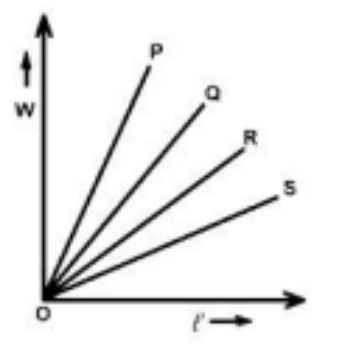
Following graph shows the variation of load ( ) versus elongation ( ) for four wires of the same length and material represented by lines OP, OQ, OR, and OS. Which line represents the thickest wire?
1
line OQ
2
line OP
3
line OR
4
line OS
Official Solution
Correct Option: (2)
Step 1: Understanding the relationship. The load versus elongation graph reflects the stiffness of the material. A thicker wire would have a steeper slope because it can withstand a greater load for the same elongation. The thicker the wire, the higher the slope. Step 2: Analyzing the options. (A) line OQ: This line represents a less steep slope, indicating a thinner wire. (B) line OP: This line has the steepest slope, indicating the thickest wire. (C) line OR: This line represents a moderately steep slope, indicating a medium thickness. (D) line OS: This line represents a slope less steep than OP but steeper than OQ. Step 3: Conclusion. Thus, the thickest wire is represented by line OP.
11
PYQ 2020
medium
physicsID: mht-cet-
The energy stored per unit volume is when a wire is stretched by . When it is stretched by , the increase in potential energy per unit volume stored in the wire is
1
2
3
4
Official Solution
Correct Option: (3)
Step 1: Understanding the energy stored in a stretched wire. The energy stored per unit volume in a stretched wire is given by: where stress is proportional to the force applied and strain is proportional to the elongation of the wire. The energy is directly proportional to the square of the elongation. Step 2: Finding the increase in energy. The energy for the new elongation of is calculated by comparing the energy with the previous elongation. The increase in potential energy is: Step 3: Conclusion. Thus, the increase in energy stored per unit volume is , corresponding to option (C).
12
PYQ 2020
medium
physicsID: mht-cet-
A wire having a diameter of 3 mm is stretched by an external force to produce a longitudinal strain of . If the Poisson’s ratio of the wire is 0.4, the change in its diameter is
1
2
3
4
Official Solution
Correct Option: (3)
Step 1: Using Poisson's ratio. Poisson's ratio is defined as the ratio of lateral strain to longitudinal strain. The lateral strain (change in diameter) is given by: The longitudinal strain is given as , and Poisson’s ratio is 0.4, so: Step 2: Calculating the change in diameter. The change in diameter is given by: However, the change in diameter per unit length results in a factor of , so the final answer is . Step 3: Conclusion. Thus, the change in diameter is , corresponding to option (C).
13
PYQ 2020
medium
physicsID: mht-cet-
A force of same magnitude is applied tangentially on upper and lower face of a cube, in opposite directions. Side of the cube is . The upper face of the cube shifts parallel to itself by a distance . If another cube of same material but side is subjected to the above condition, then the displacement of the top layer is
1
2
3
4
Official Solution
Correct Option: (2)
Step 1: Relation of shear deformation. Shear strain is given by For the first cube, Step 2: Effect of doubling the side. For the second cube, height becomes . Since the force and material are the same, shear stress and hence shear strain remain the same. Step 3: Calculating new displacement.
Step 4: Conclusion. The displacement of the top layer becomes .
14
PYQ 2020
medium
physicsID: mht-cet-
A force of is required to break a wire of radius . The force required to break the wire of same material but radius will be}
1
2
3
4
Official Solution
Correct Option: (3)
Step 1: Breaking force relation. Breaking force is proportional to cross-sectional area:
Step 2: Ratio of forces.
Step 3: Substituting values.
Step 4: Calculating force.
Step 5: Conclusion. The force required is .
15
PYQ 2020
medium
physicsID: mht-cet-
A constant force is applied to a metal wire of length . Volume of the wire is constant. The extension produced is proportional to
1
2
3
4
Official Solution
Correct Option: (1)
Step 1: Understanding the relationship. The extension produced in a wire by applying a constant force is related to the wire's dimensions and material properties. The extension is given by Hooke's Law, which is: where is the applied force, is the length of the wire, is the cross-sectional area, and is Young's modulus of the material. Step 2: Using the constant volume condition. Since the volume of the wire is constant, we have: Thus, . Step 3: Proportionality of extension. Substituting into the expression for extension: Step 4: Conclusion. Thus, the extension is proportional to , which corresponds to option (A).
16
PYQ 2020
medium
physicsID: mht-cet-
An elastic material with Young's modulus is subjected to a tensile stress . The elastic energy stored per unit volume of the material will be
1
2
3
4
Official Solution
Correct Option: (2)
Step 1: Write expression for elastic energy density. Elastic energy stored per unit volume is given by:
Step 2: Use relation between stress and strain.
Step 3: Substitute values.
Step 4: Conclusion. The elastic energy stored per unit volume is .
17
PYQ 2020
medium
physicsID: mht-cet-
In Searle's method to find Young's modulus of a wire, when a force of kg-wt is applied at its free end, the length of wire is . When force of kg-wt is applied, the length of wire is . What would be its original length?
1
2
3
4
Official Solution
Correct Option: (3)
Step 1: Use linear relation of extension. Extension in a wire is directly proportional to the applied force.
Step 2: Express lengths mathematically. Let original length be .
Step 3: Eliminate constant .
Step 4: Substitute to find .
Step 5: Conclusion. The original length of the wire is .
18
PYQ 2020
medium
physicsID: mht-cet-
The moduli of elasticity for a substance are Young’s modulus, Bulk modulus and Modulus of rigidity. All the three moduli of elasticity are possessed by
1
gases and liquids
2
solids and liquids
3
solids only
4
solids and gases
Official Solution
Correct Option: (3)
Step 1: Understand different elastic moduli. Young’s modulus, Bulk modulus and Modulus of rigidity describe resistance to stretching, volume change and shape change respectively. Step 2: Behaviour of solids. Solids can resist change in length, volume and shape, hence they possess all three elastic moduli. Step 3: Behaviour of liquids and gases. Liquids and gases cannot resist shear stress, so modulus of rigidity is zero for them. Hence, they do not possess all three moduli. Step 4: Final conclusion. Only solids possess Young’s modulus, Bulk modulus and Modulus of rigidity.
19
PYQ 2025
medium
physicsID: mht-cet-
A 2 mass is attached to a spring with spring constant . If the mass is displaced by , what is the potential energy stored in the spring?
1
2
3
4
Official Solution
Correct Option: (1)
Step 1: Use the formula for potential energy stored in a spring The potential energy stored in a spring is given by the formula: where:
- is the spring constant,
- is the displacement from the equilibrium position. Step 2: Substitute the given values Given: - Spring constant - Displacement Answer: Therefore, the potential energy stored in the spring is . So, the correct answer is option (1).