A particle having almost zero mass and exactly zero charge is
1
positron
2
electron
3
neutron
4
neutrino
Official Solution
Correct Option:
(4)
We know that the neutrino is the particle which has almost zero mass and exactly zero charge. Positron has the charge and mass [equal to electron mass]. Electron is a particle which has - charge and mass. Neutron is a particle which has zero charge and mass. So, the required answer is neutrino.
02
PYQ 2020
medium
physicsID: mht-cet-
A sample of radioactive element contains active nuclei. The half-life of the element is 15 days. The number of nuclei decayed after 60 days is
1
2
3
4
Official Solution
Correct Option:
(3)
Step 1: Formula for radioactive decay. The number of nuclei decayed over time can be calculated using the formula for half-life decay: where is the initial number of nuclei, is the time elapsed, and is the half-life of the element. The number of nuclei decayed is given by: Step 2: Applying the given values. Given that , days, and days, we first find the number of remaining nuclei after 60 days: Thus, the number of nuclei decayed is: Step 3: Conclusion. Thus, the number of nuclei decayed after 60 days is , corresponding to option (C).
03
PYQ 2020
medium
physicsID: mht-cet-
If is the half-life of a radioactive substance, then its instantaneous rate of change of activity is proportional to
1
2
3
4
Official Solution
Correct Option:
(4)
Step 1: Relation between decay constant and half-life.
Step 2: Expression for activity. Activity is given by:
Step 3: Instantaneous rate of change of activity.
Step 4: Substitute relation with half-life.
Step 5: Conclusion. The instantaneous rate of change of activity is proportional to .
04
PYQ 2020
medium
physicsID: mht-cet-
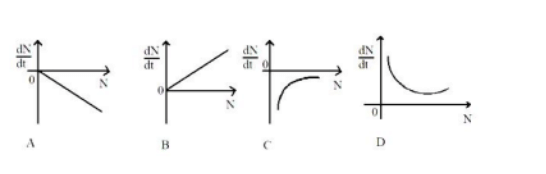
The variation of decay rate with number of active nuclei is correctly shown in graph
1
Graph D
2
Graph C
3
Graph A
4
Graph B
Official Solution
Correct Option:
(3)
Step 1: Understanding the decay process. In radioactive decay, the decay rate is proportional to the number of active nuclei . This means the more the active nuclei, the higher the decay rate. Step 2: Analyzing the graphs. - In Graph A, the decay rate increases with the number of active nuclei and then decreases, which is characteristic of the exponential decay process where the decay rate initially increases and then decreases as the number of nuclei reduces.
- Graph B shows a linear relationship, which is not characteristic of the decay process.
- Graph C shows a rapid increase followed by a sharp decrease, which is not correct for radioactive decay.
- Graph D shows a constant decay rate, which is also not accurate. Step 3: Conclusion. Graph A correctly represents the variation of decay rate with the number of active nuclei. This corresponds to option (C).
05
PYQ 2024
easy
physicsID: mht-cet-
What particles are emitted when undergoes radioactive decay?
Official Solution
Correct Option:
(1)
06
PYQ 2024
easy
physicsID: mht-cet-
Two bodies, R1 and R2, radiate power at temperatures and respectively. What is the ratio of their radiated powers?
Official Solution
Correct Option:
(1)
07
PYQ 2024
medium
physicsID: mht-cet-
If the half-life of the sample is 5 years and the initial weight of the sample is 64 gm, then the weight remaining after 15 years is:
1
16 gm
2
32 gm
3
8 gm
4
4 gm
Official Solution
Correct Option:
(3)
The formula for half-life decay is:
where:
- is the remaining quantity after time ,
- is the initial quantity,
- is the half-life of the substance. Given that years and the initial weight is 64 gm, after 15 years:
Thus, the remaining weight after 15 years is 8 gm.
08
PYQ 2024
medium
physicsID: mht-cet-
The ratio of the mass densities of nuclei of and is close to:
1
2
3
4
Official Solution
Correct Option:
(1)
The nuclear density ( ) remains approximately constant across all nuclei, regardless of atomic number or mass number. This invariance arises from the proportional relationship between the nuclear mass and volume with the mass number ( ). 1. Nuclear Density for : For , the mass number . The nuclear density is: 2. Nuclear Density for : For , the mass number . The nuclear density remains the same as that of : 3. Ratio of Densities: As the nuclear density is constant for all nuclei: Final Answer:
About Nuclear Physics - MHT-CET
Nuclear Physics is a vital chapter for MHT-CET aspirants. Mastering the concepts covered in this chapter is essential for securing a top rank.
By rigorously practicing the previous year questions associated with this chapter, you can identify high-yield topics, understand the examiner's perspective, and boost your confidence during the actual exam.
Frequently Asked Questions
Why focus on Nuclear Physics PYQs?
Analyzing PYQs for this specific chapter reveals the most frequently tested concepts and the typical complexity of questions, allowing you to tailor your study plan efficiently.
How to best use this analysis?
Review the topic breakdown to see which sub-topics within Nuclear Physics carry the most weight. Then, tackle the questions iteratively to solidify your understanding.