Human Heart Double Circulation
High-Yield Trend
Questions 4 MCQs
In humans, blood passes from the post caval to the diastolic right atrium of heart due to:
1. pushing open of the venous valves
2. suction pull
3. stimulation of the sino auricular node
4. pressure difference between the caval and atrium
| 1. | carry blood away from the heart to different organs |
| 2. | break up into capillaries which reunite to form a vein |
| 3. | carry blood from one visceral organ to another visceral organ |
| 4. | supply oxygenated blood to the different organs |
Figure shows a schematic plan of blood circulation in humans with labels A to D. Identify the label and give its function/s.
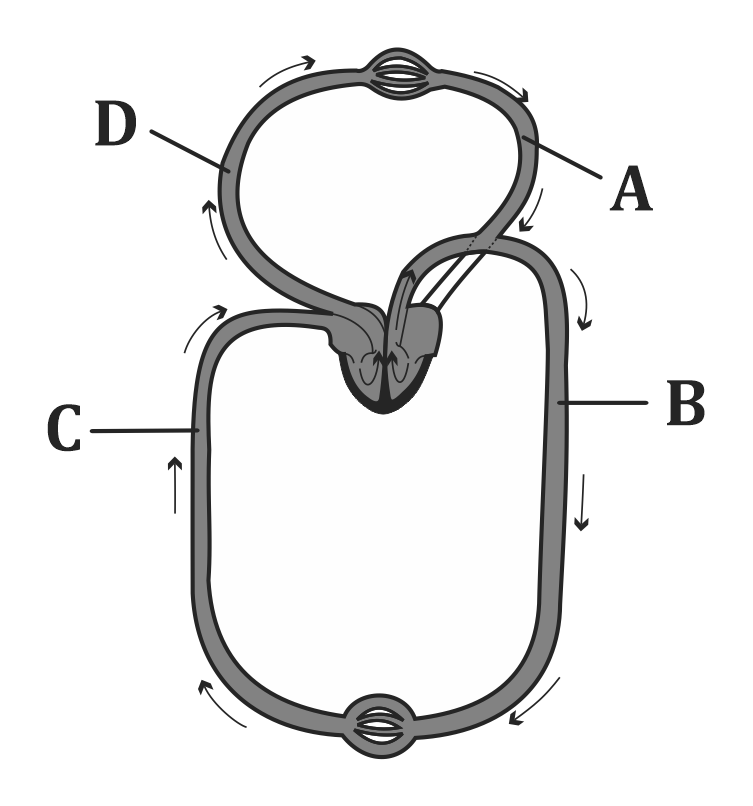
| 1. | B-Pulmonary artery- takes blood from heart to lungs, PO2 = 90mm Hg |
| 2. | C-Vena Cava- takes blood from body parts to right auricle, PCO2 = 45mm Hg |
| 3. | D-Dorsal aorta- takes blood from heart to body parts, PO2 = 95mm Hg |
| 4. | A- Pulmonary vein - takes impure blood from body parts, PO2 = 60mm Hg |
The hepatic portal vein drains blood to the liver from:
| 1. | Stomach | 2. | Kidneys |
| 3. | Intestine | 4. | Heart |
Preparing Human Heart Double Circulation for NEET
Human Heart Double Circulation is a specific sub-topic that frequently appears in the NEET examination. Understanding the underlying principles and practicing targeted questions is key to mastering this concept.
The questions compiled above are previous year questions (PYQs) directly related to Human Heart Double Circulation. Practicing these specific questions helps you understand the difficulty level and the examiner's approach to this topic.
Topic Frequently Asked Questions
Is Human Heart Double Circulation a high-weightage topic?
You can refer to the priority and consistency badges at the top of this page. High priority topics should be thoroughly revised multiple times before the exam.
Should I memorize the solutions?
No, it is highly recommended to understand the core concept and methodology behind each solution rather than memorizing them, as exact questions are rarely repeated, but the concepts definitely are.