Seminiferous Tubules Spermatogenesis
High-Yield Trend
Questions 10 MCQs
Sertoli cells are regulated by the pituitary hormone known as:
1. FSH
2. GH
3. Prolactin
4. LH
1. primary spermatocytes
2. secondary spermatocytes
3. spermatids
4. spermatogonia
The correct sequence of spermatogenetic stages leading to the formation of sperms in a mature human testis is:
| 1. | spermatocyte-spermatogonia- spermatid-sperms |
| 2. | spermatogonia-spermatocyte-spermatid-sperms |
| 3. | spermatid-spermatocyte-spermatogonia-sperms |
| 4. | spermatogonia-spermatid-spermatocyte-sperms |
Sertoli cells are found in:
| 1. | ovaries and secrete progesterone |
| 2. | adrenal cortex and secrete adrenaline |
| 3. | seminiferous tubules and provide nutrition to germ cells |
| 4. | pancreas and secrete cholecystokinin |
| 1. | spermatogonia, spermatocyte, spermatozoa, spermatid |
| 2. | Spermatogonia, spermatozoa, spermatocyte, spermatid |
| 3. | Spermatogonia, spermatocyte, spermatid, spermatozoa |
| 4. | Spermatid, spermatocyte, spermatogonia, spermatozoa |
Select the correct option of haploid cells from the following groups :
| 1. | Primary oocyte, Secondary oocyte, Spermatid |
| 2. | Secondary spermatocyte, First polar body, Ovum |
| 3. | Spermatogonia, Primary spermatocyte, Spermatid |
| 4. | Primary spermatocyte, Secondary spermatocyte, Second polar body |
Match the following columns and select the correct option:
| Column-I | Column-II | ||
| (a) | Ovary | (i) | Human chorionic gonadotropin |
| (b) | Placenta | (ii) | Estrogen & Progesterone |
| (c) | Corpus luteum | (iii) | Androgens |
| (d) | Leydig cells | (iv) | Progesterone only |
| Options: | (a) | (b) | (c) | (d) |
| 1. | (iv) | (iii) | (ii) | (i) |
| 2. | (i) | (ii) | (iii) | (iv) |
| 3. | (i) | (iii) | (ii) | (iv) |
| 4. | (ii) | (i) | (iv) | (iii) |
| Statement I: | The release of sperms into the seminiferous tubules is called spermiation. |
| Statement II: | Spermiogenesis is the process of formation of sperms from spermatogonia. |
1. Statement I is incorrect but Statement II is correct.
2. Both Statement I and Statement II are correct.
3. Both Statement I and Statement II are incorrect.
4. Statement I is correct but Statement II is incorrect.
| (a) | It results in the formation of haploid gametes. |
| (b) | Differentiation of gamete occurs after the completion of meiosis. |
| (c) | Meiosis occurs continuously in a mitotically dividing stem cell population. |
| (d) | It is controlled by the Luteinising hormone (LH) and Follicle Stimulating Hormone (FSH) secreted by the anterior pituitary. |
| (e) | It is initiated at puberty. |
| 1. | (b), (c), and (e) only | 2. | (c) and (e) only |
| 3. | (b) and (c) only | 4. | (b), (d) and (e) only |
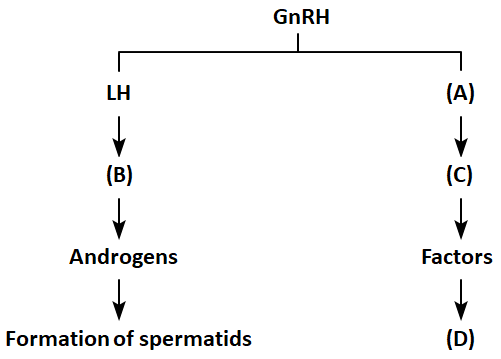
1. ICSH, Interstitial cells, Leydig cells, spermiogenesis.
2. FSH, Sertoli cells, Leydig cells, spermatogenesis.
3. ICSH, Leydig cells, Sertoli cells, spermatogenesis.
4. FSH, Leydig cells, Sertoli cells, spermiogenesis
Preparing Seminiferous Tubules Spermatogenesis for NEET
Seminiferous Tubules Spermatogenesis is a specific sub-topic that frequently appears in the NEET examination. Understanding the underlying principles and practicing targeted questions is key to mastering this concept.
The questions compiled above are previous year questions (PYQs) directly related to Seminiferous Tubules Spermatogenesis. Practicing these specific questions helps you understand the difficulty level and the examiner's approach to this topic.
Topic Frequently Asked Questions
Is Seminiferous Tubules Spermatogenesis a high-weightage topic?
You can refer to the priority and consistency badges at the top of this page. High priority topics should be thoroughly revised multiple times before the exam.
Should I memorize the solutions?
No, it is highly recommended to understand the core concept and methodology behind each solution rather than memorizing them, as exact questions are rarely repeated, but the concepts definitely are.