Amines
61 previous year questions.
High-Yield Trend
Chapter Questions 61 MCQs
(b) Lower aliphatic amines are soluble in water.
(c) Pyridine is used in the acylation reaction of amines.
(d) Although amino group is o- and p-directing in aromatic electrophilic substitution reactions, aniline on nitration gives a substantial amount of m-nitroaniline.
Three compounds are given below:
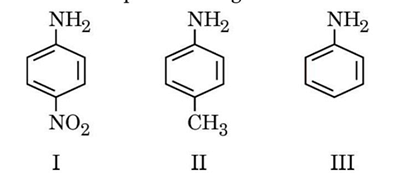
The correct decreasing order of their basic strength is:
Reason (R): Benzene diazonium chloride decomposes easily.
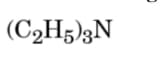
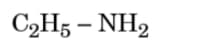
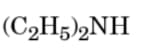
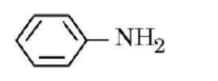
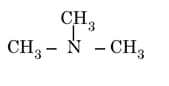
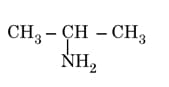
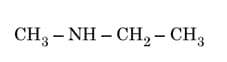
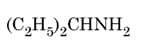
Methyl amine is more basic than aniline.
C H NH , (C H ) N, (C H ) NH
(a) Aniline from ammonium benzoate
(b) Benzene diazonium chloride from nitrobenzene
(c) 2,4,6-Tribromoaniline from aniline
Reason (R): Acetylation of aniline results in decrease of electron density on nitrogen.
Which of the following amines does not give foul smell of isocyanide on heating with chloroform and ethanolic KOH ?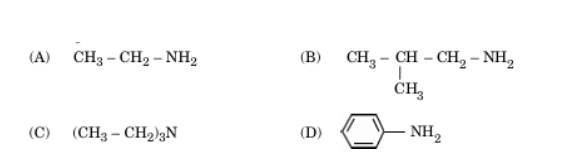
Reason (R): Ary1 halides do not undergo nucleophilic substitution reaction with the anion formed by phthalimide.
(a) In decreasing order of pKb values
C2H5NH2, (C2H5)2NH, C6H5NHCH3, C6H5NH2
(b) In increasing order of boiling point
C2H5OH, C2H5NH2, (CH3)2NH
(c) In increasing order of solubility in water
C6H5NH2, (C2H5)2NH, C2H5NH2
Amines are usually formed from amides, imides, halides, nitro compounds, etc. They exhibit hydrogen bonding which influences their physical properties. In alkyl amines, a combination of electron releasing, steric and H-bonding factors influence the stability of the substituted ammonium cations in protic polar solvents and thus affect the basic nature of amines. Alkyl amines are found to be stronger bases than ammonia. Amines being basic in nature, react with acids to form salts. Aryldiazonium salts, undergo replacement of the diazonium group with a variety of nucleophiles to produce aryl halides, cyanides, phenols and arenes.
Arrange the following in increasing order of their basic strength in aqueous solution:
CH –NH , (CH ) NH, (CH ) N
Amines are usually formed from amides, imides, halides, nitro compounds, etc. They exhibit hydrogen bonding which influences their physical properties. In alkyl amines, a combination of electron releasing, steric and H-bonding factors influence the stability of the substituted ammonium cations in protic polar solvents and thus affect the basic nature of amines. Alkyl amines are found to be stronger bases than ammonia. Amines being basic in nature, react with acids to form salts. Aryldiazonium salts, undergo replacement of the diazonium group with a variety of nucleophiles to produce aryl halides, cyanides, phenols and arenes.
Amines are usually formed from amides, imides, halides, nitro compounds, etc. They exhibit hydrogen bonding which influences their physical properties. In alkyl amines, a combination of electron releasing, steric and H-bonding factors influence the stability of the substituted ammonium cations in protic polar solvents and thus affect the basic nature of amines. Alkyl amines are found to be stronger bases than ammonia. Amines being basic in nature, react with acids to form salts. Aryldiazonium salts, undergo replacement of the diazonium group with a variety of nucleophiles to produce aryl halides, cyanides, phenols and arenes.
(i) Ethanoic acid to methanamine
(a) In decreasing order of pKb, values: C H NH , (C H ) NH, C H NHCH CH , C H NH
(b) Increasing order of boiling point: C H OH, C H NH , (C H ) NH, C H NH
(c) Increasing order of solubility in water: C H NH , (C H ) NH, C H NHCH CH
Amines have a lone pair of electrons on the nitrogen atom, due to which they behave as Lewis bases. Greater the value of or smaller the value of , stronger is the base. Amines are more basic than alcohols, ethers, esters, etc. The basic character of aliphatic amines should increase with the increase of alkyl substitution. However, it does not occur in a regular manner, as a secondary aliphatic amine is unexpectedly more basic than a tertiary amine in aqueous solutions. Aromatic amines are weaker bases than ammonia and aliphatic amines. Electron-releasing groups such as , , etc., increase the basicity, while electron-withdrawing substituents such as , , halogens, etc., decrease the basicity of amines. The effect of these substituents is more pronounced at the para-position than at the meta-position.
Arrange the following in increasing order of their basic character. Give reason: 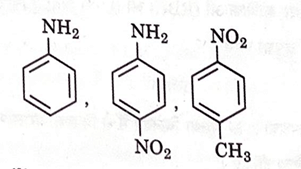
Amides are less basic than amines.
Aromatic primary amines cannot be prepared by Gabriel Phthalimide synthesis.
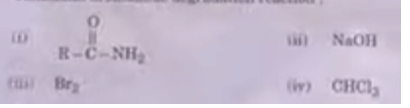
30(a)(i). Why is a stronger base than in aqueous solution?
About Amines - CBSE-CLASS-XII
Amines is a vital chapter for CBSE-CLASS-XII aspirants. Mastering the concepts covered in this chapter is essential for securing a top rank.
By rigorously practicing the previous year questions associated with this chapter, you can identify high-yield topics, understand the examiner's perspective, and boost your confidence during the actual exam.
Frequently Asked Questions
Why focus on Amines PYQs?
Analyzing PYQs for this specific chapter reveals the most frequently tested concepts and the typical complexity of questions, allowing you to tailor your study plan efficiently.
How to best use this analysis?
Review the topic breakdown to see which sub-topics within Amines carry the most weight. Then, tackle the questions iteratively to solidify your understanding.