Chemical Kinetics
93 previous year questions.
High-Yield Trend
Chapter Questions 93 MCQs
Step I: (slow)
Step II:
Molecularity of Step I and Step II is:
A → A + A (slow)
A + B → AB + B (fast)
A + B → AB (fast)
Its order would be:
For a chemical reaction A → B, the rate doubles when the concentration of A is increased four times. The order of reaction is
2
1
1/2
Zero
[Given: , , , ]
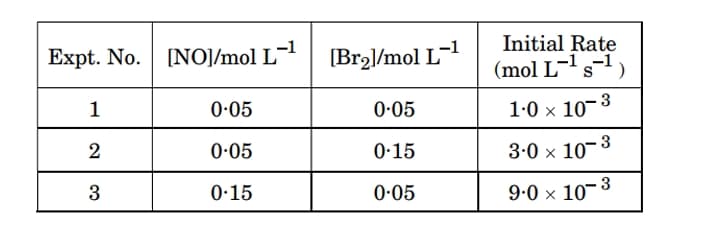
Given: Conductivity of 0.05 M KCl solution =
(a) Order of Reaction:
(b) Activation Energy:
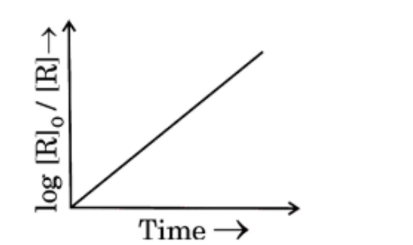
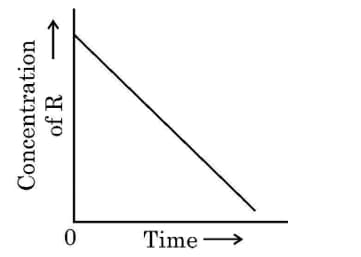
(a) Predict the order of reaction.
(b) What is the slope of the curve?
Reactant ‘A’ underwent a decomposition reaction. The concentration of ‘A’ was measured periodically and recorded in the table given below: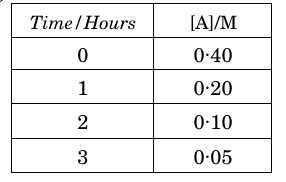
Based on the above data, predict the order of the reaction and write the expression for the rate law.
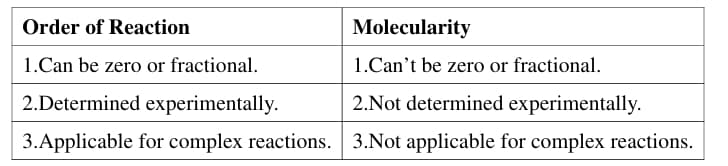
(I) We cannot determine the order of a reaction by taking into consideration the balanced chemical equation.
(II) A bimolecular reaction may become kinetically first order under a specified condition.
Assertion (A): In a first order reaction, if the concentration of the reactant is doubled, its half-life is also doubled.
Reason (R): The half-life of a reaction does not depend upon the initial concentration of the reactant in a first order reaction.
Reason (R): Actinoids are radioactive in nature.
Reason (R): The half-life of a reaction does not depend upon the initial concentration of the reactant in a first order reaction.
Given:
The reaction between A2 (g) and B2 (g) was carried out in a sealed isothermal container. The rate law for the reaction was found to be:
Rate =
If 1 mole of A2 (g) was added to the reaction chamber and the temperature was kept constant, then predict the change in rate of the reaction and the rate constant.
For a reaction:
The proposed mechanism is as given below:
(I) (slow)
(II) (fast)
The rate of the chemical reaction doubles for an increase of 10 K in absolute temperature from 298 K. Calculate activation energy (Ea).
303 R = 19.15 JK−1 mol−1, log 2 = 0.3010
(I) We cannot determine the order of a reaction by taking into consideration the balanced chemical equation.
(II) A bimolecular reaction may become kinetically first order under a specified condition.
was mol L . The concentration of N O after 60 minutes was mol L . Calculate the rate constant of the reaction at 318 K.
The following data were obtained during the first order thermal decomposition of at constant volume: 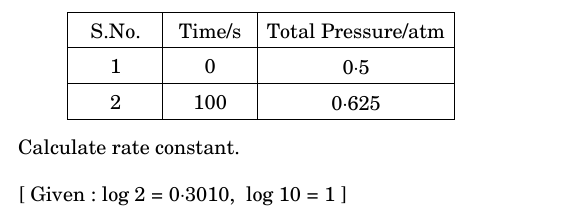
(a) Pseudo first-order reaction
(b) Half-life period of reaction ( )
was mol L . The concentration of N O after 60 minutes was mol L . Calculate the rate constant of the reaction at 318 K.
(I) is diamagnetic whereas is paramagnetic. [Atomic number: Ni = 28]
(II) CO is a stronger complexing agent than NH .
(III) The trans isomer of complex is optically inactive.
The rate of a reaction:
A + B −→ product
is given below as a function of different initial concentrations of A and B.
| Experiment | (mol L ) | (mol L ) | Initial Rate (mol L min ) |
|---|---|---|---|
| 1 | 0.01 | 0.01 | |
| 2 | 0.02 | 0.01 | |
| 3 | 0.01 | 0.02 |
| Time (Hours) | [A] (M) |
|---|---|
| 0 | 0.40 |
| 1 | 0.20 |
| 2 | 0.10 |
| 3 | 0.05 |
Passage: The rate of a chemical reaction is expressed either in terms of decrease in the concentration of reactants or increase in the concentration of a product per unit time. Rate of the reaction depends upon the nature of reactants, concentration of reactants, temperature, presence of catalyst, surface area of the reactants and presence of light. Rate of reaction is directly related to the concentration of reactant. Rate law states that the rate of reaction depends upon the concentration terms on which the rate of reaction actually depends, as observed experimentally. The sum of powers of the concentration of the reactants in the Rate law expression is called order of reaction while the number of reacting species taking part in an elementary reaction which must collide simultaneously in order to bring about a chemical reaction is called molecularity of the reaction.
Answer the following questions:
Reaction Rate Data
| Sl. No. | [A] (mol L−1) | [B] (mol L−1) | Initial rate (mol L−1 s−1) |
|---|---|---|---|
| 1 | 0.1 | 0.1 | 0.05 |
| 2 | 0.2 | 0.1 | 0.10 |
| 3 | 0.1 | 0.2 | 0.05 |
| Sl. No. | [A] (mol L-1) | [B] (mol L-1) | Initial rate (mol L-1 s-1) |
|---|---|---|---|
| 1 | 0.1 | 0.1 | 0.05 |
| 2 | 0.2 | 0.1 | 0.10 |
| 3 | 0.1 | 0.2 | 0.05 |
![concentration of reactant [R] and time](/cbse-class-xii/2025/image_8b8de08b1752140122510.png)
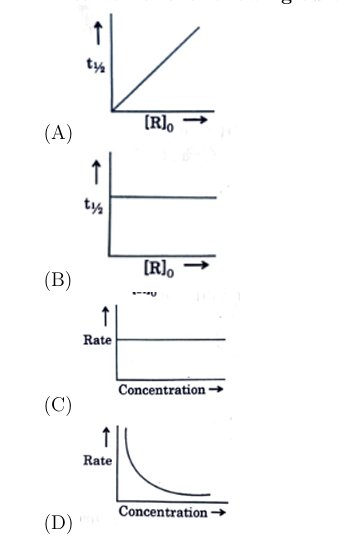
[Given : log 3 = 0.48]
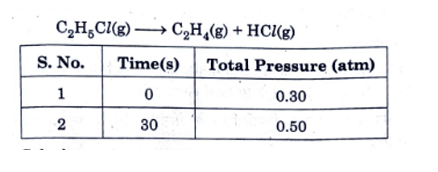
How will the rate of above reaction change if the volume of the reaction vessel is decreased to one third of its original volume? Will there be any change in the order of reaction with the reduced volume?
About Chemical Kinetics - CBSE-CLASS-XII
Chemical Kinetics is a vital chapter for CBSE-CLASS-XII aspirants. Mastering the concepts covered in this chapter is essential for securing a top rank.
By rigorously practicing the previous year questions associated with this chapter, you can identify high-yield topics, understand the examiner's perspective, and boost your confidence during the actual exam.
Frequently Asked Questions
Why focus on Chemical Kinetics PYQs?
Analyzing PYQs for this specific chapter reveals the most frequently tested concepts and the typical complexity of questions, allowing you to tailor your study plan efficiently.
How to best use this analysis?
Review the topic breakdown to see which sub-topics within Chemical Kinetics carry the most weight. Then, tackle the questions iteratively to solidify your understanding.