CBSE-CLASS-XII SERIES
Chemistry

Coordination Chemistry

35 previous year questions.

Volume: 35 Ques
Yield: High

High-Yield Trend

2
2026
27
2025
6
2024

Chapter Questions
35 MCQs

01
PYQ 2024
medium
chemistry ID: cbse-cla
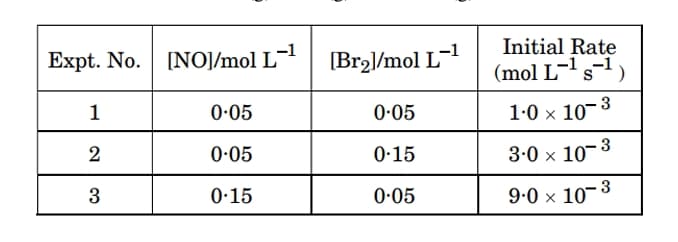
The following initial rate data were obtained for the reaction:  initial rate data were obtained for the reaction
02
PYQ 2024
easy
chemistry ID: cbse-cla
What is crystal field splitting energy?
03
PYQ 2024
medium
chemistry ID: cbse-cla
Give reason for the violet colour of the complex on the basis of crystal field theory.
04
PYQ 2024
hard
chemistry ID: cbse-cla
Arrange the following complexes in the increasing order of conductivity of their solution:
05
PYQ 2024
medium
chemistry ID: cbse-cla
Write the formula for the following coordination compound: Potassium tetrahydroxidozincate (II)
06
PYQ 2024
medium
chemistry ID: cbse-cla
Out of Cu Cl and CuCl , which is more stable in aqueous solution and why?
07
PYQ 2025
hard
chemistry ID: cbse-cla

Name the type of isomerism exhibited by the following compounds. Also, draw their corresponding isomers.

(I)

(II)

(III)

08
PYQ 2025
easy
chemistry ID: cbse-cla
The complex ions and are called
1
Ionization isomers
2
Linkage isomers
3
Co-ordination isomers
4
Geometrical isomers
09
PYQ 2025
easy
chemistry ID: cbse-cla

Assertion (A): [Cr(H_2O)_6]Cl_2 and [Fe(H_2O)_6]Cl_2 are examples of homoleptic complexes.
Reason (R): All the ligands attached to the metal are the same.

1
Both Assertion (A) and Reason (R) are true and Reason (R) is the correct explanation of the Assertion (A).
2
Both Assertion (A) and Reason (R) are true, but Reason (R) is not the correct explanation of the Assertion (A).
3
Assertion (A) is true, but Reason (R) is false.
4

Assertion (A) is false, but Reason (R) is true.

10
PYQ 2025
medium
chemistry ID: cbse-cla
Out of Ti3+, Cr3+, Mn2+ and Ni2+ ions, the one which has the highest magnetic moment is:
1
Ti3+
2
Cr3+
3
Mn2+
4
Ni2+
11
PYQ 2025
medium
chemistry ID: cbse-cla
According to Werner’s theory of coordination compounds:
1
Primary valences are ionisable.
2
Secondary valences are ionisable.
3
Both primary and secondary valences are non-ionisable.
4
Both primary and secondary valences are ionisable.
12
PYQ 2025
medium
chemistry ID: cbse-cla
Which of the following complex ions is not optically active?
1
2
3
4
13
PYQ 2025
medium
chemistry ID: cbse-cla
Which of the following complexes show linkage isomerism?
1
[Co(NH ) Cl] \hspace{1.6cm}
2
[Co(NH ) Cl ]Br
3
[Co(H O) ] \hspace{2cm}
4
[Co(NH ) (ONO)]
14
PYQ 2025
medium
chemistry ID: cbse-cla
The primary and secondary valences of Co in [Co(en)₃]Cl₃ respectively are:
1
3, 3 \hspace{1cm}
2
0, 3
3
6, 3 \hspace{1cm}
4
3, 6
15
PYQ 2025
easy
chemistry ID: cbse-cla
Differentiate between weak field and strong field ligands. How does the strength of the ligand influence the spin of the complex?
16
PYQ 2025
hard
chemistry ID: cbse-cla
Coordination number of Fe in is :
1
6
2
3
3
4
4
5
17
PYQ 2025
hard
chemistry ID: cbse-cla
Write IUPAC names of the following coordination compounds:

(ii)
(ii) Didentate ligand and Ambidentate ligand
18
PYQ 2025
medium
chemistry ID: cbse-cla
Using Crystal Field theory, write the number of unpaired electrons in octahedral complexes of Fe3+ in the presence of:
(I) Strong field ligand
(II) Weak field ligand
Atomic number: Fe = 26
19
PYQ 2025
medium
chemistry ID: cbse-cla
Give reasons:
(I) is diamagnetic whereas is paramagnetic. [Atomic number: Ni = 28]
(II) CO is a stronger complexing agent than NH .
(III) The trans isomer of complex is optically inactive.
20
PYQ 2025
medium
chemistry ID: cbse-cla
Which of the following complexes shows geometrical isomerism?
1
[Co(NH\textsubscript{3})\textsubscript{6}]\textsuperscript{3+}
2
[Co(NH\textsubscript{3})\textsubscript{5}Cl]\textsuperscript{2+}
3
[Co(NH\textsubscript{3})\textsubscript{4}Cl\textsubscript{2}]\textsuperscript{+}
4
[Co(NH\textsubscript{3})\textsubscript{5}(ONO)]\textsuperscript{2+}
21
PYQ 2025
medium
chemistry ID: cbse-cla

Answer the following:
(i) What happens to the colour of the complex when heated gradually?
(ii) Write the electronic configuration for a ion if .
(iii) Write the hybridization and magnetic behaviour of the complex .
(Atomic number: Ni = 28)

22
PYQ 2025
medium
chemistry ID: cbse-cla
Answer the following about the complexes :
(i) Write the hybridization involved in each case.
(ii) Which of them is the outer orbital complex and which one is the inner orbital complex?
(iii) Compare their magnetic behaviour.
[Atomic number: Fe = 26]
23
PYQ 2025
easy
chemistry ID: cbse-cla
Differentiate between:
(i) Double salt and Complex compound
(ii) Didentate ligand and Ambidentate ligand
24
PYQ 2025
easy
chemistry ID: cbse-cla
The diamagnetic species is :
At. No. Co = 27, Fe =26, Ni= 28]
1

2

3

4
25
PYQ 2025
hard
chemistry ID: cbse-cla
Why is [Ni(CN)4]2- square planar while [Ni(CO)4] is tetrahedral? [Atomic number : Ni = 28]
26
PYQ 2025
easy
chemistry ID: cbse-cla

Werner’s coordination theory in 1893 was the first attempt to explain the bonding in coordination complexes. It must be remembered that this theory was put forward before the electron had been discovered by J.J. Thomson in 1897, and before the electronic theory of valency. Werner did not have any of the modern instrumental techniques and all his studies were made using simple experimental techniques. Werner was able to explain the nature of bonding in complexes and he concluded that in complexes, the metal shows two different sorts of valency: primary and secondary. Primary valences are normally ionisable whereas secondary valences are non-ionisable.

27
PYQ 2025
medium
chemistry ID: cbse-cla

Why is a solution of green while a solution of is colourless? (At. No. of Ni = 28)

28
PYQ 2025
medium
chemistry ID: cbse-cla

Co2+ is easily oxidized to Co3+ in the presence of a strong ligand (At. No. of Co = 27).

29
PYQ 2025
medium
chemistry ID: cbse-cla

Low spin tetrahedral complexes are not known.

30
PYQ 2025
medium
chemistry ID: cbse-cla
Write the name and structure of a hexadentate ligand.
31
PYQ 2025
medium
chemistry ID: cbse-cla
Based on Valence Bond Theory, explain the geometry and magnetic character of [NiCl ] . [Atomic number: Ni = 28]}
32
PYQ 2025
medium
chemistry ID: cbse-cla
Explain why in tetrahedral coordination entities, low-spin configurations are rarely observed.
33
PYQ 2025
medium
chemistry ID: cbse-cla
What is meant by crystal field splitting energy? For a d4 ion, write the configuration if (i) >P.
34
PYQ 2026
medium
chemistry ID: cbse-cla
The correct IUPAC name of the complex [Pt(NH ) Cl ] is:
1
diamminedichloridoplatinum (IV)
2
diamminedichloridoplatinum (II)
3
dichloridodiammineplatinum (IV)
4
dichloridodiammineplatinum (II)
35
PYQ 2026
medium
chemistry ID: cbse-cla
Which of the following is heteroleptic complex?
1
[Co(NH ) ]
2
[Cr(NH ) ]
3
[Ni(H O) ]
4
[Co(NH ) Cl ]