Write the reaction of glucose with: (a) HI (b) Brβ water
Official Solution
Correct Option: (1)
(a) Glucose + HI β n-hexane (b) Glucose + Brβ water β gluconic acid
02
PYQ 2024
hard
chemistryID: cbse-cla
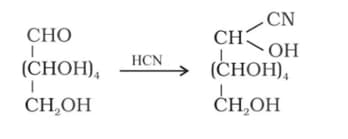
What happens when D-glucose is treated with the following reagents? (a) Br water (b) HCN
Official Solution
Correct Option: (1)
(a) Br2 water When D-glucose is treated with bromine water (Br2 in H2O), the aldehyde (-CHO) group at C-1 is selectively oxidized to a carboxylic acid (-COOH), forming D-gluconic acid.
(b) HCN When D-glucose is treated with hydrogen cyanide (HCN), the -CHO (aldehyde) group at C-1 reacts with HCN, forming a cyanohydrin (-C(OH)(CN)). This reaction increases the carbon chain by one, leading to the formation of a cyanohydrin derivative.
03
PYQ 2024
medium
chemistryID: cbse-cla
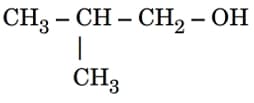
The suitable Grignard reagent used for the synthesis of with methanal is:
1
2
3
4
Official Solution
Correct Option: (3)
A Grignard reagent reacts with methanal ( ) to give a primary alcohol. Since the desired product is isopropanol, the correct Grignard reagent is isopropyl magnesium bromide ( ).
04
PYQ 2024
easy
chemistryID: cbse-cla
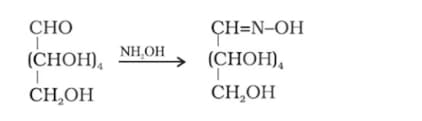
Carbohydrates are essential for life in both plants and animals. Carbohydrates are used as storage molecules as starch in plants and glycogen in animals. Chemically, they are polyhydroxy aldehydes or ketones. On the basis of their behavior on hydrolysis, carbohydrates are classified as monosaccharides, oligosaccharides, and polysaccharides. All monosaccharides are reducing sugars, i.e., they are oxidized by Tollens' reagent and Fehlingβs solution. A monosaccharide like glucose is an aldose, and its molecular formula was found to be C6H12O6. After reacting with different reagents like HI, H2NβOH, Bromine water, (CH3)2O, etc., its structure was found to contain one aldehyde group, one primary alcoholic group (βCH2OH), and four secondary alcoholic groups (>CHOH). Despite having the aldehyde group, glucose does not give some of the reactions of aldehyde groups like Schiffβs test or NaHSO3 addition. This explains the existence of glucose in two cyclic hemiacetal forms, which differ only in the configuration of the hydroxyl group at Cβ1.
Official Solution
Correct Option: (1)
05
PYQ 2025
medium
chemistryID: cbse-cla
-D-glucose and -D-glucose differ from each other with respect to the:
1
size of the hemiacetal ring \hspace{1cm}
2
configuration at the Cβ carbon
3
number of -OH groups \hspace{1cm}
4
configuration at the Cβ carbon
Official Solution
Correct Option: (2)
The key difference between -D-glucose and -D-glucose is the configuration at the Cβ carbon. In -D-glucose, the hydroxyl group at Cβ is on the opposite side of the CHβOH group, while in -D-glucose, it is on the same side.
06
PYQ 2025
medium
chemistryID: cbse-cla
Furanose ring of fructose is formed due to reaction between :
1
C1 and C4
2
C2 and C5
3
C1 and C5
4
C2 and C4
Official Solution
Correct Option: (3)
In the furanose form of fructose, the aldehyde group at C1 reacts with the hydroxyl group at C5, forming a five-membered ring. This reaction is a typical example of cyclic hemiacetal formation, resulting in the furanose form of fructose.
07
PYQ 2025
medium
chemistryID: cbse-cla
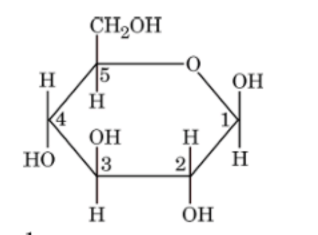
In the Haworth structure of the following carbohydrate, various carbon atoms have been numbered. The anomeric carbon is numbered as:
1
1
2
2
3
3
4
5
Official Solution
Correct Option: (1)
In the Haworth structure of carbohydrates, the anomeric carbon is the carbon atom that was part of the carbonyl group (aldehyde or ketone) in the open-chain form of the sugar. It is the first carbon in the ring structure, as shown in option (A). This carbon is important in determining the alpha or beta configuration of the sugar.
08
PYQ 2025
medium
chemistryID: cbse-cla
Which one of the following is a disaccharide?
Official Solution
Correct Option: (1)
Monosaccharides, Disaccharides, and Polysaccharides
A disaccharide is a carbohydrate composed of two monosaccharide units joined by a glycosidic bond. Let's explore the components involved in this category.
Monosaccharides:
Glucose is a monosaccharide, a simple sugar that serves as a primary source of energy for the body.
Fructose is another monosaccharide, often found in fruits and honey.
Disaccharides:
Lactose is a disaccharide made up of two monosaccharide units: glucose and galactose. It is commonly found in milk and is the sugar that gives milk its sweetness.
Polysaccharides:
Amylose is a polysaccharide made up of long chains of glucose units. It is a component of starch, which is a storage form of glucose in plants.
Conclusion:
- Glucose and fructose are monosaccharides, meaning they are single sugar units. - Lactose is a disaccharide composed of two monosaccharides: glucose and galactose. - Amylose is a polysaccharide made up of multiple glucose units.
Summary:
Thus, out of the given options, lactose is the disaccharide, formed by the glycosidic bond between glucose and galactose.
09
PYQ 2025
medium
chemistryID: cbse-cla
Which of the following statements is not true about glucose?
1
It is an aldose.
2
On heating with HI it forms n-hexane.
3
It exists in furanose form.
4
It does not give Schiff's test.
Official Solution
Correct Option: (1)
The question asks which statement about glucose is not true. Let's evaluate each option:
Glucose is an aldose: Glucose is indeed an aldose, as it contains an aldehyde group at the first carbon. Hence, this statement is true.
On heating with HI, glucose forms n-hexane: This is a characteristic reaction where the entire glucose molecule reduces to n-hexane when treated with hydrogen iodide. Thus, this statement is also true.
It exists in furanose form: Glucose typically forms a pyranose ring when cyclized, not a furanose form. Therefore, this statement is not true about glucose.
It does not give Schiff's test: Glucose does not give a positive Schiff's test because while it contains an aldehyde group, it forms a stable cyclic hemiacetal form that typically doesn't react with Schiff's reagent. Hence, this statement is true.
Considering the analysis above, the statement that is not true about glucose is: It exists in furanose form.
10
PYQ 2026
medium
chemistryID: cbse-cla
Assertion (A): Glucose gets oxidized to six carbon gluconic acid on reaction with bromine water.Reason (R): The carbonyl group is absent in the open chain structure of glucose.Choose the correct option:
1
Both Assertion (A) and Reason (R) are true and Reason (R) is the correct explanation of the Assertion (A).
2
Both Assertion (A) and Reason (R) are true, but Reason (R) is not the correct explanation of the Assertion (A).
3
Assertion (A) is true, but Reason (R) is false.
4
Assertion (A) is false, but Reason (R) is true.
Official Solution
Correct Option: (3)
Concept: Bromine water is a mild oxidizing agent that oxidizes aldehydes (βCHO) to carboxylic acids (βCOOH) without affecting other functional groups. Step 1: Check Assertion (A). Glucose contains an aldehyde group in its open-chain form. Bromine water oxidizes the aldehyde group to gluconic acid, which still contains six carbon atoms. Hence, Assertion is true. Step 2: Check Reason (R). In the open-chain structure of glucose, a carbonyl group (aldehyde) is present. So, the statement that carbonyl group is absent is incorrect. Reason is false. Step 3: Choose correct option. Assertion is true but Reason is false.
11
PYQ 2026
medium
chemistryID: cbse-cla
Which of the following reactions is not explained by the open chain structure of glucose?
1
Glucose on prolonged heating with HI forms n-hexane.
2
Glucose reacts with hydroxylamine to form an oxime.
3
Glucose gets oxidized to gluconic acid on reaction with bromine water.
4
Glucose exists in two different crystalline forms, alpha ( ) and beta ( ).
Official Solution
Correct Option: (4)
Concept: Glucose exists in both open-chain and cyclic (ring) forms. The open-chain structure explains reactions involving the aldehyde group (βCHO), while cyclic structure explains stereoisomerism like and forms. Step 1: Check which reactions are explained by open-chain structure. Option (A): Formation of n-hexane with HI shows presence of straight carbon chain. Explained by open-chain structure. Option (B): Reaction with hydroxylamine forming oxime indicates presence of aldehyde group. Explained by open-chain structure. Option (C): Oxidation to gluconic acid with bromine water confirms aldehyde group. Explained by open-chain structure. Option (D): Existence of and forms arises due to cyclic hemiacetal ring structure and anomerism. Not explained by open-chain structure.