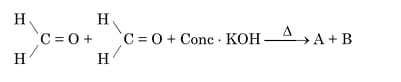
Consider the following reaction: Identify A and B from the given options:
1
A — Methanol, B — Potassium formate
2
A — Ethanol, B — Potassium formate
3
A — Methanal, B — Ethanol
4
A — Methanol, B — Potassium acetate
Official Solution
Correct Option: (1)
The reaction described is a typical decarboxylation reaction where formic acid ( ) undergoes reduction in the presence of concentrated KOH. When heated, formic acid decarboxylates, resulting in methanol (CH OH) and potassium formate (HCOOK). The reaction proceeds as follows:
1. The formic acid is treated with concentrated KOH.
2. The hydroxide ion attacks the carbonyl group of the formic acid, leading to the formation of potassium formate and the liberation of carbon dioxide.
3. The remaining product after decarboxylation is methanol. Decarboxylation of formic acid yields methanol and potassium formate.
02
PYQ 2024
easy
chemistryID: cbse-cla
Give reasons for the following:(a) Chlorine is ortho/para directing in electrophilic aromatic substitution reactions, though chlorine is an electron withdrawing group. (b) Racemic mixture is optically inactive. (c) Allyl chloride is hydrolysed more readily than n-propyl chloride.
Official Solution
Correct Option: (1)
(a) Chlorine is ortho/para directing in electrophilic aromatic substitution reactions, though chlorine is an electron withdrawing group. Chlorine is ortho/para directing in electrophilic aromatic substitution reactions Although chlorine is an electron-withdrawing group through its inductive effect, it acts as an electron-donating group through resonance by donating lone pairs on chlorine to stabilize the intermediate carbocation. This effect is more pronounced at the ortho and para positions relative to the chlorine atom. (b) Racemic mixture is optically inactive. Racemic mixture is optically inactive A racemic mixture contains two enantiomers in equal proportions. Enantiomers are non-superimposable mirror images of each other, and in a racemic mixture, the optical activities of these enantiomers cancel each other out, leading to zero optical rotation. (c) Allyl chloride is hydrolysed more readily than n-propyl chloride. Allyl chloride is hydrolysed more readily than n-propyl chloride The allyl carbocation is stabilized by resonance with the adjacent double bond, making the reaction proceed more easily. In contrast, the n-propyl carbocation does not have this resonance stabilization, making it less stable and slower to undergo hydrolysis.
03
PYQ 2024
medium
chemistryID: cbse-cla
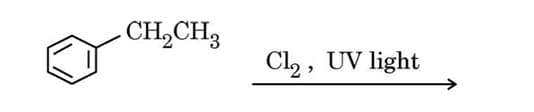
Write the major product in the following reaction:
Official Solution
Correct Option: (1)
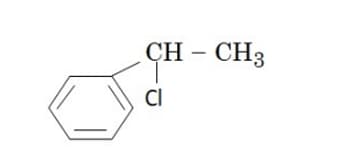
- The reaction involves ethyl chloride (CH CH Cl) in the presence of UV light, which typically promotes a free radical substitution reaction. - The major product of this reaction is ethene (CH =CH ) due to the elimination of HCl by the free radicals formed under UV light.
04
PYQ 2025
medium
chemistryID: cbse-cla
For the reaction:
2H O 2H O + O Given mechanism:
(I) H O + I → H O + IO (slow)
(II) H O + IO → H O + I + O (fast) (1) Write rate law for the reaction.
(2) Write the overall order and molecularity of the reaction.
Official Solution
Correct Option: (1)
(1) Rate depends on the slow step: (2) Overall order = 2 (first order in H O and first order in I )
Molecularity of slow step = 2 (unimolecular in H O and I ).
05
PYQ 2025
medium
chemistryID: cbse-cla
What is a rate determining step?
Official Solution
Correct Option: (1)
Rate-Determining Step in a Reaction Mechanism
In a multi-step chemical reaction, the rate-determining step is the slowest elementary step in the reaction pathway. It acts as a bottleneck for the entire reaction process, meaning that the overall rate of the reaction is limited by the rate at which this step proceeds.
This step typically:
Has the highest activation energy among all the steps in the mechanism.
Occurs more slowly compared to the other steps.
Determines the overall reaction rate, regardless of how fast the other steps occur.
Therefore, even if the subsequent steps are fast, the reaction cannot proceed faster than the rate-determining step allows. Understanding which step this is can help chemists control and optimize reaction rates in practical applications such as industrial synthesis and catalysis.