D And F Block Elements
48 previous year questions.
High-Yield Trend
Chapter Questions 48 MCQs
Why is coloured?
Reason (R): Zn, Cd and Hg do not have partially filled d-orbitals in their ground state or in any one of their common oxidation states.
Why is E for Mn3+/Mn2+ redox couple more positive?
Reason (R): Actinoids are radioactive in nature.
Answer the following questions:
Name two elements of 3d series for which the third ionisation enthalpies are quite high.
Out of KMnO and K MnO , which one is paramagnetic and why?
Write any one consequence of lanthanoid contraction.
How do you prepare potassium manganate from pyrolusite ore?
Why is the ability of oxygen more than fluorine to stabilise higher oxidation states of transition metals?
Reason (R): Zinc is a non-transition element.
Name two elements of 3d series for which the third ionisation enthalpies are quite high.
5SO + 2MnO + 6H ⟶ ?
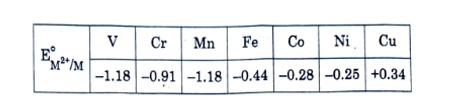
(I) The E value for manganese is highly negative, whereas E is highly positive.
Give explanation for each of the following observations:
(a) Mn3+ is an oxidizing agent, whereas Cr2+ is a reducing agent (both d4 configuration).
(b) Actinoid contraction is greater than lanthanoid contraction.
(c) Transition metals form interstitial compounds with H, B, C, N.
Complete the following ionic equations:
Reason (R) : In actinoids 5f, 6d and 7s orbitals are of comparable energies.
(I) which exhibits +4 oxidation state
(II) which exhibits +2 oxidation state.
(I) Why show irregular trend in the above values ?
(II) Why is value exceptionally positive ?
(III) Why value is highly negative ?
About D And F Block Elements - CBSE-CLASS-XII
D And F Block Elements is a vital chapter for CBSE-CLASS-XII aspirants. Mastering the concepts covered in this chapter is essential for securing a top rank.
By rigorously practicing the previous year questions associated with this chapter, you can identify high-yield topics, understand the examiner's perspective, and boost your confidence during the actual exam.
Frequently Asked Questions
Why focus on D And F Block Elements PYQs?
Analyzing PYQs for this specific chapter reveals the most frequently tested concepts and the typical complexity of questions, allowing you to tailor your study plan efficiently.
How to best use this analysis?
Review the topic breakdown to see which sub-topics within D And F Block Elements carry the most weight. Then, tackle the questions iteratively to solidify your understanding.