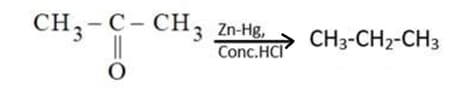
Write the chemical equations when: (a) Ethanal is treated with 2,4-dinitrophenylhydrazine? (b) Propanone is treated with Zn(Hg) and conc. HCl?

Official Solution
Correct Option: (1)
(a) Reaction of Ethanal with 2,4-Dinitrophenylhydrazine (DNPH): Ethanal ( ) reacts with 2,4-dinitrophenylhydrazine ( -Ar- ) to form a hydrazone derivative. This reaction is used to detect the presence of carbonyl groups (aldehydes and ketones).
(b) Reduction of Propanone using Zn(Hg) and Conc. HCl (Clemmensen Reduction): Propanone ( ) undergoes Clemmensen reduction in the presence of zinc amalgam (Zn-Hg) and conc. HCl, reducing the carbonyl group to an alkane.
This method is commonly used to convert ketones into alkanes.
02
PYQ 2024
medium
chemistryID: cbse-cla
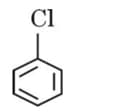
Which of the following is most reactive towards nucleophilic substitution reaction?
1
2
3
4
Official Solution
Correct Option: (4)
Allyl chloride ( ) is most reactive towards nucleophilic substitution because the allylic carbocation formed during the reaction is stabilized by resonance. Other compounds lack such stabilization, making them less reactive.
03
PYQ 2025
hard
chemistryID: cbse-cla
How can you obtain the following from aniline? Give only chemical equations.
Official Solution
Correct Option: (1)
(a) Preparation of p-Nitroaniline
Reaction: Nitration of aniline using concentrated nitric acid and sulfuric acid.
Explanation: Aniline reacts with nitrating mixture to give para-nitroaniline as the major product due to the activating nature of the –NH group.
(b) Preparation of Chlorobenzene
Reaction: Chlorination of aniline in the presence of ferric chloride as a Lewis acid catalyst.
Explanation: Chlorine reacts with aniline to give substituted products. The reaction is usually controlled to obtain mono-chlorinated derivative such as chlorobenzene.
(c) Preparation of Phenol
Reaction: Oxidation of aniline with potassium dichromate in acidic medium.
Explanation: The –NH group of aniline is oxidized to a hydroxyl group, yielding phenol.
04
PYQ 2025
hard
chemistryID: cbse-cla
Chlorobenzene to biphenyl
Official Solution
Correct Option: (1)
Conversion of Chlorobenzene to Biphenyl
To convert chlorobenzene to biphenyl, the Wurtz-Fittig reaction is employed.
In this reaction, two molecules of chlorobenzene undergo a coupling reaction in the presence of metallic sodium and dry ether. The sodium facilitates the removal of chlorine atoms and formation of a new carbon-carbon bond between the phenyl groups, resulting in the formation of biphenyl.
Reaction Equation:
Product: Biphenyl
05
PYQ 2025
medium
chemistryID: cbse-cla
Which reagents are required for one step conversion of Chlorobenzene to Diphenyl?
1
Chlorobenzene, Na, Dry ether \hspace{0.5cm}
2
Benzene, Anhydrous AlCl
3
Chlorobenzene/Fe, Dark \hspace{1.3cm}
4
NaNO + HCl
Official Solution
Correct Option: (1)
The conversion of chlorobenzene to diphenyl can be achieved using sodium in dry ether. This reaction is known as the Wurtz-Fittig reaction, where sodium donates electrons to the chlorobenzene, resulting in the formation of a biphenyl compound.
06
PYQ 2025
medium
chemistryID: cbse-cla
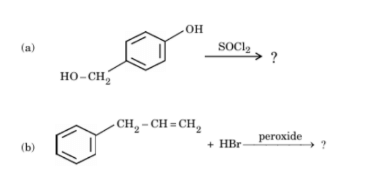
Draw the structures of the major monohalo products in each of the following reactions:
Official Solution
Correct Option: (1)
(a) Conversion of Alcohol to Alkyl Chloride using Thionyl Chloride
In this reaction, a hydroxymethyl group ( ) reacts with thionyl chloride ( ) to form the corresponding chloro derivative.
The product is benzyl chloride, and the reaction proceeds via the conversion of the hydroxyl group into a good leaving group, followed by substitution with chlorine.
Product structure:
Quick Tip: Thionyl chloride ( ) is widely used to convert alcohols into alkyl chlorides with high efficiency.
(b) Anti-Markovnikov Addition of HBr to Styrene
In this reaction, styrene ( ) reacts with in the presence of a peroxide.
Due to the peroxide effect (Kharasch effect), the reaction follows a free radical mechanism, giving the anti-Markovnikov product. This means that the bromine atom attaches to the less substituted carbon of the double bond.
Major Product: 1-bromo-2-phenylethane
This reaction is a classic example of free radical addition to alkenes influenced by the presence of peroxides.
07
PYQ 2025
medium
chemistryID: cbse-cla
Aromatic primary amines cannot be prepared by Gabriel Phthalimide synthesis.
Official Solution
Correct Option: (1)
Gabriel Phthalimide synthesis involves the reaction of phthalimide with an alkyl halide to form an amine. This method works well for aliphatic amines but fails for aromatic primary amines because the reaction does not readily occur with aryl halides. Aromatic rings are generally less reactive in nucleophilic substitution reactions due to the resonance stabilization of the ring, which makes it harder for the nucleophile (amide ion) to attack. Hence, Gabriel€™s synthesis does not work efficiently for preparing aromatic primary amines.
08
PYQ 2025
hard
chemistryID: cbse-cla
A certain reaction is 50 complete in 20 minutes at 300 K and the same reaction is 50 complete in 5 minutes at 350 K. Calculate the activation energy if it is a first order reaction. Given:
Official Solution
Correct Option: (1)
For a first-order reaction, the rate constant is related to the time taken for a certain fraction of the reaction to be completed. The equation for the rate constant for a first-order reaction is: Where: - is the initial concentration, - is the concentration after time , and - is the rate constant. However, for this problem, we will use the Arrhenius equation to relate the rate constants at two different temperatures. The Arrhenius equation is: Where: - and are the rate constants at temperatures and , - is the activation energy, - is the universal gas constant (8.314 J mol K ), - and are the temperatures in Kelvin. Step 1: Determine the rate constants and . The reaction is 50 complete at both temperatures. For a first-order reaction, the time taken to reach 50 completion is related to the rate constant by the equation: This equation relates the half-life ( ) to the rate constant ( ) for a first-order reaction. Thus: Step 2: Use the Arrhenius equation. Now we can use the Arrhenius equation to solve for the activation energy ( ): Substitute the known values into the equation: Simplify the logarithm: Simplifying further: Solving for : Thus, the activation energy for the reaction is approximately 10.57 kJ/mol. \vspace{10pt}
09
PYQ 2025
medium
chemistryID: cbse-cla
Identify A and B in each of the following reaction sequence: (a)
(b)
Official Solution
Correct Option: (1)
(a) Reaction Sequence: 1. The reaction of with results in the formation of ethyl cyanide (A) through nucleophilic substitution, where the chlorine is replaced by the cyanide ion. 2. The hydrogenation of ethyl cyanide ( ) in the presence of and a nickel catalyst leads to the reduction of the nitrile group to an amine, yielding ethylamine (B). (b) Reaction Sequence: 1. The reaction of aniline ( ) with sodium nitrite ( ) and hydrochloric acid ( ) forms a diazonium salt, (A). 2. The treatment of with an acid (e.g., ) causes the diazonium ion to undergo hydrolysis, leading to the formation of phenol (B).
10
PYQ 2025
easy
chemistryID: cbse-cla
The best reagent for converting propanamide into propanamine is:
1
excess H_2
2
Br_2 in aqueous NaOH
3
iodine in the presence of red phosphorus
4
LiAlH_4 in ether
Official Solution
Correct Option: (3)
To determine the best reagent for converting propanamide into propanamine, we need to understand the reduction process involved.
Propanamide (CH3CH2CONH2) to Propanamine (CH3CH2CH2NH2):
This conversion involves reducing the carbonyl group (C=O) of the amide to an amine group (-CH2NH2). A common method for achieving this is using reducing agents.
Excess H2: This is used for catalytic hydrogenation, which typically requires a catalyst such as Pd or Pt. While it can reduce double bonds, it is not selective for amides.
Br2 in aqueous NaOH: Used in the Hofmann Bromamide degradation to convert primary amides to primary amines with one fewer carbon atom, not suitable for this conversion.
LiAlH4 in ether: A strong reducing agent, typically used for the reduction of carboxylic acids, esters, and amides to alcohols or amines. While effective, the specific choice here is different.
Iodine in the presence of red phosphorus: This reagent is used in the reduction of amides to amines without reducing other functional groups, ideal for this transformation.
Given the options, iodine in the presence of red phosphorus is the best choice for converting propanamide into propanamine. It specifically facilitates the conversion of the carbonyl group in amides to amine groups, maintaining the carbon chain structure intact.
11
PYQ 2025
medium
chemistryID: cbse-cla
The acid formed when propyl magnesium bromide is treated with CO_2 followed by acid hydrolysis is:
1
C_3H_7COOH
2
C_2H_5COOH
3
CH_3COOH
4
C_3H_7OH
Official Solution
Correct Option: (2)
Step 1: Understanding the Reaction
Propyl magnesium bromide is a Grignard reagent that reacts with carbon dioxide (CO2) to form a carboxylate anion. This anion is then hydrolyzed to form a carboxylic acid. The reaction can be summarized as follows:
RMgBr + CO2 → RCO− + MgBr+
Upon hydrolysis, the carboxylate anion is converted into a carboxylic acid:
RCO− + H2O → RCOOH
Step 2: Conclusion
Thus, the acid formed is propionic acid (C3H7COOH), corresponding to option (A).
Propionic acid is the correct product of this Grignard reaction with CO2.
12
PYQ 2025
medium
chemistryID: cbse-cla
Write the product obtained when D-glucose reacts with .
Official Solution
Correct Option: (1)
When D-glucose reacts with hydroxylamine ( ), the product obtained is D-glucose oxime. The reaction involves the formation of an oxime by the condensation of the aldehyde group (at C-1) of D-glucose with hydroxylamine, eliminating a molecule of water ( ).
Reaction:
Structure of D-Glucose Oxime:
The oxime forms at the C-1 position of D-glucose, replacing the aldehyde group ( ) with the oxime group ( ). The rest of the glucose structure remains unchanged.
Key Points:
The reaction is specific to the open-chain form of D-glucose, which contains an aldehyde group.
In aqueous solutions, D-glucose exists predominantly in the cyclic hemiacetal form, but a small equilibrium amount of the open-chain form allows this reaction to proceed.
Oximes are stable compounds and can be used for characterization or protection of carbonyl groups in organic synthesis.
Final Answer:
The product is D-glucose oxime ( ), formed at the C-1 position.
13
PYQ 2025
easy
chemistryID: cbse-cla
What will be formed after oxidation of secondary alcohol with chromic anhydride (CrO3)?
1
Aldehyde
2
Ketone
3
Carboxylic acid
4
Ester
Official Solution
Correct Option: (2)
To solve the problem, we need to determine the product formed when a secondary alcohol is oxidized with chromic anhydride (CrO ).
1. Understanding Secondary Alcohols: A secondary alcohol has the general structure R R CHOH, where R and R are alkyl groups, meaning the carbon bearing the -OH group is attached to two other carbons.
2. Identifying the Reagent: Chromic anhydride (CrO ) is a strong oxidizing agent, often used in acidic conditions (e.g., with H SO ) to form chromic acid, a common reagent for alcohol oxidation. It can also be used in other forms, such as in the Jones oxidation (CrO in aqueous sulfuric acid and acetone).
3. Oxidation of Secondary Alcohol: When a secondary alcohol is oxidized with a strong oxidizing agent like CrO , the -OH group is converted to a carbonyl group (C=O). Since the carbon is attached to two other carbons, the product is a ketone (R R C=O). For example, if the secondary alcohol is 2-propanol (CH CH(OH)CH ), oxidation with CrO yields acetone (CH COCH ), a ketone.
4. Considering Reaction Conditions: CrO in acidic conditions ensures complete oxidation. Secondary alcohols do not oxidize further to carboxylic acids (unlike primary alcohols), as there is no hydrogen on the carbonyl carbon to allow further oxidation to a carboxyl group.
Final Answer: Oxidation of a secondary alcohol with chromic anhydride (CrO ) forms a ketone.
14
PYQ 2025
hard
chemistryID: cbse-cla
How do you convert: Chlorobenzene to biphenyl
Official Solution
Correct Option: (1)
Conversion of Chlorobenzene to Biphenyl:
The conversion of chlorobenzene (C₆H₅Cl) to biphenyl (C₆H₅-C₆H₅) involves a reaction known as the **Wurtz-Fittig Reaction**. This reaction is a type of cross-coupling reaction where two aryl halides are coupled in the presence of sodium metal.
Reaction:
2 C₆H₅Cl + Na → C₆H₅-C₆H₅ + 2 NaCl
Mechanism:
1. The reaction is carried out in dry ether and requires heat. Sodium metal donates electrons to the chlorobenzene, generating a phenyl radical (C₆H₅•) and sodium chloride (NaCl).
2. The phenyl radicals couple together to form biphenyl (C₆H₅-C₆H₅).
Conditions:
- Sodium metal (Na) is used as a reducing agent.
- The reaction takes place in the presence of anhydrous ether to prevent moisture from interfering with the reaction.
Conclusion: By heating chlorobenzene with sodium metal in ether, chlorobenzene undergoes a Wurtz-Fittig reaction to form biphenyl.
15
PYQ 2025
medium
chemistryID: cbse-cla
Identify P, Q and R in the following reaction sequence:
Official Solution
Correct Option: (1)
- P is acetic acid ( ), which reacts with ammonia ( ) to form ammonium acetate ( ).
- Q is acetamide ( ), which is formed upon heating ammonium acetate.
- R is acetyl chloride ( ), which is produced by reacting acetamide with phosphorus pentachloride ( ).
16
PYQ 2025
medium
chemistryID: cbse-cla
Convert aniline to: (I) benzene (II) sulphanilic acid
Official Solution
Correct Option: (1)
(I) To convert aniline to benzene, the process involves the removal of the amino group (-NH ) by a suitable reagent. This is generally achieved by the **reduction** of aniline using reducing agents like iron and hydrochloric acid, or by using other reducing agents like tin and hydrochloric acid. The final product is benzene. (II) To convert aniline to sulphanilic acid, aniline undergoes sulfonation. In this process, aniline reacts with fuming sulphuric acid (H SO ) or oleum, where the amino group (-NH ) of aniline gets sulfonated, resulting in sulphanilic acid (C H NH SO H).
17
PYQ 2025
medium
chemistryID: cbse-cla
Convert aniline to: (I) p-bromoaniline (II) phenol
Official Solution
Correct Option: (1)
(I) To convert aniline to p-bromoaniline, we perform bromination in the presence of a strong electrophile (Br₂) in a non-polar solvent like CS₂. The bromine atom will predominantly enter the para position relative to the -NH₂ group, as the amino group is an electron-donating group. (II) To convert aniline to phenol, we perform diazotization of aniline, followed by hydrolysis. The steps are: 1. React aniline with nitrous acid (HNO₂) to form the diazonium salt. 2. Treat the diazonium salt with water (H₂O), resulting in the displacement of the diazonium group and formation of phenol.
18
PYQ 2025
medium
chemistryID: cbse-cla
The treatment of ethyl bromide with alcoholic silver nitrite gives:
1
ethyl nitrite
2
nitroethane
3
nitromethane
4
ethene
Official Solution
Correct Option: (1)
When ethyl bromide reacts with alcoholic silver nitrite, it undergoes a nucleophilic substitution to form ethyl nitrite. The reaction involves the replacement of the bromide ion with the nitrite ion ( ).
19
PYQ 2025
medium
chemistryID: cbse-cla
CH3CH2OH can be converted to CH3CHO by :
1
catalytic hydrogenation
2
treatment with LiAlH4
3
treatment with PCC
4
treatment with KMnO4
Official Solution
Correct Option: (3)
CH3CH2OH (ethanol) is oxidized to acetaldehyde (CH3CHO) using PCC (Pyridinium chlorochromate), which is a mild oxidizing agent.