Identify wrong matching
I. \= Roundup ready = Soyabean \hspace{1cm} = Herbicide tolerant
II. \= Transgenic Plant = Papaya \hspace{1cm} = Pseudomonas resistant
III. \= Taipei variety = Rice \hspace{1cm} = rich in Vitamin B
IV. \= Flavr savr = Tomato \hspace{1cm} = Bruise resistant
1
2
3
4
Official Solution
Correct Option: (3)
Understanding the correctness of each match - I - Roundup ready = Soyabean = Herbicide tolerant (Correct) - Roundup Ready soybeans are genetically modified to be resistant to glyphosate-based herbicides. - II - Transgenic Plant = Papaya = Pseudomonas resistant (Incorrect) - Transgenic Papaya is genetically modified to resist Papaya Ringspot Virus (PRSV), not Pseudomonas. - Therefore, this match is incorrect. - III - Taipei variety = Rice = Rich in Vitamin B (Incorrect) - Taipei variety of rice is not specifically known for being rich in Vitamin B. - The most well-known Vitamin B-enriched rice is Golden Rice, which is biofortified with Vitamin A, not Vitamin B. - Therefore, this match is incorrect. - IV - Flavr Savr = Tomato = Bruise resistant (Correct) - The Flavr Savr tomato is genetically engineered to delay softening and bruising. Step 2: Examining the given options - Option 1 (I and IV) → Incorrect (Both are correct). - Option 2 (III and IV) → Incorrect (III is incorrect, but IV is correct). - Option 3 (II and III) → Correct, as both II and III contain incorrect matches. - Option 4 (I and II) → Incorrect (I is correct). Step 3: Conclusion Since Papaya is resistant to PRSV, not Pseudomonas, and Taipei rice is not known for Vitamin B enrichment, the correct answer is Option (3): II and III.
03
PYQ 2024
medium
botanyID: ts-eamce
Match the following:
\begin{tabular}{|l|l|}
\hline
List - I & List - II
\hline
A. Glut - 4 & I. Hormone
B. Antibody & II. Enzyme
C. Trypsin & III. Fights infectious agents
D. Insulin & IV. Enables glucose transport into cells
\hline
\end{tabular}
The correct answer is
1
2
3
4
Official Solution
Correct Option: (1)
Step 1: We know that: \begin{itemize} \item Glut is a protein responsible for transporting glucose, so it is associated with Enabling glucose transport into cells (IV). \item Antibody helps in fighting infections, so it is associated with Fighting infectious agents (III). \item Trypsin is an enzyme that breaks down proteins, so it is associated with Enzyme (II). \item Insulin is a hormone that regulates glucose metabolism, so it is associated with Hormone (I).
\end{itemize}
04
PYQ 2024
medium
botanyID: ts-eamce
Match the following:
\includegraphics[width=0.5\linewidth]{1image.png}
The correct answer is
1
I-C, II-A, III-D, IV-B
2
I-C, II-A, III-B, IV-D
3
I-D, II-C, III-B, IV-A
4
I-A, II-D, III-B, IV-C \
Official Solution
Correct Option: (1)
\begin{itemize} \item I - Lenticels: Lenticels facilitate gaseous exchange in plants. Therefore, the correct match is I-C (Exchange of gases). \item II - Cork cambium: Cork cambium generates suberised cells, which form the cork. Thus, the correct match is II-B (Suberised cells). \item III - Secondary cortex: The secondary cortex is responsible for producing the phelloderm. Hence, the correct match is III-D (Phelloderm). \item IV - Cork: Cork is produced by the activity of the cork cambium, making the correct match IV-A (Phellogen).
\end{itemize}
05
PYQ 2024
easy
botanyID: ts-eamce
Specialized epidermal cells surrounding the guard cells are:
1
Complementary cells
2
Subsidiary cells
3
Bulliform cells
4
Lenticels
Official Solution
Correct Option: (2)
Step 1: Understanding Stomatal Complex - Guard cells regulate stomatal opening and closing.
- Subsidiary cells are specialized epidermal cells that provide support to guard cells. Step 2: Identifying the Correct Answer - Complementary cells (Incorrect – Part of lenticels). - Subsidiary cells (Correct – Provide support to guard cells).
- Bulliform cells (Incorrect – Involved in leaf rolling).
- Lenticels (Incorrect – Gas exchange structures in woody plants).
06
PYQ 2024
medium
botanyID: ts-eamce
Identify incorrect match: A. Asparagus - Cladode - Balancing roots
B. Bougainvillea - Thorn - Runner
C. Dioscorea - Bulbil - Vegetative reproduction
D. Casuarina - Phylloclade - Xerophyte
1
A and B
2
A and C
3
B and C
4
B and D \
Official Solution
Correct Option: (1)
Step 1: Understanding the plant modifications - A. Asparagus – Cladode – Balancing roots (Incorrect) - Cladodes are flattened, leaf-like stem modifications found in plants like Asparagus and Ruscus, but balancing roots are not associated with Asparagus. - B. Bougainvillea – Thorn – Runner (Incorrect) - Bougainvillea has thorns, but runner is incorrect. - A runner is a specialized horizontal stem found in plants like Strawberry, whereas Bougainvillea does not produce runners. - C. Dioscorea – Bulbil – Vegetative reproduction (Correct) - Dioscorea reproduces vegetatively through bulbils, which develop into new plants. - D. Casuarina – Phylloclade – Xerophyte (Correct) - Casuarina exhibits phylloclades, which are modified stems that perform photosynthesis in xerophytic (dry) environments. Step 2: Examining the given options - Option 1 (A and B) → Correct, as both A and B contain incorrect matches. - Option 2 (A and C) → Incorrect, as C is correctly matched. - Option 3 (B and C) → Incorrect, as C is correctly matched. - Option 4 (B and D) → Incorrect, as D is correctly matched. Step 3: Conclusion Since A and B are incorrectly matched, the correct answer is Option (1).
07
PYQ 2024
medium
botanyID: ts-eamce
Specialized epidermal cells surrounding the guard cells are:
1
Complementary cells
2
Subsidiary cells
3
Bulliform cells
4
Lenticels
Official Solution
Correct Option: (2)
Step 1: Understanding Stomatal Complex - Guard cells regulate stomatal opening and closing.
- Subsidiary cells are specialized epidermal cells that provide support to guard cells. Step 2: Identifying the Correct Answer - Complementary cells (Incorrect – Part of lenticels). - Subsidiary cells (Correct – Provide support to guard cells).
- Bulliform cells (Incorrect – Involved in leaf rolling).
- Lenticels (Incorrect – Gas exchange structures in woody plants).
08
PYQ 2024
medium
botanyID: ts-eamce
Assertion (A): Abscisic acid is called stress hormone. Reason (R): Abscisic acid increases the tolerance of plants to various kinds of stresses.
1
2
3
4
Official Solution
Correct Option: (1)
Step 1: The assertion states that abscisic acid is a stress hormone, which is true as it is known to regulate responses to stress in plants. Step 2: The reason provided, that abscisic acid increases the tolerance of plants to various kinds of stresses, is also true. Abscisic acid plays a significant role in plant stress tolerance by inducing various protective mechanisms like stomatal closure, etc. Step 3: Since both (A) and (R) are true and (R) explains why (A) is true, the correct option is (1).
09
PYQ 2024
medium
botanyID: ts-eamce
Assertion (A): (Sigma) and (Rho) factors are essential for transcription in bacteria. Reason (R): (sigma) factor helps in initiation and (Rho) factor helps in termination of transcription.
1
2
3
4
Official Solution
Correct Option: (1)
Step 1: The sigma factor is involved in the initiation of transcription, while the rho factor helps in the termination process. Since both the factors are essential for transcription, this makes both and correct, and correctly explains .
Thus, the correct answer is option (1).
10
PYQ 2024
medium
botanyID: ts-eamce
Match the following \begin{table}[h!]
\centering
\begin{tabular}{|l|l|}
\hline
List - I & List - II \hline
A. Toxin & I. Cellulose \hline
B. Drug & II. Concanavalin A \hline
C. Lectin & III. Curcumerin \hline
D. Polymer substance & IV. Ricin \hline
\end{tabular}
\caption{Match the following}
\end{table}
The correct answer is:
1
2
3
4
Official Solution
Correct Option: (3)
- In the given match, the correct pairs are: - A (Toxin) is correctly matched with IV (Ricin) - B (Drug) is correctly matched with III (Curcumerin) - C (Lectin) is correctly matched with II (Concanavalin A) - D (Polymer substance) is correctly matched with I (Cellulose) Thus, the correct answer is option (3).
11
PYQ 2024
medium
botanyID: ts-eamce
"Families of flowering plants" book was written by:
1
Bentham and Hooker
2
Engler and Prantl
3
Hutchinson
4
Linnaeus
Official Solution
Correct Option: (3)
The book "Families of Flowering Plants" was written by Hutchinson. Hutchinson's work is significant in the classification and identification of plant families. The book is a comprehensive work on the families of flowering plants and is widely recognized in the field of plant taxonomy. - Bentham and Hooker also made significant contributions to plant classification, but their work, "Genera Plantarum," is more focused on the description of plant genera.
- Engler and Prantl are known for their "Die Natürlichen Pflanzenfamilien," another important work on plant families, but it is not the book being referenced in this question.
- Linnaeus is credited with developing the binomial nomenclature system but did not write the "Families of Flowering Plants." Thus, the correct answer is (3) Hutchinson.
12
PYQ 2025
medium
botanyID: ts-eamce
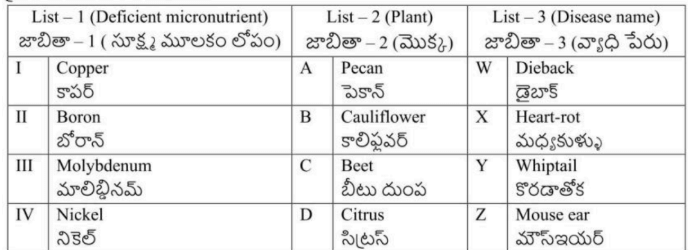
Match the following:
1
I - D - W, II - C - X, III - B - Y, IV - A - Z
2
I - D - W, II - C - X, III - A - Z, IV - B - Y
3
I - C - X, II - D - W, III - B - Y, IV - A - Z
4
I - A - Z, II - D - W, III - B - Y, IV - C - X
Official Solution
Correct Option: (1)
Step 1: Match Deficiencies to Diseases:
Copper (I): Deficiency causes Dieback (Exanthema) in Citrus. Match: I - D - W.
Boron (II): Deficiency causes Heart-rot (Brown heart) in Beet. Match: II - C - X.
Molybdenum (III): Deficiency causes Whiptail disease in Cauliflower. Match: III - B - Y.
Nickel (IV): Deficiency causes Mouse ear in Pecan (leaves become small and rounded). Match: IV - A - Z.
Step 2: Select Option:
The sequence matches Option (A).
13
PYQ 2025
medium
botanyID: ts-eamce
Function not related to Peroxysomes
1
Synthesis of glycolipids
2
Catabolism of long chain fatty acids
3
Role in photorespiration
4
Hydrogen peroxide destruction
Official Solution
Correct Option: (1)
1. Peroxisomes are involved in fatty acid -oxidation (catabolism of long-chain fatty acids), in reactions of photorespiration (in plant peroxisomes), and contain catalase for hydrogen peroxide destruction — options (2), (3) and (4) are functions associated with peroxisomes. 2. Synthesis of glycolipids is primarily a function of the endoplasmic reticulum and Golgi apparatus (membrane lipid synthesis and modification), not peroxisomes. 3. Therefore the function not related to peroxisomes is (1) Synthesis of glycolipids.