Genetic nature of Ribonucleic acid was discovered by:
1
Boveri
2
Hugo de Vries
3
Frankel Conrat
4
Khorana
Official Solution
Correct Option:
(3)
Step 1: Understanding RNA as Genetic Material Frankel Conrat demonstrated that RNA, rather than protein, carries genetic information in viruses. He conducted experiments on Tobacco Mosaic Virus (TMV) by separating its protein and RNA components and reconstituting the virus, proving that RNA was the genetic material. Step 2: Identifying the Correct Answer - Option (1) Boveri (Incorrect – Known for chromosomal inheritance).
- Option (2) Hugo de Vries (Incorrect – Proposed mutation theory). - Option (3) Frankel Conrat (Correct – Discovered RNA as genetic material).
- Option (4) Khorana (Incorrect – Known for genetic code deciphering).
02
PYQ 2024
medium
botanyID: ts-eamce
‘A’ diploid chromosome number is 4. ‘B’ haploid chromosome number is twice to that of A. ‘C’ diploid chromosome number is thrice to that of A. A, B and C respectively are
1
2
3
4
Official Solution
Correct Option:
(4)
Given that the diploid chromosome number of A is 4. Thus, the haploid number of A will be . The haploid number of B is twice that of A, so the haploid number of B will be . Therefore, the diploid number of B is . The diploid number of C is thrice that of A, so the diploid number of C is . Thus, we have the following:
03
PYQ 2024
medium
botanyID: ts-eamce
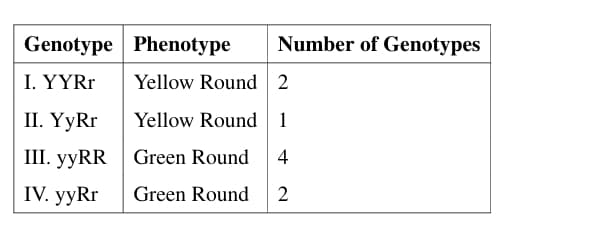
The table given below is related to the checkerboard of dihybrid F progeny of Mendel’s experiment. Identify the correct combinations:
1
I and II
2
II and IV
3
III and IV
4
I and IV
Official Solution
Correct Option:
(4)
Step 1: Understanding Dihybrid Cross and Phenotypes
- Dihybrid cross follows the 9:3:3:1 ratio for phenotypic expression. - The number of genotypes determines dominant or recessive traits in the F generation. - The correct genotype matches are I and IV.
04
PYQ 2024
medium
botanyID: ts-eamce
Arrange the ratios in the order of monohybrid test cross: incomplete dominance; and dihybrid cross.
1
2
3
4
Official Solution
Correct Option:
(2)
To arrange the ratios, we need to consider the phenotypic ratios for different types of crosses. Step 1: Incomplete dominance For incomplete dominance, the typical phenotypic ratio is as seen in the ratio . This happens when the heterozygote phenotype is distinct from both homozygous phenotypes. Step 2: Monohybrid cross In a standard monohybrid cross with complete dominance, the phenotypic ratio is , which corresponds to . Step 3: Dihybrid cross In a dihybrid cross, where two genes are involved, the phenotypic ratio is , which corresponds to . Thus, the correct order is:
05
PYQ 2024
medium
botanyID: ts-eamce
In Morgan’s experiments on linkage in Drosophila, the percentage of white-eyed, miniature-winged recombinants in the F generation is:
1
13%
2
98.7%
3
37.2%
4
62.8%
Official Solution
Correct Option:
(3)
Step 1: Understanding Linkage and Recombination
- Morgan’s experiments with Drosophila demonstrated genetic linkage between the white-eye and miniature-wing genes. - The expected recombination percentage was 37.2%, based on observed crossover frequencies.
06
PYQ 2024
medium
botanyID: ts-eamce
Match the following % Table
\begin{table}[h!]
\renewcommand{\arraystretch}{0.9} % For better row height
\centering
\begin{tabular}{|l|l|}
\hline
List - I & List - II \hline
A) ABO blood groupings & I) Frame-shift mutations \hline
B) Starch synthesis in pea seeds & II) Sickle cell anemia \hline
C) Point mutation & III) Pleiotropy \hline
D) Deletion of DNA base pairs & IV) Co-dominance \hline
\end{tabular}
\end{table} The correct answer is
1
A-IV, B-I, C-II, D-III
2
A-IV, B-II, C-III, D-I
3
A-III, B-IV, C-II, D-I
4
A-IV, B-III, C-II, D-I
Official Solution
Correct Option:
(4)
Step 1: Understanding the given statements: - A) ABO blood groupings: The ABO blood groupings are inherited based on co-dominance, where both alleles are expressed. So, this matches with IV. - B) Starch synthesis in pea seeds: This is an example of pleiotropy, where one gene affects multiple traits. Hence, it matches with III. - C) Point mutation: A point mutation can cause a genetic disorder like Sickle cell anemia, which is a result of a point mutation in the hemoglobin gene. This matches with II. - D) Deletion of DNA base pairs: A deletion of DNA base pairs leads to frame-shift mutations, which result in a change in the reading frame of the gene. This matches with I. Thus, the correct matching is:
07
PYQ 2025
medium
botanyID: ts-eamce
Chemical bonds cut by restriction endonucleases:
1
Hydrogen bonds
2
Glycosidic bonds
3
Phosphodiester bonds
4
Peptide bonds
Official Solution
Correct Option:
(3)
Step 1: Understanding Restriction Enzymes:
Restriction endonucleases are molecular scissors that cut DNA at specific recognition sites. Step 2: Mechanism of Action:
DNA strands are made of nucleotides linked by a sugar-phosphate backbone. The bond connecting the sugar of one nucleotide to the phosphate of the next is the phosphodiester bond. Restriction enzymes catalyze the hydrolysis of this specific bond to break the DNA backbone.
(Note: While sticky ends involve breaking hydrogen bonds between bases effectively separating the strands, the enzymatic \cutting action is on the phosphodiester backbone). Step 3: Evaluating Options:
(A) Hydrogen bonds: Connect base pairs; broken by helicase or heat.
(B) Glycosidic bonds: Connect base to sugar.
(C) Phosphodiester bonds: Connect nucleotides in the strand; cut by endonucleases.
(D) Peptide bonds: Connect amino acids in proteins. Step 4: Final Answer:
The correct option is (C).
08
PYQ 2025
medium
botanyID: ts-eamce
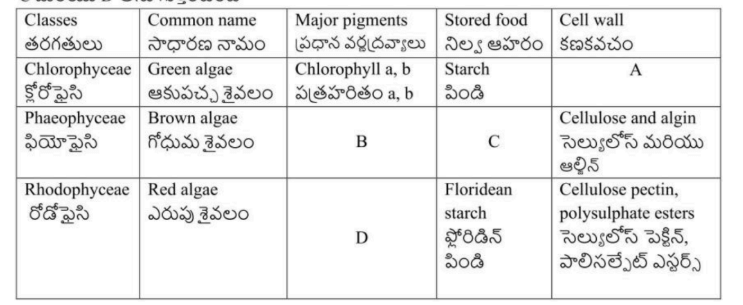
Study the following table which shows divisions of algae and their main characters, identify A, B, C and D
1
A-Cellulose, pectin; B-Chlorophyll a, c, Fucoxanthin; C-Mannitol, Laminarin; D-Chlorophyll a, d, Phycoerythrin
A-Chitin, Algin; B-Carotene; C-Starch; D-Chlorophyll a, c, Fucoxanthin
Official Solution
Correct Option:
(1)
Step 1: Analyze Missing Data:
A (Cell Wall of Green Algae): Typically composed of an inner layer of **Cellulose** and an outer layer of **Pectose/Pectin**.
B (Pigments of Brown Algae): Chlorophyll a, c, and **Fucoxanthin** (gives brown colour).
C (Stored Food of Brown Algae): Complex carbohydrates like **Laminarin** or **Mannitol**.
D (Pigments of Red Algae): Chlorophyll a, d, and **Phycoerythrin** (gives red colour).
Step 2: Conclusion:
Option (A) accurately lists all these characteristics.
09
PYQ 2025
medium
botanyID: ts-eamce
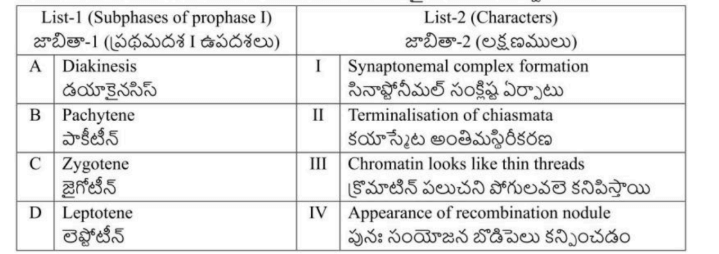
Match the list-1 with list-2 and select the correct option:
1
A - IV, B - II, C - III, D - I
2
A - I, B - III, C - II, D - IV
3
A - II, B - IV, C - III, D - I
4
A - II, B - IV, C - I, D - III
Official Solution
Correct Option:
(4)
Step 1: Match the Phases to Events:
A. Diakinesis: The final stage where the chiasmata move to the ends of chromosomes. This is called **Terminalisation** (II).
B. Pachytene: Crossing over occurs here, characterized by the appearance of **Recombination nodules** (IV).
C. Zygotene: Homologous chromosomes pair up (synapsis), facilitated by the **Synaptonemal complex formation** (I).
D. Leptotene: Chromosomes start condensing and appear as **thin threads** (III).
Step 2: Sequence:
A - II, B - IV, C - I, D - III. This matches Option (D).
10
PYQ 2025
medium
botanyID: ts-eamce
Among the following, Acidic amino acid, Basic amino acid and Neutral amino acids are in the sequence of
1
Glutamic acid - Lysine - Valine
2
Lysine - Valine - Glutamic acid
3
Glutamic acid - Valine - Lysine
4
Lysine - Glutamic acid - Valine
Official Solution
Correct Option:
(1)
Classify the given amino acids by side-chain properties:
Glutamic acid (Glu) is an acidic amino acid (negatively charged at physiological pH).
Lysine (Lys) is a basic amino acid (positively charged at physiological pH).
Valine (Val) is a neutral, non-polar (hydrophobic) amino acid.
The requested order "Acidic → Basic → Neutral" corresponds to Glutamic acid → Lysine → Valine, which is option (1).
11
PYQ 2025
medium
botanyID: ts-eamce
Chemical nature of primers of DNA/RNA
1
Oligosaccharides
2
Oligonucleotides
3
Polypeptides
4
Disaccharides
Official Solution
Correct Option:
(2)
Primers for DNA replication and transcription are short nucleic acid sequences (oligonucleotides) that provide a free 3′-OH group for DNA polymerase or RNA polymerase to extend. Polypeptides or sugars cannot act as primers.
12
PYQ 2025
medium
botanyID: ts-eamce
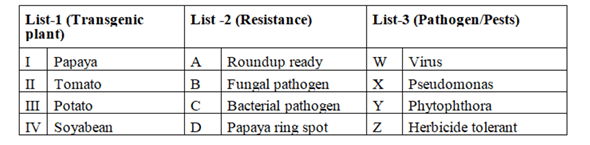
Study the List-1, List-2 and List-3 and identify correct pair:
The combination of frequency between the genes a and c is 5%; b and c is 15%; b and d is 9%; a and b is 20%; c and d is 24%; and a and d is 29%. Identify the sequence of genes on a linear chromosome:
1
a, d, b, c
2
d, b, a, c
3
a, c, b, d
4
a, b, c, d
Official Solution
Correct Option:
(1)
1. Recombination frequency ∝ distance between genes. 2. Arrange genes to satisfy given distances: a-d = 29%, d-b = 9%, b-c = 15%, a-c = 5%, c-d = 24%, a-b = 20%. 3. The linear sequence satisfying all distances is a, d, b, c. 4. Correct answer is (1) a, d, b, c.
14
PYQ 2025
medium
botanyID: ts-eamce
Which of the following is prevented by unisexual flowers that is present on different plants?
1
Autogamy and Geitonogamy
2
Geitonogamy and Xenogamy
3
Autogamy but not Geitonogamy
4
Geitonogamy but not Xenogamy
Official Solution
Correct Option:
(1)
1. Unisexual flowers borne on different plants (dioecious condition) mean an individual plant bears only male or only female flowers. 2. Autogamy (self-pollination within the same flower) is impossible because there is no bisexual flower on a plant. 3. Geitonogamy (transfer of pollen between different flowers of the same plant) is also prevented because all flowers on a plant are of the same sex — a female plant has no pollen to donate and a male plant has no ovules to receive pollen. 4. Xenogamy (cross-pollination between different plants) is still possible and, in fact, required for fertilization in dioecious species. 5. Hence, unisexual flowers on different plants prevent both autogamy and geitonogamy. Therefore the correct answer is (1) Autogamy and Geitonogamy.
15
PYQ 2025
medium
botanyID: ts-eamce
The disease sickle cell anemia is caused by substitution of 'A' by 'B' of 'C' globin chain of hemoglobin molecule. Identify A, B and C respectively
1
A-Alanine, B-Glutamic acid, C-Beta
2
A-Glutamic acid, B-Valine, C-Beta
3
A-Valine, B-Glutamic acid, C - Alpha
4
A-Valine, B - Serine, C-Beta
Official Solution
Correct Option:
(2)
Sickle cell anemia arises due to a single amino acid substitution in the β-globin chain of hemoglobin: Glutamic acid (hydrophilic) is replaced by Valine (hydrophobic) at position 6. This leads to abnormal hemoglobin (HbS) and sickling of RBCs.
16
PYQ 2025
medium
botanyID: ts-eamce
Study the List-1, List-2 and List-3 and identify correct pair:
"A" cell is placed in hypertonic solution. After some time, its osmotic potential is measured as -0.5 MPa. Then its water potential would be:
Official Solution
Correct Option:
(1)
1. Water potential , where = osmotic potential, = pressure potential. 2. In hypertonic solution, cell loses water → turgor pressure drops → . 3. Thus, MPa. 4. Hence the water potential is (2) -0.5 MPa.
18
PYQ 2025
medium
botanyID: ts-eamce
The combination of frequency between the genes a and c is 5%; b and c is 15%; b and d is 9%; a and b is 20%; c and d is 24%; and a and d is 29%. Identify the sequence of genes on a linear chromosome:
Official Solution
Correct Option:
(1)
1. Recombination frequency ∝ distance between genes. 2. Arrange genes to satisfy given distances: a-d = 29%, d-b = 9%, b-c = 15%, a-c = 5%, c-d = 24%, a-b = 20%. 3. The linear sequence satisfying all distances is a, d, b, c. 4. Correct answer is (1) a, d, b, c.
19
PYQ 2025
medium
botanyID: ts-eamce
Consider the following statements:
Assertion (A): Water uptake by root hairs from soil occurs through osmosis
Reason (R): Casparian strips in endodermis are suberized
1
Both (A) and (R) are true, (R) is the correct explanation of (A)
2
Both (A) and (R) are true, (R) is not the correct explanation of (A)
3
(A) is true, but (R) is false
4
(A) is false, but (R) is true
Official Solution
Correct Option:
(2)
Water is absorbed by root hairs from the soil via osmosis due to water potential difference. Casparian strips in the endodermis are suberized to block apoplastic movement and force water to move symplastically. While both statements are true, Casparian strips do not directly cause water uptake by root hairs; they regulate water movement inside the root. Hence, option 2 is correct.
About Genetics - TS-EAMCET
Genetics is a vital chapter for TS-EAMCET aspirants. Mastering the concepts covered in this chapter is essential for securing a top rank.
By rigorously practicing the previous year questions associated with this chapter, you can identify high-yield topics, understand the examiner's perspective, and boost your confidence during the actual exam.
Frequently Asked Questions
Why focus on Genetics PYQs?
Analyzing PYQs for this specific chapter reveals the most frequently tested concepts and the typical complexity of questions, allowing you to tailor your study plan efficiently.
How to best use this analysis?
Review the topic breakdown to see which sub-topics within Genetics carry the most weight. Then, tackle the questions iteratively to solidify your understanding.