Plant Cell Structure And Differences From Animal Cells
7 previous year questions.
Volume: 7 Ques
Yield: Medium
High-Yield Trend
6
2025
1
2024
Chapter Questions
7 MCQs
01
PYQ 2024
medium
botanyID: ts-eamce
In which of the following organisms, cell wall is not found in any stage?
1
Dinoflagellates
2
Chrysophytes
3
Slime moulds
4
Protozoans
Official Solution
Correct Option: (4)
Step 1: Understanding Cell Wall in Different Organisms Cell walls are structural components found in many organisms, providing support and protection. However, certain organisms lack a cell wall at all stages of their life cycle. - Dinoflagellates: Most have a cell wall composed of cellulose plates, though some may lack it.
- Chrysophytes: They generally possess a siliceous (silica-based) cell wall.
- Slime Moulds: These have a cell wall during the spore-forming stage, though they may be absent in the vegetative phase.
- Protozoans: These are unicellular eukaryotic organisms that completely lack a cell wall in all life stages. They have a flexible plasma membrane instead.
Step 2: Identifying the Correct Answer Since protozoans never possess a cell wall at any stage of their life cycle, the correct answer is Option (4) Protozoans. Step 3: Verifying the Options - Option (1) Dinoflagellates (Incorrect – Many have cellulose cell walls) - Option (2) Chrysophytes (Incorrect – Have silica-based cell walls)
- Option (3) Slime moulds (Incorrect – Have cell walls during spore formation) - Option (4) Protozoans (Correct – No cell wall at any stage) Thus, the correct answer is (4) Protozoans.
02
PYQ 2025
medium
botanyID: ts-eamce
Identify ``X'' name of enzyme; and ``Y'' enzyme class number by observing the reaction given below:
1
X - Glutamine oxidase, Y - 2
2
X - Glutamine synthetase, Y - 6
3
X - Glutamine reductase, Y - 4
4
X - Glutamine carboxylase, Y - 5
Official Solution
Correct Option: (2)
Step 1: Interpreting the reaction:
The given reaction represents the conversion of glutamic acid into glutamine. In this process, ammonia ( ) is incorporated, and energy is supplied through the hydrolysis of ATP into ADP and inorganic phosphate ( ).
Step 2: Determining enzyme X:
Reactions that involve the formation of a new bond between molecules using energy derived from ATP are catalyzed by enzymes known as synthetases.
In this specific case, the enzyme responsible for converting glutamate to glutamine is glutamine synthetase.
Step 3: Identifying enzyme class Y:
According to the IUBMB classification, enzymes are divided into six major classes:
Oxidoreductases
Transferases
Hydrolases
Lyases
Isomerases
Ligases
Since this reaction involves the joining of two molecules with the help of ATP, the enzyme belongs to the Ligases category, which corresponds to Class 6.
Step 4: Conclusion:
Thus, enzyme X is glutamine synthetase, and enzyme class Y is Class 6 (Ligases).
03
PYQ 2025
medium
botanyID: ts-eamce
Mobile genetic elements that replicate via an RNA intermediate:
1
Plasmids
2
Cosmids
3
Transposons
4
Phages
Official Solution
Correct Option: (3)
Step 1: Understanding Mobile Genetic Elements:
"Mobile genetic elements" are DNA sequences that can move around the genome. They are often called "jumping genes". Step 2: Classification:
Transposons are broadly classified into two types:
Class II (DNA Transposons): Move directly as DNA via a "cut and paste" mechanism.
Class I (Retrotransposons): Move via an RNA intermediate. The DNA is transcribed into RNA, and then reverse-transcribed back into DNA (cDNA) which inserts elsewhere ("copy and paste").
Step 3: Conclusion:
The question specifically asks for elements replicating via an RNA intermediate. This describes Retrotransposons, which fall under the broad category of Transposons. Plasmids and Phages are vectors or separate DNA entities, not typically classified as mobile genetic elements of the host genome in this context.
04
PYQ 2025
medium
botanyID: ts-eamce
Consider the following statements Assertion (A): Achyranthes shows spike inflorescence Reason (R): Spike shows basipetal arrangement of sessile flowers

1
Both (A) and (R) are true, (R) is the correct explanation of (A)
2
Both (A) and (R) are true, (R) is not the correct explanation of (A)
3
(A) is true, but (R) is false
4
(A) is false, but (R) is true
Official Solution
Correct Option: (3)
1. In {Achyranthes} (family Amaranthaceae), flowers are borne on an elongated, unbranched axis without pedicels, forming a spike inflorescence. Hence, Assertion (A) is true. 2. In a spike, flowers are arranged directly on the main axis (rachis) and it belongs to the {racemose type} of inflorescence. In racemose inflorescences, the floral buds open in an acropetal order — the older flowers are at the base and the younger ones are towards the apex. 3. The Reason (R) states that the spike shows a basipetal arrangement of sessile flowers, which is incorrect because basipetal succession occurs in {cymose (determinate)} inflorescences, not in racemose ones like spikes. 4. Therefore, while the Assertion (A) is true, the Reason (R) is false. Hence, the correct answer is (3) (A) is true, but (R) is false.
05
PYQ 2025
medium
botanyID: ts-eamce
Match the following:
1
2
3
4
Official Solution
Correct Option: (2)
Match each taxonomist to their classic work and the classification approach they are associated with:
I. Theophrastus is the ancient author of \emph{Historia plantarum} (W). Historically his scheme is proto-classificatory (here placed under D/W in the option).
II. Linnaeus authored \emph{Species plantarum} (X) and is famous for the Artificial (sexual) classification (C).
III. Bentham & Hooker wrote \emph{Genera plantarum} (Y) and their system is regarded as a Natural system (B).
IV. Hutchinson is known for emphasizing evolutionary/phylogenetic relationships and authored works that align with phylogenetic treatment of families (Z) — mapped to A.
Therefore the set corresponds correctly to the option (2).
06
PYQ 2025
medium
botanyID: ts-eamce
Life cycle in Rockweed of Brown Algae is
1
Diplo - biontic
2
Diplontic
3
Diplo - haplontic
4
Haplo – diplontic
Official Solution
Correct Option: (2)
1. Rockweeds (genus Fucus and similar brown algae) exhibit a diplontic life cycle: the multicellular phase is diploid (the thallus), and the only haploid stages are the gametes. Fertilisation produces a zygote that develops into the diploid thallus. 2. In diplontic life cycles, meiosis produces gametes directly (i.e., gametes are formed by meiosis), and there is no multicellular haploid generation. 3. Therefore the life cycle of rockweed (Fucus) is diplontic. Hence the correct answer is (2) Diplontic.
07
PYQ 2025
medium
botanyID: ts-eamce
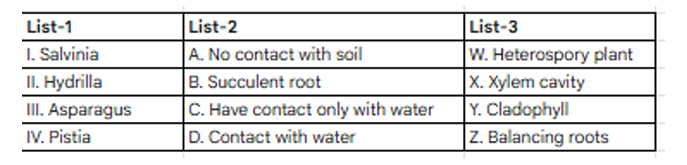
Match the following:
1
I-C-Z, II-D-W, III-B-X, IV-A-Y
2
I-A-X, II-B-Y, III-C-W, IV-D-Z
3
I-D-W, II-C-X, III-A-Z, IV-B-Y
4
I-D-W, II-C-X, III-B-Y, IV-A-Z
Official Solution
Correct Option: (1)
Salvinia: aquatic fern, floating, has balancing roots → I-C-Z
Hydrilla: submerged, gets water contact, heterosporous → II-D-W
Asparagus: succulent roots, Xylem cavity → III-B-X
Pistia: floating, no contact with soil, leaves form cladophyll → IV-A-Y
Hence, option (1) is correct.