Assertion (A): Protoxin of Bacillus thuringensis become active in gut of insects. Reason (R): Alkaline pH of intestine gut solubilizes the crystals of toxin to make it active.
1
2
3
4
Official Solution
Correct Option:
(1)
Step 1: The assertion (A) says that the protoxin of Bacillus thuringensis becomes active in the gut of insects. This is true as the protoxin is inactive in its crystalline form and needs to be activated by specific conditions in the gut of the insect. Step 2: The reason (R) states that the alkaline pH of the insect’s gut helps to solubilize the crystals of the toxin and activates it. This is also true as the alkaline pH of the gut is essential in converting the protoxin into the active form that kills the insect. Step 3: Both assertion (A) and reason (R) are true, and reason (R) provides the correct explanation for why assertion (A) is true. Therefore, the correct answer is that both (A) and (R) are correct and (R) is the correct explanation of (A).
02
PYQ 2024
medium
botanyID: ts-eamce
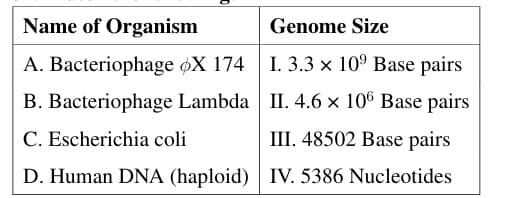
Match the following:
1
A-IV, B-II, C-II, D-I
2
A-IV, B-III, C-I, D-II
3
A-III, B-II, C-IV, D-I
4
A-II, B-IV, C-I, D-III
Official Solution
Correct Option:
(1)
Step 1: Understanding Genome Sizes
- Bacteriophage X 174 → 5386 Nucleotides. - Bacteriophage Lambda → 48502 Base pairs. - Escherichia coli → 4.6 × 10 Base pairs. - Human DNA (haploid) → 3.3 × 10 Base pairs.
03
PYQ 2024
medium
botanyID: ts-eamce
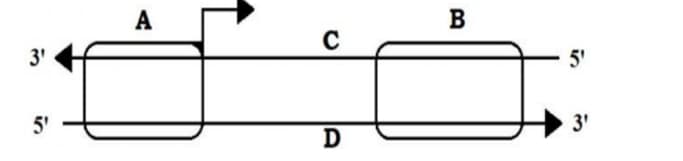
Given is the schematic structure of the transcription unit. Select the correct answer regarding A, B, C, and D:
1
A - Terminator, B - Promoter, C - Template strand, D - Coding strand
2
A - Promoter, B - Terminator, C - Coding strand, D - Template strand
3
A - Promoter, B - Terminator, C - Template strand, D - Coding strand
4
A - Terminator, B - Promoter, C - Coding strand, D - Template strand
Official Solution
Correct Option:
(3)
Step 1: Understanding the Transcription Unit
A transcription unit consists of: - Promoter: Initiates transcription. - Terminator: Marks the end of transcription. - Template strand: Serves as the template for RNA synthesis. - Coding strand: Has the same sequence as the RNA (except for uracil replacing thymine).
04
PYQ 2025
easy
botanyID: ts-eamce
Resistance to yellow mosaic virus and powdery mildew were induced by mutations in:
1
Cotton
2
Maize
3
Bhendi
4
Mung bean
Official Solution
Correct Option:
(4)
Step 1: Understanding Mutation Breeding:
Mutation breeding involves inducing mutations (using chemicals or radiation like gamma rays) to create new desirable traits, such as disease resistance, in plants. Step 2: Specific Example from Curriculum:
A classic example provided in biology textbooks (e.g., NCERT Class 12) is the induction of resistance in Mung bean to Yellow Mosaic Virus (YMV) and Powdery Mildew through mutation breeding. Step 3: Other Options:
(C) Bhendi (Okra): Resistance to YMV in Bhendi (\Abelmoschus esculentus) was transferred from a wild species resulting in a new variety called \Parbhani Kranti (Conventional breeding/Interspecific hybridization, not primarily mutation breeding in the classic textbook context). Step 4: Final Answer:
The correct option is (D).
05
PYQ 2025
easy
botanyID: ts-eamce
Identify the functions not related to Cytoskeleton?
I. Mechanical support
II. Cell motility
III. Intercellular transport
IV. Mesosome formation
1
I & II
2
I & III
3
II & III
4
III & IV
Official Solution
Correct Option:
(4)
Step 1: Analyze Cytoskeleton Functions:
The cytoskeleton is an elaborate network of filamentous proteinaceous structures in the cytoplasm. Its main functions are:
Mechanical support: Yes (I).
Motility: Yes (II) (e.g., cilia, flagella, amoeboid movement).
Maintenance of shape: Yes.
Step 2: Analyze Non-Functions:
III. Intercellular transport: The cytoskeleton helps in \intracellular transport (within the cell). \Intercellular transport (between cells) is primarily facilitated by plasmodesmata and vascular tissue, not the cytoskeleton directly.
IV. Mesosome formation: Mesosomes are infoldings of the plasma membrane found in prokaryotes (bacteria). The cytoskeleton (microtubules, etc.) is a characteristic of eukaryotes.
Step 3: Conclusion:
Functions III and IV are not related to the cytoskeleton.
06
PYQ 2025
medium
botanyID: ts-eamce
Chromosomes number in endosperm cell of ``X'' plant and the chromosomes number of gamete of plant ``Y'' are equal. Plants X and Y respectively are
1
Apple and Rice
2
Maize and potato
3
Onion and Rice
4
Onion and potato
Official Solution
Correct Option:
(4)
Step 1: Determine Chromosome Counts for Each Plant:
Since , the condition is satisfied. Step 3: Check Other Options (Briefly):
(A) Apple Endosperm ( ) vs Rice Gamete ( ). No.
(B) Maize Endosperm ( ) vs Potato Gamete ( ). No.
(C) Onion Endosperm ( ) vs Rice Gamete ( ). No. Step 4: Final Answer:
The correct pair is Onion and Potato (Option D).
07
PYQ 2025
medium
botanyID: ts-eamce
Identify correct statements from the following:
I. In pineapple fruit is syconus and fleshy peduncle is edible
II. In rice fruit is caryopsis and endosperm is edible
III. In coconut fruit is drupe and mesocarp is edible
IV. In cashew fruit is nut and cotyledons, false fruit are edible
1
II & III
2
I & II
3
I & IV
4
II & IV
Official Solution
Correct Option:
(4)
Step 1: Evaluate Each Statement:
I. Pineapple: Fruit is a Sorosis (multiple fruit), not syconus (which is Fig). Edible parts are the bracts, perianth, and rachis. (False)
II. Rice: Fruit is a Caryopsis (grain). The main edible part is the starchy endosperm. (True)
III. Coconut: Fruit is a Drupe. The mesocarp is fibrous (coir) and inedible. The edible part is the endosperm (liquid and solid). (False)
IV. Cashew: The fruit is a Nut (kidney-shaped). The edible kernel consists of cotyledons. The swollen structure above is the 'Cashew Apple', which is a modified pedicel/thalamus (false fruit) and is also edible. (True)
Step 2: Select the Correct Option:
Statements II and IV are correct. This matches Option (D).
08
PYQ 2025
hard
botanyID: ts-eamce
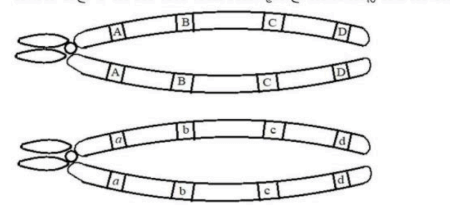
Given diagram shows a pair of homologous chromosomes during meiosis. Maximum crossing over will occur between genes
1
A and a; D and d
2
C and d; c and D
3
B and c; b and C
4
A and a; d and D
Official Solution
Correct Option:
(4)
Step 1: Principle of Crossing Over:
The frequency of crossing over between two genes on the same chromosome is directly proportional to the physical distance between them.
Step 2: Analyzing the Diagram:
The genes are arranged linearly as A-B-C-D.
Genes A and D are located at the extreme ends of the chromosome.
Genes B and C are in the middle.
The distance between A and D is the maximum. Step 3: Conclusion:
Since the distance is maximum between loci A and D, the probability of a crossover event occurring in the region between them is the highest. Thus, maximum crossing over (recombination) occurs between the genes A/a and D/d. Step 4: Final Answer:
Option (D) represents the gene pairs at the ends.
09
PYQ 2025
medium
botanyID: ts-eamce
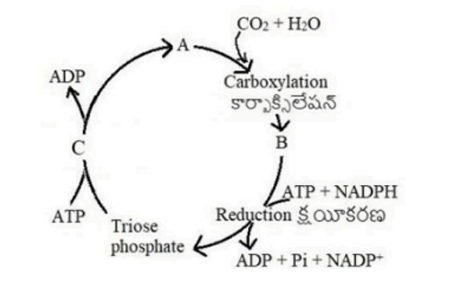
In the given representation of C3 cycle, identify A, B and C and select the correct option
1
A-3PGA, B-RUBP, C-Pyruvic acid
2
A-RUBP, B-3PGA, C-Regeneration
3
A-PEP, B-OAA, C-Malic acid
4
A-PEP, B-RUBP, C-OAA
Official Solution
Correct Option:
(2)
In the C3 (Calvin) cycle, RUBP (ribulose-1,5-bisphosphate) is the CO{2} acceptor (A). CO{2} fixation by Rubisco produces 3-phosphoglycerate (3PGA) (B). The cycle includes regeneration of RUBP (C) to allow continuous CO{2} assimilation. Hence, A-RUBP, B-3PGA, C-Regeneration is correct.
10
PYQ 2025
medium
botanyID: ts-eamce
Bt toxin kills insects by
1
Inhibiting protein synthesis
2
Obstructing biosynthetic pathway
3
Creating pores in midgut epithelial cells leading to cell swelling and lysis
4
Generating excessive heat
Official Solution
Correct Option:
(3)
Bt (Bacillus thuringiensis) toxin is a crystal protein (Cry protein) that targets the midgut epithelial cells of susceptible insects, particularly Lepidopteran larvae. The toxin binds to receptors on the epithelial cells, forms pores, disrupts osmotic balance, causes cell swelling and lysis, ultimately killing the insect. Bt toxin does not inhibit protein synthesis or generate heat; its primary mode is physical disruption of gut cells.
11
PYQ 2025
medium
botanyID: ts-eamce
Which of the following statements are correct about viroids?
1
They have free DNA with protein coat
2
They have free DNA without protein coat
3
They have free RNA with protein coat
4
They have free RNA without protein coat
Official Solution
Correct Option:
(4)
Viroids are small, circular, single-stranded RNA molecules that infect plants and do not have a protein coat, unlike viruses. They interfere with plant metabolism, causing diseases. They are simpler than viruses and consist only of RNA. Options 1–3 are incorrect as viroids are RNA, not DNA, and lack a protein coat.
12
PYQ 2025
medium
botanyID: ts-eamce
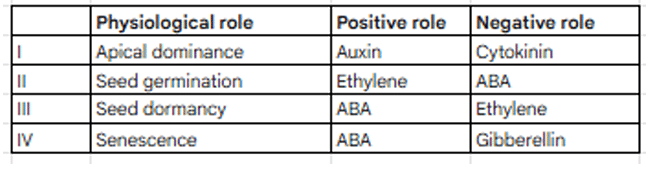
Find out the correct combinations from the following:
1
I & II
2
III & IV
3
II, III & IV
4
I, II, III & IV
Official Solution
Correct Option:
(4)
I. Auxin promotes apical dominance; cytokinin can inhibit it — correct. II. Seed germination involves Ethylene promoting growth and ABA inhibiting — correct. III. Seed dormancy is maintained by ABA; Ethylene breaks dormancy — correct. IV. Senescence is promoted by ABA and delayed by Gibberellin — correct. All combinations I–IV are correct; hence option 4.
13
PYQ 2025
medium
botanyID: ts-eamce
Identify the correct statements with regard to Golgi apparatus I. Convex side is called cis or forming face II. Concave side is called trans or maturing face III. Cisternae of Golgi can modify proteins IV. Materials enter through trans face and are released through cis face
1
I, III & IV
2
II, III & IV
3
I, II & III
4
I, II & IV
Official Solution
Correct Option:
(3)
1. The Golgi apparatus has a cis face (convex/formed side) oriented towards the endoplasmic reticulum where materials arrive — statement I is true. 2. The trans face (concave/maturing face) is where processed materials are packaged and exit the Golgi — statement II is true. 3. The Golgi cisternae are involved in post-translational modification of proteins (glycosylation, proteolytic processing, etc.) — statement III is true. 4. Statement IV is incorrect because materials enter via the cis face and are released via the trans face (opposite of what IV states). 5. Thus I, II and III are the correct statements. Hence the correct answer is (3) I, II & III.
14
PYQ 2025
medium
botanyID: ts-eamce
Consider the following statements: Assertion (A): Seed dormancy may be caused by hard seed coats in Fabaceae Reason (R): Such type of seed dormancy can be broken by stratification
Official Solution
Correct Option:
(1)
1. Hard seed coats in Fabaceae cause physical dormancy → (A) true. 2. Stratification is a treatment for physiological dormancy, not physical dormancy → (R) true but not correct explanation. 3. Hence correct answer is (2) Both (A) and (R) are true, (R) is not the correct explanation of (A).
15
PYQ 2025
medium
botanyID: ts-eamce
Tetracycline resistance gene of PBR322 shows recognition site for which restriction enzyme?
Official Solution
Correct Option:
(1)
1. PBR322 plasmid carries AmpR and TetR genes. 2. EcoRI cuts specifically in the TetR gene for cloning. 3. Other enzymes cut at different sites. 4. Hence, correct answer is (2) EcoRI.
16
PYQ 2025
medium
botanyID: ts-eamce
Which seeds cannot germinate and establish without the presence of mycorrhizae?
Official Solution
Correct Option:
(1)
1. Some gymnosperms require mycorrhizal association for seed germination. 2. Cycas seeds have large embryos and depend on fungal symbiosis for nutrients. 3. Gnetum, Ephedra, Pinus can germinate independently. 4. Correct answer is (3) Cycas.
17
PYQ 2025
medium
botanyID: ts-eamce
Zygomorphic flowers showing imbricate aestivation are present in
1
Cucumber and Cassia
2
Cassia and disc florets of Tridax
3
Pisum and Calotropis
4
Gulmohur and Cassia
Official Solution
Correct Option:
(3)
Zygomorphic flowers are bilaterally symmetrical. Imbricate aestivation refers to overlapping arrangement of petals in the bud. Pisum (pea) and Calotropis exhibit zygomorphic flowers with imbricate aestivation. Cucumber is actinomorphic, Cassia may have different aestivation. Thus, option (3) is correct.
18
PYQ 2025
medium
botanyID: ts-eamce
Consider the following statements: Assertion (A): Seed dormancy may be caused by hard seed coats in Fabaceae Reason (R): Such type of seed dormancy can be broken by stratification
1
Both (A) and (R) are true, (R) is the correct explanation of (A)
2
Both (A) and (R) are true, (R) is not the correct explanation of (A)
3
(A) is true, but (R) is false
4
(A) is false, but (R) is true
Official Solution
Correct Option:
(2)
1. Hard seed coats in Fabaceae cause physical dormancy → (A) true. 2. Stratification is a treatment for physiological dormancy, not physical dormancy → (R) true but not correct explanation. 3. Hence correct answer is (2) Both (A) and (R) are true, (R) is not the correct explanation of (A).
19
PYQ 2025
medium
botanyID: ts-eamce
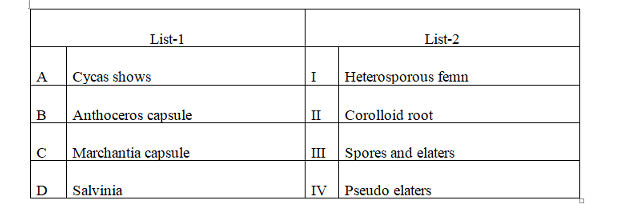
Match the following
1
A-II, B-IV, C-III, D-I
2
A-II, B-IV, C-I, D-III
3
A-I, B-III, C-II, D-IV
4
A-II, B-I, C-III, D-IV
Official Solution
Correct Option:
(1)
1. Cycas (a cycad) shows coralloid roots (specialized, coral-like, often with cyanobacterial symbionts) — hence A II. 2. Anthoceros (a hornwort) capsule contains pseudo-elaters (elongated sterile structures aiding spore dispersal) — B IV. 3. Marchantia (a liverwort) capsule contains elaters associated with spores (true elaters) — C III. 4. Salvinia is a heterosporous fern (produces microspores and megaspores) — D I. 5. Therefore the correct matching is A-II, B-IV, C-III, D-I. Hence the correct option is (1) A-II, B-IV, C-III, D-I.
20
PYQ 2025
medium
botanyID: ts-eamce
Which seeds cannot germinate and establish without the presence of mycorrhizae?
1
Gnetum
2
Ephedra
3
Cycas
4
Pinus
Official Solution
Correct Option:
(3)
1. Some gymnosperms require mycorrhizal association for seed germination. 2. Cycas seeds have large embryos and depend on fungal symbiosis for nutrients. 3. Gnetum, Ephedra, Pinus can germinate independently. 4. Correct answer is (3) Cycas.
About Molecular Biology - TS-EAMCET
Molecular Biology is a vital chapter for TS-EAMCET aspirants. Mastering the concepts covered in this chapter is essential for securing a top rank.
By rigorously practicing the previous year questions associated with this chapter, you can identify high-yield topics, understand the examiner's perspective, and boost your confidence during the actual exam.
Frequently Asked Questions
Why focus on Molecular Biology PYQs?
Analyzing PYQs for this specific chapter reveals the most frequently tested concepts and the typical complexity of questions, allowing you to tailor your study plan efficiently.
How to best use this analysis?
Review the topic breakdown to see which sub-topics within Molecular Biology carry the most weight. Then, tackle the questions iteratively to solidify your understanding.