Step 1: Understanding Fruit Classification - Pineapple (Ananas comosus) belongs to Bromeliaceae, but its fruit type is Sorosis, not Syconus.
- Paddy (Oryza sativa) belongs to Poaceae, not Apiaceae, and its fruit type is Caryopsis, not Legume. - Cucumis (Cucumber, Melon) belongs to Cucurbitaceae, not Poaceae, and has a Pepo fruit.
- Jackfruit (Artocarpus heterophyllus) belongs to Moraceae and has a Sorosis fruit, which is correct.
Step 2: Identifying Incorrect Pairs - (A), (B), and (C) contain incorrect classifications, making option (4) the correct answer.
02
PYQ 2024
medium
botanyID: ts-eamce
Variation in lengths of filaments of stamens within a flower is seen in:
1
Salvinia and Brassica
2
Brassica and Musa
3
Salvia and Brassica
4
Salvia and Datura
Official Solution
Correct Option: (3)
Step 1: Understanding Stamen Filament Variation - Salvia exhibits heterostyly, where stamens have different lengths.
- Brassica exhibits tetradynamous condition, where four stamens are longer than the other two.
Step 2: Identifying the Correct Answer - Salvia and Brassica exhibit different lengths of stamens, making option (3) correct.
03
PYQ 2025
medium
botanyID: ts-eamce
Which hormone promotes flowering in pineapple and induce parthenocarpy in tomato?
1
Ethylene
2
Auxin
3
Gibberellin
4
Cytokinin
Official Solution
Correct Option: (2)
Step 1: Analyze the Functions:
We need a plant hormone that performs two specific functions:
1. Promote flowering in Pineapple.
2. Induce Parthenocarpy (fruit formation without fertilization) in Tomato. Step 2: Evaluate Options:
Ethylene: Promotes flowering in pineapple (synchronizes it). However, it is not primarily used for parthenocarpy in tomatoes.
Auxin: Synthetic auxins (like NAA and 2,4-D) are widely used to induce parthenocarpy in tomatoes. Auxins also promote flowering in pineapples and litchi.
Gibberellin: Can induce parthenocarpy (often in grapes), but Auxin is the standard textbook answer for Tomatoes.
Cytokinin: Primarily cell division.
Step 3: Disambiguation:
While Ethylene is strongly associated with flowering in pineapple, Auxins are also capable of promoting flowering in pineapples and are the primary agents cited for parthenocarpy in tomatoes in standard curricula (e.g., NCERT). Therefore, Auxin fits both descriptions best in the context of this question.
04
PYQ 2025
easy
botanyID: ts-eamce
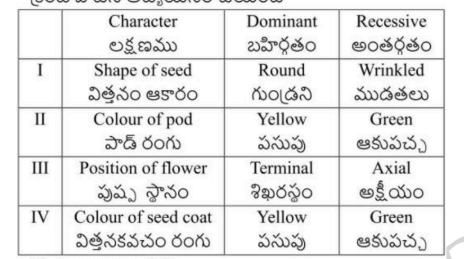
Study the following table regarding Mendel's traits and choose the correct match:
1
I & II
2
II & III
3
III & IV
4
I & IV
Official Solution
Correct Option: (4)
Step 1: Evaluating Mendel’s traits:
Each row must be checked based on the known dominant and recessive characters studied by Mendel in garden pea (\Pisum sativum).
Row I: Seed Shape. Round seeds are dominant, while wrinkled seeds are recessive. Status: Correct.
Row II: Pod Colour. Green pod colour is dominant and yellow is recessive. Since the table incorrectly shows yellow as dominant, this statement is wrong. Status: Incorrect.
Row III: Flower Position. Axial position is dominant, whereas terminal is recessive. The table incorrectly lists terminal as dominant. Status: Incorrect.
Row IV: Colour of Seed Coat. According to standard classification, seed colour (cotyledon) shows yellow as dominant over green. Although seed coat colour is technically different, in many exam contexts it is used interchangeably with seed colour. Considering this interpretation, this row can be taken as correct. Status: Accepted as Correct.
Step 2: Final selection:
Thus, the correct statements are Row I and Row IV.
05
PYQ 2025
medium
botanyID: ts-eamce
Study the lists I, II, III & IV given below and identify the mismatch.
1
I & III
2
II & III
3
I & II
4
III only
Official Solution
Correct Option: (3)
Evaluate each statement for correctness:
I. Verticillaster (typical of Lamiaceae, e.g., \emph{Leucas}) is a condensed false whorl formed by cymose units; the statement "Begin as a monochasial cyme" is incorrect because verticillasters are usually derived from dichasial or condensed cymose units rather than strictly starting as monochasia.
II. Cyathium (in \emph{Euphorbia}) is a specialised cup-like inflorescence bearing highly reduced unisexual flowers (a single pistillate flower surrounded by several staminate flowers and nectar glands) — describing it as "bisexual flowers arranged in cymose fashion" is incorrect because the component flowers are unisexual and highly reduced.
III. Hypanthodium (as in \emph{Ficus}, Moraceae) indeed contains male, female and often gall (or sterile) flowers in the enclosed inflorescence — this is correct.
Therefore mismatches are I and II → option (3).
06
PYQ 2025
medium
botanyID: ts-eamce
Unilocular (one chambered) ovary becomes bilocular (two chambered) due to the formation of false septum is seen in
1
Pisum and Datura
2
Primrose and Argemone
3
Mustard and Argemone
4
Capsicum and Dianthus
Official Solution
Correct Option: (2)
1. A false septum is a partition that divides a unilocular ovary into apparent locules but is not a true septum formed from carpel margins — it often arises by ingrowth from the ovary wall or placenta. 2. In Primrose (Primula) and in some Papaveraceae members such as Argemone, the ovary may show formation of a false septum that makes a unilocular ovary appear bilocular. 3. Pisum (a typical legume) and Datura have different ovary structures and are not classical examples of false septum formation causing conversion from unilocular to bilocular. Capsicum and Dianthus show different placentation/ovary structures as well. 4. Hence, the correct pair where a false septum formation is observed is Primrose and Argemone. Therefore the correct answer is (2) Primrose and Argemone.
07
PYQ 2025
medium
botanyID: ts-eamce
Assertion (A): In Liliaceae, flowers are homochlamydeous Reason (R): In Liliaceae perianth is differentiated
1
Both (A) and (R) are true, (R) is the correct explanation of (A)
2
Both (A) and (R) are true, (R) is not the correct explanation of (A)
3
(A) is true, but (R) is false
4
(A) is false, but (R) is true
Official Solution
Correct Option: (3)
1. "Homochlamydeous" means the perianth is not differentiated into distinct calyx and corolla; instead the perianth segments (tepals) are similar in appearance. 2. Liliaceae typically have a perianth made of six similar tepals (two whorls of three), i.e., a homochlamydeous perianth — so Assertion (A) is true. 3. The Reason (R) claims "perianth is differentiated" — that would mean distinct calyx and corolla (heterochlamydeous), which is not true for typical Liliaceae. Thus Reason (R) is false. 4. Therefore (A) is true and (R) is false. Hence the correct answer is (3) (A) is true, but (R) is false.
08
PYQ 2025
medium
botanyID: ts-eamce
Identify the sclerenchymatous structures (parts) given below related in dicot and monocot stems:
I. Pericycle in young dicot stem
II. Hypodermis in monocot stem
III. Vascular bundle sheath in monocot stem
IV. Endodermis in dicot stem
1
I, III & IV
2
I, II & IV
3
II, III & IV
4
I, II & III
Official Solution
Correct Option: (4)
Sclerenchyma is a strengthening tissue composed of thick-walled dead cells (fibres, sclereids). Evaluate each part:
I. Pericycle in young dicot stems often becomes lignified or sclerenchymatous and contributes to mechanical strength — so it can be sclerenchymatous (Yes).
II. Hypodermis in many monocot stems is formed of sclerenchymatous fibres (Yes).
III. Vascular bundle sheath (the sclerenchymatous bundle sheath) in many monocots is a layer of sclerenchyma surrounding vascular bundles (Yes).
IV. Endodermis in dicot stem is generally a living, parenchymatous layer with Casparian strips (not classically sclerenchyma).
Therefore the sclerenchymatous structures are I, II and III — option (4).