Step 1: Understanding Succulents and Phylloclades - Casuarina does not have a succulent root, and it does not form a phylloclade.
- Asparagus has a succulent stem, not a leaf, and it forms a cladode, not a phylloclade. - Opuntia has a succulent stem and is a classic example of a phylloclade.
- Aloe has succulent leaves and is correctly classified as a xerophyte. Step 2: Identifying Incorrect Pairs - Casuarina (Incorrect classification).
- Asparagus (Incorrect classification).
- Opuntia and Aloe are correctly classified. Thus, the incorrect pairs are I and II.
02
PYQ 2024
medium
botanyID: ts-eamce
Match the following: \begin{tabular}{|c|c|}
\hline
Table - I & Table - II
\hline
A) Diplointic & I) Spirogyra
B) Diplo-bionic & II) Laminaria
C) Haplo-diplontic & III) Polysiphonia
D) Haplontic & IV) Fucus
\hline
\end{tabular} The correct answer is
1
A-IV, B-I, C-II, D-III
2
A-III, B-IV, C-II, D-I
3
A-IV, B-III, C-II, D-I
4
A-II, B-III, C-IV, D-I
Official Solution
Correct Option: (3)
Step 1: Understanding life cycle types - Diplontic (A-IV - Fucus): - In the diplontic life cycle, the diploid phase (sporophyte) is dominant. - Fucus follows this type of life cycle. - Diplo-biontic (B-III - Polysiphonia): - In the diplo-biontic life cycle, both haploid and diploid phases are prominent. - Polysiphonia exhibits this type of life cycle. - Haplo-diplontic (C-II - Laminaria): - The haplo-diplontic life cycle involves an alternation of generations where both haploid and diploid stages are multicellular. - Laminaria exhibits this type. - Haplontic (D-I - Spirogyra): - In the haplontic life cycle, the haploid stage is dominant, and the diploid phase is short-lived. - Spirogyra follows this life cycle. Step 2: Examining the given options - Option 1 (A-IV, B-I, C-II, D-III) → Incorrect (Mismatch in B and D). - Option 2 (A-III, B-IV, C-II, D-I) → Incorrect (Mismatch in A and B). - Option 3 (A-IV, B-III, C-II, D-I) → Correct, as it matches the classification properly. - Option 4 (A-II, B-III, C-IV, D-I) → Incorrect (Mismatch in A and C). Step 3: Conclusion Since the correct matching is A-IV, B-III, C-II, D-I, the correct answer is Option (3).
03
PYQ 2025
medium
botanyID: ts-eamce
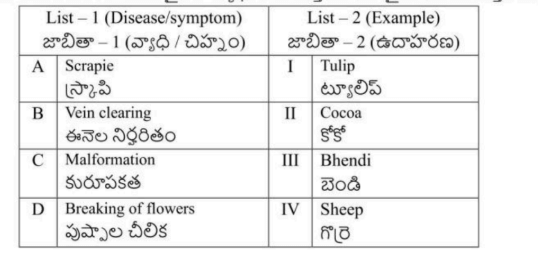
Identify correct matching of the following diseases: (Note: The question header in the source image mentioned "viral diseases observed in plants" which appears to be a context error as Scrapie is an animal prion disease, but the matching task is clear.)
1
A - II, B - I, C - IV, D - III
2
A - IV, B - III, C - I, D - II
3
A - IV, B - III, C - II, D - I
4
A - III, B - IV, C - II, D - I
Official Solution
Correct Option: (3)
Step 1: Match the Pairs:
A. Scrapie: A fatal degenerative disease affecting the nervous system of Sheep and goats. It is caused by Prions. Match: A - IV.
B. Vein clearing: A common symptom of viral infection in plants, notably Bhendi (Yellow Vein Mosaic of Okra). Match: B - III.
C. Malformation:Cocoa Swollen Shoot Virus causes swelling and malformation. (Also Mango malformation exists, but Cocoa is the remaining option suitable for 'malformation' or swelling symptoms in this set). Match: C - II.
D. Breaking of flowers: Refers to the "breaking" (streaking) of flower color, famously caused by the Tulip Breaking Virus in Tulip. Match: D - I.
Step 2: Conclusion:
The correct matching sequence is A-IV, B-III, C-II, D-I. This corresponds to Option (C).
04
PYQ 2025
easy
botanyID: ts-eamce
In a messenger RNA molecule, untranslated regions (UTRs) are present at: I. 5' end before start codon II. 3' end after stop codon III. 3' end before stop codon IV. 5' end after start codon
1
I & III
2
II & III
3
I & II
4
III & IV
Official Solution
Correct Option: (3)
Untranslated regions (UTRs) are segments of mRNA that are not translated into protein but play regulatory roles in translation and stability. The 5\textsuperscript{' } UTR is located upstream of the start codon, while the 3\textsuperscript{' } UTR is downstream of the stop codon. Regions within the coding sequence (inside start and stop codons) are translated and do not qualify as UTRs. Hence, the correct UTRs are I (5\textsuperscript{' } before start codon) and II (3\textsuperscript{' } after stop codon).
05
PYQ 2025
medium
botanyID: ts-eamce
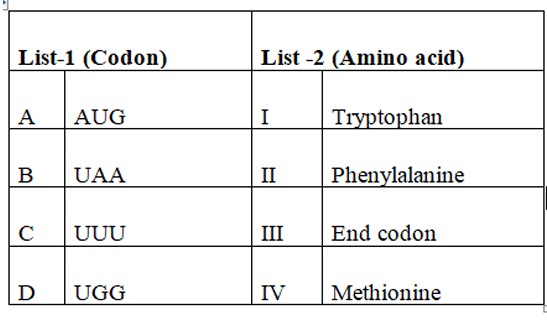
Match the following
Official Solution
Correct Option: (1)
1. AUG is the start codon in mRNA which codes for Methionine — so A IV. 2. UAA is a stop codon or termination codon — so B III. 3. UUU codes for Phenylalanine — so C II. 4. UGG codes for Tryptophan — so D I. 5. Therefore, the correct matching is A-III, B-IV, C-II, D-I. Hence the correct answer is (3) A-III, B-IV, C-II, D-I.