Step 1: Understanding Ascocarps Ascocarps are fruiting bodies of fungi belonging to the Ascomycota division. They enclose and protect ascospores during development. There are three primary types of ascocarps:
- Perithecium: A flask-shaped ascocarp with a small apical opening (ostiole) through which spores are released.
- Cleistothecium: A completely enclosed ascocarp with no opening. - Apothecium: A cup or disk-shaped ascocarp that is open, allowing the spores to disperse easily. - Cystocarp: A reproductive structure found in red algae, not an ascocarp of fungi.
Step 2: Identifying the Correct Answer Since the question describes an ascocarp that is flask-shaped with an apical opening, it matches the Perithecium. Step 3: Verifying the Options - Option (1) Perithecium (Correct)
- Option (2) Cleistothecium (Incorrect – it has no opening)
- Option (3) Apothecium (Incorrect – it is cup/disc-shaped)
- Option (4) Cystocarp (Incorrect – it is not an ascocarp) Thus, the correct answer is (1) Perithecium.
02
PYQ 2025
easy
botanyID: ts-eamce
Identify the amino acids given below and select the correct option:
1
A - Glycine, B - Serine, C - Alanine
2
A - Alanine, B - Serine, C - Glycine
3
A - Alanine, B - Glycine, C - Serine
4
A - Serine, B - Alanine, C - Glycine
Official Solution
Correct Option: (3)
Step 1: Understanding the basic concept:
Amino acids have a general structure given by , where is the amino group, is the carboxylic acid group, and is the side chain.
The identity of an amino acid depends on the nature of this group.
Step 2: Identifying the R-groups in each structure:
Let us examine the side chain (R group) in each structure:
Structure A: The R group is , which is a methyl group. This corresponds to Alanine.
Structure B: The R group is , which is the simplest possible side chain. This represents Glycine.
Structure C: The R group is , known as a hydroxymethyl group. This corresponds to Serine.
Step 3: Matching with the given options:
Thus, the correct identification is:
A = Alanine, B = Glycine, C = Serine
This matches with Option (C).
Step 4: Final conclusion:
Therefore, the correct answer is Option (C).
03
PYQ 2025
medium
botanyID: ts-eamce
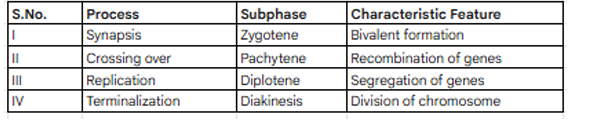
Study the following table. The correct match is.
1
I & III
2
I & IV
3
I & II
4
III & IV
Official Solution
Correct Option: (2)
Synapsis occurs in the Zygotene subphase with bivalent formation, which is correct. Terminalization occurs in Diakinesis, aligning chromosomes for division, which is a characteristic feature, though division itself happens later. Replication (S-phase) and crossing over (Pachytene) do not match Diplotene or other listed features correctly. Thus, I and IV are the best match based on the table.
04
PYQ 2025
medium
botanyID: ts-eamce
In several fungi and plants, the bisexual condition is denoted by
1
Homothallic and monoecious
2
Heterothallic and monoecious
3
Homothallic and dioecious
4
Heterothallic and dioecious
Official Solution
Correct Option: (1)
"Bisexual condition" refers to the presence of both male and female reproductive units in the same individual. In fungi, \emph{homothallic} species contain both mating types (or are self-fertile) within a single thallus, allowing self-fertilization or sexual reproduction without a distinct opposite mating partner. In higher plants, \emph{monoecious} species bear both male and female flowers on the same individual (e.g., maize is monoecious). Thus, when an organism (or plant) has both sexual functions in the same body/individual, it is described as homothallic (in fungi) or monoecious (in plants) — both terms denote "both sexes on the same unit", so the paired expression "Homothallic and monoecious" correctly denotes bisexual condition.