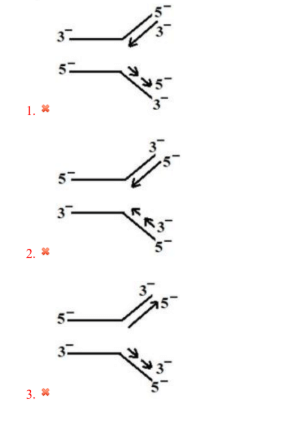
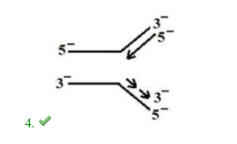
Which of the following figures correctly shows the replication fork formed during DNA replication?
1
1
2
2
3
3
4
4
Official Solution
Correct Option: (4)
Step 1: Concept of DNA Replication Polarity:
DNA Polymerase can only synthesize DNA in the 5' 3' direction.
Therefore, the template strand must be read in the 3' 5' direction.
Step 2: Analyzing the Replication Fork:
Leading Strand: Synthesized continuously. The template strand polarity is 3' 5' towards the replication fork opening.
Lagging Strand: Synthesized discontinuously (Okazaki fragments). The template strand polarity is 5' 3' towards the replication fork opening.
Step 3: Evaluating the Diagram (Option 4):
In Option 4:
Top template strand has 5' 3' polarity towards the right (fork opening). The new strand is shown growing discontinuously (short fragments) away from the fork. This is correct for the lagging strand.
Bottom template strand has 3' 5' polarity towards the right (fork opening). The new strand is shown growing continuously into the fork. This is correct for the leading strand.
Step 4: Final Answer:
Option 4 correctly depicts the polarity and the continuous vs. discontinuous synthesis.
02
PYQ 2025
medium
botanyID: ts-eamce
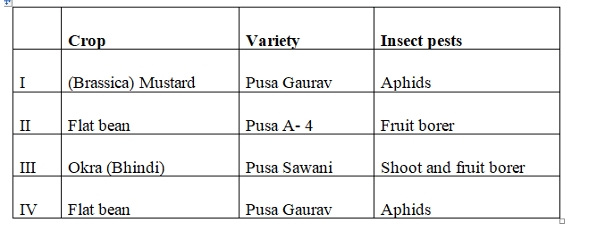
Find out mismatched pair from the following:
1
II & III
2
II & IV
3
I & II
4
III & IV
Official Solution
Correct Option: (2)
1. Check the crop, variety, and associated insect pest. 2. Flat bean (Pusa A-4) is attacked by Aphids, not Fruit borer — II is mismatched. 3. Flat bean (Pusa Gaurav) is attacked by Fruit borer or leaf feeder, not Aphids — IV is mismatched. 4. Therefore, the mismatched pairs are II and IV. Hence the correct answer is (2) II & IV.
03
PYQ 2025
medium
botanyID: ts-eamce
Find out mismatched pair from the following:
Official Solution
Correct Option: (1)
1. Check the crop, variety, and associated insect pest. 2. Flat bean (Pusa A-4) is attacked by Aphids, not Fruit borer — II is mismatched. 3. Flat bean (Pusa Gaurav) is attacked by Fruit borer or leaf feeder, not Aphids — IV is mismatched. 4. Therefore, the mismatched pairs are II and IV. Hence the correct answer is (2) II & IV.