Thermostable DNA polymerase (Taq Polymerase) enzyme is isolated from the following bacterium:
1
Thiobacillus denitrificans
2
Haemophilus gallinarum
3
Thermus aquaticus
4
Salmonella typhi
Official Solution
Correct Option:
(3)
Step 1: Understanding Taq Polymerase
- Taq polymerase is a thermostable enzyme used in PCR (Polymerase Chain Reaction). - It was isolated from the bacterium Thermus aquaticus, which thrives in hot springs.
02
PYQ 2024
medium
botanyID: ts-eamce
Tetracycline resistance gene of pBR322 consists of this restriction site:
1
BamHI
2
EcoRI
3
PstI
4
HindIII
Official Solution
Correct Option:
(1)
Step 1: Understanding the Restriction Sites in pBR322
- The pBR322 plasmid contains two antibiotic resistance genes: - Ampicillin resistance (bla gene). - Tetracycline resistance gene.
- The BamHI restriction site is present in the tetracycline resistance gene, which allows for gene insertion.
03
PYQ 2025
easy
botanyID: ts-eamce
Structurally Centrale diatoms are ``X'' symmetrical and Pennales diatoms are ``Y'' symmetrical. `X' and `Y' respectively are
1
X - Bilateral, Y - Radial
2
X - Radial, Y - Bilateral
3
X - Polyhedral, Y - Radial
4
X - Helical, Y - Bilateral
Official Solution
Correct Option:
(2)
Step 1: Classification of Diatoms:
Diatoms (Bacillariophyceae) are broadly classified into two orders based on symmetry:
Centrales (Centric diatoms): These are circular, discoid, or cylindrical in shape. They exhibit Radial symmetry.
Pennales (Pennate diatoms): These are elongated, boat-shaped, or needle-like (e.g., \Pinnularia, \Navicula). They exhibit Bilateral symmetry.
Step 2: Match Variables:
X (Centrale) = Radial.
Y (Pennales) = Bilateral. Step 3: Final Answer:
Option (B) matches this sequence.
04
PYQ 2025
easy
botanyID: ts-eamce
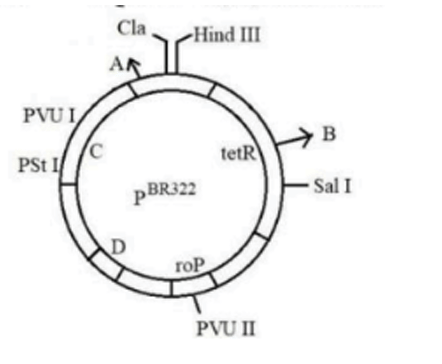
Identify A, B, C and D in the diagram of E.coli cloning vector of pBR322:
1
A-Hind I, B-ECoR1, C-ampR, D-Ori
2
A-Hind I, B-BamHI, C-KanR, D-ampR
3
A-BamHI, B-Pst I, C-Ori, D-ampR
4
A-ECoR1, B-BamHI, C-ampR, D-Ori
Official Solution
Correct Option:
(1)
1. pBR322 map: Hind I → site A, EcoRI → site B, ampR → antibiotic resistance, Ori → origin of replication. 2. BamHI & KanR are different sites/genes. 3. Correct identification is (1) A-Hind I, B-ECoR1, C-ampR, D-Ori.
05
PYQ 2025
medium
botanyID: ts-eamce
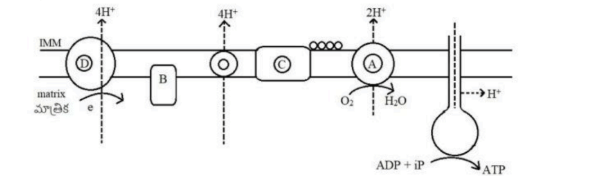
In the given scheme of ``Respiratory electron transport and oxidative phosphorylation'' identify A, B, C and D
1
A-Cytochrome C reductase; B-NADH dehydrogenase; C-Succinic dehydrogenase; D-Cytochrome C oxidase
2
A-Succinic dehydrogenase; B-Cytochrome C reductase; C-NADH dehydrogenase; D-Cytochrome C oxidase
3
A-NADH dehydrogenase; B-Cytochrome C reductase; C-Succinic dehydrogenase; D-Cytochrome C oxidase
4
A-Cytochrome C oxidase; B-Succinic dehydrogenase; C-Cytochrome C reductase; D-NADH dehydrogenase
Official Solution
Correct Option:
(4)
Step 1: Analyze the Diagram:
D (Complex I): Accepts electrons from NADH ( ). This is NADH dehydrogenase.
B (Complex II): Feeds electrons into the Ubiquinone pool but does not pump protons. This is Succinic dehydrogenase.
C (Complex III): Receives electrons from Ubiquinone and passes them to Cytochrome c. This is the Cytochrome complex or Cytochrome c reductase.
A (Complex IV): Receives electrons from Cytochrome c and reduces Oxygen to Water ( ). This is Cytochrome c oxidase.
Step 2: Match with Options:
A = Cyt C oxidase, B = Succinic dehydrogenase, C = Cyt C reductase, D = NADH dehydrogenase.
This sequence corresponds to Option (D).
06
PYQ 2025
medium
botanyID: ts-eamce
Enzymes that catalyze the removal of groups from substrates by mechanism other than hydrolysis leaving double bonds are
1
Isomerases
2
Dehydrogenases
3
Hydrolases
4
Lyases
Official Solution
Correct Option:
(4)
Lyases are enzymes that catalyze the cleavage of C–C, C–O, C–N bonds by means other than hydrolysis or oxidation, often forming a double bond or a new ring structure. Dehydrogenases remove hydrogen atoms; hydrolases catalyze hydrolysis; isomerases rearrange atoms within a molecule. Therefore, Lyases is correct.
07
PYQ 2025
medium
botanyID: ts-eamce
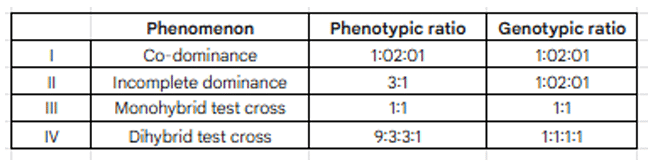
Study the following and identify the correct combinations:
1
I & III
2
II & III
3
II & IV
4
I & II
Official Solution
Correct Option:
(1)
- Codominance shows a phenotypic ratio 1:2:1 in F2 (e.g., AB blood group) with the same genotypic ratio 1:2:1. - Incomplete dominance shows a phenotypic ratio equal to the genotypic ratio 1:2:1 (e.g., red × white → pink). Here statement II is wrong in the phenotypic ratio 3:1. - Monohybrid test cross produces phenotypic and genotypic ratios 1:1. - Dihybrid test cross (heterozygous × homozygous recessive) produces phenotypic 1:1:1:1, not 9:3:3:1. Hence, correct combinations are I & III.
08
PYQ 2025
medium
botanyID: ts-eamce
Chromosome maps / Genetic maps were first prepared by:
1
Sutton and Boveri
2
Sturtevant
3
Bateson and Punnet
4
Morgan
Official Solution
Correct Option:
(2)
1. Sturtevant constructed the first genetic linkage map using Drosophila melanogaster. 2. Sutton and Boveri → chromosome theory, Morgan → experimental genetics, Bateson & Punnett → early Mendelian work. 3. Correct answer is (2) Sturtevant.
09
PYQ 2025
medium
botanyID: ts-eamce
CryIIAb and CryIAb produce toxins that control
1
Cotton bollworms and corn borer respectively
2
Corn borer and cotton bollworms respectively
3
Tobacco budworms and nematodes respectively
4
Nematodes and tobacco budworms respectively
Official Solution
Correct Option:
(1)
Cry proteins produced by genetically modified Bt crops target specific pests. CryIIAb targets Lepidopteran pests like cotton bollworms. CryIAb targets corn borers. They bind to midgut receptors and form pores leading to cell lysis. Other pests like nematodes and tobacco budworms are not primarily affected.
10
PYQ 2025
medium
botanyID: ts-eamce
Identify A, B, C and D in the diagram of E.coli cloning vector of pBR322:
Official Solution
Correct Option:
(1)
1. pBR322 map: Hind I → site A, EcoRI → site B, ampR → antibiotic resistance, Ori → origin of replication. 2. BamHI & KanR are different sites/genes. 3. Correct identification is (1) A-Hind I, B-ECoR1, C-ampR, D-Ori.
11
PYQ 2025
medium
botanyID: ts-eamce
Identify the incorrect pair: I. Zinc - ABA Synthesis II. Boron - Cell elongation III. Nickel - Urease activator IV. Molybdenum - Carbohydrate translocation
Official Solution
Correct Option:
(1)
1. Zinc → required for enzyme activation, not directly ABA synthesis. 2. Molybdenum → cofactor for nitrate reductase, not carbohydrate translocation. 3. Boron and Nickel pairs are correct. 4. Hence incorrect pairs: I & IV → (3) I & IV.
About Plant Biotechnology - TS-EAMCET
Plant Biotechnology is a vital chapter for TS-EAMCET aspirants. Mastering the concepts covered in this chapter is essential for securing a top rank.
By rigorously practicing the previous year questions associated with this chapter, you can identify high-yield topics, understand the examiner's perspective, and boost your confidence during the actual exam.
Frequently Asked Questions
Why focus on Plant Biotechnology PYQs?
Analyzing PYQs for this specific chapter reveals the most frequently tested concepts and the typical complexity of questions, allowing you to tailor your study plan efficiently.
How to best use this analysis?
Review the topic breakdown to see which sub-topics within Plant Biotechnology carry the most weight. Then, tackle the questions iteratively to solidify your understanding.