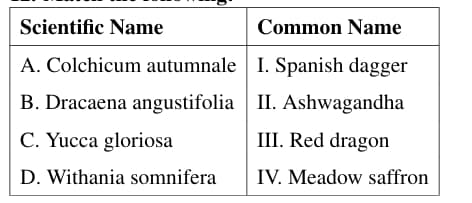
Step 1: Understanding the Floral Formula of Solanum nigrum Solanum nigrum belongs to the Solanaceae family. Its floral characteristics are:
- Bracteate (Br)
- Ebracteolate (Ebr) - Actinomorphic (Radial symmetry, ) - Calyx (K) with 5 fused sepals - Corolla (C) with 5 fused petals
- Androecium (A) with 5 epipetalous stamens
- Gynoecium (G) with a bicarpellary ovary (2 fused carpels) Step 2: Identifying the Correct Answer The correct floral formula is:
03
PYQ 2025
medium
botanyID: ts-eamce
Choose the correct statement from the following:
1
Cleistogamous flowers always exhibit autogamy
2
Chasmogamous flowers always exhibit geitonogamy
3
Cleistogamous flowers exhibit both autogamy and geitonogamy
4
Chasmogamous flowers never exhibit autogamy
Official Solution
Correct Option:
(1)
Step 1: Define Flower Types:
Cleistogamous flowers: These flowers do not open at all. Their reproductive organs are enclosed.
Chasmogamous flowers: These are open flowers with exposed anthers and stigma.
Step 2: Analyze Pollination Types:
Since Cleistogamous flowers never open, cross-pollination (xenogamy) or pollination from another flower on the same plant (geitonogamy) is physically impossible. The pollen from the anthers must land on the stigma of the \same flower. Therefore, they invariably exhibit autogamy (self-pollination). Step 3: Analyze Other Options:
(B) Chasmogamous flowers can exhibit autogamy, geitonogamy, or xenogamy depending on the plant and pollinators.
(C) Cleistogamous flowers cannot exhibit geitonogamy because they are closed.
(D) Chasmogamous flowers \can exhibit autogamy (e.g., if pollen falls on the stigma of the same flower). Step 4: Final Answer:
The correct statement is (A).
04
PYQ 2025
medium
botanyID: ts-eamce
How many meiotic divisions are required to produce 1600 seeds in an angiospermic plant?
1
1600
2
1800
3
3200
4
2000
Official Solution
Correct Option:
(4)
Step 1: Concept of Seed Formation:
One seed is formed from the fertilization of one female gamete (egg cell) by one male gamete.
Step 2: Calculating Meiosis for Female Part (Megasporogenesis):
1 Megaspore Mother Cell (MMC) undergoes 1 Meiotic division to form 4 megaspores. Usually, only 1 becomes functional and forms the embryo sac.
For 1600 seeds Meiotic divisions. Step 3: Calculating Meiosis for Male Part (Microsporogenesis):
1 Pollen Mother Cell (PMC) undergoes 1 Meiotic division to form 4 Pollen grains (Microspores).
For 1600 seeds (requiring 1600 pollens):
Step 4: Total Meiotic Divisions:
Step 5: General Formula:
Total Meiosis ( ) for seeds:
05
PYQ 2025
medium
botanyID: ts-eamce
RNA interference involves:
1
Synthesis of cDNA and RNA using reverse transcriptase
2
Silencing of specific mRNA due to complementary RNA
3
Interference of RNA in synthesis of DNA
4
Synthesis of mRNA from DNA
Official Solution
Correct Option:
(2)
Step 1: Understanding RNA Interference (RNAi):
RNA interference (RNAi) is a biological process in which RNA molecules inhibit gene expression or translation. It is a natural defense mechanism in eukaryotic organisms. Step 2: Mechanism:
RNAi involves the silencing of a specific mRNA molecule. This silencing is achieved through the formation of a double-stranded RNA (dsRNA) molecule. The complementary RNA strand binds to the target mRNA, preventing its translation into protein. This process is effectively "silencing" the gene. Step 3: Evaluating Options:
(A) Synthesis of cDNA uses reverse transcriptase, which is not the primary mechanism of RNAi.
(B) Silencing of specific mRNA due to complementary RNA correctly describes the core mechanism.
(C) Interference of RNA in DNA synthesis is incorrect.
(D) Synthesis of mRNA from DNA is transcription, not RNAi. Step 4: Final Answer:
The correct option is (B).
06
PYQ 2025
medium
botanyID: ts-eamce
Agaricus basidiocarp is having 60 basidia. Find out number of nuclear fusions, meiotic divisions and basidiospores formed from that basidiocarp
1
60; 60 & 240
2
30; 30 & 120
3
60; 30 & 240
4
30; 60 & 120
Official Solution
Correct Option:
(1)
1. Each basidium undergoes one nuclear fusion (karyogamy) to form a diploid nucleus — so number of nuclear fusions equals number of basidia. For 60 basidia: nuclear fusions = 60. 2. Each basidium then undergoes one meiotic division (meiosis I and II sequence considered as one meiotic event) producing four haploid nuclei which form four basidiospores. Thus meiotic divisions per basidium = 1, total meiotic divisions = 60. 3. Each basidium produces 4 basidiospores, so total basidiospores = 60 4 = 240. 4. Therefore the counts are 60 nuclear fusions; 60 meiotic divisions; 240 basidiospores — (1) 60; 60 & 240.
07
PYQ 2025
medium
botanyID: ts-eamce
Consider the following statements:
Assertion (A): Hilum is a scar on the seed coat
Reason (R): Through hilum the developing seeds were attached to the fruit
1
Both (A) and (R) are true, (R) is the correct explanation of (A)
2
Both (A) and (R) are true, (R) is not the correct explanation of (A)
3
(A) is true, but (R) is false
4
(A) is false, but (R) is true
Official Solution
Correct Option:
(1)
The hilum is a small mark or scar on the seed coat that represents the point of attachment of the seed to the ovary or funiculus during development. The assertion (A) is true. The reason (R) correctly explains the formation of the hilum, because the seed receives nutrients through the funiculus during development, and after detachment, the scar remains. Hence, both statements are true and (R) is the correct explanation.
08
PYQ 2025
medium
botanyID: ts-eamce
Based on the number of coharts, arrange the following series in the descending order.
Cohorts in flowers indicate the number of whorls in a flower. Thalamiflorae have numerous free floral parts (highest number of coharts), followed by Disciflorae, Heteromerae, and Calyciflorae (least number). Therefore, the descending order based on number of coharts is option (1).
09
PYQ 2025
medium
botanyID: ts-eamce
Identify the characters of ovules related to Bean family. I. Body of ovule bends II. Ovule is placed at right angles to the funiculus III. Embryo sac is slightly curved IV. Micropyle comes towards the funiculus
1
I, II & IV
2
II, III & IV
3
I, III & IV
4
I, II, III & IV
Official Solution
Correct Option:
(3)
1. In the bean family (Leguminosae/Fabaceae), the ovules are typically anatropous or campylotropous — the body of the ovule is bent (I is true). 2. "Ovule is placed at right angles to the funiculus" (II) corresponds to orthotropous/hemianatropous conditions; legumes commonly show anatropous or campylotropous ovules rather than strictly right-angled placement, so II is not a general characteristic. 3. The embryo sac may be slightly curved in such ovules (III is accepted as true in many leguminous ovules), and the micropyle often faces or comes towards the funiculus due to the curvature (IV true). 4. Therefore I, III and IV correctly describe typical ovule characters related to the bean family. Hence the correct answer is (3) I, III & IV.
10
PYQ 2025
medium
botanyID: ts-eamce
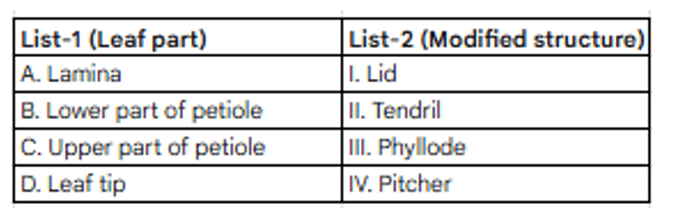
Identify the correct parts of leaf modifications of the pitcher plant shown in Lists-1 and-2.
1
A-I, B-II, C-III, D-IV
2
A-III, B-IV, C-II, D-I
3
A-IV, B-III, C-I, D-II
4
A-IV, B-III, C-II, D-I
Official Solution
Correct Option:
(4)
In pitcher plants, the lamina forms the pitcher (A-IV), the upper part of petiole forms a tendril (C-II), the lower part of petiole becomes a phyllode (B-III), and the leaf tip forms a lid (D-I). These modifications help in insect trapping, photosynthesis, and protection. Thus, option (4) correctly represents the functional leaf modifications.
11
PYQ 2025
medium
botanyID: ts-eamce
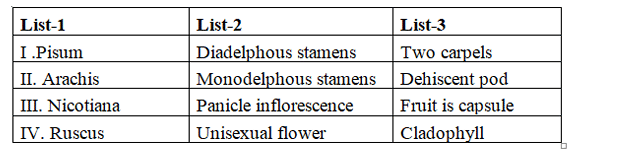
Identify the wrong pair
1
II & IV
2
I & II
3
I & III
4
III & IV
Official Solution
Correct Option:
(2)
1. Row I (Pisum): Pisum (pea) has diadelphous stamens (a typical papilionaceous flower condition) — that part of the pair (List-2) is correct. However, "Two carpels" (List-3) is incorrect for Pisum: pea has a single carpel (mono carpellary, forming a single pod). So the Pisum pair is wrong (I is wrong). 2. Row II (Arachis): Arachis (peanut) belongs to Papilionoideae and typical papilionaceous flowers have diadelphous stamens (9+1), not monadelphous (all fused into one). Thus "Monodelphous stamens" is an incorrect descriptor for Arachis — so II is also wrong. The fruit being a dehiscent pod is correct. 3. Row III (Nicotiana): Nicotiana often shows cymose to panicle type inflorescences and the fruit is indeed a capsule — this row is typically correct. 4. Row IV (Ruscus): Ruscus has unisexual flowers and cladophylls (flattened stems) — this is correct. 5. Therefore the wrong pairs are I (Pisum) and II (Arachis). Hence the correct option is (2) I & II.
About Angiosperms - TS-EAMCET
Angiosperms is a vital chapter for TS-EAMCET aspirants. Mastering the concepts covered in this chapter is essential for securing a top rank.
By rigorously practicing the previous year questions associated with this chapter, you can identify high-yield topics, understand the examiner's perspective, and boost your confidence during the actual exam.
Frequently Asked Questions
Why focus on Angiosperms PYQs?
Analyzing PYQs for this specific chapter reveals the most frequently tested concepts and the typical complexity of questions, allowing you to tailor your study plan efficiently.
How to best use this analysis?
Review the topic breakdown to see which sub-topics within Angiosperms carry the most weight. Then, tackle the questions iteratively to solidify your understanding.