Substrate-level phosphorylation (SLP) is a process in which a phosphate group is directly transferred from a high-energy substrate to ADP, forming ATP. This occurs in glycolysis and the Krebs cycle.
Step 2: Analyzing the Reactions
- 1,3-bisphosphoglyceric acid → 3-phosphoglyceric acid: Substrate-level phosphorylation occurs here (ATP is generated). - 3-phosphoglyceric acid → 2-phosphoglyceric acid: This is a simple isomerization reaction and does not involve ATP formation. - Phosphoenol pyruvate → Pyruvic acid: ATP is generated via substrate-level phosphorylation. - Succinyl CoA → Succinic acid: ATP (or GTP) is generated in this step via substrate-level phosphorylation. Thus, the reaction where substrate-level phosphorylation does not occur is option (B).
02
PYQ 2025
medium
botanyID: ts-eamce
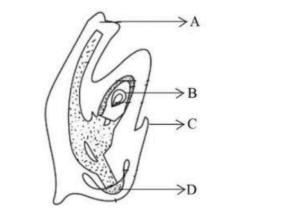
The given diagram is longitudinal section of an embryo of grass plant. Identify A, B, C and D parts
1
A - Epicotyl, B - Coleoptile, C - Radicle, D - Root cap
2
A - Scutellum, B - Shoot apex, C - Epiblast, D - Root cap
3
A - Shoot apex, B - Coleoptile, C - hypoblast, D - Radicle
4
A - Scutellum, B - Shoot apex, C - Mesoblast, D - Coleorhiza
Official Solution
Correct Option:
(2)
Step 1: Analyze the Diagram Labels (Standard Monocot Embryo):
A (Top shield-shaped structure): This is the single cotyledon of the grass family, called the Scutellum.
B (Region enclosed by sheath): The label points to the shoot tip region, which is the Shoot apex (plumule), enclosed by the coleoptile.
C (Side flap): This represents the remains of the second cotyledon, called the Epiblast.
D (Bottom tip): The label points to the protective covering at the very tip of the root (radicle). This is the Root cap (covered further by the coleorhiza).
Step 2: Evaluate Options:
Option (B) matches all labels correctly: A-Scutellum, B-Shoot apex, C-Epiblast, D-Root cap.
Option (D) incorrectly uses the term "Mesoblast".
03
PYQ 2025
medium
botanyID: ts-eamce
Identify the incorrect match:
Official Solution
Correct Option:
(1)
1. Photophosphorylation produces ATP and NADPH, not hexose sugar. 2. Hexose sugar is synthesized during the Calvin cycle (carbon fixation). 3. Proton gradient → ATP synthesis, C3 plants → 3-PGA, PEP carboxylase → OAA are all correct. 4. Hence incorrect match is (3) Photophosphorylation - Hexose sugar synthesis.
04
PYQ 2025
medium
botanyID: ts-eamce
Ubiquinone is a mobile electron carrier between
I. Complex I and complex III
II. Complex II and complex III
III. Complex III and complex IV
IV. Complex I and complex IV
1
I & III
2
II & III
3
II & IV
4
I & II
Official Solution
Correct Option:
(4)
Ubiquinone (Coenzyme Q) is a lipid-soluble electron carrier in the mitochondrial electron transport chain. It transfers electrons: - From Complex I (NADH dehydrogenase) to Complex III (cytochrome bc1). - From Complex II (succinate dehydrogenase) to Complex III. It does not interact with Complex IV directly; cytochrome c carries electrons from III to IV. Therefore, the correct pairs are I & II.
05
PYQ 2025
medium
botanyID: ts-eamce
Identify the incorrect match:
1
Proton gradient across membrane - ATP synthesis
2
Fixation of CO2 in C3 plants - Synthesis of 3 PGA
3
Photophosphorylation - Hexose sugar synthesis
4
CO2 fixation by PEP case - Synthesis of OAA
Official Solution
Correct Option:
(3)
1. Photophosphorylation produces ATP and NADPH, not hexose sugar. 2. Hexose sugar is synthesized during the Calvin cycle (carbon fixation). 3. Proton gradient → ATP synthesis, C3 plants → 3-PGA, PEP carboxylase → OAA are all correct. 4. Hence incorrect match is (3) Photophosphorylation - Hexose sugar synthesis.
About Respiration Of Plants - TS-EAMCET
Respiration Of Plants is a vital chapter for TS-EAMCET aspirants. Mastering the concepts covered in this chapter is essential for securing a top rank.
By rigorously practicing the previous year questions associated with this chapter, you can identify high-yield topics, understand the examiner's perspective, and boost your confidence during the actual exam.
Frequently Asked Questions
Why focus on Respiration Of Plants PYQs?
Analyzing PYQs for this specific chapter reveals the most frequently tested concepts and the typical complexity of questions, allowing you to tailor your study plan efficiently.
How to best use this analysis?
Review the topic breakdown to see which sub-topics within Respiration Of Plants carry the most weight. Then, tackle the questions iteratively to solidify your understanding.