Perisperm is a tissue found in some seeds, derived from the nucellus, and it provides nourishment to the developing embryo. The ploidy level of perisperm is 2n, which is diploid, because it is derived from the diploid nucellus tissue of the ovule. This makes it different from the endosperm, which is usually triploid (3n) in many plants. Thus, the correct ploidy of perisperm is 2n.
02
PYQ 2024
medium
botanyID: ts-eamce
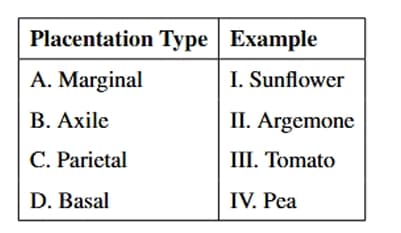
Match the following:
1
A - II, B - I, C - III, D - IV
2
A - IV, B - III, C - II, D - I
3
A - IV, B - III, C - I, D - II
4
A - III, B - IV, C - II, D - I
Official Solution
Correct Option: (2)
Step 1: Understanding Placentation Types Placentation refers to how ovules are attached inside the ovary. - Marginal Placentation → Pea (IV) (Ovules arranged along one side, typical of legumes)
- Axile Placentation → Tomato (III) (Ovules attached to a central column) - Parietal Placentation → Argemone (II) (Ovules attached to the outer wall) - Basal Placentation → Sunflower (I) (Single ovule at the base)
Step 2: Matching Correctly Correct matching is:(2) A - IV, B - III, C - II, D - I
03
PYQ 2024
medium
botanyID: ts-eamce
Assertion (A): Direct pollination is found in gymnosperms. Reason (R): Ovules of gymnosperms are naked.
1
(A) and (R) are correct, and (R) is the correct explanation of (A).
2
(A) and (R) are correct, but (R) is not the correct explanation of (A).
3
(A) is correct, but (R) is not correct.
4
(A) is not correct, but (R) is correct.
Official Solution
Correct Option: (1)
Step 1: Understanding Gymnosperm Pollination Gymnosperms exhibit direct pollination since their ovules are exposed (naked) and pollen lands directly on the ovule. This is in contrast to angiosperms, where pollen lands on the stigma before fertilization.
Step 2: Evaluating the Assertion and Reason - Assertion (A) is correct: Gymnosperms have direct pollination. - Reason (R) is correct: The ovules are exposed, leading to direct pollen reception. - (R) correctly explains (A), making option (1) correct.
04
PYQ 2024
medium
botanyID: ts-eamce
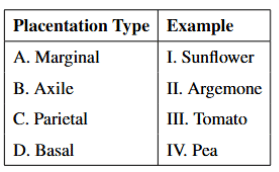
Match the following:
1
A - II, B - I, C - III, D - IV
2
A - IV, B - III, C - II, D - I
3
A - IV, B - III, C - I, D - II
4
A - III, B - IV, C - II, D - I
Official Solution
Correct Option: (2)
Step 1: Understanding Placentation Types Placentation refers to how ovules are attached inside the ovary. - Marginal Placentation → Pea (IV) (Ovules arranged along one side, typical of legumes)
- Axile Placentation → Tomato (III) (Ovules attached to a central column) - Parietal Placentation → Argemone (II) (Ovules attached to the outer wall) - Basal Placentation → Sunflower (I) (Single ovule at the base) Step 2: Matching Correctly Correct matching is:(2) A - IV, B - III, C - II, D - I
05
PYQ 2024
medium
botanyID: ts-eamce
Assertion (A): Direct pollination is found in gymnosperms. Reason (R): Ovules of gymnosperms are naked.
1
(A) and (R) are correct, and (R) is the correct explanation of (A).
2
(A) and (R) are correct, but (R) is not the correct explanation of (A).
3
(A) is correct, but (R) is not correct.
4
(A) is not correct, but (R) is correct.
Official Solution
Correct Option: (1)
Step 1: Understanding Gymnosperm Pollination Gymnosperms exhibit direct pollination since their ovules are exposed (naked) and pollen lands directly on the ovule. This is in contrast to angiosperms, where pollen lands on the stigma before fertilization. Step 2: Evaluating the Assertion and Reason - Assertion (A) is correct: Gymnosperms have direct pollination. - Reason (R) is correct: The ovules are exposed, leading to direct pollen reception.
- (R) correctly explains (A), making option (1) correct.
06
PYQ 2024
medium
botanyID: ts-eamce
‘Pepo’ fruit develops from the following type of ovary:
A pepo is a type of fruit that develops from an inferior ovary. The typical characteristics of a pepo are:
- It is tricarpellary, meaning it has three carpels.
- It is syncarpous, meaning the carpels are fused together.
- It is unilocular, meaning there is only one chamber in the ovary.
- It has parietal placentation, where the ovules are attached to the walls of the ovary. These features are characteristic of fruits like cucumbers, pumpkins, and melons, all of which are classified as pepo fruits. In comparison to other options:
- Axile placentation refers to the ovules being attached to the central axis within the ovary, which is not found in pepo fruits.
- Trilocular would mean there are three chambers, which does not apply to the unilocular nature of pepo. Thus, the correct answer is (1) Tricarpellary, Syncarpous, Unilocular, Parietal placentation.
07
PYQ 2024
medium
botanyID: ts-eamce
Primary endosperm nucleus is formed by the fusion of
1
2
3
4
Official Solution
Correct Option: (3)
The primary endosperm nucleus is formed by the fusion of two polar nuclei with one male gamete nucleus. This fusion leads to the formation of a triploid nucleus that gives rise to the endosperm, a tissue that nourishes the developing embryo. Thus, the correct answer is option (3) .
Variation in lengths of filaments of stamens within a flower is seen in:
1
Salvinia and Brassica
2
Brassica and Musa
3
Salvia and Brassica
4
Salvia and Datura
Official Solution
Correct Option: (3)
Step 1: Understanding Stamen Filament Variation - Salvia exhibits heterostyly, where stamens have different lengths.
- Brassica exhibits tetradynamous condition, where four stamens are longer than the other two. Step 2: Identifying the Correct Answer - Salvia and Brassica exhibit different lengths of stamens, making option (3) correct.
10
PYQ 2024
medium
botanyID: ts-eamce
Intine of pollen grain is made up of:
1
Sporopollenin
2
Cellulose and Lignin
3
Chitin and Lignin
4
Cellulose and Pectin
Official Solution
Correct Option: (4)
The intine of a pollen grain is the inner layer of the pollen wall, located inside the outer layer called the exine. The intine is primarily made up of cellulose and pectin, which are complex carbohydrates. These substances provide structural support and protect the genetic material within the pollen grain. To clarify the other options:
- Sporopollenin is a major component of the exine, not the intine. It is a highly resistant substance that helps protect the pollen from environmental stresses.
- Chitin and lignin are not components of the intine. Chitin is found in the exoskeletons of arthropods and fungi, and lignin is found in the cell walls of plants but is not a part of the pollen grain intine.
- Cellulose and lignin are found in the cell walls of many plant structures, but cellulose and pectin are the primary components of the intine layer of pollen. Thus, the correct answer is (4) Cellulose and Pectin.
- Cleistogamous flowers are those that remain closed and do not open. These flowers are always autogamous, meaning they self-pollinate. As a result, cross-pollination does not occur in cleistogamous flowers. Thus, the correct statement is option 1. - Option 2: Xenogamy refers to cross-pollination, which can occur via various mechanisms, not just wind pollination. Therefore, this statement is incorrect. - Option 3: Chasmogamous flowers are the opposite of cleistogamous flowers. These flowers open to facilitate pollination, so this statement is also incorrect. - Option 4: Zostera is a genus of marine plants, and it exhibits hydrophily, meaning pollination by water. However, it does not specifically exhibit epihydrophily, as this term refers to pollination via water droplets adhering to the surface, which is not characteristic of Zostera. Thus, this statement is also incorrect. Thus, the correct answer is option 1.
13
PYQ 2025
medium
botanyID: ts-eamce
Loosely arranged parenchyma cells in Lenticels:
1
Epithem
2
Hydathode
3
Stomata
4
Complementary cells
Official Solution
Correct Option: (4)
Step 1: Concept of lenticels:
Lenticels are small, lens-shaped openings present in the bark of woody stems. They help in the exchange of gases between the internal tissues of the plant and the external environment.
Step 2: Structure of lenticels:
Below the opening of a lenticel, the cork cambium (phellogen) forms a group of loosely packed, thin-walled parenchyma cells instead of tightly packed cork cells.
These cells contain large intercellular spaces, which allow efficient gaseous exchange.
Step 3: Identification of the cells:
The loosely arranged cells present in lenticels are known as complementary cells.
Step 4: Eliminating other options:
Epithem: Found in hydathodes and involved in guttation.
Hydathode: A structure responsible for removal of excess water.
Stomata: Openings on leaves mainly for transpiration and gas exchange.
Step 5: Conclusion:
Thus, the correct answer is Complementary cells.
14
PYQ 2025
medium
botanyID: ts-eamce
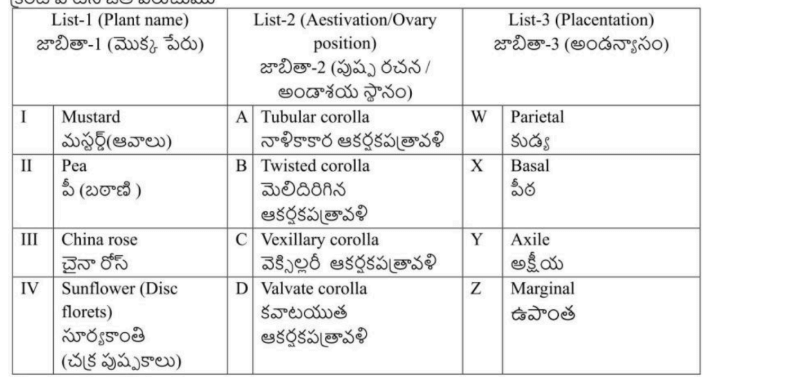
Match the following:
1
I - D - W, II - C - Z, III - A - X, IV - B - Y
2
I - D - W, II - C - Z, III - B - Y, IV - A - X
3
I - A - Z, II - D - Y, III - B - X, IV - C - W
4
I - C - X, II - D - Y, III - A - W, IV - B - Z
Official Solution
Correct Option: (2)
Step 1: Match Plants to Characteristics:
I. Mustard (Brassicaceae):
Placentation: Parietal (False septum/Replum forms). Matches W.
Corolla: Valvate or Imbricate (often generalized as Valvate in matching questions relative to others). Matches D.
Pair: I - D - W.
II. Pea (Fabaceae):
Aestivation: Vexillary (Papilionaceous). Matches C.
Placentation: Marginal. Matches Z.
Pair: II - C - Z.
III. China Rose (Malvaceae):
Aestivation: Twisted. Matches B.
Placentation: Axile. Matches Y.
Pair: III - B - Y.
IV. Sunflower (Asteraceae):
Flower Type: Disc florets have Tubular corolla. Matches A.
Placentation: Basal. Matches X.
Pair: IV - A - X.
Step 2: Verification:
The sequence is:
I-D-W, II-C-Z, III-B-Y, IV-A-X.
This matches Option (B).
15
PYQ 2025
medium
botanyID: ts-eamce
Diplontic life cycle is shown by:
1
Volvox
2
Polysiphonia
3
Laminaria
4
Fucus
Official Solution
Correct Option: (4)
Step 1: Understanding Algal Life Cycles:
Most algae are Haplontic (e.g., \Volvox, \Spirogyra, \Chlamydomonas).
Some are Haplo-diplontic (e.g., \Ectocarpus, \Polysiphonia, Kelps like \Laminaria).
A few are Diplontic. Step 2: Identifying the Exception:
\Fucus, a brown alga, is a notable exception among algae as it follows a Diplontic life cycle, similar to gymnosperms and angiosperms. The dominant phase is diploid (2n), and meiosis leads directly to gamete formation. Step 3: Evaluating Options:
Volvox: Haplontic.
Polysiphonia: Haplo-diplontic.
Laminaria: Haplo-diplontic.
Fucus: Diplontic.
Therefore, the correct answer is Fucus.
16
PYQ 2025
medium
botanyID: ts-eamce
Select the correct pair
1
Genetic nature of DNA – Frenkel Conrat
2
In vitro DNA synthesis - Hanning
3
Double helical model of RNA - Watson and Crick
4
Genetic code - Marshall Nirenberg
Official Solution
Correct Option: (4)
1. Fraenkel-Conrat (Francoise Fraenkel-Conrat) is known for showing that the genetic nature of tobacco mosaic virus (TMV) is RNA, not DNA — the phrasing in option (1) is imprecise. 2. "In vitro DNA synthesis" is associated with different investigators (e.g., Arthur Kornberg worked on DNA polymerase and in vitro DNA synthesis) — "Hanning" is not the standard attribution. 3. Watson and Crick proposed the double helical model for DNA (not RNA), so option (3) is incorrect. 4. Marshall Nirenberg deciphered aspects of the genetic code (shared Nobel Prize for cracking the genetic code). Thus option (4) is the correct historically accurate pair. 5. Therefore the correct answer is (4) Genetic code - Marshall Nirenberg.
17
PYQ 2025
medium
botanyID: ts-eamce
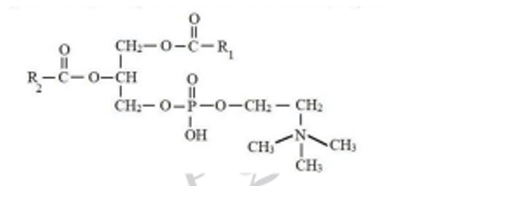
Identify the below structural formula along with its related function
1
Cholesterol - A component of animal cell membrane
2
Adenosine - A component of nucleic acid
3
Lecithin - A component of cell membrane
4
Triglyceride - An energy source
Official Solution
Correct Option: (3)
1. The question asks to identify a structural formula and match it to function. Among the options, lecithin (phosphatidylcholine) is a typical phospholipid with a glycerol backbone, two fatty acid chains and a phosphate–choline head group; lecithin molecules are major components of biological membranes. 2. Cholesterol is also a membrane component (option 1 is true as a statement), adenosine is a nucleoside present in nucleic acids (option 2 is true as a statement), and triglycerides function as energy storage (option 4 true as a statement). 3. However, the structural formula most classically shown in such MCQs for "identify the below structural formula" and "component of cell membrane" is usually a phospholipid (lecithin). Therefore the best choice matching a typical membrane phospholipid structural formula is lecithin. 4. Hence the correct answer (most likely intended) is (3) Lecithin - A component of cell membrane.
18
PYQ 2025
medium
botanyID: ts-eamce
Anatomical characters applicable to hydrophytes and xerophytes respectively are
1
Poorly developed xylem and multilayered epidermis
2
Well-developed xylem and flexible stem
3
Stems with waxy coating and reduced mechanical tissue
4
Very thick cuticle and spongy parenchyma
Official Solution
Correct Option: (1)
1. Hydrophytes (aquatic plants) typically have poorly developed mechanical tissues and reduced xylem, because water availability is high and support/water-conducting requirements are lower. Hence "poorly developed xylem" matches hydrophytes. 2. Xerophytes (plants of dry habitats) show adaptations to reduce water loss — examples include thick cuticle, multilayered epidermis, sunken stomata, and other xeromorphic features; multilayered epidermis is a xerophytic feature. 3. Option (1) pairs the hydrophytic character "poorly developed xylem" with the xerophytic character "multilayered epidermis", so it correctly matches hydrophyte and xerophyte respectively. 4. Other options either mix features incorrectly (e.g., spongy parenchyma is hydrophytic, not xerophytic) or are partially inaccurate. 5. Therefore the correct answer is (1) Poorly developed xylem and multilayered epidermis.
19
PYQ 2025
medium
botanyID: ts-eamce
Leaf tendrils and foliar stipules are found in this plant
1
Derris indica
2
Pisum sativum
3
Crotalaria juncea
4
Trigonella foenum-graecum
Official Solution
Correct Option: (2)
\emph{Pisum sativum} (pea) is a classic example of a plant bearing leaf tendrils and conspicuous foliar stipules. In pea, the terminal leaflet or rachis is often modified into tendrils which help in climbing, and the leaves have large foliar stipules at the base that are leaf-like. \emph{Derris indica}, \emph{Crotalaria} and \emph{Trigonella} do show leaf modifications in places but are not the standard textbook examples combining both prominent tendrils and large foliar stipules as in \emph{Pisum}. Hence option (2) is correct.
20
PYQ 2025
medium
botanyID: ts-eamce
Identify the correctly matched pairs.
A. Leptotene - Synapsis occurs
B. Zygotene - Pairing of homologous chromosomes
C. Pachytene - Crossing over do not occur
D. Diplotene - Nuclear membrane dissolves
E. Diakinesis - Terminalisation of chiasmata
1
B and E are correct
2
B and C are correct
3
A and B are correct
4
B and D are correct
Official Solution
Correct Option: (1)
Review prophase I sub-stages of meiosis:
Leptotene — chromosomes condense; synapsis (pairing) has not yet occurred (so statement A is false).
Zygotene — homologous chromosomes pair/synapse (statement B is true).
Pachytene — crossing over (genetic recombination) occurs here (so statement C "do not occur" is false).
Diplotene — nuclear membrane is still present; chromosomes begin to separate at chiasmata (statement D is false about membrane dissolving).
Diakinesis — final sub-stage of prophase I; terminalisation of chiasmata and preparation for metaphase occurs (statement E is true).
Thus only B and E are correct → option (1).