Assertion (A): Beggiatoa is not a chemoautotrophic bacterium. Reason (R): Chemoautotrophic bacteria derive carbon from CO and energy from oxidation of inorganic compounds.
1
Both (A) and (R) are correct, and (R) is the correct explanation of (A).
2
Both (A) and (R) are correct, but (R) is not the correct explanation of (A).
3
(A) is correct, but (R) is incorrect.
4
(A) is incorrect, but (R) is correct.
Official Solution
Correct Option:
(4)
Step 1: Understanding Beggiatoa's Metabolism
- Beggiatoa is a chemoautotrophic bacterium that derives energy from sulfur oxidation. - Therefore, Assertion (A) is incorrect. - Reason (R) is correct because chemoautotrophs derive energy from inorganic compounds.
02
PYQ 2024
medium
botanyID: ts-eamce
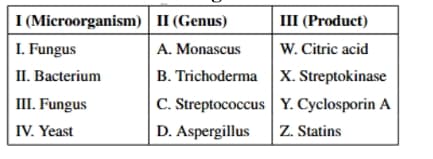
Match the following:
1
I-A-Y; II-B-X; III-C-W; IV-D-Z
2
I-C-Z; II-B-Y; III-A-X; IV-D-W
3
I-D-W; II-B-X; III-C-Y; IV-A-Z
4
I-D-W; II-C-X; III-B-Y; IV-A-Z
Official Solution
Correct Option:
(4)
Step 1: Understanding Microbial Products
- Aspergillus produces Citric acid (W). - Streptococcus produces Streptokinase (X). - Trichoderma produces Cyclosporin A (Y). - Monascus produces Statins (Z). Thus, the correct match is option (D).
03
PYQ 2025
medium
botanyID: ts-eamce
24 PGAL molecules are formed in plant. Calculate the number of used and the number of G3P used for regeneration of RUBP molecules?
1
12 & 24 G3P
2
24 & 48 G3P
3
12 & 20 G3P
4
20 & 12 G3P
Official Solution
Correct Option:
(3)
Step 1: Stoichiometry of the Calvin Cycle:
The standard Calvin Cycle equation for the production of PGAL (G3P) is:
Out of these 6 PGAL:
1 PGAL is the Net Gain (used for glucose synthesis).
5 PGAL are used for the **Regeneration** of 3 RuBP molecules.
Step 2: Calculate for 24 PGAL Formed:
The question states that **24 PGAL molecules are formed** (Gross production).
Scale Factor: .
Used: .
G3P (PGAL) for Regeneration: .
Step 3: Final Answer:
12 and 20 G3P. This matches Option (C).
04
PYQ 2025
medium
botanyID: ts-eamce
How many ATP are formed through (ETS) Electro Transport System alone from
A) Glycolysis
B) Oxidative decarboxylation of 2 molecules of pyruvic acid
C) 2 Acetyl coenzyme A molecules respectively
1
A-4, B-6, C-22
2
A-4, B-6, C-24
3
A-6, B-4, C-20
4
A-4, B-6, C-8
Official Solution
Correct Option:
(1)
Step 1: Analyze ATP yield via ETS for each stage:
The question asks specifically for ATP formed through ETS alone (excluding substrate-level phosphorylation). A) Glycolysis:
Glycolysis produces 2 NADH molecules in the cytoplasm.
These NADH must be shuttled into the mitochondria to enter ETS.
If the Glycerol-3-Phosphate shuttle is used (common in skeletal muscle/brain), each NADH yields 2 ATP.
Total ATP via ETS = .
(Note: If Malate-Aspartate shuttle is used, yield is 6 ATP, but Option A starts with 4, suggesting the G-3-P shuttle assumption).
B) Oxidative Decarboxylation (Link Reaction):
2 Pyruvic acid 2 Acetyl CoA.
Produces 2 NADH (mitochondrial matrix).
Each mitochondrial NADH yields 3 ATP in ETS.
Total ATP via ETS = .
C) Krebs Cycle (2 Acetyl CoA molecules):
Per Acetyl CoA: 3 NADH and 1 FADH are produced.
For 2 Acetyl CoA: and .
ATP from NADH: .
ATP from FADH : .
Total ATP via ETS = .
(Substrate-level phosphorylation [GTP] is excluded as per the "ETS alone" condition).
Step 2: Match with Options:
Values are: A=4, B=6, C=22.
This matches Option (A).
05
PYQ 2025
medium
botanyID: ts-eamce
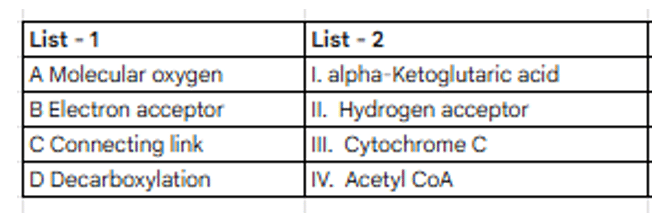
Match the following and choose the correct option from the lists given below:
1
A-I, B-III, C-IV, D-II
2
A-III, B-I, C-II, D-IV
3
A-II, B-III, C-IV, D-I
4
A-IV, B-III, C-I, D-II
Official Solution
Correct Option:
(1)
A: Molecular oxygen participates in final electron acceptance (so connected to electron transport, option may vary; verify in context). B: Electron acceptor = Cytochrome C. C: Connecting link = Acetyl CoA (links glycolysis to TCA cycle). D: Decarboxylation = α-Ketoglutaric acid undergoes decarboxylation in TCA cycle.
06
PYQ 2025
medium
botanyID: ts-eamce
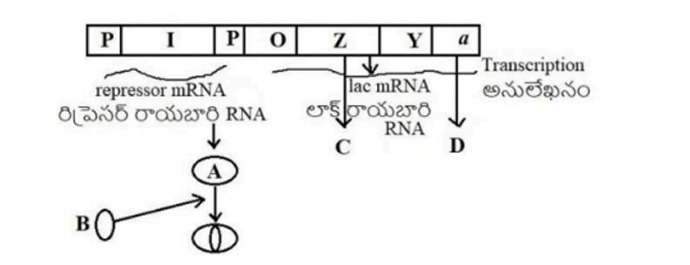
The figure given below shows lac operon and its function. Identify A, B, C and D respectively:
Official Solution
Correct Option:
(1)
1. In lac operon, A = Repressor protein, which binds operator to prevent transcription. 2. B = Inducer (allolactose) inactivates repressor and allows transcription. 3. C = Permease, facilitates lactose entry into the cell. 4. D = β-galactosidase, hydrolyzes lactose to glucose and galactose. 5. Hence the correct assignment is (1) A-Repressor, B-Inducer, C-Permease, D-B galactosidase.
07
PYQ 2025
medium
botanyID: ts-eamce
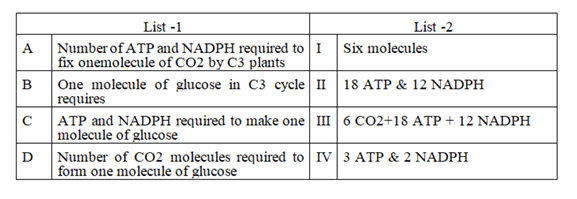
Identify the correct matching pair to Calvin cycle:
1
A-II, B-III, C-IV, D-I
2
A-I, B-IV, C-II, D-III
3
A-IV, B-III, C-I, D-II
4
A-IV, B-III, C-II, D-I
Official Solution
Correct Option:
(1)
1. Fixing one CO2 in C3 cycle requires 3 ATP & 2 NADPH → A → IV. 2. One glucose formation requires 6 CO2, 18 ATP & 12 NADPH → B → III. 3. ATP & NADPH required for one glucose = 18 ATP & 12 NADPH → C → II. 4. Number of CO2 molecules per glucose = 6 → D → I. 5. Correct matching is (1) A-II, B-III, C-IV, D-I.
08
PYQ 2025
medium
botanyID: ts-eamce
The figure given below shows lac operon and its function. Identify A, B, C and D respectively:
1. In lac operon, A = Repressor protein, which binds operator to prevent transcription. 2. B = Inducer (allolactose) inactivates repressor and allows transcription. 3. C = Permease, facilitates lactose entry into the cell. 4. D = β-galactosidase, hydrolyzes lactose to glucose and galactose. 5. Hence the correct assignment is (1) A-Repressor, B-Inducer, C-Permease, D-B galactosidase.
09
PYQ 2025
medium
botanyID: ts-eamce
The given figure represents the termination process of transcription in bacteria. Identify A, B and C respectively
1
A-DNA, B-RNA polymerase, C-Rho factor
2
A-RNA, B-RNA polymerase, C-Rho factor
3
A-RNA, B-RNA polymerase, C-Sigma factor
4
A-RNA, B-DNA polymerase, C-Sigma factor
Official Solution
Correct Option:
(2)
In bacteria, transcription termination can be Rho-dependent. - A = newly synthesized RNA transcript. - B = RNA polymerase synthesizing RNA. - C = Rho factor, which is a helicase that moves along RNA to unwind the DNA-RNA hybrid and terminate transcription. Sigma factor is only required for initiation, not termination.
10
PYQ 2025
easy
botanyID: ts-eamce
Identify the correct matching pair to Calvin cycle:
Official Solution
Correct Option:
(1)
1. Fixing one CO2 in C3 cycle requires 3 ATP & 2 NADPH → A → IV. 2. One glucose formation requires 6 CO2, 18 ATP & 12 NADPH → B → III. 3. ATP & NADPH required for one glucose = 18 ATP & 12 NADPH → C → II. 4. Number of CO2 molecules per glucose = 6 → D → I. 5. Correct matching is (1) A-II, B-III, C-IV, D-I.
About Microbiology - TS-EAMCET
Microbiology is a vital chapter for TS-EAMCET aspirants. Mastering the concepts covered in this chapter is essential for securing a top rank.
By rigorously practicing the previous year questions associated with this chapter, you can identify high-yield topics, understand the examiner's perspective, and boost your confidence during the actual exam.
Frequently Asked Questions
Why focus on Microbiology PYQs?
Analyzing PYQs for this specific chapter reveals the most frequently tested concepts and the typical complexity of questions, allowing you to tailor your study plan efficiently.
How to best use this analysis?
Review the topic breakdown to see which sub-topics within Microbiology carry the most weight. Then, tackle the questions iteratively to solidify your understanding.