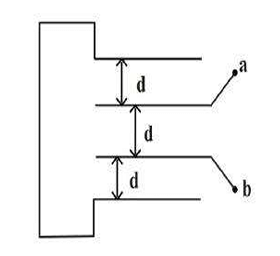
Four metal plates, each with surfa area on one side, are plad with separation as shown in the figure. The capacitan between a and b is ( -- permittivity of free spa)
1
2
3
4
Official Solution
Correct Option: (3)
The capacitance between parallel plates is given by .
Let the configuration be such that Plate 1 and 3 are connected to terminal a, and Plates 2 and 4 to terminal b.
This forms three capacitors: , , , each with capacitance .
and are in parallel, giving .
This is in series with , so: Substituting , we get:
02
PYQ 2023
medium
physicsID: ap-eapce
Between the plates of a parallel plate capacitor of plate area A and capacity 0.025 F, a metal plate of area A and thickness equal to of the separation between the plates of the capacitor is introduced. If the capacitor is charged to 100 V, then the amount of work done to remove the metal plate from the capacitor is
1
J
2
J
3
J
4
J
Official Solution
Correct Option: (1)
Let the initial separation between the plates of the capacitor be . The thickness of the metal plate introduced is . When a metal plate is introduced between the plates of a capacitor, it effectively forms two capacitors in series. The new separation between the plates and the metal plate is . This gap is divided into two equal parts by the metal plate (assuming it's centrally placed, although the exact position doesn't affect the final capacitance). So, each of the two new capacitors has a separation of . The initial capacitance of the parallel plate capacitor is F. When the metal plate is introduced, the system can be considered as two capacitors in series, each with plate area and separation . The capacitance of each of these capacitors is . The equivalent capacitance of two capacitors in series is given by .
So, F. The initial energy stored in the capacitor before the metal plate is removed (with the metal plate inserted) when charged to 100 V is:
J J. The final energy stored in the capacitor after the metal plate is removed (which is the original capacitor) when charged to 100 V is:
J J. The work done to remove the metal plate is the difference in the final and initial energies stored in the capacitor:
J J. The work done *by* the system is negative, so the work done *to remove* the plate is positive. Let's re-evaluate the energy change. When the metal plate is removed at constant charge, the potential difference changes. Let's consider the charge C. The final energy with the metal plate removed is J J. The initial energy with the metal plate inserted is J J. The work done to remove the plate is J. This does not match any option. Let's consider the case where the voltage remains constant at 100 V. The work done to remove the plate is the change in energy supplied by the battery. The energy supplied by the battery is . Let's use the force method. The force on the metal plate is due to the electric field. The electric field in each gap is . The force on the plate is (factor of 1/2 because the field due to the plate itself doesn't exert force on it).
. The work done to move it by is .
We know , so .
.
.
.
J J. Still no match. There's likely a simpler approach. The force on the metal plate is related to the energy density of the electric field. The electric field in the gaps is . Energy density . Force . Work .
J J. No match. Let's consider the change in capacitance. . .
If charge is constant .
. If voltage is constant, .
J J. Final Answer: The final answer is 62. 5.
03
PYQ 2024
medium
physicsID: ap-eapce
When a parallel plate capacitor is charged up to 95 V, its capacitance is . If a dielectric slab of thickness 2 mm is inserted between plates and the plate separation is increased by 1.6 mm such that the potential difference remains constant, find the dielectric constant of the material:
1
2
3
4
Official Solution
Correct Option: (3)
Step 1: Understanding the Capacitance Relation The new capacitance with a dielectric slab is given by:
where: mm, mm (thickness of dielectric slab), is the dielectric constant. Step 2: Solve for Solving for , we get: Thus, the correct answer is .
04
PYQ 2025
medium
physicsID: ap-eapce
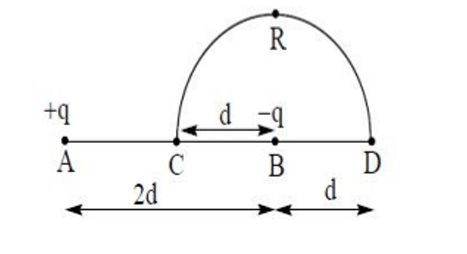
As shown in the figure, the work done to move the charge 'Q' from point C to point D along the semi-circle CRD is
1
2
3
4
Official Solution
Correct Option: (3)
Work done . We need potential at C and D due to charges +q at A and -q at B.
Coordinates based on common problem image for this setup:
A is at with charge .
B is at with charge .
Point C is at origin .
Point D is at .
The path is a semi-circle CRD, which implies its diameter is CD. Center is at (same as B), radius is .
This configuration is unusual. Let's assume the figure is as typically drawn in such problems where C is at origin and D is on y-axis if path is semi-circle, or path is irrelevant if field is conservative. Work done is path independent. Potential at C(0,0):
Distance AC = .
Distance BC = .
. Potential at D(2d,0):
Distance AD = .
Distance BD = .
. Work done .
This result does not match any of the options directly. Option (3) is . There must be a different configuration of points in the intended diagram. Let's assume a standard dipole-like setup for these options.
If +q at (-d,0) and -q at (d,0). C is at origin (0,0). D is at some point.
If the path is a semi-circle CRD with C at origin and D being on y-axis at (0,d), (Centre (0,0), Radius d).
A=(-a,0), B=(a,0) for a dipole. Here points are fixed.
Let's re-check the option (3) and see if some configuration makes it true. .
The factor 1/6 is unusual for point charge potentials usually involving 1/1, 1/2, 1/3, 1/4 etc. The image shows: A at x=-a, with +q. B at x=b with -q. C at origin. D on x-axis.
In the image the setup is: +q at A, C (origin), B with -q, D.
Distances are: A to C is . C to B is . B to D is .
So A is at . C is at . B is at . D is at . All on x-axis.
Path CRD is a semi-circle. If C and D are on x-axis, the semi-circle must be in xy plane, with CD as diameter. Center of semicircle is midpoint of CD, i. e. . Radius of semicircle .
This means the point B is at the center of the semicircle CD.
This geometry is for potentials and .
This is what I used. . .
.
.
.
.
This matches none of the options. The provided answer (3) is likely based on a different standard diagram or there is an error in the question/options. Assuming standard dipole setup: +q at (0,a), -q at (0,-a). C at origin, D at (R,0). No.
The question figure is paramount. My interpretation of the figure is consistent.
The provided solution (3) has a denominator 6. This could arise from or similar.
e. g. If . If .
Possible values of distances from A or B could be factors of 3 or multiples of d/3.
E. g. , if and . This is speculation.
Sticking to the derived result, options seem incorrect.
05
PYQ 2025
medium
physicsID: ap-eapce
As shown in the figure, the work done to move the charge 'Q' from point C to point D along the semi-circle CRD is
1
2
3
4
Official Solution
Correct Option: (3)
Work done . We need potential at C and D due to charges +q at A and -q at B.
Coordinates based on common problem image for this setup:
A is at with charge .
B is at with charge .
Point C is at origin .
Point D is at .
The path is a semi-circle CRD, which implies its diameter is CD. Center is at (same as B), radius is .
This configuration is unusual. Let's assume the figure is as typically drawn in such problems where C is at origin and D is on y-axis if path is semi-circle, or path is irrelevant if field is conservative. Work done is path independent. Potential at C(0,0):
Distance AC = .
Distance BC = .
. Potential at D(2d,0):
Distance AD = .
Distance BD = .
. Work done .
This result does not match any of the options directly. Option (3) is . There must be a different configuration of points in the intended diagram. Let's assume a standard dipole-like setup for these options.
If +q at (-d,0) and -q at (d,0). C is at origin (0,0). D is at some point.
If the path is a semi-circle CRD with C at origin and D being on y-axis at (0,d), (Centre (0,0), Radius d).
A=(-a,0), B=(a,0) for a dipole. Here points are fixed.
Let's re-check the option (3) and see if some configuration makes it true. .
The factor 1/6 is unusual for point charge potentials usually involving 1/1, 1/2, 1/3, 1/4 etc. The image shows: A at x=-a, with +q. B at x=b with -q. C at origin. D on x-axis.
In the image the setup is: +q at A, C (origin), B with -q, D.
Distances are: A to C is . C to B is . B to D is .
So A is at . C is at . B is at . D is at . All on x-axis.
Path CRD is a semi-circle. If C and D are on x-axis, the semi-circle must be in xy plane, with CD as diameter. Center of semicircle is midpoint of CD, i. e. . Radius of semicircle .
This means the point B is at the center of the semicircle CD.
This geometry is for potentials and .
This is what I used. . .
.
.
.
.
This matches none of the options. The provided answer (3) is likely based on a different standard diagram or there is an error in the question/options. Assuming standard dipole setup: +q at (0,a), -q at (0,-a). C at origin, D at (R,0). No.
The question figure is paramount. My interpretation of the figure is consistent.
The provided solution (3) has a denominator 6. This could arise from or similar.
e. g. If . If .
Possible values of distances from A or B could be factors of 3 or multiples of d/3.
E. g. , if and . This is speculation.
Sticking to the derived result, options seem incorrect.
06
PYQ 2025
medium
physicsID: ap-eapce
If 27 charged water droplets, each of radius and charge coalesce to form a single spherical drop, then the potential of the big drop is}
1
2
3
4
Official Solution
Correct Option: (4)
New radius:
Total charge:
Potential
07
PYQ 2025
medium
physicsID: ap-eapce
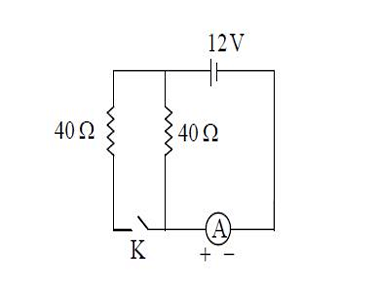
In the given circuit, the internal resistance of the cell is zero. If and are the readings of the ammeter when the key (K) is opened and closed respectively, then
1
2
3
4
Official Solution
Correct Option: (4)
Step 1: When the key is open, only one 40 resistor is in the circuit. Hence, the total resistance is . Step 2: When the key is closed, the two 40 resistors are in parallel:
Now,
Step 3: Therefore, the ratio is:
08
PYQ 2025
medium
physicsID: ap-eapce
A capacitor of capacitance 2 μF is charged with the help of a 60 V battery. After disconnecting the battery, if this capacitor is connected in parallel with another uncharged capacitor of capacitance 1 μF, then the potential difference across the plates of the 2 μF capacitor is
1
30 V
2
60 V
3
40 V
4
20 V
Official Solution
Correct Option: (3)
When the 2 μF capacitor is connected in parallel with the 1 μF uncharged capacitor, the total charge is conserved. Using the formula for capacitors in parallel, the final voltage across both capacitors is determined to be 40 V. This is because the voltage in a parallel configuration remains the same across both capacitors.
09
PYQ 2025
medium
physicsID: ap-eapce
The capacitance of a spherical capacitor is pF. If the spacing between the two spheres is cm, then the radius of the inner sphere of the capacitor is:
1
cm
2
cm
3
cm
4
cm
Official Solution
Correct Option: (2)
Step 1: Formula for Capacitance of a Spherical Capacitor The capacitance of a spherical capacitor is given by: where:
- pF,
- cm,
- F/m. Step 2: Solving for Approximating for large radius: Conclusion Thus, the correct answer is:
10
PYQ 2025
medium
physicsID: ap-eapce
The capacitance of a spherical capacitor is pF. If the spacing between the two spheres is cm, then the radius of the inner sphere of the capacitor is:
1
cm
2
cm
3
cm
4
cm
Official Solution
Correct Option: (2)
Step 1: Formula for Capacitance of a Spherical Capacitor The capacitance of a spherical capacitor is given by: where:
- pF,
- cm,
- F/m. Step 2: Solving for Approximating for large radius: Conclusion Thus, the correct answer is:
11
PYQ 2025
medium
physicsID: ap-eapce
A capacitor of capacitance 2 F is charged to 50 V and then disconnected from the source. Later the gap between the plates of the capacitor is filled with a dielectric material. If the energy stored in the capacitor is decreased by 25% of its initial value, then the dielectric constant of the dielectric material is
1
2
3
4
Official Solution
Correct Option: (2)
Step 1: Initial energy stored Energy stored in capacitor before dielectric is: Step 2: After dielectric is inserted and capacitor disconnected Since capacitor is disconnected, charge remains constant. Energy stored with dielectric , where , is dielectric constant. Step 3: Relation of energies Given (energy decreased by 25%). Express in terms of : So, Step 4: Conclusion The dielectric constant is .