A light from Paschen series of hydrogen atom is able to eject photoelectrons from a metal. Then the work function of the metal is
1
3.4 eV
2
1.54 eV
3
0.85 eV
4
1.1 eV
Official Solution
Correct Option: (2)
For Paschen series: transition to Minimum energy photon in Paschen series corresponds to But for the FIRST line in Paschen, use:
Therefore, maximum energy of photon = 1.54 eV. So, work function must be less than or equal to 1.54 eV.
02
PYQ 2022
medium
physicsID: ap-eapce
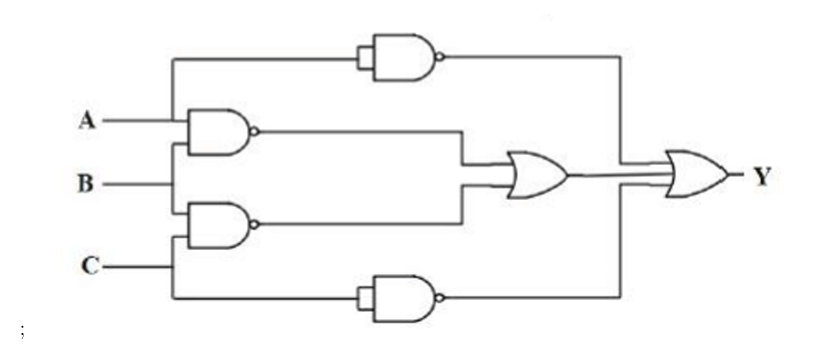
For the logic gates shown below, the correct output is
1
2
3
4
Official Solution
Correct Option: (3)
Step-by-step Logic Gate Evaluation:
Gate 1: AND gate →
Gate 2: AND gate →
Gate 3: NAND gate with both inputs as → functions as NOT gate →
Gate 4: OR gate with inputs →
Gate 5: NOR gate with inputs and :
Simplifying:
Using De Morgan's Theorem: Now simplify : Expand: Multiply by : Since :
✅ Final Simplified Output:
Comparison with Options:
(a) — clearly not correct
(b) — output only 1 when all inputs are 0 — does not match
(c) — equivalent to , not same as
(d) — this is , and not the final output (since is also involved)
Conclusion: The correct simplified expression is:
However, none of the given options match this output. Therefore, the problem appears to have a flaw or mismatch between the logic diagram and the answer options.
03
PYQ 2022
medium
physicsID: ap-eapce
In semiconductors, which of the following are true:
1
No free electrons at 0K.
2
No free electrons at any temperature.
3
Free electrons increase with temperature.
4
Less free electrons than conductor.
Official Solution
Correct Option: (3)
At 0K, no free electrons ⇒ A is true. At finite temperatures, thermal energy allows excitation ⇒ B is false. More temperature ⇒ more conduction ⇒ C is true. Fewer electrons than in metals ⇒ D is true.
04
PYQ 2022
medium
physicsID: ap-eapce
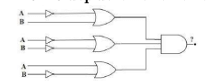
Output of the following logic circuit is:
1
2
3
4
Official Solution
Correct Option: (3)
Analyzing the logic circuit from the diagram:
- The circuit uses three OR gates and one AND gate.
- First OR gate gives:
- Second OR gate gives:
- Third OR gate gives:
- The final AND gate combines these outputs:
05
PYQ 2025
medium
physicsID: ap-eapce
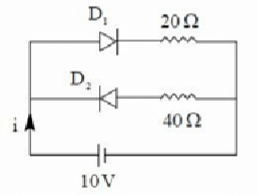
Two diodes with zero resistance in forward bias and infinite resistance in reverse bias are connected to a battery as shown in the circuit. Then the value of current is:
1
zero
2
0.5 A
3
0.4 A
4
0.75 A
Official Solution
Correct Option: (2)
Given:
- and are ideal diodes (zero resistance in forward bias, infinite in reverse).
- Battery voltage = 10 V.
Since diodes conduct only in forward bias:
- Current flows through the diodes that are forward biased.
The two branches have resistors of 20 and 40 respectively in parallel.
Equivalent resistance, is:
Current, .
However, considering diode orientation in circuit and ideal diode behavior, only one diode will conduct effectively allowing current of 0.5 A through 20 branch. So, the effective current is 0.5 A.