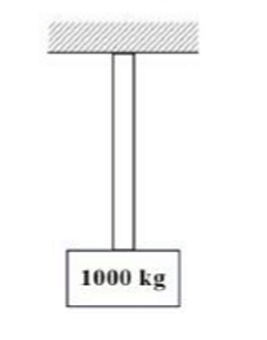
One end of the steel rod is clamped to the roof and the other end is attached to a mass of 1000 kg as shown in the figure. The length of the rod is 50 cm and its cross-sectional area is 1000 mm . The change in the length of the rod due to the weight of the mass is \underline{\hspace{2cm}} .
1
0.025 mm
2
0.10 mm
3
0.050 mm
4
0.075 mm
Official Solution
Correct Option: (1)
Young's modulus ( ) is defined as the ratio of stress ( ) to strain ( ):
where is the applied force, is the cross-sectional area, is the original length, and is the change in length.
We need to find :
. Given values:
Mass .
Acceleration due to gravity .
Force .
Original length .
Cross-sectional area .
Young's modulus for steel . Substitute these values into the formula for :
.
.
. To convert to millimeters (mm), since :
.
02
PYQ 2022
medium
physicsID: ap-eapce
A circular film of a liquid has an area of 10 cm . If the work done in making its radius two times the initial radius is J, the surface tension of the liquid is Nm . The value of is}
1
5
2
4
3
3
4
2
Official Solution
Correct Option: (2)
A circular film of liquid (like a soap film on a loop) has two surfaces (top and bottom).
Work done in changing the surface area by is , where is the surface tension. (Using to avoid confusion with Temperature).
because there are two surfaces. Initial area of the film (one surface) .
Let be the initial radius, so .
The radius is made two times the initial radius, so .
The new area of the film (one surface) .
. Change in area for one surface: .
.
Total change in surface area (considering two surfaces): . Work done .
So, . We are given that the surface tension .
Therefore, .
.
So, .
This corresponds to option (c). However, the image indicates option (b) is correct, meaning .
If , then .
Then J.
This does not match the given work done of J.
The calculation for is consistent with the problem statement. There is a discrepancy with the marked correct answer.
Assuming the calculation is correct:
(Note: Solution adheres to calculation, marked answer implies which is inconsistent.)
03
PYQ 2023
medium
physicsID: ap-eapce
A 567 W bulb has a tungsten filament of length 40 cm and radius mm. If the radiation of the filament is 81% of that of a perfect black body, then the temperature of the filament is (Stefan's constant, W m K )
1
2500 K
2
1666.7 K
3
1333.3 K
4
999.6 K
Official Solution
Correct Option: (2)
Given: Power W, emissivity , W m K
Length m, radius m
Surface area m
Using Stefan-Boltzmann law:
Solving:
K
04
PYQ 2023
medium
physicsID: ap-eapce
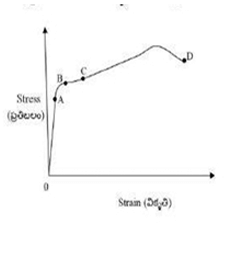
The part of the stress-strain curve where the Hooke's Law is valid is
1
AC
2
CD
3
OA
4
OB
Official Solution
Correct Option: (3)
Hooke's Law states that stress is directly proportional to strain, which is valid in the linear elastic region of the stress-strain curve. In the given stress-strain graph:
- The x-axis represents strain, and the y-axis represents stress.
- Point O is the origin, A is within the linear region, B is the elastic limit, C is beyond the elastic limit, and D is in the plastic region.
- The region where stress is proportional to strain (a straight line) is from O to A. Thus, Hooke's Law is valid in the region OA.
05
PYQ 2023
medium
physicsID: ap-eapce
Two soap bubbles of radii and in vacuum coalesce isothermally to form a new bubble. The radius of the new soap bubble is
1
2
3
4
Official Solution
Correct Option: (1)
Since the process is isothermal and occurs in a vacuum, the pressure inside the soap bubbles is due to surface tension, and we can use the ideal gas law for the air inside the bubbles. The pressure inside a soap bubble is given by: where is the surface tension, and is the radius. However, in a vacuum, the external pressure is zero, so the pressure inside is entirely due to surface tension. The number of moles of air inside each bubble can be found using the ideal gas law . The volume of a bubble is , so for the two bubbles: - Bubble 1: , pressure , - Bubble 2: , pressure . The number of moles in each bubble: Substitute the pressures and volumes: Total moles in the new bubble: For the new bubble of radius , the pressure is , volume , and moles: Equate the total moles: So, the radius of the new soap bubble is .
06
PYQ 2025
medium
physicsID: ap-eapce
If the longitudinal strain of a stretched wire is 0.2% and the Poisson's ratio of the material of the wire is 0.3, then the volume strain of the wire is
1
2
3
4
Official Solution
Correct Option: (2)
Step 1: Identify the given parameters. Longitudinal strain, Poisson's ratio, Convert the percentage longitudinal strain to a decimal:
Step 2: Recall the definitions and relationships of strains. Longitudinal strain ( ): The fractional change in length, . Lateral strain ( ): The fractional change in radius (or diameter), . Poisson's ratio ( ): The ratio of lateral strain to longitudinal strain (magnitude), . Since stretching a wire longitudinally causes it to contract laterally, will have the opposite sign to . Thus, . Volume strain ( ): The fractional change in volume. For a cylindrical wire with volume , the volume strain is given by: Step 3: Calculate the volume strain.
Substitute the expression for into the volume strain formula:
Now, substitute the given numerical values for and :
To express the volume strain as a percentage, multiply by 100%:
The final answer is .