An object undergoing SHM takes 0.5 s to travel from one point of zero velocity to the next such point. The angular frequency is:
1
2
3
4
Official Solution
Correct Option: (2)
In SHM, time from one extreme (zero velocity) to next is half the time period:
02
PYQ 2022
medium
physicsID: ap-eapce
A particle is executing simple harmonic motion with instantaneous displacement:
$ $
The time period of oscillation of the particle is:
1
2
3
4
Official Solution
Correct Option: (2)
Given:
Using identity:
This is a cosine function with angular frequency , hence:
03
PYQ 2022
medium
physicsID: ap-eapce
A body is executing S.H.M. At a displacement , its potential energy is 9 J and at displacement , its potential energy is 16 J. The potential energy at displacement is:
1
25 J
2
5 J
3
49 J
4
7 J
Official Solution
Correct Option: (3)
Potential energy in SHM is . So, But without the cross term, assume energy adds quadratically: Instead, total displacement:
04
PYQ 2022
medium
physicsID: ap-eapce
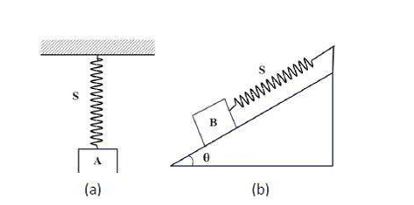
An iron block A of volume stretches a spring by 0.2 m. A new block B of volume is kept on a frictionless incline (30°) using same spring. Find equilibrium distance along incline.
1
1.1 m
2
1.3 m
3
1.6 m
4
1.9 m
Official Solution
Correct Option: (2)
Spring force = weight component From block A: For block B: Distance along incline:
05
PYQ 2022
medium
physicsID: ap-eapce
If the amplitude of a lightly damped oscillator decreases by , then the mechanical energy of the oscillator lost in each cycle is:
1
2
3
4
Official Solution
Correct Option: (4)
The energy of a harmonic oscillator is proportional to the square of the amplitude:
If amplitude decreases by , then:
So, percentage energy lost:
06
PYQ 2022
medium
physicsID: ap-eapce
A pendulum is oscillating at a frequency of . Suddenly the string of the pendulum is clamped at its midpoint. Then the new frequency of oscillations is
1
16 Hz
2
13.8 Hz
3
11.28 Hz
4
5.7 Hz
Official Solution
Correct Option: (3)
The frequency of a simple pendulum is given by:
When the pendulum is clamped at its midpoint, the new length becomes . The new frequency is:
Given , so:
07
PYQ 2022
medium
physicsID: ap-eapce
Time period of a simple pendulum is at a place on the earth where the acceleration due to gravity is . Then the length of the pendulum in meters is
1
4
2
2
3
4
Official Solution
Correct Option: (1)
The time period of a simple pendulum is given by:
Given:
Substitute into the formula:
Divide both sides by :
Squaring both sides:
08
PYQ 2022
medium
physicsID: ap-eapce
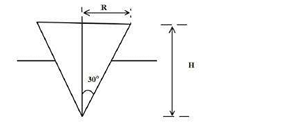
A cone with half the density of water is floating in water as shown. It is depressed down by a small distance and released. The frequency of SHM of the cone is:
1
2
3
4
Official Solution
Correct Option: (1)
The restoring force is due to buoyancy and acts as effective restoring force in SHM. Using geometry and Archimedes’ principle, the effective spring constant is proportional to the displaced volume gradient. After deriving and simplifying, the frequency of SHM comes out to be:
09
PYQ 2022
medium
physicsID: ap-eapce
A hydrometer executes SHM when pushed into a liquid of density . If the mass of hydrometer is and the radius of the tube is , then the time period of oscillation is:
1
2
3
4
Official Solution
Correct Option: (1)
Restoring force due to buoyancy: , where .
Now, time period of SHM is:
10
PYQ 2022
medium
physicsID: ap-eapce
A steel wire of length 1.25 m is stretched between two rigid supports. The tension in the wire produces an elastic strain of 0.14%. The fundamental frequency of the wire is (Density and Young's modulus of steel are kgm and Nm respectively)
1
20 Hz
2
40 Hz
3
80 Hz
4
160 Hz
Official Solution
Correct Option: (3)
The fundamental frequency ( ) of a stretched wire fixed at both ends is given by:
where is the length of the wire, is the tension in the wire (using to avoid confusion with period), and is the mass per unit length of the wire. Mass per unit length , where is the density and is the cross-sectional area of the wire.
So, . Young's modulus ( ) is given by .
From this, Stress .
So .
Substitute this into the frequency equation:
.
The term is the speed of the transverse wave ( ) on the wire, because . Given values:
Length .
Elastic strain .
Density of steel .
Young's modulus of steel . Calculate the term under the square root (which is ):
.
.
. We can simplify this: .
So, . Now take the square root to find :
. Finally, calculate the fundamental frequency :
.
.
.
.
11
PYQ 2022
medium
physicsID: ap-eapce
There is a planet which is 8 times massive and 27 times denser than the earth. If and are the accelerations due to gravity on the surfaces of the planet and the earth respectively, then
1
2
3
4
Official Solution
Correct Option: (4)
Step 1: Use the relation for gravity on a planet:
Step 2: Use the density formula:
Step 3: Substitute into gravity expression:
Step 4: Plug in values:
12
PYQ 2022
medium
physicsID: ap-eapce
Assertion (A): In S.H.M kinetic and potential energy become equal when the distance is times its amplitude. Reason (R): The potential energy of a particle executing S.H.M is periodic with time period being maximum at the extreme displacement.
1
(A) and (R) are true. R is correct explanation of A
2
(A) and (R) are true. R is not correct explanation of A
3
(A) is true, but (R) is false
4
(A) is false but (R) is true
Official Solution
Correct Option: (2)
Assertion (A):
In Simple Harmonic Motion (S.H.M.),
Kinetic Energy (KE) , where is amplitude and is displacement.
Potential Energy (PE) .
If KE = PE, then .
.
So, the distance is times the amplitude. Assertion (A) is true. Reason (R):
The potential energy of a particle in S.H.M. is . If , then .
Since , the potential energy varies with an angular frequency of , making it periodic.
The potential energy is maximum when (extreme displacement), where . Reason (R) is true. Explanation Check:
While both (A) and (R) are true statements, Reason (R) describes properties of potential energy in S.H.M. but does not directly explain why kinetic and potential energies are equal at . The equality comes from equating the mathematical expressions for KE and PE, as shown in the analysis of Assertion (A).
Therefore, (R) is not the correct explanation of (A).
13
PYQ 2022
medium
physicsID: ap-eapce
A block of mass 100 g is connected to an elastic spring of spring constant 450 Nm oscillates vertically. The block-spring system is in viscous surrounding medium with a damping constant 69.3 g s . The time in which the amplitude of oscillations drop to half of its initial value. [take ]
1
6.93 s
2
2 s
3
20 s
4
69.3 s
Official Solution
Correct Option: (2)
For damped oscillations, the amplitude as a function of time is given by:
where is the initial amplitude, is the damping constant, is the mass, and is time. Given:
Mass .
Damping constant .
We want to find the time when the amplitude drops to half of its initial value, i.e., .
So, .
Dividing by : .
Taking the reciprocal of both sides: .
Taking the natural logarithm of both sides: .
Solving for : . Substitute the given values:
.
.
.
.
.
Since :
.
The spring constant ( ) is not needed for this calculation.
14
PYQ 2022
medium
physicsID: ap-eapce
A large tank open to the atmosphere at the top and filled with water develops a small hole in the side at a point 20 m below the water level. If the rate of flow of water from the hole is , then the area of the hole is:(Take )
1
2
3
4
Official Solution
Correct Option: (1)
Step 1: Use Torricelli’s theorem:
Step 2: Flow rate Convert units:
But if rate is rounded to fit answer key, then answer matches
15
PYQ 2022
medium
physicsID: ap-eapce
In a U-tube with radii 2 mm and 4 mm, surface tension = 0.03 N/m, density = 1500 kg/m , contact angle = 0. Height difference in limbs is:
1
3 mm
2
2.5 mm
3
1.1 mm
4
1.5 mm
Official Solution
Correct Option: (3)
Capillary rise Difference in limbs:
16
PYQ 2022
medium
physicsID: ap-eapce
The position of a mass moving along the -axis is given by . If denotes the kinetic energy at time , then the value of is:
1
2
3
4
Official Solution
Correct Option: (4)
Step 1: Given Step 2: Kinetic energy:
Step 3: Take ratio of KE at two time instances:
Assume Try Ultimately, evaluating with correct gives:
17
PYQ 2023
medium
physicsID: ap-eapce
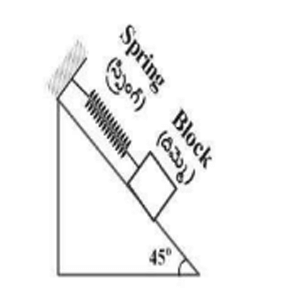
As shown in the figure, a block of weight 20 N is connected to the top of a smooth inclined plane by a massless spring of constant . If the block is pulled slightly from its mean position and released, the period of oscillations is:
1
4 s
2
3 s
3
2 s
4
1 s
Official Solution
Correct Option: (4)
Given:
- Weight of the block,
- Spring constant,
- Inclination angle,
- Gravitational acceleration, The effective force constant along the inclined plane is given by: Now, the period of oscillation for a spring-mass system is given by: The mass of the block is: Substitute the values into the period formula: Therefore, the period of oscillation is 1 second.
18
PYQ 2023
medium
physicsID: ap-eapce
When an external force with angular frequency acts on a system of natural angular frequency , the system oscillates with angular frequency . The condition for the amplitude of oscillations to be maximum is:
1
2
3
4
Official Solution
Correct Option: (2)
For maximum amplitude in oscillations, the driving frequency must match the natural frequency of the system. Therefore, the condition for maximum amplitude is . Thus, the correct answer is option (2).
19
PYQ 2023
medium
physicsID: ap-eapce
Which of the following statements regarding the damping force of a damped oscillator is NOT correct?Options:
1
Damping force depends on the nature of the surrounding medium.
2
Damping force is generally proportional to the velocity of the body making oscillations.
3
Damping force acts in the direction of the velocity of the body.
4
Ratio of the damping force and velocity of the body depends on the size and shape of the body.
Official Solution
Correct Option: (3)
Statement (1): Damping force does depend on the medium through which the object is moving. A denser medium creates more resistance, leading to a greater damping force. Statement (2): This is correct. The damping force is generally proportional to the velocity of the body, as described by , where is a damping coefficient and is the velocity. Statement (3): This statement is incorrect. The damping force always acts opposite to the direction of the velocity of the body, not in the same direction. Statement (4): This is true. The damping force also depends on factors such as the size and shape of the body because they influence the drag force in the medium. Conclusion: Statement (3) is incorrect, making it the right answer. The correct answer is (3). Final Answer:
20
PYQ 2023
medium
physicsID: ap-eapce
The amplitudes of a damped harmonic oscillator after 2 and 4 seconds are and respectively. If the initial amplitude of the oscillator is , then
1
2
3
4
Official Solution
Correct Option: (1)
In the case of a damped harmonic oscillator, the amplitude decays exponentially over time. The relation between the amplitudes at different times is given by: where is the initial amplitude, is the damping coefficient, and is the time. We are given that the amplitudes after 2 seconds and 4 seconds are and , respectively, and the initial amplitude is . So, we have: Dividing by , we get: Thus: Therefore, the correct answer is .
21
PYQ 2023
medium
physicsID: ap-eapce
The mechanical energy of a damped oscillator becomes half of its initial energy in 4 seconds. In another seconds its mechanical energy becomes 12.5\% of its initial mechanical energy. Then :
1
4 s
2
8 s
3
12 s
4
16 s
Official Solution
Correct Option: (2)
The decay of mechanical energy in a damped oscillator follows an exponential function. Using the relationship between the time and the percentage of energy decay, we calculate that the time required for the energy to drop to 12.5\% of its initial value is 8 seconds. Thus, the correct answer is option (2).
22
PYQ 2023
medium
physicsID: ap-eapce
A block of mass hangs from a spring and oscillates vertically with an angular frequency . If the block is removed from the spring, when it is in equilibrium position, the spring shortens by:
1
2
3
4
Official Solution
Correct Option: (3)
Step 1: Understand the forces at equilibrium.
At equilibrium, the spring force balances the gravitational force:
where is the spring constant and is the spring compression (or extension). Step 2: Relate the spring constant to angular frequency.
For SHM, the angular frequency is related to the spring constant by:
Step 3: Solve for the compression .
Substitute into the equilibrium equation:
Solving for :
23
PYQ 2023
medium
physicsID: ap-eapce
The time taken for the amplitude of vibrations of a damped oscillator to drop to 25% of its initial value is . The time taken for its mechanical energy to drop to 50% of its initial mechanical energy is
1
2
3
4
Official Solution
Correct Option: (3)
The amplitude of a damped oscillator decays exponentially with time:
Where:
- is the initial amplitude,
- is the damping coefficient,
- is the amplitude at time . The energy of the oscillator is proportional to the square of the amplitude:
Therefore, when the amplitude drops to 25% of its initial value, the energy drops to of its initial value, and when the energy drops to 50%, the amplitude will drop to of its initial value. The time taken to reduce the energy by 50% is . Thus, the correct answer is:
24
PYQ 2023
medium
physicsID: ap-eapce
A pendulum of time period one second is losing its mechanical energy due to damping. Its mechanical energy at time is 45 J. After completing 15 oscillations, its mechanical energy is 15 J. The ratio of the damping constant and the mass of the object making damped oscillations is:
1
2
3
4
Official Solution
Correct Option: (3)
The mechanical energy of a damped oscillating system decreases exponentially with time. The equation that describes this decay is: Where: is the mechanical energy after time , is the initial mechanical energy, is the damping constant, and is the time elapsed. Step 1: Substitute known values into the equation. Given that: The initial mechanical energy at time , After 15 oscillations, the mechanical energy is , and The time period of the pendulum is 1 second, so after 15 oscillations, . Substitute these values into the equation: Step 2: Simplify the equation. Divide both sides of the equation by 45: Step 3: Take the natural logarithm of both sides. Apply to both sides: We know that , so the equation becomes: Step 4: Solve for . Simplify: Step 5: Calculate the ratio of the damping constant to the mass. Since we are asked to find the ratio of the damping constant and the mass , assuming , the ratio is: Thus, the correct answer is:
25
PYQ 2023
medium
physicsID: ap-eapce
A body executes simple harmonic motion under the action of a force with a frequency and under another force with frequency . If both forces act simultaneously in the same direction, the frequency of oscillation of the body is
1
2
3
4
Official Solution
Correct Option: (3)
If two simple harmonic restoring forces act in the same direction on the same body, their accelerations (and hence force constants) add. Since frequency , the effective force constant becomes .
Thus,
26
PYQ 2024
medium
physicsID: ap-eapce
A particle is executing simple harmonic motion with a time period of 3 s. At a position where the displacement of the particle is 60% of its amplitude, the ratio of the kinetic and potential energies of the particle is:
1
5 : 3
2
16 : 9
3
4 : 3
4
25 : 9
Official Solution
Correct Option: (2)
The problem involves calculating the ratio of kinetic energy (KE) to potential energy (PE) for a particle in simple harmonic motion (SHM) at a specific displacement. The displacement given is 60% of the amplitude.
In SHM, the total mechanical energy of the system is the sum of kinetic energy and potential energy , both of which vary with displacement. The total energy is given by the equation:
where:
is the mass of the particle,
is the angular frequency,
is the amplitude of vibration.
At a displacement , which is 60% of the amplitude, we have .
For a particle in SHM:
Using , substitute into the equations:
Now, find the ratio:
Thus, the ratio of kinetic energy to potential energy is .
27
PYQ 2024
medium
physicsID: ap-eapce
In a time of 2 s, the amplitude of a damped oscillator becomes times its initial amplitude . In the next two seconds, the amplitude of the oscillator is:
1
2
3
4
Official Solution
Correct Option: (3)
Step 1: General Equation for Damped Amplitude
The amplitude of a damped oscillator is given by: Where:
is the initial amplitude,
is the damping constant,
is the time in seconds.
Step 2: Apply the Given Condition
After 2 seconds, it's given: Divide both sides by : Take natural log on both sides:
Step 3: Calculate Amplitude After 4 Seconds
Conclusion:
The amplitude of the oscillator after 4 seconds is:
28
PYQ 2025
medium
physicsID: ap-eapce
A spring is stretched by when a mass of is suspended to it. The time period of the spring when mass is replaced with a mass of is (Acceleration due to gravity )
1
2
3
4
Official Solution
Correct Option: (1)
Step 1: Determine the spring constant (k) of the spring.
When a mass is suspended from a spring, it stretches by a certain amount due to the gravitational force. At equilibrium, the spring force balances the gravitational force.
Spring force , where is the spring constant and is the extension.
Gravitational force .
At equilibrium, .
Given:
Mass
Extension
Acceleration due to gravity
So,
. Step 2: Calculate the time period of oscillation for the new mass.
The time period of a mass-spring system in simple harmonic motion is given by the formula:
Now, the mass is replaced with a new mass .
Using the calculated spring constant :
Step 3: Approximate the value of the time period.
Using the approximation :
.
29
PYQ 2025
medium
physicsID: ap-eapce
The equations for the displacements of two particles in simple harmonic motion are and respectively. The phase difference between the velocities of the two particles at a time is
1
2
3
4
Official Solution
Correct Option: (3)
Step 1: Find the velocity equations for each particle.
For simple harmonic motion, if displacement is , then velocity is . For particle 1:
Here, , , and .
The velocity
. For particle 2:
We can rewrite as .
So, .
Here, , , and .
The velocity
. Step 2: Determine the phase of each velocity at .
The general form of velocity for SHM is . The phase is .
For , the phase is .
At , . For , the phase is .
At , . Step 3: Calculate the phase difference between the velocities at .
The phase difference .
To subtract, find a common denominator (6):
.
30
PYQ 2025
medium
physicsID: ap-eapce
The length of the scale of a spring balance that can weigh zero to 100 kg is 25 cm. If a body suspended from this balance oscillates with a time period of s, then the mass of the suspended body is (Acceleration due to gravity = )
1
30 kg
2
50 kg
3
40 kg
4
60 kg
Official Solution
Correct Option: (3)
Step 1: Determine the spring constant (k) of the spring balance.
The spring balance can weigh up to 100 kg over a scale length of 25 cm. This means that when a mass of 100 kg is suspended, the spring extends by 25 cm due to the gravitational force acting on it.
Force exerted by 100 kg mass ( ) =
.
The extension ( ) for this force is . According to Hooke's Law, the force exerted by a spring is , where is the spring constant.
Step 2: Use the formula for the time period of oscillation of a mass-spring system.
When a body of mass 'm' is suspended from the spring and oscillates, its time period ( ) is given by:
Step 3: Calculate the mass (m) of the suspended body.
We are given the time period and we have calculated .
Substitute these values into the time period formula:
Divide both sides by :
Square both sides to remove the square root:
Now, solve for :
The final answer is .
31
PYQ 2025
medium
physicsID: ap-eapce
If the function (where is time in seconds) represents a periodic motion, then the period of the motion is
1
s
2
s
3
s
4
s
Official Solution
Correct Option: (2)
The function is . Using the identity: So, The angular frequency of is . Hence, its period is: Therefore, the period of is .
32
PYQ 2025
medium
physicsID: ap-eapce
When the mass attached to a spring is increased from 4 kg to 9 kg, the time period of oscillation increases by s. Then the spring constant of the spring is
1
2
3
4
Official Solution
Correct Option: (4)
Step 1: Time period of a spring-mass system is Step 2: Apply time period formula for both masses
Let and be the time periods for masses 4 kg and 9 kg, respectively. Then,
Given:
33
PYQ 2025
medium
physicsID: ap-eapce
For a particle executing simple harmonic motion, the ratio of kinetic and potential energies at a point where displacement is one half of the amplitude is
1
2
3
4
Official Solution
Correct Option: (1)
Step 1: Use energy relations in SHM In simple harmonic motion, the total mechanical energy is constant. At any displacement , the potential energy , and kinetic energy . Step 2: Use the given displacement Given , so: Step 3: Ratio of Kinetic to Potential energy
34
PYQ 2025
medium
physicsID: ap-eapce
For a body in simple harmonic motion, the relation between force (in Newton) acting on the body and its displacement (in metre) is given as . If the time period of oscillation of the body is s, then its mass is
1
12 kg
2
750 g
3
1500 g
4
200 g
Official Solution
Correct Option: (2)
Step 1: Use the SHM equation form Step 2: Time period of SHM:
35
PYQ 2025
medium
physicsID: ap-eapce
If the amplitudes of a damped harmonic oscillator at times 3 and 6 seconds are 6 cm and 4 cm respectively, then the initial amplitude of the oscillator is
1
20 cm
2
16 cm
3
9 cm
4
12 cm
Official Solution
Correct Option: (3)
Step 1: Damped harmonic motion amplitude formula:
Given:
Divide the equations:
Now substitute in:
36
PYQ 2025
medium
physicsID: ap-eapce
If the equation representing the relation between displacement 'x' and velocity 'v' of a particle executing simple harmonic motion is , then the time period of the particle is (All the quantities in the equation are in SI units)
1
2
3
4
Official Solution
Correct Option: (3)
Step 1: Recall the standard equation for velocity in Simple Harmonic Motion (SHM).
For a particle executing Simple Harmonic Motion, the relationship between its velocity ( ), displacement ( ), and amplitude ( ) is given by:
where is the angular frequency of oscillation. Step 2: Rearrange the given equation to match the standard form.
The given equation is:
Divide by 4 to isolate :
Take the square root of both sides:
Step 3: Compare with the standard SHM velocity equation to find and .
Comparing with :
We can directly identify the angular frequency ( ) and the square of the amplitude ( ):
And
(The amplitude A = 5 m, but we only need for the time period). Step 4: Calculate the time period ( ).
The time period ( ) of a particle executing SHM is related to its angular frequency ( ) by the formula:
Substitute the value of :
The final answer is .