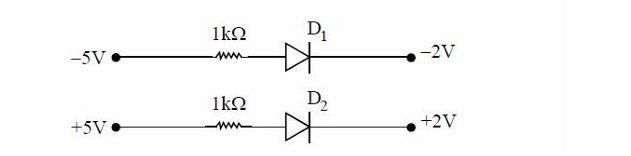
If two diodes and are connected as shown in the figure, then
1
both the diodes and are forward biased.
2
both the diodes and are reverse biased.
3
diode is forward biased and diode is reverse biased.
4
diode is reverse biased and diode is forward biased.
Official Solution
Correct Option: (4)
- For : Left side is at , right side at . Since the anode is more negative than cathode, it is reverse biased. - For : Left side is at , right side at . Since the anode is more positive than the cathode, it is forward biased.
02
PYQ 2025
medium
physicsID: ap-eapce
A transistor has 3 impurity regions of different doping levels. In the order of increasing doping level, the regions are
1
emitter, base, collector
2
collector, base, emitter
3
base, emitter, collector
4
base, collector, emitter
Official Solution
Correct Option: (4)
Step 1: Understand the doping levels in a transistor. In a transistor, the three regions have different doping levels: Base: Very lightly doped and thin. Collector: Moderately doped. Emitter: Heavily doped to inject a large number of charge carriers. Step 2: Arrange in increasing doping order. Step 3: Select the correct option. The correct order is: base, collector, emitter option (4).
03
PYQ 2025
medium
physicsID: ap-eapce
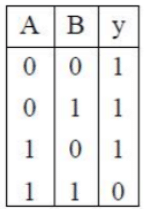
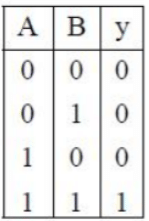
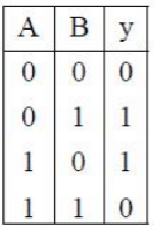
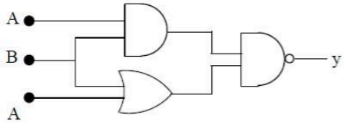
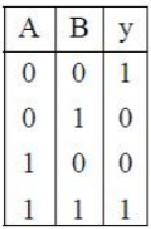
If three logic gates are connected as shown in the figure, then the correct truth table of the circuit is
1
2
3
4
Official Solution
Correct Option: (2)
Step 1: Analyze the circuit and identify the logic gates. The given circuit diagram shows three logic gates connected in series. Let's denote the inputs as A and B, and the final output as y. 1. First Gate: This is an AND gate. Its inputs are A and B. Let the output of this gate be . The Boolean expression for is: 2. Second Gate: This is an OR gate. Its inputs are A and the output of the first gate ( ). Let the output of this gate be . The Boolean expression for is: 3. Third Gate: This is a NOT gate (inverter). Its input is the output of the second gate ( ). Its output is the final output . The Boolean expression for is: Step 2: Simplify the Boolean expression (optional but helpful for verification). Using Boolean algebra, the expression can be simplified by the Absorption Law, which states that . In our case, and . So, . Therefore, the final output simplifies to:
This means the entire circuit is equivalent to a NOT gate applied to input A. Step 3: Construct the truth table based on the logical operations. Let's systematically determine the output for all possible combinations of inputs A and B: Step 4: Compare the derived truth table with the given options. The derived truth table is: This matches the truth table provided in Option (2). The final answer is .
04
PYQ 2025
medium
physicsID: ap-eapce
In a common emitter amplifier of a transistor, if the ratio of the voltage gain and current amplification factor is 4, then the ratio of the collector and base resistances is.
1
2
3
4
Official Solution
Correct Option: (4)
Step 1: Known Information. In a common emitter (CE) amplifier, the voltage gain ( ) is given by: $ \beta R_C R_E A_v \beta A_v = 4\beta \beta \beta \neq 0 R_B R_E R_C R_B R_C R_B R_B \boxed{4 : 1} $
05
PYQ 2025
medium
physicsID: ap-eapce
In a transistor, if the emitter and collector currents are respectively 2 mA and 1.95 mA, then the base current is
1
50 A
2
0.05 A
3
50 mA
4
5 mA
Official Solution
Correct Option: (1)
Step 1: Understand the Fundamental Relationship of Currents in a Transistor
In a bipolar junction transistor (BJT), the emitter current ( ) is the sum of the base current ( ) and the collector current ( ). This relationship is based on Kirchhoff's current law applied to the transistor.
The fundamental current relationship is given by:
Our goal is to find the base current ( ). Rearranging the formula:
Step 2: Identify the Given Current Values
Emitter current:
Collector current: Step 3: Compute the Base Current
Substitute the given values into the derived formula for :
Step 4: Convert the Result to the Required Units (if necessary)
The options are given in A and mA. It's often convenient to convert mA to A for comparison, as .
Step 5: Analyze the Options
\begin{itemize} \item Option (1): 50 A. Correct, as it matches our calculated value of . \item Option (2): 0.05 A. Incorrect (this is not ). \item Option (3): 50 mA. Incorrect. \item Option (4): 5 mA. Incorrect.
\end{itemize}
06
PYQ 2025
medium
physicsID: ap-eapce
If the collector and base currents of a transistor in common emitter configuration are 5 mA and 50 A, then the current amplification factor of the transistor is