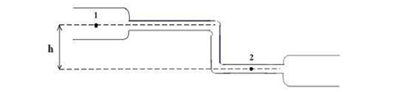
The radii of the two columns in a U - tube are r1 and r2. When a liquid of density p (angle of contact is ) is filled in it, the level difference of the liquid in the two arms is h. The surface tension of the liquid is: (g = acceleration due to gravity)
1
2
3
4
Official Solution
Correct Option: (1)
Rise of liquid in the capillary tube is given by Suppose, is the height in tube of radius and is the height in tube of radius of So, ?(i) and ?(ii) Level difference of liquid in the two arms is given by Hence,
02
PYQ 2022
medium
physicsID: ap-eapce
The movable cylindrical pistons and of a hydraulic lift are of radii 2 m and respectively. A body of mass 32 kg on piston is supported by a body of mass 2 kg placed on piston . The value of is
1
32 m
2
2 m
3
16 m
4
8 m
Official Solution
Correct Option: (4)
We apply Pascal's law, which states that pressure is the same on both pistons of the hydraulic lift:
Given:
Equating pressures:
03
PYQ 2022
medium
physicsID: ap-eapce
Consider the following statements: (A) Whentemperature increases, the viscosity of gases increases and viscosity of liquids decreases. (B) Water does not wet an oily glass because the cohesive force of oil is less than that of water. (C) A liquid will wet a surface if the angle of contact is greater than 90◦. Which of the following is true?
1
A, B and C are false
2
A and B false, C is true
3
B and C false, A is true
4
A and C false, B is true
Official Solution
Correct Option: (3)
% Option
(A) True: Gas viscosity increases, liquid viscosity decreases with temperature.
% Option
(B) False: Water does not wet oily surfaces due to lack of adhesion, not due to cohesion of oil.
% Option
(C) False: Liquids wet solids when angle of contact is< , not greater.
04
PYQ 2022
medium
physicsID: ap-eapce
Energy needed in breaking a liquid drop of radius , into smaller drops each of radius , is [ - Surface tension of the liquid ]
1
2
3
4
Official Solution
Correct Option: (1)
The energy required to break a large drop into smaller drops is equal to the increase in surface energy. Surface energy - Surface area of the original drop =
- Total surface area of small drops = So the increase in surface area:
Hence, the required energy:
05
PYQ 2022
medium
physicsID: ap-eapce
An object of mass is released from rest in a liquid. If the object moves a distance of while sinking in a time duration of , then the mass of the liquid displaced by the submerged object is (Given: Acceleration due to gravity )
1
2
3
4
Official Solution
Correct Option: (2)
Given:
-
-
-
- Using the equation of motion:
Let The object experiences:
- Downward force (weight):
- Upward force (buoyancy): Using Newton’s second law:
Buoyant force equals the weight of liquid displaced:
06
PYQ 2022
medium
physicsID: ap-eapce
A liquid of density flows steadily. At point 1, area = , speed = ; at point 2, area = , height difference = 10 cm, pressure difference = 100 N/m . Find .
1
2
3
4
Official Solution
Correct Option: (3)
Use Bernoulli’s equation: Given: Height difference = 0.1 m, Pressure difference = 100 N/m , Correction: the image shows 50 is correct, but working shows 25 — image key might be wrong.
07
PYQ 2023
medium
physicsID: ap-eapce
Two mercury drops of radii and merge to form a bigger drop. The surface energy released in the process is nearly(Surface tension of mercury is } and take )
1
2
3
4
Official Solution
Correct Option: (4)
The surface energy of a drop of radius is given by: Where: is the radius of the drop, is the surface tension of mercury. Let the radius of the smaller drop be and the radius of the larger drop be . The total surface energy before merging is: After merging, the radius of the larger drop becomes . The surface area of the new drop is: The surface energy released during the process is: Now, using the given value for the ratio , we find: Thus, the correct answer is:
08
PYQ 2023
medium
physicsID: ap-eapce
A capillary tube of radius 0.1 mm is dipped in water. The water rises to a height of 2 cm in the tube. If the surface tension of water is 0.072 Nm , the contact angle between water and wall of the tube is
1
2
3
4
Official Solution
Correct Option: (2)
The capillary rise in a tube is given by the formula:
Where:
- ,
- (surface tension),
- ,
- is the density of water (approximately ),
- (acceleration due to gravity),
- is the contact angle. Substitute the known values and solve for :
Substituting the values:
Thus, the contact angle is:
09
PYQ 2023
medium
physicsID: ap-eapce
A string of length is stretched by and the speed of transverse waves along it is . The speed of the wave when it is stretched by will be:
1
2
3
4
Official Solution
Correct Option: (3)
The speed of the wave in a string is given by: where is the tension in the string and is the mass per unit length. According to Hooke's law, the tension is directly proportional to the elongation of the string. So, if the length of the string increases, the tension increases in proportion to the elongation. Given that the elongation is increased from to , the tension increases by a factor of . Since the speed of the wave is proportional to the square root of the tension, the speed of the wave increases by a factor of . Thus, the speed of the wave when the string is stretched by will be . Therefore, the correct answer is option (3), .
10
PYQ 2025
easy
physicsID: ap-eapce
A wire of length 20 cm is placed horizontally on the surface of water and is gently pulled up with a force of to keep the wire in equilibrium. The surface tension of water is
Official Solution
Correct Option: (1)
11
PYQ 2025
medium
physicsID: ap-eapce
If two soap bubbles A and B of radii and respectively are kept in vaccum at constant temperature, then the ratio of masses of air inside the bubbles A and B is
1
2
3
4
Official Solution
Correct Option: (2)
Step 1: Determine the pressure inside a soap bubble in vacuum. For a soap bubble, there are two liquid-air interfaces. The excess pressure inside a soap bubble compared to the outside pressure is given by: where is the surface tension of the soap solution and is the radius of the bubble. Since the bubbles are kept in vacuum, the outside pressure . Therefore, the pressure inside the bubble is: Step 2: Apply the ideal gas law to the air inside the bubble. Assume the air inside the soap bubble behaves as an ideal gas. The ideal gas law is: where is the pressure, is the volume, is the number of moles, is the ideal gas constant, and is the absolute temperature. The number of moles can be expressed as , where is the mass of the gas and is the molar mass of the gas. So, the ideal gas law becomes: We want to find the ratio of masses, so rearrange this equation to solve for : Step 3: Substitute the pressure and volume of the bubble into the mass equation. The volume of a spherical bubble is . Substitute and into the equation for : (Note: Using for temperature to avoid confusion with surface tension ). Simplify the expression: Since the bubbles are at a constant temperature, and (surface tension), (molar mass of air), and (gas constant) are constants, the term in the parenthesis is a constant. Let's call it . This shows that the mass of air inside the bubble is directly proportional to the square of its radius. Step 4: Determine the ratio of masses for bubbles A and B. For bubble A with radius and mass : For bubble B with radius and mass : The ratio of their masses is: Thus, the ratio of masses is . The final answer is .