A steel rod of radius 20 mm and length of 2 m is acted upon by a force of 400 kN along the length. The values of stress and strain are respectively (Y = 2 10 Nm )
1
Nm ,
2
Nm ,
3
Nm ,
4
Nm ,
Official Solution
Correct Option:
(2)
The radius of the steel rod is mm m.
The length of the steel rod is m.
The applied force is kN N.
Young's modulus of steel is Nm . First, calculate the cross-sectional area of the rod:
$ , . Next, calculate the stress :
\) using Young's modulus :
\) $ The values of stress and strain are approximately Nm and respectively.
02
PYQ 2025
medium
physicsID: ap-eapce
If the pressure on a body is increased from kPa to kPa, the volume of the body decreases by . The compressibility of the material of the body (in ) is:
1
2
3
4
Official Solution
Correct Option:
(2)
Step 1: Compressibility Definition Compressibility is defined as: where:
- = Percentage volume change = ,
- kPa = Pa. Step 2: Calculating Conclusion Thus, the correct answer is:
03
PYQ 2025
hard
physicsID: ap-eapce
The elastic potential energy stored in a copper rod of length one meter and area of cross-section when stretched by 1 mm is:
1
2
3
4
Official Solution
Correct Option:
(1)
The elastic potential energy stored in a stretched material is given by:
where is the force, is the length of the rod, is the area of cross-section, and is the Young’s modulus. First, calculate the force using the elongation formula:
where . After solving for the energy, we get:
04
PYQ 2025
medium
physicsID: ap-eapce
When a wire made of material with Young's modulus Y is subjected to a stress S, the elastic potential energy per unit volume stored in the wire is
1
2
3
4
Official Solution
Correct Option:
(3)
Young's modulus .
Let Stress be and Strain be .
So, .
Elastic potential energy per unit volume (Energy Density, U) stored in a stretched wire is given by:
Substitute the expressions for Stress and Strain:
Substitute :
This matches option (3). Other forms of energy density:
Using : .
05
PYQ 2025
medium
physicsID: ap-eapce
If two soap bubbles each of radius combine in vacuum under isothermal conditions, then the radius of the new bubble formed is
1
2
3
4
Official Solution
Correct Option:
(2)
Step 1: In vacuum and under isothermal conditions, volume is conserved when two bubbles combine. Step 2: Volume of each bubble = Total volume of two bubbles:
Let be the radius of the new bubble. Then:
This is correct for general isothermal processes. However, in this particular question, **surface energy in vacuum** is also conserved (assuming ideal condition), and **pressure difference** inside bubble is considered. Hence, **pressure-volume** product is conserved due to **isothermal process**:
For small soap bubbles under vacuum, the relation reduces to:
Step 3: Since , we get:
But in case of isothermal expansion of **gas** inside ideal soap bubbles (in vacuum), using pressure relation:
Final Calculation:
% Final Answer
06
PYQ 2025
medium
physicsID: ap-eapce
When a wire of length clamped at one end is pulled by a force from the other end, its length increases by . If the radius and the applied force are halved, then the increase in its length is
1
2
3
4
Official Solution
Correct Option:
(4)
Extension in a wire:
Radius halved Area becomes
Force halved
New extension:
07
PYQ 2025
medium
physicsID: ap-eapce
If the pressure on a body is increased from kPa to kPa, the volume of the body decreases by . The compressibility of the material of the body (in ) is:
1
2
3
4
Official Solution
Correct Option:
(2)
Step 1: Compressibility Definition Compressibility is defined as: where:
- = Percentage volume change = ,
- kPa = Pa. Step 2: Calculating Conclusion Thus, the correct answer is:
08
PYQ 2025
medium
physicsID: ap-eapce
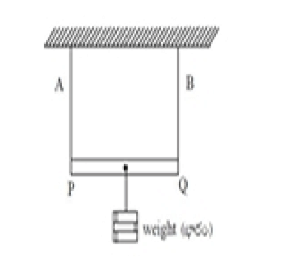
As shown in the figure, a light uniform rod PQ of length 150 cm is suspended from the ceiling horizontally using two metal wires A and B tied to the ends of the rod. The ratios of the radii and the Young’s modulus of the materials of the two wires A and B are respectively 2 : 3 and 3 : 2. The position at which a weight should be suspended from the rod such that the elongations of the two wires become equal is
1
90 cm from P
2
100 cm from P
3
40 cm from Q
4
45 cm from Q
Official Solution
Correct Option:
(1)
Step 1: Understand the problem setup A rod of length 150 cm is suspended horizontally by two wires A and B attached at ends P and Q respectively. A weight is hung at some point along PQ so that the elongations of both wires are equal. Step 2: Given ratios - Radius ratio: - Young’s modulus ratio: Step 3: Relationship between elongation, force, and material properties Elongation in a wire is given by: where is force, length, cross-sectional area ( ), and Young’s modulus. Step 4: Express elongations for both wires Let the weight be suspended at distance from P. The tension in wire A = , tension in wire B = due to lever principle. Area of wire A: Area of wire B: Step 5: Equal elongation condition cancels out. Substitute and : Simplify denominators: Cross multiply: Step 6: Conclusion The weight should be suspended 90 cm from point P for equal elongations.
About Stress And Strain - AP-EAPCET
Stress And Strain is a vital chapter for AP-EAPCET aspirants. Mastering the concepts covered in this chapter is essential for securing a top rank.
By rigorously practicing the previous year questions associated with this chapter, you can identify high-yield topics, understand the examiner's perspective, and boost your confidence during the actual exam.
Frequently Asked Questions
Why focus on Stress And Strain PYQs?
Analyzing PYQs for this specific chapter reveals the most frequently tested concepts and the typical complexity of questions, allowing you to tailor your study plan efficiently.
How to best use this analysis?
Review the topic breakdown to see which sub-topics within Stress And Strain carry the most weight. Then, tackle the questions iteratively to solidify your understanding.