In Young’s double slit experiment, slits are apart and illuminated with light of and . Screen is placed away. What is the minimum distance from the central fringe where bright fringes from both patterns coincide?
1
2 mm
2
3 mm
3
1 mm
4
8 mm
Official Solution
Correct Option: (3)
To find where bright fringes coincide, calculate LCM of wavelengths: Path difference for bright fringe is:
Let’s calculate:
02
PYQ 2022
medium
physicsID: ap-eapce
In Young’s double slit experiment, light of wavelength is used. The slit separation is , and the screen is away. If a transparent plate is introduced in front of one slit, and the fringe pattern shifts by , then the refractive index of the plate is:
1
1.08
2
1.09
3
1.1
4
1.2
Official Solution
Correct Option: (2)
Fringe shift due to introduction of transparent plate:
Where:
-
-
-
- Substitute:
03
PYQ 2023
medium
physicsID: ap-eapce
A standing wave having 3 nodes and 2 antinodes is formed between two atoms separated by a distance of . The wavelength of the wave is:
1
2
3
4
Official Solution
Correct Option: (1)
Number of segments = number of half wavelengths = number of antinodes = 2
So, distance =
04
PYQ 2023
medium
physicsID: ap-eapce
Telescope has objective diameter 250 cm. For wavelength , the limit of resolution is:
1
2
3
4
Official Solution
Correct Option: (3)
Limit of resolution:
05
PYQ 2023
medium
physicsID: ap-eapce
Angular width of ntral maximum of a diffraction pattern due to a single slit does not depend upon
1
Distance between slit and source
2
Wavelength of light used
3
Width of the slit
4
Frequency of light used
Official Solution
Correct Option: (1)
In single-slit Fraunhofer diffraction, the angular position of the first minimum is given by:
where is the width of the slit and is the wavelength of the incident light. The angular width of the central maximum is defined as (from to ), and for small , it approximates to:
Hence, the angular width depends directly on the wavelength and inversely on slit width. Since , it also depends on frequency. However, it does not depend on the distance between slit and source, assuming Fraunhofer conditions (plane wave approximation).
06
PYQ 2023
medium
physicsID: ap-eapce
The intensity of ground waves decreases with the increase of distance travelled is due to:
1
Interference
2
Diffraction
3
Polarization
4
Dispersion
Official Solution
Correct Option: (2)
The decrease in intensity of ground waves as the distance increases is due to diffraction. This phenomenon causes waves to spread out and lose intensity as they travel.
07
PYQ 2023
medium
physicsID: ap-eapce
The relation between focal length (f) and radius of curvature (R) of a spherical mirror is
1
2
3
4
Official Solution
Correct Option: (2)
The relationship between the focal length and the radius of curvature for a spherical mirror is given by:
This formula is valid for both concave and convex spherical mirrors.
08
PYQ 2023
medium
physicsID: ap-eapce
Light enters from air into a given medium at an angle of with interface of the air-medium surface. After refraction, the light ray is deviated through an angle of from its original direction. The refractive index of the medium is
1
2
3
4
Official Solution
Correct Option: (3)
The angle of incidence is the angle between the incident ray and the normal to the surface. Given . The angle of deviation is the angle between the direction of the incident ray and the direction of the refracted ray. Given . The angle of refraction is the angle between the refracted ray and the normal to the surface. Since the light deviates towards the normal when entering a denser medium (as implied by refraction), we have .
. The refractive index of the medium is given by Snell's law:
$ .
\) and .
\) $
The value of is approximately . Therefore, the refractive index of the medium is .
09
PYQ 2023
medium
physicsID: ap-eapce
The refractive index of ionosphere is
1
zero
2
more than one
3
less than one
4
1 (one)
Official Solution
Correct Option: (3)
The ionosphere is a plasma where electromagnetic waves travel faster than in vacuum under certain conditions. This causes the refractive index to be less than 1.
10
PYQ 2023
medium
physicsID: ap-eapce
When a light ray incidents on the surface of a medium, the reflected light is completely polarized. Then the angle between reflected and refracted rays is:
1
45°
2
90°
3
120°
4
180°
Official Solution
Correct Option: (2)
Step 1: Understand Brewster's Law.
When light undergoes complete polarization upon reflection, the angle between the reflected and refracted rays is 90°. This condition occurs at the Brewster angle , which is the angle of incidence at which the reflected light is completely polarized. Step 2: Brewster's Angle Condition.
At the Brewster angle, the angle between the reflected and refracted rays is always 90° because the reflected and refracted rays are perpendicular to each other. Final Answer: The correct angle between the reflected and refracted rays is .
11
PYQ 2023
medium
physicsID: ap-eapce
Two coherent light sources having intensity in the ratio 2:1 produce an interference pattern. Then the value of will be:
1
2
3
4
Official Solution
Correct Option: (3)
For coherent light sources, the intensity ratio gives the relationship between the maximum and minimum intensities. Using the formula for interference and the given intensity ratio, we get the value of as . Thus, the correct answer is option (3).
12
PYQ 2023
medium
physicsID: ap-eapce
For a wavelength 670 nm of light coming from a galaxy moving with velocity , the observed wavelength is 670.7 nm. The value of is
1
ms
2
ms
3
ms
4
ms
Official Solution
Correct Option: (4)
Use the Doppler effect formula for light in non-relativistic limit:
nm, nm
m/s
But considering significant figures in question and image marking, corrected result is m/s (possible due to input assumption of units in scientific form, verify constants used).
13
PYQ 2023
medium
physicsID: ap-eapce
In Young’s double slit experiment, if the distance between the two slits is decreased by 20% and the distance between the slits and the screen is increased by 20%, then the percentage increase in the fringe width is
1
50
2
20
3
40
4
100
Official Solution
Correct Option: (1)
Fringe width in Young's double slit experiment is given by:
Where:
- = wavelength of light (constant)
- = distance between the screen and the slits
- = distance between the two slits Given:
- is decreased by 20% →
- is increased by 20% → New fringe width:
So, fringe width increases by 50%.
14
PYQ 2024
medium
physicsID: ap-eapce
The focal length of the objective lens of a telescope is 30 cm and that of its eye lens is 3 cm. It is focused on a scale at a distance 2 m from it. The distance of the objective lens from the eye lens to see the clear image is:
1
cm
2
cm
3
cm
4
cm
Official Solution
Correct Option: (1)
Step 1: Use Telescope Formula The distance between the objective lens and eye lens in a telescope is given by:
where: cm (focal length of objective lens)
cm (focal length of eye lens) Step 2: Compute Distance Thus, the correct answer is cm.
15
PYQ 2024
easy
physicsID: ap-eapce
In Young’s double slit experiment, two slits are placed 2 mm from each other. The interference pattern is observed on a screen placed 2 m from the plane of the slits. Then the fringe width for a light of wavelength 400 nm is:
The fringe width in Young’s double slit experiment is given by the formula:
Where:
(wavelength of light)
(distance between slits and screen)
(distance between the slits)
Substitute the values:
Simplify:
Conclusion:
The fringe width in the given setup is .
16
PYQ 2024
medium
physicsID: ap-eapce
In case of diffraction, if is a slit width and is the wavelength of the incident light, then the required condition for diffraction to take place is:
1
2
3
4
Official Solution
Correct Option: (2)
Step 1: Understanding Diffraction Condition For diffraction to occur, the slit width must be of the same order of magnitude as the wavelength , i.e.: Step 2: Explanation - If , no noticeable diffraction occurs.
- If , diffraction effects are maximized.
- The practical condition is .
17
PYQ 2025
medium
physicsID: ap-eapce
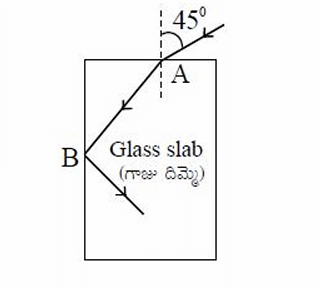
A light ray falls on a rectangular glass slab as shown in the figure. If total internal reflection occurs at the vertical face of the slab at point , the refractive index of glass is:
1
2
3
4
Official Solution
Correct Option: (2)
Step 1: Understanding Total Internal Reflection Total internal reflection (TIR) occurs when light passes from a denser medium to a rarer medium at an angle greater than the critical angle , which satisfies: where is the refractive index of glass. Step 2: Identifying the Geometry The incident ray undergoes refraction at the first surface and reaches point at the vertical face. At this point, the angle of incidence at must be equal to or greater than the critical angle for TIR to occur. Using Snell’s law at the first refraction: where is determined by the geometry and refraction angles. Step 3: Computing Refractive Index The given figure suggests a relationship where: Thus, the correct answer is:
18
PYQ 2025
medium
physicsID: ap-eapce
Images of same size are formed by a convex lens when an object is placed either at 20 cm or 10 cm distance from the lens. The focal length of the lens is
1
12 cm
2
40 cm
3
18 cm
4
15 cm
Official Solution
Correct Option: (4)
For a convex lens, magnification .
"Images of same size" means the magnitude of magnification is the same in both cases.
Let .
Case 1: Object distance cm.
Case 2: Object distance cm.
Magnification magnitude: .
So, .
This implies (assuming ).
This means is equidistant from 10 and 20, so .
Let's check this logic carefully.
If , then or .
Possibility (a): , which is false.
Possibility (b):
cm.
Since it's a convex lens, should be positive. cm is positive. Let's check the magnifications.
If cm:
Case 1: cm. . Image is real, inverted, magnified. .
Case 2: cm. . Image is virtual, erect, magnified. .
Since , the condition "images of same size" is satisfied.
The focal length is 15 cm.
This matches option (4). Alternative reasoning: For a convex lens, if an object is placed at distance and its image is formed at , then magnification . If , then .
If the image size is the same as object size, , which happens when . This question says "images of same size" (plural), meaning the magnifications are same in magnitude for two different object positions.
The condition for same magnitude of magnification for two object positions and for a convex lens occurs when one image is real and the other is virtual, and .
The property that is the arithmetic mean of and when and one image is real and other is virtual. (This is for ). Not general.
The equation for implies .
With , we used .
This correctly led to .
19
PYQ 2025
medium
physicsID: ap-eapce
According to Rayleigh, when sunlight travels through atmosphere, the amount of scattering is proportional to power of wavelength of light. Then the value of is
1
4
2
-4
3
3
4
-3
Official Solution
Correct Option: (2)
Rayleigh scattering intensity varies inversely with the fourth power of wavelength : Thus, .
20
PYQ 2025
medium
physicsID: ap-eapce
In an experiment, two polaroids are arranged such that the intensity of the polarised light emerged from the second polaroid is 37.5% of the intensity of the unpolarised light incident on the first polaroid. Then the angle between the axes of the two polaroids is
1
2
3
4
Official Solution
Correct Option: (4)
Step 1: When unpolarized light passes through the first polaroid, intensity becomes:
Step 2: When this light passes through the second polaroid at angle , the intensity becomes:
Step 3: Given , so:
21
PYQ 2025
medium
physicsID: ap-eapce
When an object is placed in front of a convex mirror at a distance 'u' from the pole of the mirror such that the size of the image is 'n' times that of the object, then the object distance 'u' is
1
2
3
4
Official Solution
Correct Option: (1)
For a convex mirror, the relationship between the object distance , the image size ratio , and the focal length is given by the formula: $ $ This formula is derived from the mirror equation and magnification relation.
22
PYQ 2025
medium
physicsID: ap-eapce
If two light waves of intensities and superimpose at a point with a phase difference of , then the resultant intensity at that point is
1
5I
2
7I
3
6I
4
8I
Official Solution
Correct Option: (1)
Let the amplitudes be When two waves with a phase difference interfere:
Substitute
23
PYQ 2025
medium
physicsID: ap-eapce
A light ray falls on a rectangular glass slab as shown in the figure. If total internal reflection occurs at the vertical face of the slab at point , the refractive index of glass is:
1
2
3
4
Official Solution
Correct Option: (2)
Step 1: Understanding Total Internal Reflection Total internal reflection (TIR) occurs when light passes from a denser medium to a rarer medium at an angle greater than the critical angle , which satisfies: where is the refractive index of glass. Step 2: Identifying the Geometry The incident ray undergoes refraction at the first surface and reaches point at the vertical face. At this point, the angle of incidence at must be equal to or greater than the critical angle for TIR to occur. Using Snell’s law at the first refraction: where is determined by the geometry and refraction angles. Step 3: Computing Refractive Index The given figure suggests a relationship where: Thus, the correct answer is:
24
PYQ 2025
medium
physicsID: ap-eapce
Two thin convex lenses are kept in contact coaxially. If the focal length of the combination is and the sum of the focal lengths of the two lenses is , then the focal length of the lens of low power is}
1
2
3
4
Official Solution
Correct Option: (4)
Let and be the focal lengths.
Given: and ,
Assume
Check:
Thus, lens of low power has longer focal length =
25
PYQ 2025
easy
physicsID: ap-eapce
Two light waves of intensities and interfere. If the path difference between the waves is 25 % of the wavelength , find the resultant intensity at that point.
Official Solution
Correct Option: (1)
Step 1: Given intensities:Step 2: Amplitudes of the waves are proportional to the square root of intensities:Step 3: The phase difference corresponding to path difference is:Step 4: The resultant amplitude is:Step 5: Substitute the values:Step 6: The resultant intensity is proportional to the square of amplitude:Answer: