A bar magnet of length and magnetic moment of is placed in a uniform magnetic field of intensity , with its axis making an angle of with the field. The torque on the magnet is
1
2
3
4
Official Solution
Correct Option: (4)
Torque on a magnetic dipole in a magnetic field is given by:
Where:
- , magnetic moment
- , magnetic field
-
02
PYQ 2023
medium
physicsID: ap-eapce
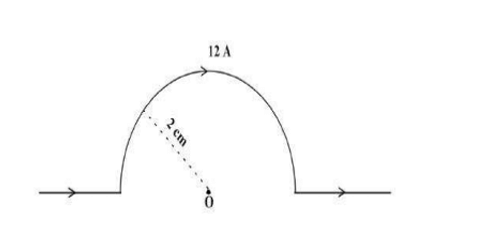
A straight wire carrying a current of 12 A is bent into a semi-circular arc of radius 2 cm as shown in the figure. Then the magnetic field due to the straight segments at the centre of the arc is
1
12 T
2
6 T
3
24 T
4
0
Official Solution
Correct Option: (4)
Step 1: Identify the straight segments and their contribution.
The wire is bent into a semi-circular arc of radius 2 cm, with straight segments extending infinitely on either side of the arc. The figure indicates a semi-circle centered at point , with the straight segments lying along a line (the diameter of the circle). We need the magnetic field at due to the straight segments (not the arc). For a straight wire carrying current , the magnetic field at a perpendicular distance is given by the Biot-Savart law or Ampere’s law:
Step 2: Analyze the geometry and calculate.
The straight segments are along the diameter of the semi-circle, and the center is at a distance equal to the radius (2 cm = 0.02 m) from the straight wire. However, the key insight is the positioning: the straight segments are semi-infinite (extending from the ends of the arc to infinity). For a semi-infinite wire, the magnetic field at a point perpendicular to the wire at distance is:
Here, A, m. There are two straight segments (one from each end of the arc), both contributing to the field at . Compute for one segment:
The other segment produces a field of the same magnitude but in the opposite direction (using the right-hand rule, the currents in the two straight segments produce fields at that cancel out). Thus, the net field due to the straight segments is:
Final Answer: The magnetic field due to the straight segments is .
03
PYQ 2023
medium
physicsID: ap-eapce
If the magnetic field is along the positive y-axis and the electron is moving along the positive x-axis, the direction of force on the electron is
1
along axis
2
along axis
3
along axis
4
along axis
Official Solution
Correct Option: (4)
From Lorentz force law:
- : along
- : along
- (for electron) Using the right-hand rule for :
So the force is in the negative z-direction.
04
PYQ 2023
medium
physicsID: ap-eapce
A flexible wire loop carrying current is placed in external magnetic field. Its shape becomes:
1
helical
2
circular
3
straight line
4
parabolic
Official Solution
Correct Option: (2)
Current loop in magnetic field experiences inward magnetic force. A flexible wire attains minimum potential energy in circular shape.
05
PYQ 2025
medium
physicsID: ap-eapce
When an electron accelerated from rest through a potential difference enters a uniform magnetic field, the maximum force on it is F. If the potential difference is changed to , then the maximum force on the electron in the same magnetic field is 4F, then =
1
1 : 4
2
4 : 1
3
2 : 1
4
1 : 16
Official Solution
Correct Option: (4)
Step 1: Relate potential difference to kinetic energy and velocity
When an electron (charge , mass ) is accelerated from rest through a potential difference , its potential energy is converted into kinetic energy.
From this, we can express the velocity as:
Step 2: Relate velocity to the maximum magnetic force
When a charged particle moves in a uniform magnetic field , the magnetic force on it is given by:
For an electron ( ), the force is .
The maximum force occurs when (i.e., the velocity is perpendicular to the magnetic field), so:
Step 3: Combine the relationships for the first case
Substitute equation (1) into equation (2):
Here, is the maximum force when the potential difference is . Step 4: Combine the relationships for the second case
When the potential difference is changed to , the maximum force becomes .
Let the new force be .
Step 5: Find the ratio
Divide equation (3) by equation (4):
To remove the square root, square both sides:
So, the ratio is . Step 6: Analyze Options
\begin{itemize} \item Option (1): 1 : 4. Incorrect. \item Option (2): 4 : 1. Incorrect. \item Option (3): 2 : 1. Incorrect. \item Option (4): 1 : 16. Correct, as it matches our calculated ratio.
\end{itemize}
06
PYQ 2025
easy
physicsID: ap-eapce
A charged particle of mass and charge moves with a velocity perpendicular to a magnetic field . The radius of the circular path it follows is:
1
2
3
4
Official Solution
Correct Option: (3)
- A charged particle moving perpendicular to a magnetic field experiences a Lorentz force , which provides the centripetal force for circular motion. - Centripetal force required: . - Equate the forces: - Solve for : - This matches option (C).
07
PYQ 2025
medium
physicsID: ap-eapce
If the radius of a circular coil is doubled and the number of turns is halved, then the magnetic field at the centre of the coil for the same current is
1
becomes doubled
2
becomes one fourth
3
becomes quadrupled
4
remains unchanged
Official Solution
Correct Option: (2)
Step 1: Recall the Formula for Magnetic Field at the Centre of a Circular Coil
The magnetic field ( ) at the centre of a circular coil with turns, radius , and carrying a current is given by the formula:
Where is the permeability of free space (a constant). Step 2: Identify the Initial Conditions
Let the initial magnetic field be .
Initial number of turns =
Initial radius =
Initial current =
So, the initial magnetic field is:
Step 3: Identify the New Conditions
The problem states that the radius of the circular coil is doubled and the number of turns is halved, while the current remains the same.
New number of turns =
New radius =
New current = Step 4: Calculate the New Magnetic Field
Let the new magnetic field be . Substitute the new conditions into the formula for :
Step 5: Compare the New Magnetic Field with the Initial Magnetic Field
Divide equation (2) by equation (1):
Therefore, . The magnetic field becomes one fourth of its initial value. Step 6: Analyze Options
\begin{itemize} \item Option (1): becomes doubled. Incorrect. \item Option (2): becomes one fourth. Correct, as it matches our calculated result. Option (3): becomes quadrupled. Incorrect. \item Option (4): remains unchanged. Incorrect.
\end{itemize}