A cricket ball of mass 50 g and velocity 50 cm/s is stopped in 0.5 s. What is the force applied?
1
0.07 N
2
0.05 N
3
5 N
4
7 N
Official Solution
Correct Option:
(2)
Convert to SI units: Mass = 0.05 kg, Velocity = 0.5 m/s, Time = 0.5 s Force
02
PYQ 2022
medium
physicsID: ap-eapce
A ball of mass 0.5 kg moving horizontally at strikes a vertical wall and rebounds with speed . The change in linear momentum is 8.0 kg·m/s. Find the magnitude of .
1
6.0 m/s
2
9.0 m/s
3
26.0 m/s
4
13.0 m/s
Official Solution
Correct Option:
(1)
Initial momentum = (right)
Final momentum = (left)
Change in momentum =
03
PYQ 2022
medium
physicsID: ap-eapce
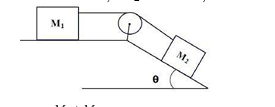
Two masses and are arranged as shown. If is the acceleration of the system, and is doubled, halved, then new acceleration is:
1
2
3
4
Official Solution
Correct Option:
(1)
For initial condition, acceleration: When , , substitute in the new form: Since ratios stay consistent in this derivation, simplified result is:
04
PYQ 2022
medium
physicsID: ap-eapce
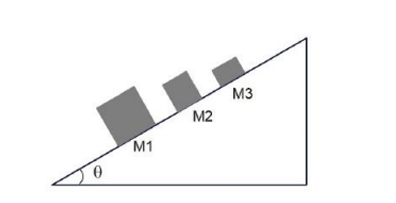
Three blocks ( ) lie on a plane. The angle of inclination is increased. If the coefficient of friction is the same for all, then:
1
begins to slide at a higher inclination angle than
2
begins to slide at a lower inclination angle than
3
begin to slide at the same inclination angle
4
begins to slide at a higher angle than
Official Solution
Correct Option:
(3)
The condition for onset of sliding:
Note: This equation is independent of mass. Hence, the angle at which sliding begins is the same for all blocks, regardless of . Conclusion: All blocks begin to slide simultaneously at the same
05
PYQ 2022
medium
physicsID: ap-eapce
A bar of mass resting on a smooth horizontal plane starts moving due to a constant force . In the process of its rectilinear motion the angle between the direction of this force and the horizontal varies as , where is a constant and is the distance traversed by the bar from its initial position. The velocity of the bar as a function of the angle is:
1
2
3
4
Official Solution
Correct Option:
(2)
Step 1: Since the direction of force varies with displacement, we use the work-energy theorem:
But here, angle is a function of : Instead of resolving components, we observe that net work done is:
Or, equivalently: use energy approach — from external force: So,
06
PYQ 2022
medium
physicsID: ap-eapce
An object moving along x-axis with a uniform acceleration has velocity at . After 2 s, if it is at , then its acceleration is:
1
2
3
4
Official Solution
Correct Option:
(1)
Use kinematic equation: Given:
07
PYQ 2022
medium
physicsID: ap-eapce
A biker travels of the distance with speed and of the distance with speed . Then the average speed is:
1
2
3
4
Official Solution
Correct Option:
(3)
Step 1: Total distance = The biker covers:
- at speed : time
- at speed : time Step 2: Total time:Step 3: Average speed:Conclusion: The average speed is
08
PYQ 2022
medium
physicsID: ap-eapce
A car covers a distance at a speed of 60 km/h. It returns to the starting point at a speed of . If the average speed for the entire trip is 48 km/h, then what is the magnitude of ?
1
40 km/h
2
36 km/h
3
44 km/h
4
32 km/h
Official Solution
Correct Option:
(1)
Average speed for round trip is given by:
Given: , average speed = 48. Solve:
09
PYQ 2022
medium
physicsID: ap-eapce
Two rectangular blocks of masses 40 kg and 60 kg are connected by a string on a frictionless table. A force of 1000 N is applied on the 60 kg block away from the 40 kg block. Find the tension in the string.
1
450 N
2
400 N
3
350 N
4
500 N
Official Solution
Correct Option:
(2)
Total mass kg.
Total acceleration
Now apply Newton’s second law to 40 kg block:
10
PYQ 2023
medium
physicsID: ap-eapce
The maximum acceleration with which a body of mass 200 kg is lowered into a well using a rope having a breaking force of 50 kg-wt is (Acceleration due to gravity = 10 )
1
2
3
4
Official Solution
Correct Option:
(1)
Step 1: Convert breaking force to Newtons.
Step 2: Apply Newton's second law.
When lowering the body with acceleration , the net downward force is . Step 3: For maximum acceleration, tension is maximum (breaking force). Step 4: Substitute the given values.
Step 5: Solve for maximum acceleration.
Thus, the maximum acceleration is .
11
PYQ 2023
medium
physicsID: ap-eapce
The time taken by a net force of 10 N to change the velocity by 4 m/s of a body of mass 10 kg is:
1
4 s
2
6 s
3
8 s
4
2 s
Official Solution
Correct Option:
(1)
We use Newton's second law to find the acceleration of the body: Now, using the equation of motion: Therefore, the time taken is 4 seconds.
12
PYQ 2023
medium
physicsID: ap-eapce
According to Newton's law of cooling, the temperature of a body is at time and the temperature of the surroundings is . The rate of change of temperature is given byIf the initial temperature at time is , then the temperature is:
1
2
3
4
Official Solution
Correct Option:
(3)
The differential equation for Newton's law of cooling is: The solution to this differential equation is: Thus, the temperature of the body at time is .
13
PYQ 2023
medium
physicsID: ap-eapce
A body of mass 10 kg is kept on a rough horizontal surfa of coefficient of friction 0.3. If a horizontal for of 50 N is applied on the body, then the acleration of the body is (Acleration due to gravity )
1
2
3
4
Official Solution
Correct Option:
(2)
First, calculate the normal reaction: . The maximum static friction is . Since the applied force (50 N) exceeds this, motion occurs, and kinetic friction applies, taken as same ( ). Net force acting:
Hence, the acceleration is .
14
PYQ 2023
medium
physicsID: ap-eapce
Two bodies of masses and are dropped from two different heights and respectively. The ratio of the times taken by the two masses to touch the ground is (neglect air resistance)
1
2
3
4
Official Solution
Correct Option:
(4)
The time taken by a body to fall freely under gravity from a height is given by:
Where is the acceleration due to gravity. For two bodies dropped from heights and , the times taken for the bodies to reach the ground are:
The ratio of the times is:
Thus, the ratio of the times is .
15
PYQ 2023
medium
physicsID: ap-eapce
The magnitude of the external force acting on moving bodies can be known directly by
1
Law of conservation of angular momentum
2
Newton’s first law of motion.
3
Newton’s second law of motion.
4
Law of conservation of energy.
Official Solution
Correct Option:
(3)
According to Newton’s second law of motion, the external force acting on a body is directly proportional to the rate of change of momentum. This law provides a direct relationship between the force acting on a body and its acceleration, which is the key to calculating the magnitude of the external force acting on moving bodies. Thus, the correct answer is:
16
PYQ 2023
medium
physicsID: ap-eapce
Force is the mutual interaction between bodies according to:
1
Newton’s first law of motion
2
Newton’s second law of motion
3
Newton’s third law of motion
4
Newton’s law of gravitation
Official Solution
Correct Option:
(3)
Newton’s third law states: "For every action, there is an equal and opposite reaction."
This defines mutual interaction, hence applicable here.
17
PYQ 2025
medium
physicsID: ap-eapce
Two blocks A and B of masses 2 kg and 4 kg respectively are kept on a rough horizontal surface. If same force of 20 N is applied on each block, then the ratio of the accelerations of the blocks A and B is (Coefficient of kinetic friction between the surface and the blocks is 0.3 and acceleration due to gravity = )
1
2
3
4
Official Solution
Correct Option:
(2)
Step 1: Identify the given parameters and general formula for acceleration. Given: Mass of block A, Mass of block B, Applied force on each block, Coefficient of kinetic friction, Acceleration due to gravity, For a block on a rough horizontal surface with an applied force , the net force acting on the block in the direction of motion is , where is the kinetic friction force. The kinetic friction force is given by , where is the normal force. For a horizontal surface, . So, . According to Newton's second law, , so . Thus, the acceleration is given by: Before calculating, we must ensure that the applied force is greater than the maximum static friction (or in this case, kinetic friction is assumed to be active, implying motion). The kinetic friction force must be less than the applied force for acceleration to occur. Step 2: Calculate the acceleration for block A ( ). For block A: Friction force . Since , the block accelerates. Step 3: Calculate the acceleration for block B ( ). For block B: Friction force . Since , the block accelerates. Step 4: Determine the ratio of the accelerations. The ratio of the accelerations of blocks A and B is : So the ratio is 7:2. The final answer is .
18
PYQ 2025
medium
physicsID: ap-eapce
A block of mass 2 kg is placed on a rough horizontal surface. If a horizontal force of 20 N acting on the block produces an acceleration of 7 m/s in it, then the coefficient of kinetic friction between the block and the surface is (Acceleration due to gravity = 10 m/s )
1
0.2
2
0.3
3
0.4
4
0.5
Official Solution
Correct Option:
(2)
Let's analyze the problem step by step: Step 1: Identify the given data Mass of the block, Applied force, Acceleration of the block, Acceleration due to gravity, Step 2: Calculate the net force causing acceleration Using Newton's second law, net force Step 3: Determine the frictional force The applied force causes acceleration, but the net accelerating force is only . The difference is due to friction: Step 4: Calculate the normal force Since the block is on a horizontal surface, the normal force Step 5: Calculate the coefficient of kinetic friction Hence, the coefficient of kinetic friction is 0.3.
About Newtons Laws Of Motion - AP-EAPCET
Newtons Laws Of Motion is a vital chapter for AP-EAPCET aspirants. Mastering the concepts covered in this chapter is essential for securing a top rank.
By rigorously practicing the previous year questions associated with this chapter, you can identify high-yield topics, understand the examiner's perspective, and boost your confidence during the actual exam.
Frequently Asked Questions
Why focus on Newtons Laws Of Motion PYQs?
Analyzing PYQs for this specific chapter reveals the most frequently tested concepts and the typical complexity of questions, allowing you to tailor your study plan efficiently.
How to best use this analysis?
Review the topic breakdown to see which sub-topics within Newtons Laws Of Motion carry the most weight. Then, tackle the questions iteratively to solidify your understanding.