A circular plate A of radius 1.5r is removed from one edge of a uniform circular plate B of radius 2r. The distance of centre of mass of the remaining portion from the centre of the plate B is
1
2
3
4
Official Solution
Correct Option: (2)
Let the center of the larger circular plate B be the origin (0, 0).
The radius of plate B is .
The area of plate B is .
Let the mass per unit area of the uniform plate be .
The mass of plate B is .
The center of mass of plate B is at the origin (0, 0). The circular plate A of radius is removed from one edge of plate B.
The center of plate A is at a distance from the center of plate B along the x-axis. So, the center of mass of the removed portion A is at .
The area of plate A is .
The mass of plate A is . Let the remaining portion be C. The mass of the remaining portion is . Let the center of mass of the remaining portion C be at .
Using the formula for the center of mass of a system of particles:
(for the x-coordinate)
Due to symmetry about the x-axis, the y-coordinate of the center of mass is .
The distance of the center of mass of the remaining portion from the center of the plate B is .
02
PYQ 2023
medium
physicsID: ap-eapce
Two boys A and B with masses 30 kg and 20 kg respectively are at the two extremes of a boat of mass 50 kg and length 5 m resting still on water. Boys A and B move towards each other and meet at the midpoint of the boat. During the process, the distance moved by the boat and boys is (Neglect friction between water and boat)
1
50 cm
2
2 m
3
2.5 m
4
25 cm
Official Solution
Correct Option: (1)
Since no external horizontal forces act on the system, the center of mass of the system remains stationary. Initially, the center of mass is at rest, and as the boys move towards each other, the boat moves in the opposite direction to conserve momentum. The mass of the boat and the boys results in the boat moving a small distance compared to the boys. The total distance moved by the boat and boys is 50 cm.
03
PYQ 2025
easy
physicsID: ap-eapce
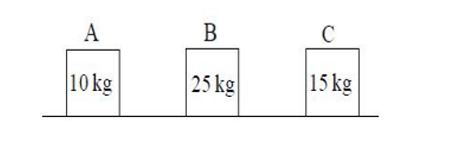
Three blocks A, B and C are arranged as shown in the figure such that the distance between two successive blocks is 10 m. Block A is displaced towards block B by 2 m and block C is displaced towards block B by 3 m. The distance through which the block B should be moved so that the centre of mass of the system does not change is
1
1.4 m, towards block C
2
1.5 m, towards block A
3
2 m, towards block A
4
1 m, towards block C
Official Solution
Correct Option: (4)
Let the initial positions of the blocks be:
m, kg
m, kg
m, kg
Initial centre of mass .
Total mass kg.
m. New positions after displacement (before B is moved):
Block A is displaced towards B by 2 m: m.
Block C is displaced towards B by 3 m: m.
Let block B be moved by a distance . Its new position is .
The new centre of mass .
We want the centre of mass to not change, so m.
m.
Since is positive, block B should be moved 1 m in the positive x-direction.
In the setup, positive x-direction is from A towards C.
So, block B should be moved 1 m towards block C.
This matches option (4).
04
PYQ 2025
medium
physicsID: ap-eapce
Radius of gyration of a thin uniform rod of length about an axis passing through its centre and perpendicular to its length is:
1
2
3
4
Official Solution
Correct Option: (1)
Step 1: Defining the Radius of Gyration The radius of gyration is related to the moment of inertia and mass by: For a thin uniform rod rotating about its centre, the moment of inertia is: Thus, Conclusion Thus, the correct answer is:
05
PYQ 2025
medium
physicsID: ap-eapce
Three blocks A, B and C are arranged as shown in the figure such that the distance between two successive blocks is 10 m. Block A is displaced towards block B by 2 m and block C is displaced towards block B by 3 m. The distance through which the block B should be moved so that the centre of mass of the system does not change is
1
1.4 m, towards block C
2
1.5 m, towards block A
3
2 m, towards block A
4
1 m, towards block C
Official Solution
Correct Option: (4)
Let the initial positions of the blocks be:
m, kg
m, kg
m, kg
Initial centre of mass .
Total mass kg.
m. New positions after displacement (before B is moved):
Block A is displaced towards B by 2 m: m.
Block C is displaced towards B by 3 m: m.
Let block B be moved by a distance . Its new position is .
The new centre of mass .
We want the centre of mass to not change, so m.
m.
Since is positive, block B should be moved 1 m in the positive x-direction.
In the setup, positive x-direction is from A towards C.
So, block B should be moved 1 m towards block C.
This matches option (4).
06
PYQ 2025
medium
physicsID: ap-eapce
The angular velocity of a body changes from to in a time of . If the moment of inertia of the body is , then the rate of change of angular momentum of the body is
1
2
3
4
Official Solution
Correct Option: (3)
Step 1: Given:
Step 2: Angular momentum Step 3: Rate of change of angular momentum:
% Final Answer
07
PYQ 2025
medium
physicsID: ap-eapce
Ratio of angular velocity of hour hand of a watch and the angular velocity of rotation of earth is
1
2
3
4
Official Solution
Correct Option: (2)
Angular velocity
,
08
PYQ 2025
medium
physicsID: ap-eapce
Radius of gyration of a thin uniform rod of length about an axis passing through its centre and perpendicular to its length is:
1
2
3
4
Official Solution
Correct Option: (1)
Step 1: Defining the Radius of Gyration The radius of gyration is related to the moment of inertia and mass by: For a thin uniform rod rotating about its centre, the moment of inertia is: Thus, Conclusion Thus, the correct answer is:
09
PYQ 2025
medium
physicsID: ap-eapce
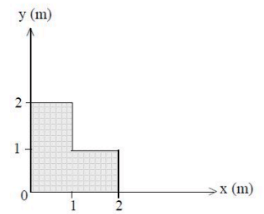
The coordinates of the centre of mass of a uniform L-shaped plate of mass 3 kg shown in the figure is:
1
2
3
4
Official Solution
Correct Option: (1)
Step 1: Divide the L-shape into two rectangles. Let’s denote: Block A: vertical rectangle of dimension Block B: horizontal rectangle of dimension Assume uniform density. Total mass = 3 kg. So, each block has: Area of A = units, Area of B = unit, Total area = 3 units. So, mass of A = 2 kg, mass of B = 1 kg. Step 2: Coordinates of individual centroids Centroid of A is at Centroid of B is at Step 3: Use the center of mass formula: So, the center of mass =
10
PYQ 2025
medium
physicsID: ap-eapce
A body of mass 2 kg is moving towards north with a velocity of 20 m/s and another body of mass 3 kg is moving towards east with a velocity of 10 m/s. The magnitude of the velocity of the centre of mass of the system of the two bodies is
1
20 m/s
2
10 m/s
3
15 m/s
4
m/s
Official Solution
Correct Option: (2)
Given: Mass of body 1, , velocity (north) Mass of body 2, , velocity (east) Velocity of centre of mass components: Assigning coordinate axes: north as y-axis, east as x-axis, we get: Calculate components: Magnitude of :
11
PYQ 2025
medium
physicsID: ap-eapce
If the radius of gyration of a thin circular ring about an axis passing through its centre and perpendicular to its plane is cm, then its radius about its diameter is Identify the correct option from the following:
1
10 cm
2
20 cm
3
cm
4
cm
Official Solution
Correct Option: (1)
Step 1: Relate radius of gyration to moment of inertia
The radius of gyration about an axis is given by , where is the moment of inertia and is the mass. For a thin circular ring of radius about an axis through its center and perpendicular to its plane, , so . Given cm, the radius cm. Step 2: Find the radius of gyration about the diameter
For a thin circular ring, the moment of inertia about a diameter (using the perpendicular axis theorem) is . The radius of gyration about the diameter is . Substitute cm: cm. Step 3: Match with options
The radius of gyration about the diameter is 10 cm, matching option (1).