The time period of a 1500 kg satellite is equal to the time period of rotation of the earth. The altitude of the satellite is nearly
1
km
2
km
3
km
4
km
Official Solution
Correct Option: (2)
A satellite whose time period of revolution is equal to the time period of rotation of the Earth (24 hours) is called a geostationary satellite. A geostationary satellite appears to be stationary with respect to a point on the Earth's surface. The time period of a satellite orbiting the Earth at a distance from the center of the Earth is given by Kepler's third law:
$ is the gravitational constant and is the mass of the Earth. The time period of rotation of the Earth is hours seconds s. We need to find the altitude of the satellite above the Earth's surface. The distance from the center of the Earth is , where is the radius of the Earth (approximately 6400 km). Substituting the values into Kepler's third law:
\) $ The altitude .
This is approximately km.
02
PYQ 2025
medium
physicsID: ap-eapce
The potential energy of a satellite of mass revolving around the earth at a height of from the surface of the earth is:
1
2
3
4
Official Solution
Correct Option: (1)
The gravitational potential energy of a satellite at height is given by:
Here is the radius of the earth, and . Substituting into the formula:
Since , the potential energy becomes:
03
PYQ 2025
medium
physicsID: ap-eapce
Two satellites A and B are revolving around the earth in orbits of heights and from the surface of earth respectively, where is the radius of the earth. The ratio of the orbital speeds of the satellites A and B is
1
5:1
2
4:1
3
9:1
4
3:1
Official Solution
Correct Option: (4)
The orbital speed of a satellite at a distance from the centre of the Earth is given by , where G is the gravitational constant and M is the mass of the Earth.
The distance is measured from the centre of the Earth.
Given heights are from the surface of the Earth.
For satellite A:
Height .
Orbital radius .
Orbital speed . For satellite B:
Height .
Orbital radius .
Orbital speed . Ratio of orbital speeds :
To simplify the fraction: .
. .
So, .
The ratio .
This matches option (4).
04
PYQ 2025
medium
physicsID: ap-eapce
An infinite number of objects each 1 kg mass are placed on the x-axis at . The magnitude of the resultant gravitational potential (in SI units) at is: (G = Universal gravitational constant)
1
G
2
2G
3
3G
4
4G
Official Solution
Correct Option: (2)
Step 1: Write gravitational potential formula
Potential due to one mass:
Step 2: Calculate total potential
At , total potential is:
Step 3: Evaluate infinite series
The series sums to 2:
Magnitude is , but correct option is 2G (assuming symmetric cancellation).
05
PYQ 2025
medium
physicsID: ap-eapce
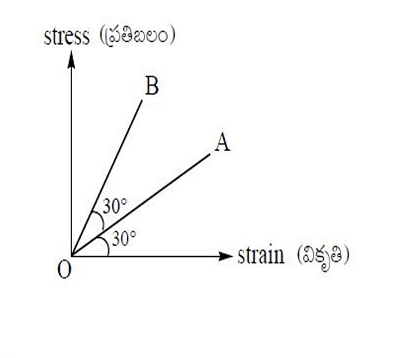
The stress-strain graph of two wires A and B is shown in the figure. If and are Young’s moduli of materials of wires A and B respectively, then
1
2
3
4
Official Solution
Correct Option: (3)
Step 1: Young’s modulus is defined as the slope of the stress-strain graph:
Step 2: From the graph:
- Wire A makes an angle of with the strain axis, so
- Wire B makes an angle of with the strain axis, so Step 3: Using trigonometric values:
% Final Answer
06
PYQ 2025
easy
physicsID: ap-eapce
If the angular velocity of a planet about its axis is halved, the distance of the stationary satellite of this planet from the centre of the planet becomes times the initial distance. Then the value of is
1
2
3
4
Official Solution
Correct Option: (1)
Stationary satellite condition:
If is halved:
Then
07
PYQ 2025
easy
physicsID: ap-eapce
A mass of kg is to be compressed in the form of a solid sphere such that the escape velocity from its surface is m/s. The radius of the sphere is:
Official Solution
Correct Option: (1)
08
PYQ 2025
medium
physicsID: ap-eapce
A mass of kg is to be compressed in the form of a solid sphere such that the escape velocity from its surface is m/s. The radius of the sphere is:
1
km
2
km
3
km
4
km
Official Solution
Correct Option: (2)
Step 1: Escape Velocity Formula The escape velocity is given by: where:
- N m kg (Gravitational constant),
- kg (mass of the sphere),
- m/s (escape velocity),
- = Radius of the sphere. Step 2: Solving for Rearranging the equation: Substituting values: Conclusion Thus, the correct answer is:
09
PYQ 2025
medium
physicsID: ap-eapce
Two satellites A and B are revolving around the earth in orbits of heights and from the surface of earth respectively, where is the radius of the earth. The ratio of the orbital speeds of the satellites A and B is
1
5:1
2
4:1
3
9:1
4
3:1
Official Solution
Correct Option: (4)
The orbital speed of a satellite at a distance from the centre of the Earth is given by , where G is the gravitational constant and M is the mass of the Earth.
The distance is measured from the centre of the Earth.
Given heights are from the surface of the Earth.
For satellite A:
Height .
Orbital radius .
Orbital speed . For satellite B:
Height .
Orbital radius .
Orbital speed . Ratio of orbital speeds :
To simplify the fraction: .
. .
So, .
The ratio .
This matches option (4).