JEE-ADVANCED SERIES Chemistry
Hybridisation
10 previous year questions.
Volume: 10 Ques
Yield: Medium
High-Yield Trend
1
2021 1
2010 1
1999 1
1997 1
1996 1
1992 1
1989 1
1984 1
1982 1
1981 Chapter Questions 10 MCQs
01
PYQ 1981
medium
chemistry ID: jee-adva
If a molecule , has zero dipole moment, the sigma
bonding orbitals used by M (atomic number < 21) are
1
pure p
2
sp-hybridised
3
-hybridised
4
-hybridised
02
PYQ 1982
medium
chemistry ID: jee-adva
Among the following, the linear molecule is
1
2
3
4
03
PYQ 1984
easy
chemistry ID: jee-adva
On hybridisation of one s and one p-orbital we get
1
two mutually perpendicular orbitals
2
two orbitals at
3
four orbitals directed tetrahedrally
4
three orbitals in a plane
04
PYQ 1989
medium
chemistry ID: jee-adva
The molecule which has pyramidal shape is
1
2
3
4
05
PYQ 1992
easy
chemistry ID: jee-adva
The maximum possible number of hydrogen bonds a water
molecule can form is
1
2
2
4
3
3
4
1
06
PYQ 1996
medium
chemistry ID: jee-adva
Which one of the following molecules is planar?
1
2
3
4
07
PYQ 1997
medium
chemistry ID: jee-adva
Which one of the following compounds has hybridisation?
1
2
3
4
CO
08
PYQ 1999
medium
chemistry ID: jee-adva
In the compound , the bonds is of
1
2
3
4
09
PYQ 2010
medium
chemistry ID: jee-adva
The species having pyramidal shape is
1
2
3
4
10
PYQ 2021
medium
chemistry ID: jee-adva
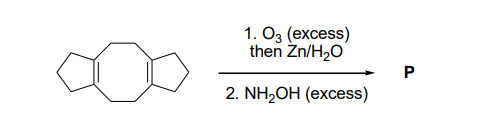
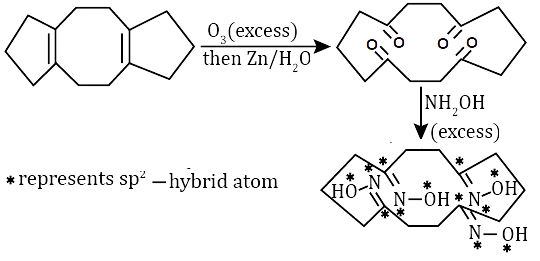
In the reaction given below, the total number of atoms having sp2 hybridization in the major product P is ___.
About Hybridisation - JEE-ADVANCED
Hybridisation is a vital chapter for JEE-ADVANCED aspirants. Mastering the concepts covered in this chapter is essential for securing a top rank.
By rigorously practicing the previous year questions associated with this chapter, you can identify high-yield topics, understand the examiner's perspective, and boost your confidence during the actual exam.
Frequently Asked Questions
Why focus on Hybridisation PYQs?
Analyzing PYQs for this specific chapter reveals the most frequently tested concepts and the typical complexity of questions, allowing you to tailor your study plan efficiently.
How to best use this analysis?
Review the topic breakdown to see which sub-topics within Hybridisation carry the most weight. Then, tackle the questions iteratively to solidify your understanding.