JEE-ADVANCED SERIES
Chemistry

Organic Chemistry

44 previous year questions.

Volume: 44 Ques
Yield: High

High-Yield Trend

7
2025
1
2024
14
2023
2
2022
1
2021
1
2020
2
2013
1
2011
2
2009
3
2008
3
2006
1
2005
1
2003
1
1996
1
1991

Chapter Questions
44 MCQs

01
PYQ 1982
medium
chemistry ID: jee-adva
The ion that cannot be precipitated by both HCl and is
1
2
3
4
02
PYQ 1986
medium
chemistry ID: jee-adva
Which one amongst the following pairs of ions cannot be separated by in dilute HCl ?
1
2
3
4
03
PYQ 1987
medium
chemistry ID: jee-adva
The brown ring complex compound is formulated as The oxidation state of iron is
1
1
2
2
3
3
4
0
04
PYQ 1991
medium
chemistry ID: jee-adva
The reagents, and aqueous will precipitate
1
2
3
4
05
PYQ 1996
medium
chemistry ID: jee-adva
An aqueous solution and chrome alum is heated with excess of and filtered. The materials obtained are
1
a colourless filtrate and a green residue
2
a yellow filtrate and a green residue
3
a yellow filtrate and a brown residue
4
a green filtrate and brown residue
06
PYQ 2003
medium
chemistry ID: jee-adva
a colourless gas with irritating smell green solution and are
1
2
3
4
07
PYQ 2005
medium
chemistry ID: jee-adva
A metal nitrate reacts with KI to give a black precipitate which on addition of excess of KI convert into orange colour solution. The cation of metal nitrate is
1
2
3
4
08
PYQ 2006
medium
chemistry ID: jee-adva
decolourises on addition of KCN, the product is
1
2
get reduced to form
3
4
CuCN
09
PYQ 2006
medium
chemistry ID: jee-adva
A solution when diluted with and boiled, it gives a white precipitate. On addition of excess , the volume of precipitate decreases leaving behind a white gelatinous precipitate. Identify the precipitate which dissolves in
1
2
3
4
10
PYQ 2006
medium
chemistry ID: jee-adva
on reaction with and forms a white crystalline precipitate. What is its formula?
1
2
3
4
11
PYQ 2008
easy
chemistry ID: jee-adva
The correct statement(s) concerning the structures and is/are
1
and are resonance structures
2
and are tautomers
3
and are geometrical isomers
4
and are diastereomers
12
PYQ 2008
medium
chemistry ID: jee-adva
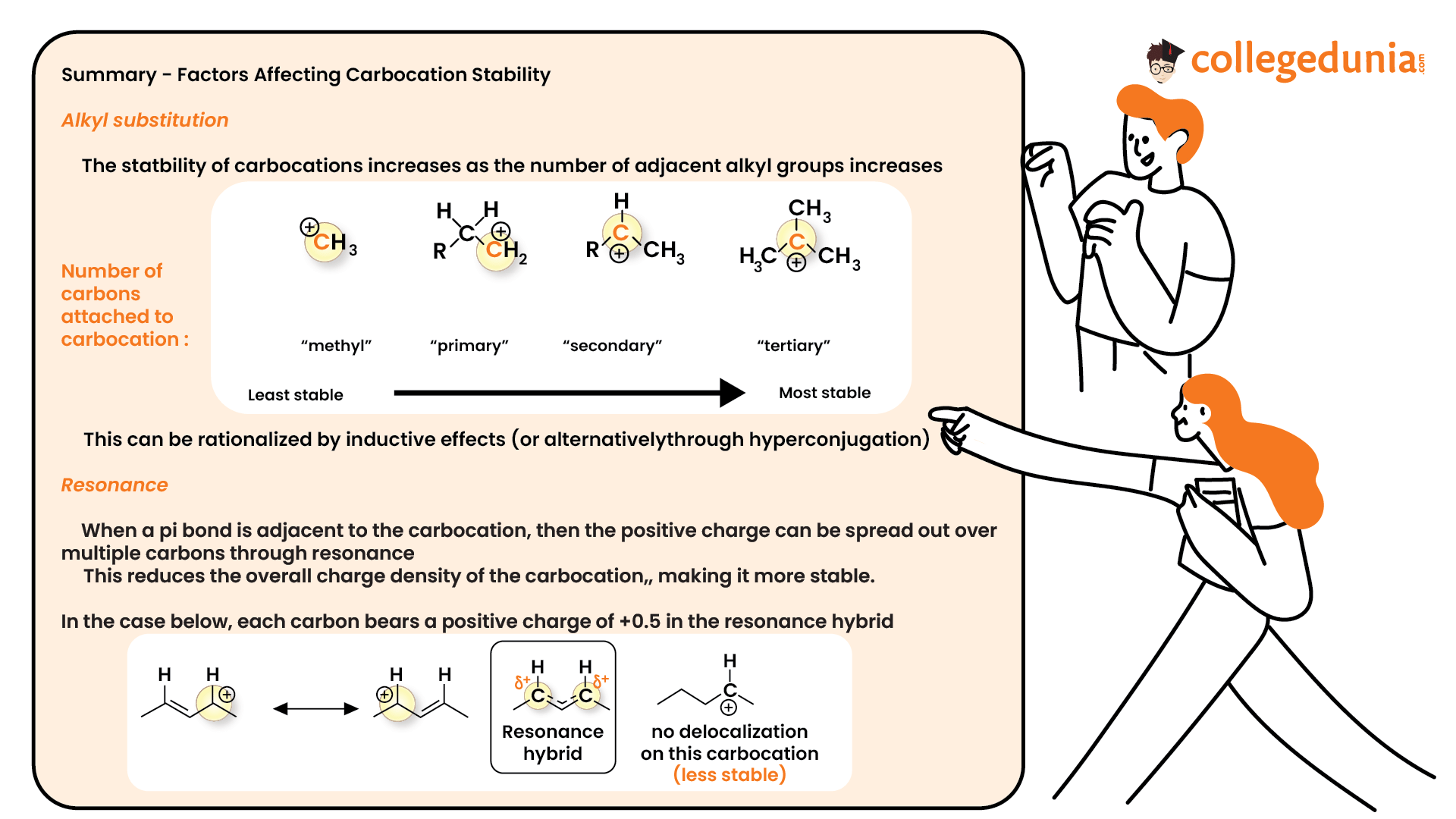
Hyperconjugation involves overlap of the following orbitals
1
2
3
4
13
PYQ 2008
hard
chemistry ID: jee-adva
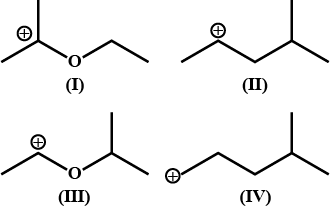
The correct stability order for the following species is
1
2
3
4
14
PYQ 2009
medium
chemistry ID: jee-adva
The correct stability order of the following resonance structure is (I) (II) (c) (IV)
1
2
3
4
15
PYQ 2009
medium
chemistry ID: jee-adva
In the following carbocation; that is most likely to migrate to the positively charged carbon is
1
2
3
4
16
PYQ 2011
medium
chemistry ID: jee-adva
Passing gas into a mixture of and ions in an acidified aqueous solution precipitates
1
CuS and HgS
2
MnS and CuS
3
MnS and NiS
4
NiS and HgS
17
PYQ 2013
medium
chemistry ID: jee-adva
The hyperconjugative stabilities of tert-butyl cation and 2-butene, respectively, are due to
1
electron delocalisations
2
electron delocalisations
3
electron delocalisations
4
electrons delocalisations
18
PYQ 2013
medium
chemistry ID: jee-adva
Upon treatment with ammoniacal , the metal ion that precipitates as a sulphide is
1
Fe (III)
2
Al(III)
3
Mg (II)
4
Zn(II)
19
PYQ 2020
medium
chemistry ID: jee-adva
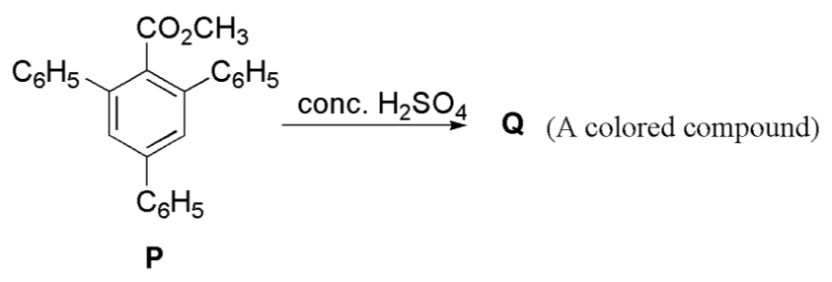
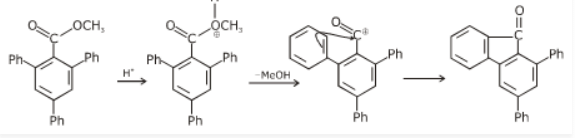
In the following reaction, compound Q is obtained from compound P via an ionic intermediate.
degree of unsaturation of Q
|What is the degree of unsaturation of Q?
20
PYQ 2021
easy
chemistry ID: jee-adva
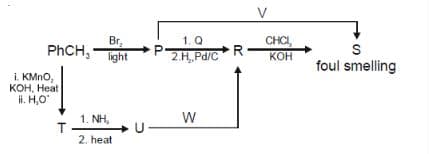
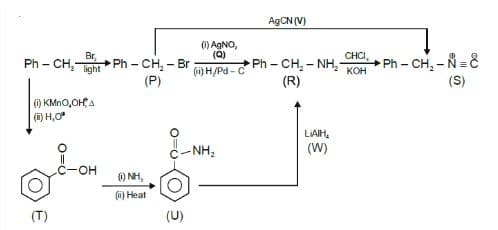
Correct option(s) for the following sequence of reactions is(are)
Sequence of Reaction
1
Q = KNO2, W = LiAlH4
2
R = benzenamine, V = KCN
3
Q = AgNO2, R = phenylmethanamine
4
W = LiAlH4, V = AgCN
21
PYQ 2022
medium
chemistry ID: jee-adva
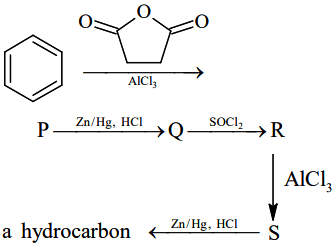
Considering the following reaction sequence, the correct statement(s) is(are)
Compound P and Q are carboxylic acids
1
Compounds and are carboxylic acids.
2
Compound decolorizes bromine water.
3
Compounds and react with hydroxylamine to give the corresponding oximes.
4
Compound reacts with dialkylcadmium to give the corresponding tertiary alcohol.
22
PYQ 2022
medium
chemistry ID: jee-adva
Considering the following reaction sequence, the correct statement(s) is(are)
Compound P and Q are carboxylic acids
1
Compounds and are carboxylic acids.
2
Compound decolorizes bromine water.
3
Compounds and react with hydroxylamine to give the corresponding oximes.
4
Compound reacts with dialkylcadmium to give the corresponding tertiary alcohol.
23
PYQ 2023
easy
chemistry ID: jee-adva

The major products obtained from the reactions in List-II are the reactants for the named reactions mentioned in List-I. Match List-I with List-II and choose the correct option.
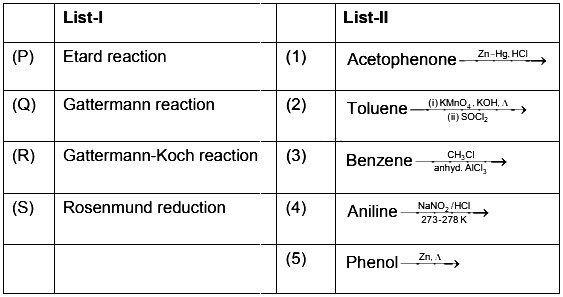
1

P →2; Q→4 ; R →1; S →3

2

P →1; Q→3 ; R →5; S →2

3

P →3; Q→2 ; R →1; S →4

4

P →3; Q→4 ; R →5; S →2

24
PYQ 2023
easy
chemistry ID: jee-adva
Plotting against for aqueous solutions of a monobasic weak acid (HX) resulted in a straight line with y-axis intercept of P and slope of S. The ratio is
[ = molar conductivity,
= limiting molar conductivity,
= molar concentration,
= dissociation constant of HX]
1

2

3

4

25
PYQ 2023
medium
chemistry ID: jee-adva
50 mL of 0.2 molal urea solution (density = 1.012 g mL−1 at 300 K) is mixed with 250 mL of a solution containing 0.06 g of urea. Both solutions were prepared in the same solvent. The osmotic pressure (in Torr) of the resulting solution at 300 K is ___.
[Use: Molar mass of urea = 60 g mol−1 ; gas constant, R = 62 L Torr K−1 mol−1; Assume, ΔmixH = 0, ΔmixV = 0]
26
PYQ 2023
easy
chemistry ID: jee-adva

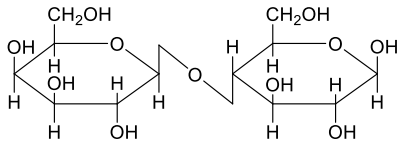
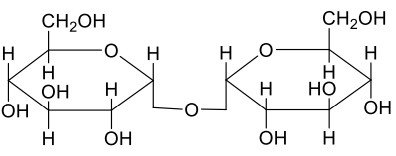
A disaccharide X cannot be oxidised by bromine water. The acid hydrolysis of X leads to a laevorotatory solution. The disaccharide X is
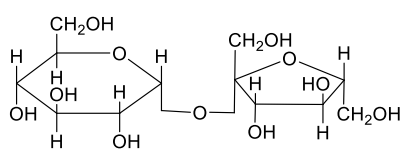
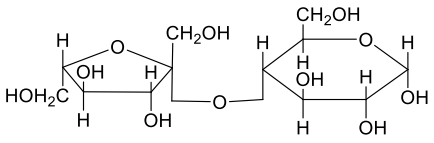
1
A disaccharide X
2
A disaccharide X
3
A disaccharide X cannot be oxidised
4
A disaccharide X cannot be oxidised
27
PYQ 2023
easy
chemistry ID: jee-adva

The total number of sp2 hybridised carbon atoms in the major product P (a non-heterocyclic compound) of the following reaction is ___.

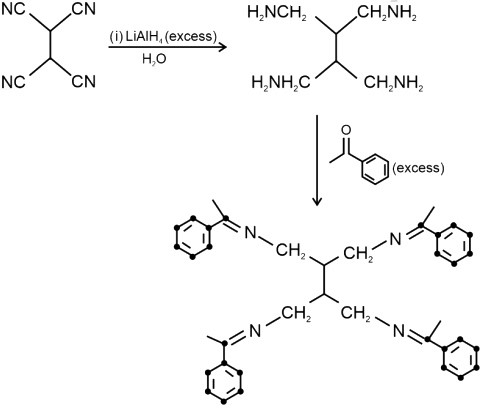
28
PYQ 2023
easy
chemistry ID: jee-adva

On decreasing the 𝑝H from 7 to 2, the solubility of a sparingly soluble salt (MX) of a weak acid (HX) increased from 10−4 mol L−1 to 10−3 mol L−1. The 𝑝Ka of HX is
29
PYQ 2023
hard
chemistry ID: jee-adva

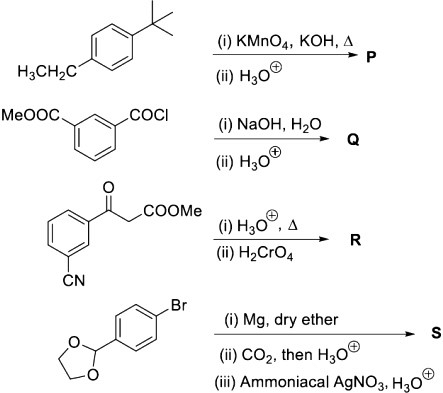
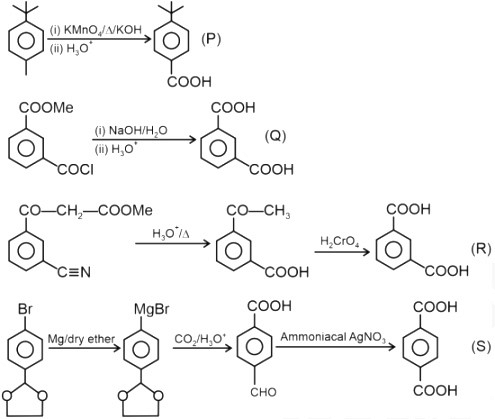
In the following reactions, P, Q, R, and S are the major products.
The correct statement(s) about P, Q, R, and S is(are)

1

P and Q are monomers of polymers dacron and glyptal, respectively.

2

P, Q, and R are dicarboxylic acids.

3

Compounds Q and R are the same.

4

R does not undergo aldol condensation and S does not undergo Cannizzaro reaction.
30
PYQ 2023
easy
chemistry ID: jee-adva
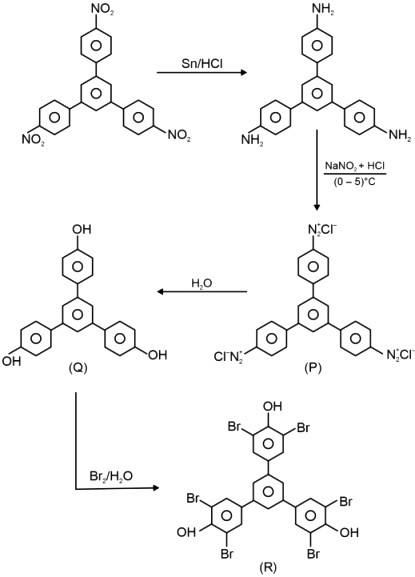
A trinitro compound, 1,3,5-tris-(4-nitrophenyl)benzene, on complete reaction with an excess of Sn/HCl gives a major product, which on treatment with an excess of NaNO2/HCl at 0°C provides P as the product. P, upon treatment with excess of H2O at room temperature, gives the product Q. Bromination of Q in aqueous medium furnishes the product R. The compound P upon treatment with an excess of phenol under basic conditions gives the product S. The molar mass difference between compounds Q and R is 474 g mol–1 and between compounds P and S is 172.5 g mol–1. The number of heteroatoms present in one molecule of R is ______ .
[Use: Molar mass (in g mol–1): H = 1, C = 12, N = 14, O = 16, Br = 80, Cl = 35.5 Atoms other than C and H are considered as heteroatoms]
31
PYQ 2023
easy
chemistry ID: jee-adva
A trinitro compound, 1,3,5-tris-(4-nitrophenyl)benzene, on complete reaction with an excess of Sn/HCl gives a major product, which on treatment with an excess of NaNO2/HCl at 0°C provides P as the product. P, upon treatment with excess of H2O at room temperature, gives the product Q. Bromination of Q in aqueous medium furnishes the product R. The compound P upon treatment with an excess of phenol under basic conditions gives the product S. The molar mass difference between compounds Q and R is 474 g mol–1 and between compounds P and S is 172.5 g mol–1.
32
PYQ 2023
easy
chemistry ID: jee-adva
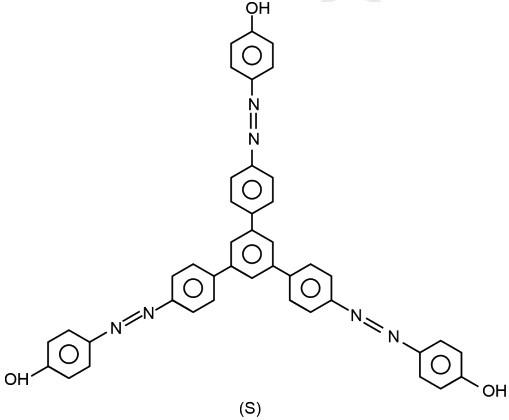
“PARAGRAPH II” A trinitro compound, 1,3,5-tris-(4-nitrophenyl)benzene, on complete reaction with an excess of Sn/HCl gives a major product, which on treatment with an excess of NaNO2/HCl at 0oC provides P as the product. P, upon treatment with excess of H2O at room temperature, gives the product Q. Bromination of Q in aqueous medium furnishes the product R. The compound P upon treatment with an excess of phenol under basic conditions gives the product S. The molar mass difference between compounds Q and R is 474 g mol–1 and between compounds P and S is 172.5 g mol–1. The total number of carbon atoms and heteroatoms present in one molecule of S is ______ .
[Use: Molar mass (in g mol–1): H = 1, C = 12, N = 14, O = 16, Br = 80, Cl = 35.5 Atoms other than C and H are considered as heteroatoms]
33
PYQ 2023
easy
chemistry ID: jee-adva
50 mL of 0.2 molal urea solution (density = 1.012 g mL−1 at 300 K) is mixed with 250 mL of a solution containing 0.06 g of urea. Both solutions were prepared in the same solvent. The osmotic pressure (in Torr) of the resulting solution at 300 K is ___.
[Use: Molar mass of urea = 60 g mol−1 ; gas constant, R = 62 L Torr K−1 mol−1; Assume, ΔmixH = 0, ΔmixV = 0]
34
PYQ 2023
easy
chemistry ID: jee-adva
The total number of hybridised carbon atoms in the major product P (a non-heterocyclic compound) of the following reaction is ___.
35
PYQ 2023
medium
chemistry ID: jee-adva
A trinitro compound, 1,3,5-tris-(4-nitrophenyl)benzene, on complete reaction with an excess of Sn/HCl gives a major product, which on treatment with an excess of NaNO2/HCl at 0°C provides P as the product. P, upon treatment with excess of H2O at room temperature, gives the product Q. Bromination of Q in aqueous medium furnishes the product R. The compound P upon treatment with an excess of phenol under basic conditions gives the product S. The molar mass difference between compounds Q and R is 474 g mol–1 and between compounds P and S is 172.5 g mol–1. The number of heteroatoms present in one molecule of R is ______ .
[Use: Molar mass (in g mol–1): H = 1, C = 12, N = 14, O = 16, Br = 80, Cl = 35.5 Atoms other than C and H are considered as heteroatoms]
36
PYQ 2023
medium
chemistry ID: jee-adva
A trinitro compound, 1,3,5-tris-(4-nitrophenyl)benzene, on complete reaction with an excess of Sn/HCl gives a major product, which on treatment with an excess of NaNO2/HCl at 0oC provides P as the product. P, upon treatment with excess of H2O at room temperature, gives the product Q. Bromination of Q in aqueous medium furnishes the product R. The compound P upon treatment with an excess of phenol under basic conditions gives the product S. The molar mass difference between compounds Q and R is 474 g mol–1 and between compounds P and S is 172.5 g mol–1. The total number of carbon atoms and heteroatoms present in one molecule of S is ______ .
[Use: Molar mass (in g mol–1): H = 1, C = 12, N = 14, O = 16, Br = 80, Cl = 35.5 Atoms other than C and H are considered as heteroatoms]
37
PYQ 2024
medium
chemistry ID: jee-adva
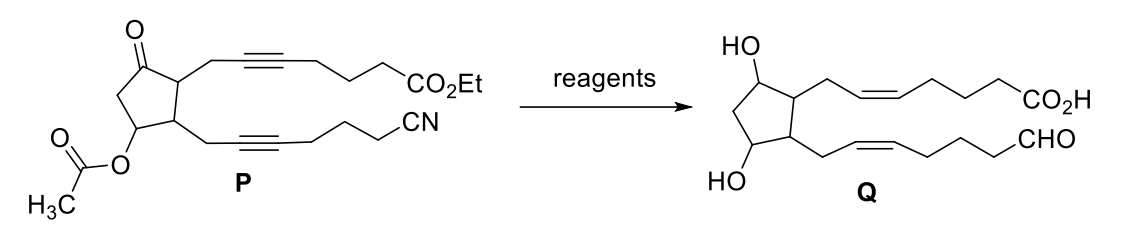
The option(s) with correct sequence of reagents for the conversion of P to Q is(are)
The option(s) with correct sequence of reagents for the conversion of P to Q is
1
i) Lindlar’s catalyst, H2; ii) SnCl2/HCl; iii) NaBH4; iv) H3O+
2
i) Lindlar’s catalyst, H2; ii) H3O+ ; iii) SnCl2/HCl; iv) NaBH4
3
i) NaBH4; ii) SnCl2/HCl; iii) H3O+ ; iv) Lindlar’s catalyst, H2
4
i) Lindlar’s catalyst, H2; ii) NaBH4; iii) SnCl2/HCl; iv) H3O+
38
PYQ 2025
medium
chemistry ID: jee-adva

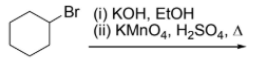
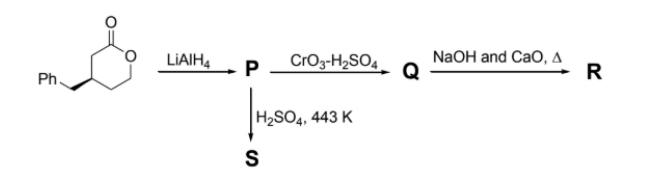
For the reaction sequence given below, the correct statement(s) is(are):
1
is optically active.
2
gives Bayer’s test.
3
gives effervescence with aqueous NaHCO .
4
is an alkyne.
39
PYQ 2025
medium
chemistry ID: jee-adva

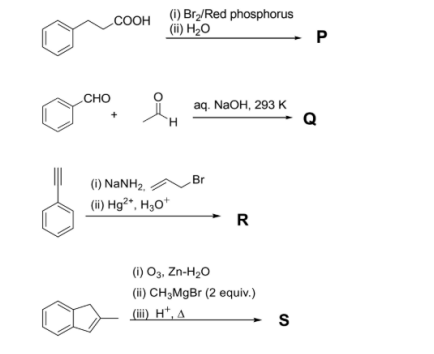
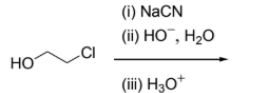
Monocyclic compounds and are the major products formed in the reaction sequences given below.
The product having the highest number of unsaturated carbon atom(s) is:
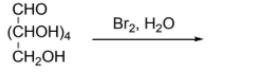
1

2

3

4

40
PYQ 2025
medium
chemistry ID: jee-adva
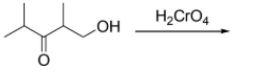
The correct reaction/reaction sequence that would produce a dicarboxylic acid as the major product is
1

2

3

4

41
PYQ 2025
medium
chemistry ID: jee-adva

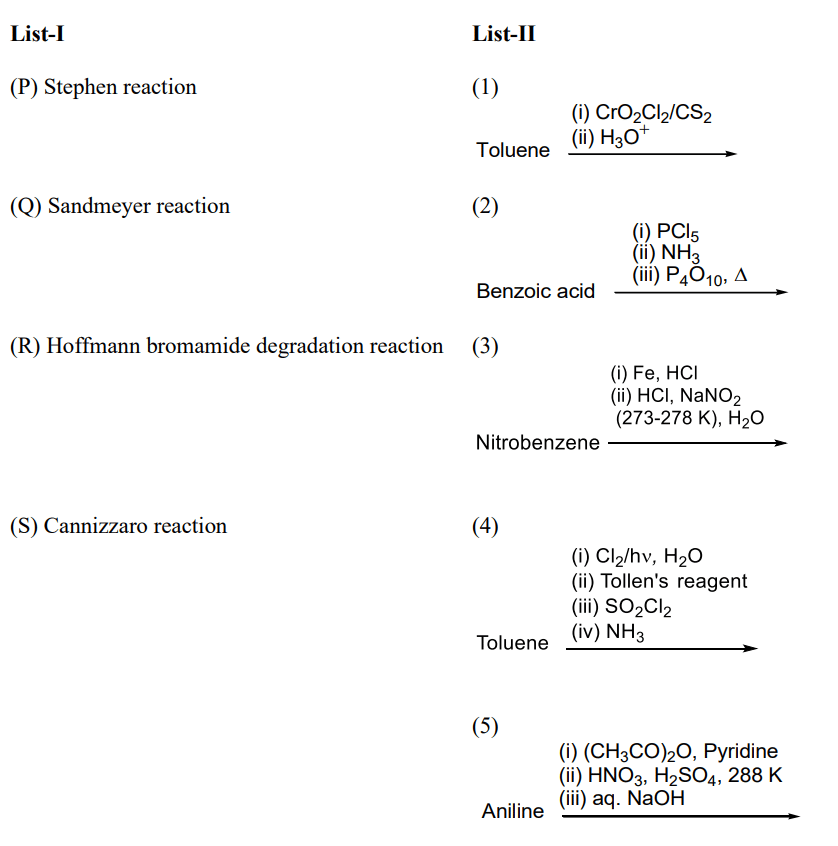
The major products obtained from the reactions in List-II are the reactants for the named reactions mentioned in List-I. Match each entry in List-I with the appropriate entry in List-II and choose the correct option.
1
P → 2; Q → 4; R → 1; S → 3
2
P → 2; Q → 3; R → 4; S → 1
3
P → 5; Q → 3; R → 4; S → 2
4

P → 5; Q → 4; R → 2; S → 1

42
PYQ 2025
medium
chemistry ID: jee-adva

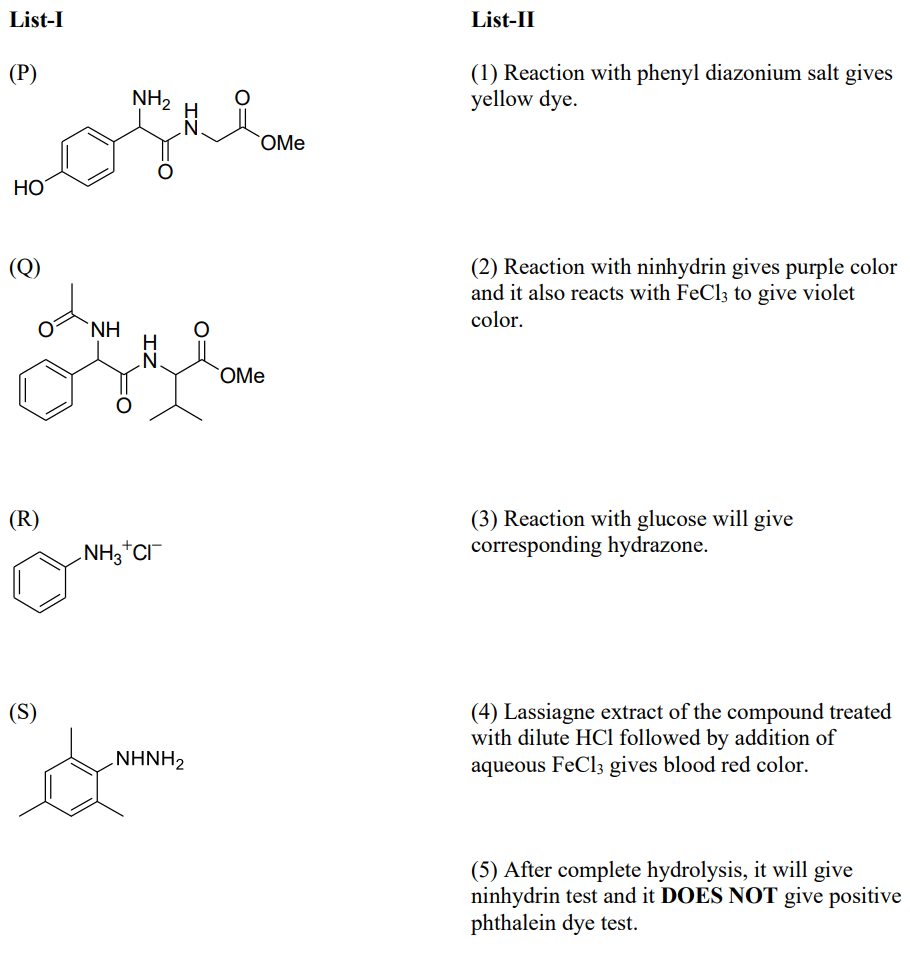
Match the compounds in List-I with the appropriate observations in List-II and choose the correct option.
1
P → 1; Q → 5; R → 4; S → 2
2
P → 2; Q → 5; R → 1; S → 3
3
P → 5; Q → 2; R → 1; S → 4
4

P → 2; Q → 1; R → 5; S → 3

43
PYQ 2025
medium
chemistry ID: jee-adva

For the reaction sequence given below, the correct statement(s) is (are):
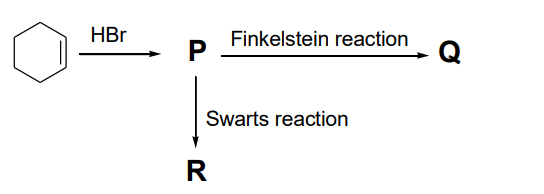
(In the options, X is any atom other than carbon and hydrogen, and it is different in P, Q, and R.)

1
C–X bond length in and follows the order
2
C–X bond enthalpy in and follows the order
3
Relative reactivity toward reaction in and follows the order
4

value of the conjugate acids of the leaving groups in and follows the order

44
PYQ 2025
hard
chemistry ID: jee-adva

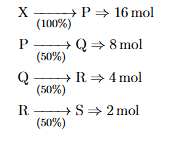
The reaction sequence given below is carried out with 16 moles of X. The yield of the major product in each step is given below the product in parentheses. The amount (in grams) of S produced is ____.
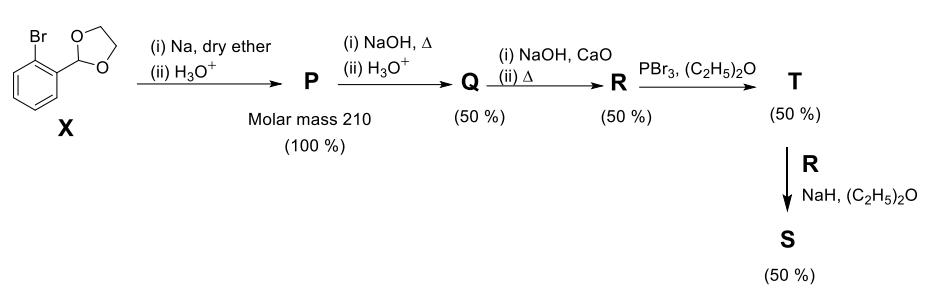
Use: Atomic mass (in amu): H = 1, C = 12, O = 16, Br = 80