Step 1: Understanding the reaction
The given compound is 1-methylcyclohex-1-ene. The reaction involves the mono-bromination of this compound using Br2 in the presence of UV light. UV light promotes a free-radical substitution mechanism, where the bromine atom (Br) can attach to different positions on the cyclohexene ring. This results in the formation of different possible isomers.
Step 2: Reaction mechanism
- In the presence of UV light, Br2 undergoes homolytic cleavage, forming two bromine radicals.
- The bromine radical then abstracts a hydrogen atom from one of the carbon atoms on the cyclohexene ring, generating a new carbon radical.
- The new carbon radical can then react with Br2 to form a bromo product.
Step 3: Identifying possible positions for bromine substitution
The cyclohexene ring has a methyl group at position 1 (from the given structure 1-methylcyclohex-1-ene). The potential positions for bromine substitution are: 1. On the carbon adjacent to the methyl group (position 2). 2. On the carbon at position 3 (next to the double bond). 3. On the carbon at position 4 (farther from the methyl group). 4. On the carbon at position 5 (on the other side of the double bond). Step 4: Analyzing possible stereoisomers
Upon substitution, the product may have stereoisomers due to the formation of chiral centers. A chiral center can form if the substitution creates a non-superimposable mirror image (enantiomer) or if the substitution is at a position where cis-trans isomerism can occur.
For instance, when bromine is attached to positions that create a chiral center (e.g., position 3 and 5), stereoisomers can be formed. Specifically, the bromination can lead to cis-trans isomerism at those positions.
Step 5: Count the possible isomers
- There are several positions where the bromine can be substituted, and each substitution can lead to different isomers due to cis-trans and stereoisomerism.
- The number of possible isomers, including both stereoisomers and geometrical isomers, is calculated as follows:
- For each possible position of bromine, there are two possible configurations: one where the bromine is attached to the same side (cis) and one where it is on the opposite side (trans).
- This results in several stereoisomers.
Step 6: Conclusion
The maximum number of possible isomers (including stereoisomers) that can be formed from the mono-bromination of 1-methylcyclohex-1-ene using Br2 and UV light is 13.
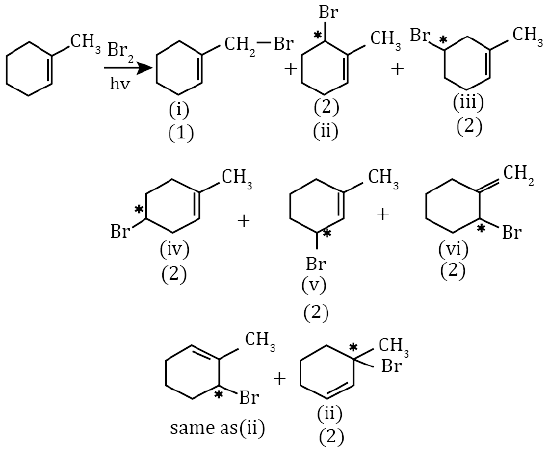
The monobromination of 1-methylcyclohexene under UV light occurs via a free radical mechanism. This process generates allyl radicals, which are stabilized through resonance, and secondary alkyl radicals, which are stabilized through hyperconjugation. Among the seven resulting products, six exhibit optical activity, leading to the formation of a total of 13 possible isomers.