Number of electrons in the valence orbit of nitrogen in an ammonia molecule are
1
8
2
5
3
6
4
7
Official Solution
Correct Option: (1)
The electronic configuration of nitrogen is It has 5 electrons in valence shell, hence in ammonia molecule it completes its octet by sharing 3 electrons with three H-atoms, therefore it has 8 electrons in its valence shell in ammonia molecule
02
PYQ 2018
medium
chemistryID: mht-cet-
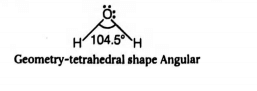
What is the geometry of water molecule?
1
distorted tetrahedral
2
tetrahedral
3
trigonal planer
4
diagonal
Official Solution
Correct Option: (1)
Geometry of a molecule can be predicted by using the formula
= valence shell electrons of the central atom
= number of monovalent atom
total positive charge
total negative charge
In case of molecule,
Hybridisation of molecule comes out to be Thus the geometry of molecule is tetrahedral but the shape is distorted tetrahedral or angular due to presence of two lone pair of electrons.
03
PYQ 2018
easy
chemistryID: mht-cet-
Formation of is explained on the basis of what hybridisation of phosphorus atom
Official Solution
Correct Option: (1)
04
PYQ 2020
medium
chemistryID: mht-cet-
The electronic configuration of Be molecule according to MOT is
1
( ) ( ), ( ), ( )
2
( ) ( ), ( ), ( )
3
( ) ( ), ( ), ( )
4
( ) ( ), ( ), ( )
Official Solution
Correct Option: (2)
Step 1: Understanding Molecular Orbital Theory (MOT). According to MOT, the electronic configuration of molecules is determined by the combination of atomic orbitals to form molecular orbitals. For Be , the bonding molecular orbitals are filled first, followed by the antibonding orbitals. Step 2: Analyzing the options. (A) ( ) ( ), ( ), ( ): This is incorrect because the antibonding orbital should be filled. (B) ( ) ( ), ( ), ( ): This is the correct configuration for Be , with both the bonding and antibonding orbitals filled as per MOT. (C) ( ) ( ), ( ), ( ): This is incorrect because Be does not have an unpaired electron in the orbital. (D) ( ) ( ), ( ), ( ): This is incorrect because the orbital cannot have only one electron. Step 3: Conclusion. The correct electronic configuration for Be according to MOT is (B).
05
PYQ 2020
medium
chemistryID: mht-cet-
What is the bond order in molecule?
1
2
zero
3
4
Official Solution
Correct Option: (4)
Step 1: Write the electronic configuration. Nitrogen molecule has a total of 14 electrons. Step 2: Apply molecular orbital theory. In , there are 10 electrons in bonding molecular orbitals and 4 electrons in antibonding molecular orbitals. Step 3: Calculate bond order.
Step 4: Conclusion. Hence, the bond order of the nitrogen molecule is .
06
PYQ 2020
medium
chemistryID: mht-cet-
What is molecular formula of allyl bromide?
1
2
3
4
Official Solution
Correct Option: (3)
Step 1: Understanding allyl group. The allyl group has the structure .
Step 2: Formation of allyl bromide. When bromine replaces one hydrogen atom of the allyl group, allyl bromide is formed.
Step 4: Conclusion. Thus, the molecular formula of allyl bromide is .
07
PYQ 2020
medium
chemistryID: mht-cet-
Identify the major product ‘B’ in the following reaction. Propene A B
1
2–Chloropropane
2
Propan–2–ol
3
1–Chloropropane
4
Propan–1–ol
Official Solution
Correct Option: (2)
Step 1: Addition of HCl to propene. HCl adds to propene according to Markovnikov’s rule.
Product A is 2–chloropropane. Step 2: Reaction of A with aqueous KOH. Aqueous KOH causes nucleophilic substitution forming alcohol.
Step 3: Identify product B. The product formed is propan–2–ol. Step 4: Conclusion. Major product B is propan–2–ol.
08
PYQ 2020
medium
chemistryID: mht-cet-
Which of the following molecules is a polar molecule?
1
Oxygen (O )
2
Hydrogen (H )
3
Carbon dioxide (CO )
4
Hydrogen Chloride (HCl)
Official Solution
Correct Option: (4)
Step 1: Understanding polarity of molecules. A polar molecule is one in which the electrons are not equally shared between atoms, leading to a dipole moment. This occurs when there is a significant difference in electronegativity between the atoms. Step 2: Analyzing the options. - (A) Oxygen (O ): Oxygen is a diatomic molecule with equal electronegativity, so it is non-polar.
- (B) Hydrogen (H ): Similar to oxygen, hydrogen is a diatomic molecule with equal electronegativity, so it is non-polar.
- (C) Carbon dioxide (CO ): Despite having polar bonds, the linear shape of CO makes it a non-polar molecule because the dipoles cancel each other out.
- (D) Hydrogen chloride (HCl): HCl has a polar bond because chlorine is much more electronegative than hydrogen, making it a polar molecule. Step 3: Conclusion. Thus, HCl is a polar molecule, corresponding to option (D).
09
PYQ 2020
medium
chemistryID: mht-cet-
Which among the following is a first oxidation product of butan-2-ol?
1
Butanal
2
Butanoic acid
3
Propanoic acid and
4
Butan-2-one
Official Solution
Correct Option: (4)
Step 1: Identifying the nature of butan-2-ol. Butan-2-ol is a secondary alcohol because the hydroxyl group is attached to a carbon atom bonded to two other carbon atoms.
Step 2: Oxidation behavior of secondary alcohols. On oxidation, secondary alcohols are converted into ketones. They do not form aldehydes or acids in the first step of oxidation.
Step 3: Applying the concept. When butan-2-ol is oxidized, it loses hydrogen atoms and forms the corresponding ketone, which is butan-2-one.
Step 4: Conclusion. Therefore, the first oxidation product of butan-2-ol is butan-2-one.
10
PYQ 2020
medium
chemistryID: mht-cet-
Which type of overlap is involved in formation of C-H bond in ethene molecule?
1
sp - p
2
sp - s
3
sp - s
4
sp - s
Official Solution
Correct Option: (1)
Step 1: Understanding the bond formation. In ethene (C H ), the carbon atoms are sp hybridized and form sigma bonds with hydrogen atoms. The overlap that occurs between the sp hybrid orbital of carbon and the p orbital of hydrogen results in the C-H bond. This is the sp - p overlap. Step 2: Analyzing the options. (A) sp - p: Correct. This is the correct overlap in ethene for the formation of the C-H bond. (B) sp - s: Incorrect. This overlap occurs in other bonding situations but not in ethene. (C) sp - s: Incorrect. This is not the correct overlap for the C-H bond in ethene. (D) sp - s: Incorrect. This overlap does not occur in the C-H bond in ethene. Step 3: Conclusion. The correct answer is (A) sp - p, as this is the overlap involved in the formation of the C-H bond in ethene.
11
PYQ 2020
medium
chemistryID: mht-cet-
What is the value of dipole moment for HCl molecule?
1
1.91 D
2
1.03 D
3
1.85 D
4
3.33 D
Official Solution
Correct Option: (2)
Step 1: Understanding dipole moment. The dipole moment ( ) of a molecule depends on the difference in electronegativity between the atoms and the distance between them. In HCl, chlorine is more electronegative than hydrogen, creating a dipole. Step 2: Analyzing the options. (A) 1.91 D: Incorrect. This is too high for HCl's dipole moment. (B) 1.03 D: Correct. This is the actual dipole moment value for the HCl molecule. (C) 1.85 D: Incorrect. This value does not match the dipole moment of HCl. (D) 3.33 D: Incorrect. This value is much too high for HCl. Step 3: Conclusion. The correct answer is (B) 1.03 D, which is the dipole moment of the HCl molecule.
12
PYQ 2020
medium
chemistryID: mht-cet-
Total number of lone pairs of electron on oxygen atoms in carbon dioxide are
1
2
2
3
3
4
4
1
Official Solution
Correct Option: (3)
Step 1: Understanding the structure of carbon dioxide. The molecular structure of carbon dioxide (CO ) consists of a central carbon atom doubly bonded to two oxygen atoms. Each oxygen atom has two lone pairs of electrons. Thus, there are a total of 4 lone pairs of electrons in CO . Step 2: Analyzing the options. (A) 2: This is incorrect, as each oxygen atom in CO has 2 lone pairs. (B) 3: This is incorrect, as there are 4 lone pairs in total. (C) 4: This is the correct answer, as each oxygen atom has 2 lone pairs, making a total of 4 lone pairs in CO . (D) 1: This is incorrect, as there are 4 lone pairs in CO . Step 3: Conclusion. The correct answer is (C) 4.
13
PYQ 2020
medium
chemistryID: mht-cet-
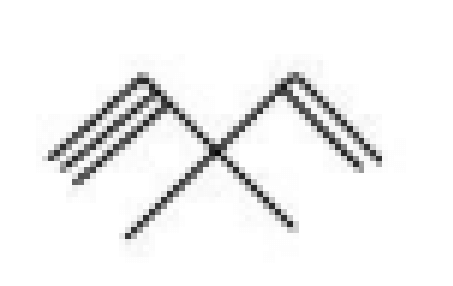
Why is bond order of molecule zero? (N = bonding electrons, N = antibonding electrons)
1
2
3
4
Official Solution
Correct Option: (4)
Step 1: Write the bond order formula. Bond order is given by:
Step 2: Electronic configuration of . Each Be atom has electronic configuration . In , the molecular orbital configuration becomes:
Step 3: Count bonding and antibonding electrons. Number of bonding electrons Number of antibonding electrons Step 4: Calculate bond order.
Step 5: Conclusion. Since the number of bonding electrons is equal to the number of antibonding electrons, the bond order of is zero.
14
PYQ 2020
medium
chemistryID: mht-cet-
In resonance hybrid of ozone molecule, O-O bond length is
1
128 pm
2
134.5 pm
3
121 pm
4
148 pm
Official Solution
Correct Option: (1)
Step 1: Understanding Ozone's Bond Length. In the resonance hybrid of the ozone (O ) molecule, the bonding is delocalized, meaning that the O-O bonds are not identical but have an intermediate bond length between a single and a double bond. This gives an average bond length of 128 pm.
Step 2: Analyzing the options. (A) 128 pm: Correct. The average O-O bond length in the resonance hybrid of ozone is 128 pm. (B) 134.5 pm: Incorrect. This bond length is longer than the actual bond length in ozone. (C) 121 pm: Incorrect. This bond length is shorter than the actual bond length in ozone. (D) 148 pm: Incorrect. This bond length is much longer than the actual O-O bond length in ozone.
Step 3: Conclusion. The correct bond length in the resonance hybrid of ozone is 128 pm, which corresponds to option (A).
15
PYQ 2020
medium
chemistryID: mht-cet-
What is the value of rate constant of first-order reaction, if it takes 15 minutes for consumption of 20% of reactants?
1
2
3
4
Official Solution
Correct Option: (4)
Step 1: Formula for rate constant of first-order reaction. For a first-order reaction, the equation is given by:
Substitute the given values into the formula: Step 2: Conclusion. The correct answer is (D) .
16
PYQ 2020
medium
chemistryID: mht-cet-
Which of the following metals is refined by vapour phase refining in Mond process?
1
Zn
2
Si
3
Ni
4
Zr
Official Solution
Correct Option: (3)
Step 1: Understanding the Mond process. The Mond process is a method used to purify nickel by converting it into a volatile carbonyl complex and then decomposing it to obtain pure nickel. This process is specifically used for nickel.
Step 2: Analyzing the options. (A) Zn: Zinc is not purified by the Mond process. (B) Si: Silicon is not refined by the Mond process. (C) Ni: Correct — Nickel is refined by the Mond process. (D) Zr: Zirconium is not refined by the Mond process.
Step 3: Conclusion. The correct answer is (C) Ni, as nickel is refined using the Mond process.
17
PYQ 2020
medium
chemistryID: mht-cet-
H molecule is more stable than Li molecule, because:
1
In H molecule molecular orbitals are shielded by electrons.
2
In H bond order is one.
3
In Li molecule molecular orbitals are shielded by electrons.
4
In Li molecule outer molecular orbitals are shielded by the inner electrons.
Official Solution
Correct Option: (4)
Step 1: Understanding Stability of Molecules. The stability of a molecule is related to its bond order, which is the difference between the number of electrons in bonding molecular orbitals and antibonding molecular orbitals. In H , the bond order is one, and the molecular orbitals are not significantly shielded. In Li , however, the molecular orbitals are shielded by the inner electrons, which reduces the bonding interaction and makes the molecule less stable.
Step 2: Analyzing the options. (A) In H molecule molecular orbitals are shielded by electrons: Incorrect. This statement is not relevant for the stability comparison of H and Li . (B) In H bond order is one: Incorrect. This is true, but it does not explain why H is more stable than Li . (C) In Li molecule molecular orbitals are shielded by electrons: Incorrect. This statement is not the reason for the instability of Li . (D) In Li molecule outer molecular orbitals are shielded by the inner electrons: Correct. This shielding reduces the effective bonding and makes Li less stable than H .
Step 3: Conclusion. The correct answer is (D), as it explains the reduced stability of the Li molecule due to electron shielding.
18
PYQ 2020
medium
chemistryID: mht-cet-
How many pi bonds and sigma bonds are present in the following molecule?
1
5 , 14 -bonds
2
3 , 17 -bonds
3
3 , 16 -bonds
4
2 , 17 -bonds
Official Solution
Correct Option: (3)
Step 1: Identifying Bond Types. In the given molecule, the sigma bonds ( ) are formed by the head-on overlap of orbitals, while pi bonds ( ) are formed by the sidewise overlap of p-orbitals. By counting the single and double bonds in the molecule, we can calculate the total number of sigma and pi bonds. Typically, for a molecule with alternating single and double bonds, the number of pi bonds will be equal to the number of double bonds, and sigma bonds will be counted for both single and double bonds.
Step 2: Analyzing the options. (A) 5 , 14 -bonds: Incorrect. This is too many pi bonds for the given structure. (B) 3 , 17 -bonds: Incorrect. The number of sigma bonds is too high. (C) 3 , 16 -bonds: Correct. This is the correct count based on the given structure of alternating single and double bonds. (D) 2 , 17 -bonds: Incorrect. The number of pi bonds is too low for this structure.
Step 3: Conclusion. The correct count is 3 , 16 -bonds, which corresponds to option (C).
19
PYQ 2020
medium
chemistryID: mht-cet-
How many lone pair of electrons are present on chlorine atom in chlorous acid ?
1
2
3
4
Official Solution
Correct Option: (2)
Step 1: Formula of chlorous acid. Chlorous acid has the molecular formula .
Step 2: Valence electrons of chlorine. Chlorine has 7 valence electrons. In , chlorine forms two bonds with oxygen atoms.
Step 3: Lone pair calculation. After bond formation, chlorine retains two lone pairs of electrons.
Step 4: Conclusion. Thus, the number of lone pairs present on chlorine atom in chlorous acid is 2.
20
PYQ 2020
medium
chemistryID: mht-cet-
Which among the following orbitals form Delta ( ) molecular orbitals?
1
and orbitals
2
and orbitals
3
and orbitals
4
and orbitals
Official Solution
Correct Option: (4)
Step 1: Understanding delta molecular orbitals. Delta ( ) molecular orbitals are formed by the sidewise overlap of orbitals having four lobes lying in the plane perpendicular to the internuclear axis.
Step 2: Nature of d-orbitals. The and orbitals possess four lobes oriented between or along the axes, making them suitable for overlap.
Step 3: Elimination of other options. Orbitals like and are involved in or bonding, not bonding.
Step 4: Conclusion. Hence, molecular orbitals are formed by the overlap of and orbitals}.
21
PYQ 2020
medium
chemistryID: mht-cet-
What is the formal charge on hydrogen atom in water molecule?
1
2
3
4
Official Solution
Correct Option: (2)
Step 1: Formula for formal charge. Formal charge is calculated using the formula:
Step 2: Formal charge on hydrogen in water. Hydrogen has 1 valence electron and forms one single covalent bond with oxygen. It has no lone pair electrons.
Step 3: Conclusion. Thus, the formal charge on hydrogen atom in water molecule is zero.
22
PYQ 2020
medium
chemistryID: mht-cet-
How many lone pairs of electrons are present on each oxygen atom in any oxy acids of chlorine?
1
0
2
3
3
1
4
2
Official Solution
Correct Option: (4)
Step 1: Understanding oxy acids of chlorine. In oxy acids of chlorine, such as hypochlorous acid (HOCl) or chloric acid (HClO₃), each oxygen atom typically has two lone pairs of electrons. This is because oxygen tends to form two bonds and retain two lone pairs of electrons. Step 2: Analyzing the options. (A) 0: Incorrect. Oxygen in oxy acids of chlorine always has lone pairs. (B) 3: Incorrect. Oxygen in these acids does not have 3 lone pairs. (C) 1: Incorrect. Oxygen in oxy acids generally has 2 lone pairs. (D) 2: Correct — Each oxygen atom in oxy acids of chlorine has 2 lone pairs of electrons. Step 3: Conclusion. The correct answer is (D) 2, as each oxygen atom in oxy acids of chlorine has two lone pairs of electrons.
23
PYQ 2020
medium
chemistryID: mht-cet-
Which of the following molecules contain hybrid orbitals with 25% 's' character?
1
Ethylene
2
Boron trifluoride
3
Acetylene
4
Methane
Official Solution
Correct Option: (4)
Step 1: Understanding hybridization. Hybridization is the process of mixing atomic orbitals to form new hybrid orbitals. Methane ( ) involves hybridization, which has 25% -character and 75% -character. Step 2: Analyzing the options. (A) Ethylene: Incorrect. Ethylene involves hybridization, with 33.33% -character. (B) Boron trifluoride: Incorrect. Boron trifluoride involves hybridization as well. (C) Acetylene: Incorrect. Acetylene involves hybridization, which has 50% -character. (D) Methane: Correct — Methane involves hybridization, which has 25% -character. Step 3: Conclusion. The correct answer is (D) Methane, as it contains hybrid orbitals with 25% -character.
24
PYQ 2020
medium
chemistryID: mht-cet-
An ideal gas expands isothermally and reversibly from 10m to 20m at 300K, performing 5×10 J of work on surroundings, calculate number of moles of gas used?
1
1
2
3
3
2
4
1.5
Official Solution
Correct Option: (2)
Step 1: Using the work equation for an isothermal process. For an ideal gas expanding isothermally, the work done is given by:
Where: - (work done) - (gas constant) - (temperature) - (initial volume) - (final volume) Step 2: Rearranging the equation. Substitute the known values:
Step 3: Conclusion. The correct answer is (B) 3 moles.
25
PYQ 2020
medium
chemistryID: mht-cet-
If is the magnitude of charge and is the distance between the centres of positive and negative charges, then dipole moment ( ) is given by
1
2
3
4
Official Solution
Correct Option: (2)
Step 1: Understanding dipole moment. Dipole moment is a vector quantity that represents the separation of positive and negative charges in a molecule. It depends on the magnitude of charge and the distance between the charges.
Step 2: Mathematical expression. For a dipole consisting of charges and separated by a distance , the dipole moment is defined as:
Step 3: Analysis of options. (A) Incorrect — dipole moment is not a sum of charge and distance. (B) Correct — dipole moment is the product of charge and separation distance. (C) Incorrect — inverse relation is not applicable. (D) Incorrect — subtraction has no physical meaning here.
Step 4: Conclusion. The correct expression for dipole moment is .
26
PYQ 2020
medium
chemistryID: mht-cet-
Identify the enzyme that catalyses the reaction of CO with water in the human body.
1
Ferroxidase
2
Catalase
3
Nitrogenase
4
Carbonic anhydrase
Official Solution
Correct Option: (4)
Step 1: Understanding the reaction. Carbonic anhydrase is the enzyme responsible for catalyzing the reversible hydration of carbon dioxide to form carbonic acid (H CO ) in the human body. This reaction is important in processes like respiration and maintaining pH balance.
Step 2: Analyzing the options. (A) Ferroxidase: This enzyme catalyzes the oxidation of iron, not the reaction of CO with water. (B) Catalase: Catalase catalyzes the breakdown of hydrogen peroxide, not CO . (C) Nitrogenase: Nitrogenase is involved in nitrogen fixation, not the hydration of CO . (D) Carbonic anhydrase: This is the correct enzyme, as it catalyzes the reaction between CO and water.
Step 3: Conclusion. The correct answer is (D) Carbonic anhydrase.
27
PYQ 2020
medium
chemistryID: mht-cet-
According to molecular orbital theory, antibonding molecular orbitals of O contain
1
4 electrons
2
6 electrons
3
10 electrons
4
8 electrons
Official Solution
Correct Option: (1)
Step 1: Understanding molecular orbitals. In molecular orbital theory, the antibonding molecular orbitals of diatomic oxygen (O ) are formed from the overlap of atomic orbitals. For O , the antibonding orbitals are the and orbitals. O has a total of 16 electrons, with 10 electrons in bonding orbitals and 6 in antibonding orbitals. Of these, 4 electrons occupy the antibonding orbitals. Step 2: Analyzing the options. (A) 4 electrons: This is correct. O has 4 electrons in antibonding molecular orbitals, specifically in the orbitals. (B) 6 electrons: This is incorrect. There are only 4 electrons in antibonding orbitals in O . (C) 10 electrons: This is incorrect. Only 4 electrons are in antibonding orbitals, not 10. (D) 8 electrons: This is incorrect. O has 4 electrons in antibonding orbitals. Step 3: Conclusion. The correct answer is (A) 4 electrons.
28
PYQ 2020
medium
chemistryID: mht-cet-
The H-N-H bond angle in NH molecule is
1
101°
2
90°
3
109° 28'
4
107° 18'
Official Solution
Correct Option: (4)
Step 1: Understanding the bond angle in NH . Ammonia (NH ) has a trigonal pyramidal geometry, where the bond angle is slightly less than 109.5°, the ideal bond angle for a tetrahedral structure. The actual bond angle in NH is around 107° 18'.
Step 2: Analyzing the options. (A) 101°: This bond angle is too small for NH . (B) 90°: This bond angle is incorrect as NH has a pyramidal shape with a larger bond angle. (C) 109° 28': This is the ideal bond angle for a tetrahedral molecule, not for NH . (D) 107° 18': Correct — This is the observed bond angle in NH .
Step 3: Conclusion. The correct answer is (D) 107° 18', as it is the bond angle in NH .
29
PYQ 2020
medium
chemistryID: mht-cet-
In which of the following molecules, 2 bonds are present?
1
C H
2
C H
3
C H
4
C H
Official Solution
Correct Option: (3)
Step 1: Understanding bonds. A bond is formed by the sideways overlap of p-orbitals. Alkenes and alkynes contain bonds. In C H (ethyne or acetylene), the carbon-carbon triple bond consists of one sigma bond and two bonds.
Step 2: Analyzing the options. (A) C H : This is ethane, which contains only sigma bonds. (B) C H : This is ethene, which contains one bond along with the sigma bond in the carbon-carbon double bond. (C) C H : Correct — This molecule contains two bonds in the triple bond. (D) C H : This is cyclohexene, which contains one bond in the carbon-carbon double bond.
Step 3: Conclusion. The correct answer is (C) C H , as it contains two bonds.
30
PYQ 2020
medium
chemistryID: mht-cet-
Which of the following is a multimolecular colloid?
1
Silver sol
2
Solution of rubber in organic solvent
3
Aqueous solution of protein
4
Aqueous polyvinyl alcohol
Official Solution
Correct Option: (1)
Step 1: Understanding multimolecular colloids. Multimolecular colloids are those where the particles consist of aggregates of molecules, typically smaller than macromolecules. These particles can be made from small molecules or atoms.
Step 2: Analyzing the options. (A) Silver sol: Correct — Silver sol is a colloidal solution where silver particles are dispersed in water and they form aggregates. This qualifies as a multimolecular colloid. (B) Solution of rubber in organic solvent: This is a macromolecular colloid, not multimolecular. (C) Aqueous solution of protein: This can be a macromolecular colloid, where proteins are large molecules and form colloidal solutions. (D) Aqueous polyvinyl alcohol: This is a macromolecular colloid as well.
Step 3: Conclusion. The correct answer is (A) Silver sol, as it is an example of a multimolecular colloid.
31
PYQ 2020
medium
chemistryID: mht-cet-
Energy required to dissociate of into free atoms is . The value of bond enthalpy of bond is
1
2
3
4
Official Solution
Correct Option: (1)
Step 1: Convert mass into moles. Molar mass of . Step 2: Interpret given energy. Energy is required to break mol of bonds. Step 3: Calculate bond enthalpy. Energy required to break mol of bonds is: Step 4: Conclusion. Thus, bond enthalpy of bond is .
32
PYQ 2020
medium
chemistryID: mht-cet-
An organic compound was found to contain 40.0% C and 6.66% H. Find its molecular formula (molar mass = 180).
1
C H O
2
C H O
3
CH O
4
C H O
Official Solution
Correct Option: (4)
Step 1: Understanding the mass percentages. Let the molar mass of the compound be 180 g/mol. From the given percentages, the mass of carbon (C) in 180 g is: The mass of hydrogen (H) is: Step 2: Determining moles of C and H. - Moles of C = moles. - Moles of H = moles. Step 3: Finding the empirical formula. The empirical formula is C H , and since the molar mass is 180 g/mol, we can find the molecular formula by dividing the molar mass by the empirical formula mass (which is ). Thus, the molecular formula is C H O .
Step 4: Conclusion. The correct molecular formula is (D) C H O .
33
PYQ 2020
medium
chemistryID: mht-cet-
What is the order of reaction for decomposition of gaseous acetaldehyde?
1
1
2
2
3
1.5
4
0
Official Solution
Correct Option: (3)
Step 1: Understanding the reaction order. The decomposition of gaseous acetaldehyde (CH CHO) follows a reaction with fractional order. Experimental data show that the reaction order for this process is 1.5, meaning the reaction rate depends on both the first and second powers of the concentration of acetaldehyde.
Step 2: Analyzing the options. (A) 1: This is incorrect. The reaction is not a simple first-order reaction. (B) 2: This is incorrect. The reaction is not second order. (C) 1.5: Correct — The order of the reaction is 1.5. (D) 0: This is incorrect. A zero-order reaction would imply that the rate of reaction does not depend on the concentration, which is not the case here.
Step 3: Conclusion. The correct answer is (C) 1.5.
34
PYQ 2020
medium
chemistryID: mht-cet-
If one 's', three 'p' and one 'd' atomic orbitals take part in hybridization, then number of hybrid orbitals formed are
1
5
2
3
3
4
4
2
Official Solution
Correct Option: (1)
Step 1: Understanding hybridization. Hybridization involves the mixing of atomic orbitals to form hybrid orbitals. The number of hybrid orbitals formed is equal to the number of atomic orbitals mixed. Here, 1 's', 3 'p', and 1 'd' orbitals are mixed, so 5 hybrid orbitals will be formed. Step 2: Analyzing the options. (A) 5: Correct — The number of hybrid orbitals formed is the sum of 1 from the 's' orbital, 3 from the 'p' orbitals, and 1 from the 'd' orbital, giving a total of 5. (B) 3: Incorrect, this would be the case if only 3 orbitals were involved. (C) 4: Incorrect, this would be the case if only 4 orbitals were involved. (D) 2: Incorrect, this would be the case if only 2 orbitals were involved. Step 3: Conclusion. The correct answer is (A) 5.
35
PYQ 2020
medium
chemistryID: mht-cet-
What type of hybridisation results in tetrahedral geometry?
1
2
3
4
Official Solution
Correct Option: (3)
Step 1: Understand tetrahedral geometry. In tetrahedral geometry, four equivalent orbitals arrange themselves to minimize repulsion. Step 2: Hybridisation involved. One orbital and three orbitals hybridise to form four equivalent hybrid orbitals. Step 3: Conclusion. Hence, hybridisation results in tetrahedral geometry.
36
PYQ 2020
medium
chemistryID: mht-cet-
Which type of overlap is involved in the formation of O–H bonds in a water molecule?
1
2
3
4
Official Solution
Correct Option: (2)
Step 1: Hybridization of oxygen. In a water molecule, the oxygen atom undergoes hybridization due to two bond pairs and two lone pairs. Step 2: Orbital overlap involved. Each O–H bond is formed by the overlap of an -hybridized orbital of oxygen with the orbital of hydrogen. Step 3: Conclusion. Hence, the overlap involved is .
37
PYQ 2020
medium
chemistryID: mht-cet-
Which of the following molecules does not obey octet rule?
1
2
NaCl
3
4
Official Solution
Correct Option: (4)
Step 1: Understanding the octet rule. The octet rule states that atoms tend to form molecules in which they have eight electrons in their valence shell. However, some molecules do not follow this rule, such as those involving elements from periods 3 or higher that can have more than 8 electrons in their valence shell. Step 2: Analyzing the options. (A) : Correct, nitrogen obeys the octet rule with 8 electrons in its valence shell. (B) NaCl: Correct, sodium and chlorine both obey the octet rule. (C) : Correct, chlorine obeys the octet rule with 8 electrons in its valence shell. (D) : Incorrect — violates the octet rule, as sulfur has 12 electrons in its valence shell. Step 3: Conclusion. The correct answer is (D) .
38
PYQ 2020
medium
chemistryID: mht-cet-
What type of hybridization is present in PCl molecule?
1
sp hybridization
2
sp hybridization
3
sp d hybridization
4
sp d hybridization
Official Solution
Correct Option: (3)
Step 1: Understanding PCl structure. In the PCl molecule, phosphorus is the central atom, surrounded by five chlorine atoms. The molecule adopts a trigonal bipyramidal structure, where three chlorine atoms are in the equatorial plane and two are in the axial positions. This arrangement indicates the use of sp d hybridization, where one 3s, three 3p, and one 3d orbital mix to form five hybrid orbitals. Step 2: Analyzing the options. (A) sp hybridization: This is incorrect as it only involves three orbitals and would not result in five bonds. (B) sp hybridization: This is incorrect as it involves four orbitals and is suitable for tetrahedral geometry, not for five bonds. (C) sp d hybridization: This is correct as it involves five hybrid orbitals and is appropriate for the trigonal bipyramidal geometry of PCl . (D) sp d hybridization: This is incorrect, as it is not necessary for the bonding in PCl . Step 3: Conclusion. The correct answer is (C) sp d hybridization, which is used in PCl for its trigonal bipyramidal structure.
39
PYQ 2022
hard
chemistryID: mht-cet-
The number of sigma bonds in vanillin is?
Official Solution
Correct Option: (1)
The structure of vanillin consists of several functional groups. Let's break down the compound and count the σ bonds in each part:
Carbon-Carbon (C-C) bonds: Vanillin has a total of 8 carbon atoms, which are all connected to each other through single σ bonds. Therefore, there are 8 σ bonds in the carbon skeleton.
Carbon-Oxygen (C-O) bonds: Vanillin contains three C-O bonds—one between the aldehyde functional group (-CHO) and a carbon atom, and two between the aromatic ring and oxygen atoms in the hydroxyl groups (-OH). Therefore, there are 3 σ bonds in C-O.
Carbon-Hydrogen (C-H) bonds: Vanillin has 8 carbon atoms, and each carbon atom is bonded to hydrogen atoms. Since each C-H bond is a single σ bond, there are a total of 8 σ bonds in C-H. Adding up the σ bonds in each category: 8 σ bonds (C-C) + 3 σ bonds (C-O) + 8 σ bonds (C-H) = 19 σ bonds Therefore, vanillin contains 19 sigma (σ) bonds.
40
PYQ 2022
easy
chemistryID: mht-cet-
Identify the correct increasing order of energies of molecular orbitals for F2 molecule.
1
2
3
4
Official Solution
Correct Option: (4)
Let's break down the options to understand why this is the correct order:
In the F2 molecule, the bonding orbital is formed by the overlap of the two 1s atomic orbitals from each fluorine atom. This bonding orbital is lower in energy compared to the other molecular orbitals.
The antibonding orbital is formed by the destructive overlap of the two 1s atomic orbitals. It is higher in energy than the bonding orbital.
The bonding orbital is formed by the overlap of the two 2s atomic orbitals from each fluorine atom. It is lower in energy than the σ* 1s orbital.
Finally, the antibonding orbital is formed by the destructive overlap of the two 2s atomic orbitals. It is higher in energy than the bonding orbital.
Therefore, the correct order is , which corresponds to option (D).
41
PYQ 2022
easy
chemistryID: mht-cet-
Which among the following is correct decreasing order of covalent character of ionic bond?
1
NaCl > MgCl2 > AlCl3
2
AlCl3 > NaCl > MgCl2
3
AlCl3 > MgCl2 > NaCl
4
MgCl2 > NaCl > AlCl3
Official Solution
Correct Option: (3)
The covalent character in an ionic bond is determined by the difference in electronegativity between the atoms involved. When the electronegativity difference is small, the ionic bond tends to have more covalent character. In the given options, aluminum chloride (AlCl3) has the highest covalent character because aluminum (Al) and chlorine (Cl) have a relatively small electronegativity difference. Magnesium chloride (MgCl2) has a slightly higher electronegativity difference than AlCl3, but still less than sodium chloride (NaCl). Therefore, the decreasing order of covalent character is AlCl3 > MgCl2 > NaCl. Option (C) AlCl3 > MgCl2 > NaCl represents the correct decreasing order of covalent character of the ionic bond among the provided options.
42
PYQ 2023
medium
chemistryID: mht-cet-
Find bond order; N2 +, N2 - , N2 +2, CO. Arrange the given molecules in increasing order of their acidic strength.
Official Solution
Correct Option: (1)
To determine the bond order of each molecule, we need to examine the molecular orbital diagram for each species. The bond order is calculated by taking the difference between the number of bonding electrons and the number of antibonding electrons and dividing it by 2.
N2+: In N2+, one electron is removed from the antibonding orbital. The molecular orbital configuration is then: - Bonding electrons: 5 - Antibonding electrons: 2 The bond order is calculated as: So, the bond order for N2+ is 1.5.
N2-: In N2-, an additional electron is added to the antibonding orbital. The molecular orbital configuration is: - Bonding electrons: 5 - Antibonding electrons: 4 The bond order is: Therefore, the bond order for N2- is 0.5.
N22+: N22+ does not exist as a stable molecule. This is because it requires the addition of four electrons to the antibonding orbitals, which is highly unfavorable in terms of molecular stability.
CO: CO has a triple bond between carbon and oxygen. The molecular orbital diagram for CO shows that there are 10 bonding electrons and 6 antibonding electrons. The bond order is: So, the bond order for CO is 2.
Arranging the molecules in increasing order of their acidic strength: The increasing order of acidic strength can be determined by looking at the bond order and stability. A higher bond order typically corresponds to greater stability and weaker acidity (less likely to donate protons). Therefore, the order is:
N2- < N2+ < CO < N22+
Conclusion: In terms of increasing acidic strength, the correct order is: N2-, N2+, CO, N22+.
43
PYQ 2024
medium
chemistryID: mht-cet-
Antibonding molecular orbital is formed by
1
Addition of two atomic orbitals
2
Subtraction of two atomic orbitals
3
Interaction of two atomic orbitals
4
Combination of two atomic orbitals
Official Solution
Correct Option: (2)
Step 1: Antibonding molecular orbitals are formed when two atomic orbitals combine in such a way that they cancel each other out, leading to destructive interference. This process is known as the subtraction of atomic orbitals.
Step 2: - (A) Addition of atomic orbitals forms bonding molecular orbitals.
- (C) Interaction of atomic orbitals is a general term, but it doesn't specify the formation of antibonding orbitals.
- (D) Combination refers to both bonding and antibonding orbital formation, but antibonding orbitals specifically form by subtraction. Conclusion: Antibonding molecular orbitals are formed by the subtraction of atomic orbitals.
44
PYQ 2024
medium
chemistryID: mht-cet-
Hot concentrated sulphuric acid is a moderately strong oxidizing agent, which of the following reactions does not show oxidizing behaviour?
1
2
Oxidation of SO2 to SO3
3
Dehydration of alcohols to alkenes
4
Reaction with metals to form metal sulfates
Official Solution
Correct Option: (1)
Step 1: In this reaction, sulfuric acid is acting as a catalyst and does not undergo a change in oxidation state, so it does not exhibit oxidizing behavior. It is simply facilitating the reaction.
Step 2: - (B) Sulfuric acid oxidizes sulfur dioxide (SO2) to sulfur trioxide (SO3), showing oxidizing behavior.
- (C) Sulfuric acid dehydrates alcohols to form alkenes, but it does not show oxidizing behavior.
- (D) Sulfuric acid reacts with metals to form metal sulfates, which is typically an oxidation process. Conclusion: Reaction (A) does not exhibit oxidizing behavior.
45
PYQ 2025
medium
chemistryID: mht-cet-
Which from following medicinal properties is exhibited by curcumin?
1
Analgesic
2
Antiseptic
3
Antioxidant
4
Antimicrobial
Official Solution
Correct Option: (3)
Step 1: Fact Check
Curcumin is the active ingredient found in Turmeric (Haldi). Step 2: Properties
It is widely known for its anti-inflammatory and potent **antioxidant** properties. While it has mild antimicrobial/antiseptic effects, its primary classification in modern chemistry/pharmacology syllabus is as an antioxidant. Final Answer: (C)
46
PYQ 2025
medium
chemistryID: mht-cet-
Which of the following ions will have the highest lattice energy?
1
2
3
4
Official Solution
Correct Option: (2)
Step 1: Recall the concept of lattice energy Lattice energy is the energy released when one mole of an ionic compound is formed from its ions in the gas phase. The lattice energy is higher when the ions are smaller and have a higher charge. Step 2: Compare the ionic compounds - has Na and Cl , both with a charge of .
- has and , both with a charge of .
- has K and Cl , with K being larger than Na .
- has and F , with smaller ions than NaCl, but the charges are still . Step 3: Conclude the highest lattice energy Among these, has ions with the highest charges (2+ and 2-) and smaller ionic radii compared to , , and . Hence, it will have the highest lattice energy. Answer: Therefore, will have the highest lattice energy. So, the correct answer is option (2).
47
PYQ 2025
medium
chemistryID: mht-cet-
Which of the following is the correct hybridization of the central atom in ?
1
2
3
4
Official Solution
Correct Option: (2)
In , the central carbon atom forms two double bonds with oxygen atoms. Since there are two regions of electron density around the carbon atom, the hybridization of the carbon atom is . Thus, the correct hybridization of the central atom in is , corresponding to option (2).
48
PYQ 2025
medium
chemistryID: mht-cet-
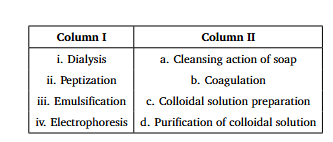
Match column I (process) with column II (application)
1
i - d, ii - a, iii - c, iv - b
2
i - d, ii - c, iii - a, iv - b
3
i - c, ii - b, iii - d, iv - a
4
i - b, ii - c, iii - a, iv - d
Official Solution
Correct Option: (2)
Concept:
Each colloidal process has a specific application. Step 1: Dialysis. Removes impurities â purification. Step 2: Peptization. Converts precipitate â colloidal solution. Step 3: Emulsification. Responsible for soap cleansing action. Step 4: Electrophoresis. Leads to coagulation. Step 5: Conclusion.
49
PYQ 2025
medium
chemistryID: mht-cet-
Which of the following compounds contains a coordinate (dative) covalent bond?
1
HCl
2
NH\textsubscript{3}
3
H\textsubscript{2}O
4
NH\textsubscript{4}\textsuperscript{+}
Official Solution
Correct Option: (4)
A coordinate covalent bond is a type of covalent bond in which both electrons in the shared pair come from the same atom. In the ammonium ion (NH\textsubscript{4}\textsuperscript{+}), one lone pair from nitrogen is donated to a hydrogen ion (H\textsuperscript{+}), forming a coordinate bond. The other three N–H bonds are regular covalent bonds. Other options: (a) HCl — polar covalent bond. (b) NH\textsubscript{3} — only covalent bonds. (c) H\textsubscript{2}O — only covalent bonds.
50
PYQ 2025
medium
chemistryID: mht-cet-
Which of the following elements has the highest electronegativity?
1
Oxygen
2
Nitrogen
3
Fluorine
4
Chlorine
Official Solution
Correct Option: (3)
Electronegativity is the tendency of an atom to attract a shared pair of electrons in a covalent bond. In the periodic table, electronegativity increases across a period and decreases down a group. Fluorine, being at the top right of the periodic table (excluding noble gases), has the highest electronegativity value of 3.98 (Pauling scale). Other options: (a) Oxygen (3.44) — high, but less than fluorine. (b) Nitrogen (3.04) — lower. (d) Chlorine (3.16) — high among halogens but still less than fluorine.
51
PYQ 2025
medium
chemistryID: mht-cet-
Which of the following is correct IUPAC name of catechol?
1
Benzene-1,2-diol
2
Benzene-1,3-diol
3
Benzene-1,4-diol
4
Benzene-1,3,5-triol
Official Solution
Correct Option: (1)
Step 1: Identification
Catechol is a dihydroxybenzene where the two hydroxyl ( ) groups are at the ortho positions relative to each other. Step 2: IUPAC Nomenclature
Numbering the benzene ring to give the substituents the lowest possible locants, the positions are 1 and 2. Step 3: Conclusion
The IUPAC name is Benzene-1,2-diol. Final Answer: (A)
52
PYQ 2025
medium
chemistryID: mht-cet-
Which of the following compounds is an example of an ionic bond?
1
H O
2
CO
3
NaCl
4
Cl
Official Solution
Correct Option: (3)
An ionic bond is formed when one atom transfers electrons to another atom, resulting in the formation of oppositely charged ions that are held together by electrostatic forces. - H O (water): Covalent bond between hydrogen and oxygen. - CO (carbon dioxide): Covalent bond between carbon and oxygen. - NaCl (sodium chloride): Ionic bond between sodium (Na) and chloride (Cl) ions. - Cl (chlorine gas): Covalent bond between two chlorine atoms. Answer: NaCl is an example of an ionic bond, so the correct answer is option (3).
53
PYQ 2025
medium
chemistryID: mht-cet-
What is the empirical formula of a compound containing 40% sulfur and 60% oxygen by mass?
1
2
3
4
Official Solution
Correct Option: (1)
We are given the following percentages by mass:
Sulfur (S) = 40%
Oxygen (O) = 60%
Step 1: Assume 100 g of the compound
This simplifies the calculation, as the percentage directly translates to grams:
Sulfur: 40 g
Oxygen: 60 g
Step 2: Convert mass to moles
The molar mass of sulfur (S) is 32 g/mol, and for oxygen (O) it is 16 g/mol:
For sulfur:
For oxygen:
Step 3: Find the mole ratio
To find the empirical formula, divide the moles of each element by the smallest number of moles:
For sulfur:
For oxygen:
Thus, the ratio of sulfur to oxygen is 1:3.
Step 4: Write the empirical formula
From the mole ratio of 1:3, the empirical formula of the compound is .
54
PYQ 2025
medium
chemistryID: mht-cet-
What is the value of the ionization energy of hydrogen in joules? (Given that the ionization energy of hydrogen is )
1
2
3
4
Official Solution
Correct Option: (1)
Step 1: Convert ionization energy from eV to joules 1 electronvolt (eV) is equal to . Therefore, the ionization energy of hydrogen in joules can be calculated by multiplying the energy in eV by the conversion factor: Step 2: Calculate the ionization energyAnswer: Therefore, the ionization energy of hydrogen is . So, the correct answer is option (1).
55
PYQ 2025
medium
chemistryID: mht-cet-
What is the total number of orbitals in the third energy level (n = 3)?
1
9
2
16
3
4
4
3
Official Solution
Correct Option: (1)
In the third energy level ( ), there are three possible sublevels:
The -sublevel has 1 orbital.
The -sublevel has 3 orbitals.
The -sublevel has 5 orbitals.
The total number of orbitals in the third energy level is the sum of the orbitals in each sublevel:
56
PYQ 2025
medium
chemistryID: mht-cet-
What is the molecular geometry of ?
1
Linear
2
Trigonal planar
3
Tetrahedral
4
Octahedral
Official Solution
Correct Option: (2)
Step 1: Determine the number of bonding and lone pairs on the central atom In , sulfur is the central atom. It is bonded to three oxygen atoms, and there are no lone pairs on the sulfur atom. The sulfur atom has 6 valence electrons, and the oxygen atoms each contribute 2 electrons. Thus, sulfur forms three double bonds with oxygen atoms. Step 2: Determine the molecular geometry Since there are three regions of electron density (three bonding pairs of electrons) and no lone pairs on the central sulfur atom, the molecular geometry is trigonal planar. Answer: Therefore, the molecular geometry of is trigonal planar. So, the correct answer is option (2).
57
PYQ 2025
medium
chemistryID: mht-cet-
Which from following mixtures obeys Raoult's law?
1
Chloroform + acetone
2
Carbon disulfide + acetone
3
Benzene + toluene
4
Ethanol + acetone
Official Solution
Correct Option: (3)
Raoult’s law is obeyed by ideal solutions. A solution behaves ideally when:
Intermolecular forces between , , and are nearly equal
No association or dissociation occurs
Components have similar molecular size and polarity
Step 1: Analyse each mixture
Chloroform + acetone: Strong hydrogen bonding occurs negative deviation from Raoult’s law (non-ideal)
Carbon disulfide + acetone: Different polarity and weak interactions positive deviation (non-ideal)
Benzene + toluene: Both are non-polar aromatic hydrocarbons with similar size and intermolecular forces ideal solution
Which of the following compounds exhibits ionic bonding?
1
H O
2
NaCl
3
CO
4
CH
Official Solution
Correct Option: (2)
Ionic bonding occurs when electrons are transferred from one atom to another, typically between metals and non-metals. In NaCl (sodium chloride), sodium (Na) donates an electron to chlorine (Cl), forming Na and Cl ions, which are held together by electrostatic forces. This is a classic example of ionic bonding. Thus, the compound that exhibits ionic bonding is NaCl.