Identify 'A' in the following reaction. CH -CH -CH=CH-NO CH -NO + CH -CH=CH-O
1
K Cr O
2
KMnO
3
H O
4
LiAlH
Official Solution
Correct Option:
(3)
Step 1: Analyzing the reaction. The given reaction involves the reduction of a nitro group (NO ) to form an amine group (NO to NH ) and an alkene group (CH=CH) undergoing hydration. This is a typical reaction for the reduction of nitro compounds and hydration of alkenes. The reagent H O (aqueous acid) facilitates both processes: it reduces the nitro group and promotes hydration. Step 2: Analyzing the options. (A) K Cr O : Potassium dichromate is an oxidizing agent, not a reducing agent, so it is not involved in this reaction. (B) KMnO : Potassium permanganate is an oxidizing agent, so it is not suitable for this reduction reaction. (C) H O : This is the correct answer. Aqueous acid is commonly used to reduce nitro groups to amines and to hydrate alkenes. (D) LiAlH : Lithium aluminium hydride is a strong reducing agent, but it would not be used here for hydration. Step 3: Conclusion. The correct answer is (C) H O .
02
PYQ 2020
medium
chemistryID: mht-cet-
Aluminium crystallises in face centred cubic structure, having atomic radius 125 pm. The edge length of the unit cell of aluminium is
1
253.5 pm
2
353.5 pm
3
465.0 pm
4
250.0 pm
Official Solution
Correct Option:
(2)
Step 1: Relation for FCC lattice. In a face centred cubic (fcc) structure, atoms touch along the face diagonal. The relation between edge length and atomic radius is:
Step 2: Substituting given value.
Step 3: Calculation.
Step 4: Conclusion. Thus, the edge length of the unit cell of aluminium is 353.5 pm.
03
PYQ 2020
medium
chemistryID: mht-cet-
Identify `A` in the following reaction:
1
Ethanol
2
Propane
3
1-Chloropropane
4
Propan-1-ol
Official Solution
Correct Option:
(1)
Step 1: Analyze the first reaction. In the first step, compound reacts with thionyl chloride in the presence of pyridine under reflux conditions. This reaction converts an alcohol into the corresponding alkyl chloride. Hence, compound must be an alcohol. Step 2: Analyze the second reaction. The alkyl chloride reacts with alcoholic potassium cyanide on heating. In this reaction, the cyanide ion replaces the halide ion via nucleophilic substitution, forming a nitrile. The product formed is propane nitrile, which contains three carbon atoms. Step 3: Carbon chain analysis. Since the nitrile product has three carbon atoms, the alkyl halide must be chloroethane, which upon reaction with KCN gives propionitrile (propane nitrile). Therefore, the original alcohol must be ethanol. Step 4: Evaluation of options. (A) Ethanol: Correct, as it forms chloroethane with , which then gives propane nitrile with KCN. (B) Propane: Incorrect, as alkanes do not react with . (C) 1-Chloropropane: Incorrect, as it is already a halide and not the starting compound . (D) Propan-1-ol: Incorrect, as it would lead to butane nitrile, not propane nitrile. Step 5: Conclusion. Thus, the compound is correctly identified as ethanol.
04
PYQ 2020
medium
chemistryID: mht-cet-
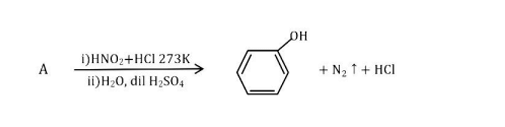
Identify compound 'A' in the following reaction.
1
Benzene
2
Chlorobenzene
3
Aniline
4
Cumene
Official Solution
Correct Option:
(3)
Step 1: Analyzing the reaction. The given reaction involves the nitration of an aromatic compound, followed by reduction. The nitration reaction involves the use of a mixture of nitric acid (HNO ) and hydrochloric acid (HCl), followed by heating at 273K. The reduction step is done with water and dilute H SO . This combination of reactions leads to the formation of an amine group, specifically aniline (C H NH ). Step 2: Analyzing the options. (A) Benzene: This is incorrect as the reaction produces an amine, not just benzene. (B) Chlorobenzene: This is incorrect because the reaction does not produce chlorobenzene. (C) Aniline: This is the correct answer, as the product of the reaction is aniline (C H NH ). (D) Cumene: This is incorrect because the reaction does not involve cumene. Step 3: Conclusion. The correct answer is (C) Aniline.
05
PYQ 2020
medium
chemistryID: mht-cet-
Hydroxide of which alkali metal is used in manufacture of soft soap?
1
Lithium
2
Caesium
3
Potassium
4
Sodium
Official Solution
Correct Option:
(4)
Step 1: Understanding the process. Sodium hydroxide (NaOH) is commonly used in the manufacture of soft soap. The reaction involves the saponification of fats and oils with sodium hydroxide, producing soap and glycerol. Step 2: Analyzing the options. (A) Lithium: Incorrect. Lithium hydroxide is not commonly used in soap making. (B) Caesium: Incorrect. Caesium hydroxide is highly reactive and not used in soap making. (C) Potassium: Incorrect. Potassium hydroxide is used in soft soap, but sodium is more common. (D) Sodium: Correct. Sodium hydroxide is the most common alkali used to make soft soap. Step 3: Conclusion. The correct answer is (D) Sodium, as sodium hydroxide is widely used in the production of soft soap.
06
PYQ 2020
medium
chemistryID: mht-cet-
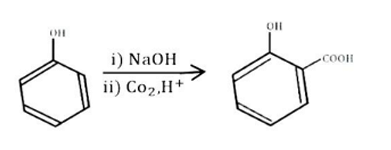
The reaction stated below is named as
1
Kolbe's reaction
2
Sandmeyer's reaction
3
Reimer-Tiemann reaction
4
Stephen reaction
Official Solution
Correct Option:
(1)
Step 1: Understanding Kolbe's reaction. Kolbe’s reaction is a decarboxylation reaction of carboxylates in the presence of a strong base, followed by the addition of carbon dioxide. The reaction given in the question represents the Kolbe reaction, which leads to the formation of a carboxylic acid. Step 2: Analyzing the options. (A) Kolbe's reaction: Correct — This is the correct reaction, where sodium phenoxide reacts with carbon dioxide to form salicylic acid. (B) Sandmeyer's reaction: Incorrect. This involves the conversion of diazonium salts to aryl halides, not a decarboxylation. (C) Reimer-Tiemann reaction: Incorrect. This reaction involves the introduction of a formyl group to a phenol molecule. (D) Stephen reaction: Incorrect. This reaction is related to the formation of imines, not a decarboxylation. Step 3: Conclusion. The correct answer is (A) Kolbe's reaction, which is a decarboxylation reaction that leads to the formation of a carboxylic acid.
07
PYQ 2026
medium
chemistryID: mht-cet-
Which of the following reagents is used to prepare alkyl isocyanides from alkyl halides ?
1
(alc.)
2
(alc.)
3
(aq.)
4
Official Solution
Correct Option:
(2)
Concept:
The cyanide ion is an ambident nucleophile, meaning it has two possible sites of attack:
Carbon end
Nitrogen end
The type of reagent used determines which atom participates in the nucleophilic attack, thereby deciding the final product. Step 1: {Reaction with .} is an ionic compound and dissociates completely in solution to give free ions. The nucleophilic attack occurs through the carbon atom, forming a bond and producing alkyl cyanides (nitriles). Step 2: {Reaction with .} is largely covalent in nature. In this compound, the carbon atom is strongly bonded to silver, leaving the nitrogen atom available for nucleophilic attack. As a result, the reaction forms alkyl isocyanides. Step 3: {Conclusion.} Since the formation of alkyl isocyanides occurs when nucleophilic attack takes place through nitrogen, the reagent required is:
08
PYQ 2026
easy
chemistryID: mht-cet-
Identify the product formed when reacts with alcoholic .
1
2
3
4
Official Solution
Correct Option:
(2)
Concept: Alkyl halides react differently with depending on the solvent:
Alcoholic → Elimination reaction producing an alkene.
Alcoholic promotes dehydrohalogenation, where a hydrogen atom and a halogen atom are removed from adjacent carbon atoms, forming a double bond. Step 1: {Identify the reactant.} The given compound is which is ethyl bromide, a primary alkyl halide. Step 2: {Apply elimination with alcoholic .} In the presence of alcoholic , the reaction proceeds via elimination of:
from one carbon
from the adjacent carbon
Step 3: {Identify the product.} The elimination forms the alkene which is ethene.
09
PYQ 2026
medium
chemistryID: mht-cet-
What product is formed when a ketone reacts with hydrazine ?
1
Alcohol
2
Hydrazone
3
Amide
4
Ester
Official Solution
Correct Option:
(2)
Concept: Ketones react with hydrazine in a condensation reaction to form hydrazones. This reaction involves nucleophilic attack of hydrazine on the carbonyl carbon followed by elimination of water. General reaction: The product is called a hydrazone. Step 1: {Identify the functional group in ketones.} Ketones contain the carbonyl group: Step 2: {Reaction with hydrazine.} Hydrazine acts as a nucleophile and attacks the carbonyl carbon, forming an intermediate which eliminates water. Step 3: {Formation of final product.} The final product contains the functional group which is known as a hydrazone. Hence, the correct option is (B).
About Organic Reactions - MHT-CET
Organic Reactions is a vital chapter for MHT-CET aspirants. Mastering the concepts covered in this chapter is essential for securing a top rank.
By rigorously practicing the previous year questions associated with this chapter, you can identify high-yield topics, understand the examiner's perspective, and boost your confidence during the actual exam.
Frequently Asked Questions
Why focus on Organic Reactions PYQs?
Analyzing PYQs for this specific chapter reveals the most frequently tested concepts and the typical complexity of questions, allowing you to tailor your study plan efficiently.
How to best use this analysis?
Review the topic breakdown to see which sub-topics within Organic Reactions carry the most weight. Then, tackle the questions iteratively to solidify your understanding.