Identify 'A' in the following reaction C H OH + HCl C H Cl + H O
1
anhydrous ZnCl
2
pyridine
3
conc. H SO
4
NaNO
Official Solution
Correct Option: (1)
Step 1: Understanding the reaction. The reaction involves the substitution of the hydroxyl group in ethanol (C H OH) with a chlorine atom to form ethyl chloride (C H Cl). This is a nucleophilic substitution reaction.
Step 2: Analyzing the options. (A) anhydrous ZnCl : Correct โ Anhydrous ZnCl is commonly used as a catalyst for this reaction because it helps in the activation of the hydroxyl group for nucleophilic substitution. (B) pyridine: Pyridine is often used in reactions involving acid chlorides, not for substitution reactions like this one. (C) conc. H SO : Concentrated sulfuric acid is a dehydrating agent and may be used in some substitution reactions but not specifically for this one. (D) NaNO : Sodium nitrite is used in diazotization reactions, not in this type of substitution reaction.
Step 3: Conclusion. The correct reagent is (A) anhydrous ZnCl .
02
PYQ 2020
medium
chemistryID: mht-cet-
Concentrated H SO reacts with PCl to produce
1
HClO
2
SO Cl
3
SOCl
4
HClO
Official Solution
Correct Option: (2)
Step 1: Understanding the reaction. Concentrated sulfuric acid (H SO ) reacts with phosphorus pentachloride (PCl ) to produce sulfuryl chloride (SO Cl ) and phosphorus oxychloride (POCl ).
Step 2: Analyzing the options. (A) HClO : This compound is not formed in the reaction with PCl . (B) SO Cl : Correct โ This is sulfuryl chloride, the product of the reaction. (C) SOCl : This is thionyl chloride, but it is not the product of this reaction. (D) HClO : This is perchloric acid, which is not formed in this reaction.
Step 3: Conclusion. The correct answer is (B) SO Cl , which is formed in the reaction between concentrated H SO and PCl .
03
PYQ 2020
medium
chemistryID: mht-cet-
Standard entropies of and are , and J K mol respectively. What is the value of for the formation of ?
1
2
3
4
Official Solution
Correct Option: (4)
Step 1: Write the balanced chemical equation.
Step 2: Write the entropy change expression.
Step 3: Substitute the given values.
Step 4: Conclusion. The correct expression for entropy change is option (D).
04
PYQ 2020
medium
chemistryID: mht-cet-
Which of the following oxyacids of sulphur contain SโOโS linkage?
1
2
3
4
Official Solution
Correct Option: (2)
Step 1: Understanding SโOโS linkage. An SโOโS linkage refers to a structure in which two sulphur atoms are connected through an oxygen atom. Such linkages are found in certain condensed oxyacids of sulphur. Step 2: Analyze each option. (A) : This compound does not contain an SโOโS bridge; the sulphur atoms are not linked through oxygen. (B) : This is pyrosulphurous acid, which contains an SโOโS linkage between the two sulphur atoms. (C) : Thiosulphuric acid contains an SโS bond, not an SโOโS linkage. (D) : This compound does not show an SโOโS linkage. Step 3: Conclusion. Among the given options, only contains an SโOโS linkage.
05
PYQ 2020
medium
chemistryID: mht-cet-
Which of the following statements is true for the carbonyl group?
1
Carbon atom is sp hybridised
2
Carbon atom forms three sigma bonds
3
C-C-O bond angle is 90ยฐ
4
The carbonyl bond is weaker as compared to the double bond in alkene
Official Solution
Correct Option: (2)
Step 1: Understanding the carbonyl group. In the carbonyl group (C=O), the carbon is sp hybridized and forms two sigma bonds: one with oxygen and the other with a substituent group. The third sigma bond is formed by the single bond to the other substituent group, such as a hydrogen or alkyl group.
Step 2: Analyzing the options. (A) Carbon atom is sp hybridised: This is incorrect because the carbon in the carbonyl group is sp hybridized. (B) Carbon atom forms three sigma bonds: This is correct. The carbon in the carbonyl group forms three sigma bonds. (C) C-C-O bond angle is 90ยฐ: This is incorrect because the bond angle around the carbonyl carbon is about 120ยฐ, not 90ยฐ. (D) The carbonyl bond is weaker as compared to the double bond in alkene: This is incorrect. The carbonyl bond is stronger than the double bond in an alkene due to the presence of both sigma and pi bonds.
Step 3: Conclusion. The correct answer is (B) Carbon atom forms three sigma bonds.
06
PYQ 2020
medium
chemistryID: mht-cet-
Which among the following amino acids has the lowest molar mass?
1
Alanine
2
Aspartic acid
3
Arginine
4
Asparagine
Official Solution
Correct Option: (1)
Step 1: Understanding the amino acids. Among the amino acids listed, alanine has the lowest molar mass. The molecular weights of the amino acids are: - Alanine: 89.1 g/mol - Aspartic acid: 133.1 g/mol - Arginine: 174.2 g/mol - Asparagine: 132.1 g/mol Step 2: Conclusion. The correct answer is (A) Alanine because it has the lowest molar mass compared to the other amino acids listed.
07
PYQ 2020
medium
chemistryID: mht-cet-
How many lone pair of electrons are present on chlorine atom in hypophosphorous acid?
1
1
2
3
3
2
4
4
Official Solution
Correct Option: (2)
Step 1: Understanding the structure of hypophosphorous acid. In hypophosphorous acid (H PO ), the chlorine atom is attached to the phosphorus atom and has lone pairs. To determine the number of lone pairs, we examine chlorine's valence shell. Chlorine has 7 valence electrons, and one of these electrons is involved in bonding with phosphorus, leaving 3 lone pairs of electrons on chlorine. Step 2: Analyzing the options. (A) 1: This is incorrect. Chlorine has 3 lone pairs in this structure. (B) 3: This is correct. Chlorine has 3 lone pairs in hypophosphorous acid. (C) 2: This is incorrect. Chlorine has 3 lone pairs. (D) 4: This is incorrect. Chlorine has 3 lone pairs, not 4. Step 3: Conclusion. The correct answer is (B) 3.
08
PYQ 2020
medium
chemistryID: mht-cet-
Identify 'B' in the following series of reactions: Ethanol SO , ฮ}}\) A B
1
Ethyl magnesium bromide
2
Ethyl bromide
3
Sodium ethoxide
4
Ethene
Official Solution
Correct Option: (1)
Step 1: Analyzing the reaction. - The first reaction involves the reaction of ethanol with sodium bromide (NaBr) and sulfuric acid (H SO ), resulting in the formation of ethyl bromide (C H Br). - The second reaction involves the reaction of ethyl bromide with magnesium (Mg) in dry ether, forming ethyl magnesium bromide (C H MgBr). This is a Grignard reagent.
Step 2: Analyzing the options. (A) Ethyl magnesium bromide: Correct โ This is the product formed in the second reaction when ethyl bromide reacts with magnesium in dry ether. (B) Ethyl bromide: This is the intermediate product from the first reaction, not the final product. (C) Sodium ethoxide: Sodium ethoxide is not formed in this sequence of reactions. (D) Ethene: Ethene is not produced in this sequence.
Step 3: Conclusion. The correct answer is (A) Ethyl magnesium bromide.
09
PYQ 2020
medium
chemistryID: mht-cet-
Which of the following compounds is present in natural rubber as a monomer?
1
1, 3-Butadiene
2
2-Chloro-1,3-butadiene
3
Styrene
4
2-Methyl-1,3-butadiene
Official Solution
Correct Option: (4)
Step 1: Understanding the monomer in natural rubber. Natural rubber is made from polymerizing 2-methyl-1,3-butadiene, also known as isoprene. This monomer undergoes addition polymerization to form polyisoprene, the polymer that makes up natural rubber.
Step 2: Analyzing the options. (A) 1, 3-Butadiene: This is used in the production of synthetic rubber but is not the monomer in natural rubber. (B) 2-Chloro-1,3-butadiene: This compound is not used in the production of natural rubber. (C) Styrene: Styrene is used in the production of polystyrene, not natural rubber. (D) 2-Methyl-1,3-butadiene: Correct โ This is the monomer used in the production of natural rubber.
Step 3: Conclusion. The correct monomer for natural rubber is (D) 2-Methyl-1,3-butadiene.
10
PYQ 2020
medium
chemistryID: mht-cet-
Which among the following ionic species has least precipitating power?
1
Cl
2
SO
3
Mg
4
Al
Official Solution
Correct Option: (1)
Step 1: Understanding precipitating power. Precipitating power refers to the ability of an ion to form insoluble salts with other ions. The higher the charge and smaller the ion, the stronger its precipitating power.
Step 2: Analyzing the options. (A) Cl : Chloride ion has a low charge and relatively larger size, making it the least effective in precipitating other ions. (B) SO : Sulfate ions have a higher charge than chloride ions and can precipitate more effectively. (C) Mg : Magnesium ions have a +2 charge, which gives them a stronger precipitating power compared to Cl . (D) Al : Aluminum ions have the highest charge (+3), making them the strongest precipitant among the options.
Step 3: Conclusion. The least precipitating ion is (A) Cl , as it has the lowest charge and largest size compared to the other options.
11
PYQ 2020
medium
chemistryID: mht-cet-
P O reacts with water to produce
1
H P(OH)
2
H PO
3
H PO
4
H P(OH)
Official Solution
Correct Option: (3)
Step 1: Understanding the reaction. When phosphorus pentoxide (P O ) reacts with water, it forms phosphoric acid (H PO ). The reaction is:
Step 2: Analyzing the options. (A) H P(OH) : Incorrect, this is not the product of the reaction. (B) H PO : Incorrect, this is phosphorous acid, not phosphoric acid. (C) H PO : Correct โ Phosphoric acid is formed from the reaction of P O with water. (D) H P(OH) : Incorrect, this is not a valid product of the reaction. Step 3: Conclusion. The correct answer is (C) H PO .
12
PYQ 2020
medium
chemistryID: mht-cet-
Which among the following oxides is amphoteric in nature?
1
2
3
4
Official Solution
Correct Option: (4)
Step 1: Understanding amphoteric oxides. Amphoteric oxides are oxides that can react with both acids and bases to form salts and water. Common examples include oxides of metals like aluminium and zinc. Step 2: Analyzing the options. (A) : Incorrect, this is an acidic oxide and does not exhibit amphoteric behavior. (B) : Incorrect, calcium oxide is a basic oxide, not amphoteric. (C) : Incorrect, boron trioxide is an acidic oxide, not amphoteric. (D) : Correct โ Tin(II) oxide is amphoteric and can react with both acids and bases. Step 3: Conclusion. The correct answer is (D) .
13
PYQ 2020
medium
chemistryID: mht-cet-
Which among the following is a mineral of Sulphur?
1
Fluorapatite
2
Carnalite
3
Cinnabar
4
Sylvine
Official Solution
Correct Option: (3)
Step 1: Understanding minerals of sulfur. Cinnabar is the primary ore of sulfur, containing mercury sulfide (HgS). Other listed minerals do not contain sulfur as their main component. Step 2: Analyzing the options. (A) Fluorapatite: This is a phosphate mineral and does not contain sulfur. (B) Carnalite: This is a mineral of potassium and magnesium chloride, not sulfur. (C) Cinnabar: Correct โ Cinnabar is a mineral of sulfur. (D) Sylvine: This is a potassium chloride mineral and does not contain sulfur. Step 3: Conclusion. The correct answer is (C) Cinnabar.
14
PYQ 2020
medium
chemistryID: mht-cet-
Which among the following is used as a source of oxygen in submarine in emergency breathing apparatus?
1
Potassium superoxide
2
Sodium peroxide
3
Rubidium superoxide
4
Lithium monoxide
Official Solution
Correct Option: (1)
Step 1: Understanding oxygen generation in submarines. In submarines, oxygen is often generated through chemical reactions in emergency situations, particularly when a breathable atmosphere is required in a confined space. Potassium superoxide (KO ) is commonly used in these devices. It releases oxygen when it reacts with moisture in the air. Step 2: Analyzing the options. (A) Potassium superoxide: Potassium superoxide is a source of oxygen used in emergency breathing apparatus in submarines. It reacts with water to release oxygen. (B) Sodium peroxide: Sodium peroxide also releases oxygen, but it is not as commonly used in submarines for this purpose. (C) Rubidium superoxide: Rubidium superoxide is similar to potassium superoxide but is less commonly used in practice. (D) Lithium monoxide: Lithium monoxide is not used for oxygen generation in submarines. Step 3: Conclusion. The correct answer is (A) Potassium superoxide, as it is widely used in emergency breathing apparatus.
15
PYQ 2020
medium
chemistryID: mht-cet-
Which among the following is NOT a mineral of chlorine?
1
Horn silver
2
Cryolite
3
Carnalite
4
Sylvine
Official Solution
Correct Option: (1)
Step 1: Understanding minerals of chlorine. Chlorine is a halogen, and minerals containing chlorine are typically halide minerals. Some common minerals of chlorine include sylvine, cryolite, and carnallite. Step 2: Analyzing the options. (A) Horn silver: Correct โ Horn silver is primarily composed of silver chloride (AgCl), which is a mineral of chlorine. However, this is not typically considered a mineral of chlorine itself. (B) Cryolite: This is a mineral of chlorine, as it contains sodium fluoride and sodium chloride. (C) Carnalite: This mineral contains potassium chloride and magnesium chloride, making it a mineral of chlorine. (D) Sylvine: This is a mineral of chlorine, primarily consisting of potassium chloride. Step 3: Conclusion. The correct answer is (A) Horn silver.
16
PYQ 2025
medium
chemistryID: mht-cet-
Which amino acid from following contains โCH as side chain?
1
Leucine
2
Alanine
3
Serine
4
Valine
Official Solution
Correct Option: (2)
Step 1: Concept
Amino acids have the general formula . The group is the side chain. Step 2: Identification
- Glycine:
- Alanine:
- Valine:
- Serine: Step 3: Conclusion
Alanine has a methyl group ( ) as its side chain. Final Answer: (B)
17
PYQ 2025
medium
chemistryID: mht-cet-
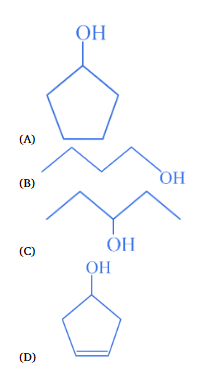
Which of the following is the structure of an alcohol with molecular formula ?
1
A
2
B
3
C
4
D
Official Solution
Correct Option: (1)
Concept:
For alcohols:
Step 1: Check given formula. This corresponds to a saturated alcohol (no double bond or ring). Step 2: Analyze options.
(A) Cyclopentanol รขยย ring รขยย
(B) Open chain alcohol รขยย saturated รขยย \checkmark
(C) Branched alcohol but incorrect hydrogen count
(D) Contains double bond รขยย unsaturated
Step 3: Conclusion. Only open-chain saturated alcohol matches formula.
18
PYQ 2025
medium
chemistryID: mht-cet-
Calculate the number of atoms present in 1 g of an element if it forms fcc unit cell structure. [ ]}
1
2
3
4
Official Solution
Correct Option: (4)
Step 1: Identify Given
Mass of unit cell .
Number of atoms in FCC unit cell ( ) . Step 2: Calculate Number of Unit Cells
Number of unit cells in 1 g
Number of unit cells Step 3: Calculate Number of Atoms
Total atoms
Total atoms
Total atoms . Final Answer: (D)
19
PYQ 2025
medium
chemistryID: mht-cet-
Identify the reagent used in following reaction.
1
2
3
4
Official Solution
Correct Option: (2)
Concept:
Carbonyl compounds react with derivatives of ammonia to form characteristic derivatives. Step 1: Identify reaction type. Ketones react with semicarbazide to form semicarbazone: Step 2: Identify reagent. Step 3: Conclusion. Reagent required is semicarbazide.
20
PYQ 2025
medium
chemistryID: mht-cet-
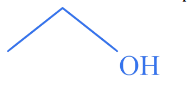
What is the molar mass of compound represented by following structure formula?
1
2
3
4
Official Solution
Correct Option: (2)
Concept:
Molar mass is calculated by summing atomic masses of all atoms present in the compound. Step 1: Identify the structure. The given structure shows a two-carbon chain with an group:
This is ethanol. Step 2: Count atoms.
Concept:
Metals can be classified based on their physical properties such as hardness, malleability, and reactivity.
โข Hard metals (like iron and copper) are strong and not easily cut.
โข Soft metals are those that can be easily cut with a knife.
โข Alkali metals (Group 1 elements like sodium, potassium) are extremely soft and highly reactive.
Sodium is a well-known soft metal and can even be cut with a knife due to its low density and weak metallic bonding. Step 1: Analyzing each option.
โข Iron: A hard and strong metal, not soft.
โข Sodium: A very soft metal, can be cut easily with a knife.
โข Aluminium: Moderately hard, not classified as a soft metal like alkali metals.
โข Copper: Hard and tough metal, not soft. Step 2: Identifying the correct answer.
Among the given options, only sodium belongs to alkali metals and is soft in nature.