Which coordinate compound from the following has a net negative charge on the complex ion?
1
Tris(ethylenediamine)cobalt(III) chloride
2
Potassium trioxalato aluminate(III)
3
Tetracarbonyl nickel(0)
4
Diammine silver(I) chloride
Official Solution
Correct Option: (2)
Step 1: Write the complex ions involved. Tris(ethylenediamine)cobalt(III) chloride contains the complex ion , which is positively charged. Potassium trioxalato aluminate(III) contains the complex ion . Tetracarbonyl nickel(0) is a neutral complex . Diammine silver(I) chloride contains the complex ion . Step 2: Identify the net charge. Among the given options, only carries a net negative charge. Step 3: Conclusion. Hence, potassium trioxalato aluminate(III) has a negatively charged complex ion.
02
PYQ 2020
medium
chemistryID: mht-cet-
Which among the following is a correct formula of pentaammine aqua cobalt(III) iodide?
1
2
3
4
Official Solution
Correct Option: (1)
Step 1: Understand the name of the complex. The complex is pentaammine aqua cobalt(III) iodide. This indicates that cobalt is in the +3 oxidation state and is coordinated with five ammonia molecules and one water molecule.
Step 2: Determine charge on the complex ion. Ammonia and water are neutral ligands. Cobalt is in the +3 oxidation state, so the complex ion has a charge of .
Step 3: Balance with counter ions. To neutralize the +3 charge, three iodide ions are required outside the coordination sphere.
Step 4: Final structure. Thus, the correct formula is:
Step 5: Conclusion. Option (A) correctly represents the coordination compound.
03
PYQ 2020
medium
chemistryID: mht-cet-
Which of the following is NOT a character of an ideal drug?
1
Should destroy harmful organisms
2
Should not disturb physiological process
3
Harmless to host
4
Is not localized to the affected site
Official Solution
Correct Option: (4)
Step 1: Understanding the characteristics of an ideal drug. An ideal drug should target the affected site, cause minimal side effects, and be harmless to the host while effectively destroying harmful organisms.
Step 2: Analyzing the options. (A) Should destroy harmful organisms: This is a characteristic of an ideal drug. (B) Should not disturb physiological process: Correct โ An ideal drug should not disrupt the normal physiological processes. (C) Harmless to host: Correct โ An ideal drug must not harm the host. (D) Is not localized to the affected site: Incorrect โ An ideal drug should be localized to the affected site for maximum efficacy.
Step 3: Conclusion. The correct answer is (D) Is not localized to the affected site.
04
PYQ 2020
medium
chemistryID: mht-cet-
If 38.55 kJ of heat is absorbed when 6.0 g of O react with ClF according to the reaction:What is the standard enthalpy of reaction?
1
72.28 kJ
2
205.6 kJ
3
102.8 kJ
4
49.80 kJ
Official Solution
Correct Option: (2)
Step 1: Calculate the number of moles of O . The molar mass of O is 32 g/mol. Therefore, the number of moles of O is:
Step 2: Calculate the heat absorbed per mole. The total heat absorbed is 38.55 kJ. To find the heat absorbed per mole:
Step 3: Conclusion. The standard enthalpy of reaction is 205.6 kJ.
05
PYQ 2020
medium
chemistryID: mht-cet-
Which among the following sources contains caryophyllene?
1
Peppermint
2
Oil of roses
3
Oil of ginger
4
Oil of cloves
Official Solution
Correct Option: (4)
Step 1: Understanding caryophyllene. Caryophyllene is a naturally occurring sesquiterpene, primarily found in the essential oils of several plants, especially cloves. It has a distinctive spicy, peppery odor. Step 2: Analyzing the options. (A) Peppermint: Peppermint contains menthol, not caryophyllene. (B) Oil of roses: Oil of roses contains various compounds but not caryophyllene. (C) Oil of ginger: Ginger oil does not primarily contain caryophyllene. (D) Oil of cloves: Clove oil is rich in caryophyllene, making this the correct answer. Step 3: Conclusion. The correct answer is (D) Oil of cloves, as it contains caryophyllene.
06
PYQ 2020
medium
chemistryID: mht-cet-
Which of the following actinoids exhibits only +3 oxidation state?
1
Lr (z = 103)
2
U (z = 92)
3
Th (z = 90)
4
Pa (z = 91)
Official Solution
Correct Option: (1)
Step 1: Understanding oxidation states. Lr (Lawrencium) is an actinide element that exhibits only a +3 oxidation state. Other elements in the actinide series can exhibit multiple oxidation states, including +4, +5, and +6.
Step 2: Analyzing the options. (A) Lr (z = 103): Correct โ Lr typically exhibits a +3 oxidation state. (B) U (z = 92): Uranium can exhibit oxidation states of +3, +4, +5, and +6. (C) Th (z = 90): Thorium can exhibit oxidation states of +3 and +4. (D) Pa (z = 91): Protactinium can exhibit oxidation states of +3, +4, and +5.
Step 3: Conclusion. The correct answer is (A) Lr as it exhibits only the +3 oxidation state.
07
PYQ 2020
medium
chemistryID: mht-cet-
Identify the product A in the following reaction: -CH -CH Cl + 2 KOH A + 2 KCl + H O} \)
1
CH -CH -CH OH
2
CH -CH -C=O
3
CH -CH -CH Cl
4
CH -CH -C H
Official Solution
Correct Option: (4)
Step 1: Analyzing the reaction. This is a reaction between a primary alkyl halide (CH -CH -CH Cl) and aqueous potassium hydroxide (KOH) under heat. This results in an elimination reaction, where the chloride (Cl ) is replaced by a hydroxyl group, forming an alcohol. The product is butane.
Step 2: Conclusion. The correct product is (D) CH -CH -C H .
08
PYQ 2020
medium
chemistryID: mht-cet-
Identify the neohhexyl chloride from the following.
1
(CH ) C-CH -CH -Cl
2
CH -(CH ) -CH -Cl
3
(CH ) CH-CH -CH -Cl
4
(CH ) C-CH -Cl
Official Solution
Correct Option: (1)
Step 1: Understanding Neohhexyl chloride. Neohhexyl chloride is a compound with a branching structure where a chlorine atom is attached to a carbon atom in the structure. In this case, the correct structure is (CH ) C-CH -CH -Cl.
Step 2: Analyzing the options. (A) (CH ) C-CH -CH -Cl: Correct โ This is the structure of neohhexyl chloride. (B) CH -(CH ) -CH -Cl: This structure does not match neohhexyl chloride. (C) (CH ) CH-CH -CH -Cl: This structure does not represent neohhexyl chloride. (D) (CH ) C-CH -Cl: This is an incorrect structure for neohhexyl chloride.
Step 3: Conclusion. The correct answer is (A) (CH ) C-CH -CH -Cl.
09
PYQ 2020
medium
chemistryID: mht-cet-
How many water molecules are hydrogen bonded in the following molecular formula? [Cu(H O) ] SO H O
1
4
2
3
3
1
4
5
Official Solution
Correct Option: (3)
Step 1: Understanding the structure of the complex. In the given molecular formula SO H O, \) the copper ion (Cu ) is surrounded by six water molecules coordinated to it. Additionally, there is one water molecule hydrogen-bonded to the complex, not directly coordinated to the copper ion.
Step 2: Analyzing the options. (A) 4: This is incorrect. Only one water molecule is hydrogen-bonded, not four. (B) 3: This is incorrect. Only one water molecule is hydrogen-bonded. (C) 1: Correct โ There is one water molecule hydrogen-bonded to the complex. (D) 5: This is incorrect. Only one water molecule is hydrogen-bonded.
Step 3: Conclusion. The correct answer is (C) 1.
10
PYQ 2020
medium
chemistryID: mht-cet-
Which of the following is NOT used as a semipermeable membrane?
1
Cellulose nitrate
2
Copper ferrocyanide
3
Ammonium chloride
4
Cellulose
Official Solution
Correct Option: (3)
Step 1: Understanding semipermeable membranes. A semipermeable membrane is a material that allows certain molecules or ions to pass through it by diffusion and occasionally by facilitated diffusion. Substances like cellulose nitrate, copper ferrocyanide, and cellulose are commonly used in laboratory settings as semipermeable membranes, but ammonium chloride does not serve this purpose.
Step 2: Analyzing the options. (A) Cellulose nitrate: Cellulose nitrate is commonly used as a semipermeable membrane. (B) Copper ferrocyanide: Copper ferrocyanide is used as a semipermeable membrane. (C) Ammonium chloride: Correct โ Ammonium chloride is not typically used as a semipermeable membrane. (D) Cellulose: Cellulose is used as a semipermeable membrane in various applications.
Step 3: Conclusion. The correct answer is (C) Ammonium chloride.
11
PYQ 2020
medium
chemistryID: mht-cet-
Heat of combustion of , and are , and respectively. Hence, the heat of formation of is
1
2
3
4
Official Solution
Correct Option: (2)
Step 1: Write the formation reaction of ethane. Step 2: Apply Hessโs law using combustion reactions. Combustion of reactants and products gives: Step 3: Calculate heat of formation. Step 4: Conclusion. Thus, the heat of formation of ethane is .
12
PYQ 2020
medium
chemistryID: mht-cet-
What is IUPAC name of ?
1
Bis (ethylenediamine) dichloro cobalt (III) ion
2
Dichloro ethylenediamine cobalt (I)
3
Ethylene diamine cobalt (I) dichloride
4
Ethylene diamine cobalt chloride
Official Solution
Correct Option: (1)
Step 1: Understanding the IUPAC naming convention. In IUPAC nomenclature, we name coordination complexes by indicating the ligands first, followed by the metal and its oxidation state in parentheses. In this case, the complex contains two ethylenediamine (en) ligands and two chloride ions as ligands, with cobalt in the +3 oxidation state. The prefix "bis" is used for two identical ligands. Step 2: Analyzing the options. (A) Bis (ethylenediamine) dichloro cobalt (III) ion: Correct โ This follows the IUPAC rules for naming coordination complexes. (B) Dichloro ethylenediamine cobalt (I): Incorrect โ The oxidation state of cobalt should be +3, not +1. (C) Ethylene diamine cobalt (I) dichloride: Incorrect โ The ligand order is incorrect, and the oxidation state is wrong. (D) Ethylene diamine cobalt chloride: Incorrect โ This is a simplified name and does not follow the IUPAC convention for coordination compounds. Step 3: Conclusion. The correct answer is (A) Bis (ethylenediamine) dichloro cobalt (III) ion.
13
PYQ 2020
medium
chemistryID: mht-cet-
What is the quantity of heat evolved when 6 g carbon combines with sulfur to form CSโ according to the reaction:
1
22 KJ
2
32 KJ
3
46 KJ
4
11 KJ
Official Solution
Correct Option: (3)
Step 1: Calculate the number of moles of carbon. The molar mass of carbon is 12 g/mol, so 6 g of carbon is:
Step 2: Calculate the heat evolved. From the given reaction, 1 mole of carbon releases 92 KJ. Therefore, 0.5 moles of carbon will release:
Step 3: Conclusion. The correct answer is (C) 46 KJ.
14
PYQ 2020
medium
chemistryID: mht-cet-
Which among the following reagents is used for conversion of glucose to glucosime?
1
HCN
2
water
3
Hydroxylamine
4
Dilute nitric acid
Official Solution
Correct Option: (3)
Step 1: Identify functional group in glucose. Glucose contains an aldehyde group ( ). Step 2: Reaction involved. Hydroxylamine reacts with the aldehyde group to form an oxime (glucosime). Step 3: Conclusion. Hence, hydroxylamine is used for conversion of glucose to glucosime.
15
PYQ 2020
medium
chemistryID: mht-cet-
Relation between and for the reaction is
1
2
3
4
Official Solution
Correct Option: (2)
Step 1: Understanding the reaction and relationship between and . For the given reaction, the change in enthalpy and the change in internal energy are related by the equation:
Where is the number of moles of gas formed, is the universal gas constant, and is the temperature. For this reaction, the net change in the number of moles of gas is 1 (from 2 moles of to 3 moles of gas), so:
Step 2: Conclusion. The correct answer is (B) .
16
PYQ 2020
medium
chemistryID: mht-cet-
The molecular mass of an organic monobasic acid is 129 and the value of is 2, what is empirical formula mass of compound?
1
158.0
2
193.5
3
64.5
4
258
Official Solution
Correct Option: (1)
Step 1: Empirical formula calculation. The molecular mass is given as 129, and the value of (the number of molecules) is 2. The empirical formula mass is calculated by dividing the molecular mass by . Step 2: Conclusion. The correct answer is (A) 158.0.
17
PYQ 2025
medium
chemistryID: mht-cet-
Which among the following salts is NOT hydrolysed in water?
1
2
3
4
Official Solution
Correct Option: (3)
Concept:
Hydrolysis of salts depends on the nature of the parent acid and base:
Strong acid + Strong base รขยย No hydrolysis
Strong acid + Weak base รขยย Acidic hydrolysis
Weak acid + Strong base รขยย Basic hydrolysis
Weak acid + Weak base รขยย Complete hydrolysis
Step 1: Analyze each salt.
: NaOH (strong base) + H CO (weak acid) รขยย hydrolysis
What is the difference in molar masses of Undecane and Decane?
1
140 g mol
2
70 g mol
3
24 g mol
4
14 g mol
Official Solution
Correct Option: (4)
Step 1: Formula
Alkanes follow the general formula . Step 2: Identification
- Decane:
- Undecane: Step 3: Analysis
The difference between any two consecutive members of a homologous series is a unit.
Mass of . Final Answer: (D)
20
PYQ 2025
medium
chemistryID: mht-cet-
Which is the weakest ligand?
1
2
\text{EDTA}
3
\text{en}
4
\text{CO}
Official Solution
Correct Option: (1)
Ligands are species that bind to a central metal atom or ion in a complex. The strength of a ligand is determined by its ability to donate electron pairs to the metal center. Ligands can be classified as strong or weak field ligands based on their ability to split the d-orbitals of the metal ion. - (Fluoride ion): is a weak field ligand. It is a halide ion and has a lower ability to split the d-orbitals of the metal ion. - EDTA (Ethylenediaminetetraacetate): EDTA is a strong field ligand. It is a chelating ligand and binds to the metal center through multiple donor atoms, which makes it a strong ligand. - en (Ethylenediamine): en is a bidentate ligand, meaning it can donate two lone pairs to the metal. It is also a strong field ligand, though not as strong as EDTA. - CO (Carbon monoxide): CO is a very strong field ligand. It binds strongly to the metal center through its lone pair and is known for forming very stable metal complexes. Step 1: Conclusion
Since fluoride ( ) is the weakest among the given ligands in terms of its ability to split the metalโs d-orbitals, the correct answer is .
21
PYQ 2025
medium
chemistryID: mht-cet-
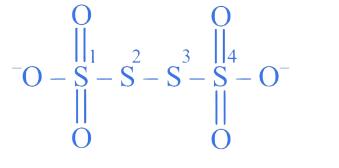
What are the respective oxidation states of sulphur atoms numbered 1 to 4 in tetrathionate ion as shown below?
1
2
3
4
Official Solution
Correct Option: (2)
Concept:
In tetrathionate ion , oxidation states depend on bonding:
Sulphur bonded to oxygen รขยย higher oxidation state
Sulphur bonded only to sulphur รขยย lower oxidation state
Step 1: Identify terminal sulphur atoms (1 and 4). These sulphur atoms are bonded to oxygen atoms. Each has oxidation state:
Step 2: Identify middle sulphur atoms (2 and 3). These sulphur atoms are bonded only to sulphur atoms. Thus their oxidation state:
Step 3: Conclusion.
22
PYQ 2025
medium
chemistryID: mht-cet-
Calculate the change in internal energy of the system if of work is done on the system and it releases of heat in a particular reaction.