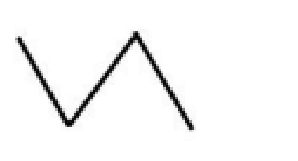
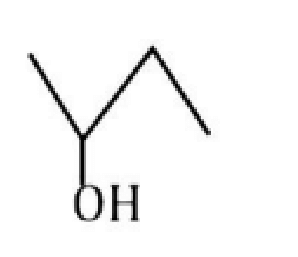
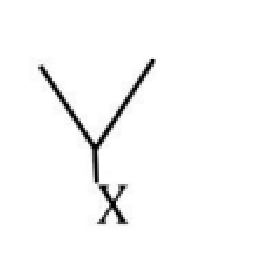
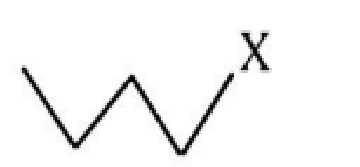
Concept: Chemistry (Organic Chemistry) - IUPAC Nomenclature of Alkenes. Step 1: Identify the principal functional group. The principal functional group is the carbon-carbon double bond (C=C). This makes the compound an alkene, so the suffix will be "-ene". Step 2: Determine the longest carbon chain containing the double bond. The longest continuous chain of carbon atoms that includes the double bond contains 6 carbons. Therefore, the parent alkane name is hexane, and as an alkene, the parent root is "hexene". Step 3: Number the carbon chain. Numbering must start from the end that gives the lowest possible locants to the double bond.
If we number from left to right: . The double bond is at position 3.
If we number from right to left, the double bond is also at position 3.
When the double bond position is symmetrical, we apply the lowest locant rule to the substituents.
Left to right: substituents at 3 (bromo) and 4 (methyl).
Right to left: substituents at 3 (methyl) and 4 (bromo).
According to alphabetical order, Bromo comes before Methyl, so it should get the lower number. Thus, we number from left to right to give Bromo the 3 position. Step 4: Identify and locate the substituents. Based on our numbering, there is a Bromine atom at Carbon-3 (3-bromo) and a Methyl group at Carbon-4 (4-methyl). Step 5: Assemble the final IUPAC name. Combine the substituent names in alphabetical order, followed by the parent chain and the double bond position:
3-Bromo + 4-methyl + hex-3-ene = 3-Bromo-4-methylhex-3-ene. $ $
02
PYQ 2014
medium
chemistryID: mht-cet-
Which of the following is formed when propene is heated with bromine at high temperature?
1
1,2-Dibromopropane
2
1-Bromopropane
3
2-Bromopropene
4
3-Bromopropene
Official Solution
Correct Option: (4)
Concept: Chemistry (Organic Chemistry) - Allylic Substitution. Step 1: Identify the reactants and reaction conditions. The reactants are propene ( ) and bromine ( ). The reaction condition is specified as "high temperature" (typically around ). Step 2: Recall the reactivity of alkenes with halogens at different temperatures. At room temperature or lower, halogens like typically undergo electrophilic addition across the carbon-carbon double bond, which would form 1,2-dibromopropane. However, at high temperatures, the reaction pathway changes completely. Step 3: Determine the high-temperature reaction mechanism. At high temperatures, the bond undergoes homolytic cleavage to form bromine free radicals. This initiates a free radical substitution reaction rather than an addition reaction. Step 4: Identify the target site for radical substitution. Free radical substitution in alkenes preferentially occurs at the allylic position (the carbon atom adjacent to the double bond) because the resulting allyl radical is highly resonance-stabilized. In propene ( ), the terminal methyl group ( ) is the allylic carbon. Step 5: Determine the final product and its IUPAC name. A hydrogen atom from the allylic methyl group is substituted by a bromine atom.
The reaction is: .
The resulting molecule, , is commonly known as allyl bromide. According to IUPAC nomenclature, numbering starts from the double bond, making the bromo group at position 3. Thus, its systematic name is 3-bromopropene. $ $
03
PYQ 2014
medium
chemistryID: mht-cet-
Identify the product ' ' in the following sequence of reactions.
1
Methyl cyanide
2
Ethylamine
3
Methylamine
4
Ethyl cyanide
Official Solution
Correct Option: (2)
Concept: Chemistry (Organic Chemistry) - Nucleophilic Substitution and Mendius Reduction. Step 1: Analyze the first reaction step to find product A. The first step is the reaction of methyl bromide ( ) with potassium cyanide ( ). This is a classic nucleophilic substitution ( ) reaction. Step 2: Determine the structure of product A. The cyanide nucleophile ( ) displaces the bromide leaving group ( ). This forms methyl cyanide, also known as acetonitrile.
Reaction: .
Thus, intermediate is . Step 3: Analyze the second reaction step to find product B. The second step involves treating product A ( ) with sodium metal in ethanol ( ). This specific reagent combination is a strong reducing agent. Step 4: Identify the specific named reaction. The reduction of an alkyl cyanide (nitrile) using sodium and ethanol is known as the Mendius reduction. This process systematically reduces the carbon-nitrogen triple bond ( ) to a primary amine group ( ). Step 5: Determine the final structure and name of product B. During the reduction, four hydrogen atoms are added across the nitrile group.
Reaction: .
The resulting molecule contains a two-carbon chain attached to an amino group. The IUPAC name for this primary amine is ethanamine, and its common name is ethylamine. $ $
04
PYQ 2014
medium
chemistryID: mht-cet-
Identify the product in the following reaction. Toluene
1
Benzal chloride
2
Benzaldehyde
3
Benzyl alcohol
4
Benzoic acid
Official Solution
Correct Option: (2)
Concept: Chemistry (Organic Chemistry) - Etard Reaction. Step 1: Analyze the first step of the reaction. Toluene is treated with chromyl chloride ( ) in a solvent like carbon disulfide ( ). Step 2: Identify intermediate A. The chromyl chloride oxidizes the methyl group of toluene to form a brown chromium complex as an intermediate (A). Step 3: Analyze the second step (hydrolysis). The chromium complex (A) is then subjected to acid hydrolysis using . Step 4: Identify the final product B. Hydrolysis of the complex yields benzaldehyde as the final product (B). $ $
05
PYQ 2014
medium
chemistryID: mht-cet-
Which among the following is used to prepare from ?
1
Na / dry ether
2
couple / ethanol
3
/ ether
4
/
Official Solution
Correct Option: (1)
Concept: Chemistry (Organic Chemistry) - Wurtz Reaction. Step 1: Analyze the reactant and the product. The reactant is ethyl chloride ( ), which is a 2-carbon alkyl halide. The product is n-butane ( ), which is a 4-carbon alkane. Step 2: Observe the change in the carbon chain. The number of carbon atoms in the product is exactly double the number of carbon atoms in the starting alkyl halide ( ). The product is also a symmetrical alkane. Step 3: Recall the named reaction for coupling alkyl halides. The specific reaction used to prepare higher symmetrical alkanes from alkyl halides by doubling the carbon chain is known as the Wurtz reaction. Step 4: Identify the reagents for the Wurtz reaction. The Wurtz reaction requires treating an alkyl halide with metallic sodium ( ) in the presence of dry ether as a solvent. The ether must be dry (anhydrous) to prevent the highly reactive sodium from reacting with water. Step 5: Verify the reaction equation. .
Since the reagents perfectly facilitate this doubling transformation, Option A is the correct choice. $ $
06
PYQ 2014
medium
chemistryID: mht-cet-
What is the number of moles of tertiary carbon atoms in a molecule of isobutane?
1
One
2
Two
3
Three
4
Four
Official Solution
Correct Option: (1)
Concept: Chemistry (Organic Chemistry) - Classification of Carbon Atoms. Step 1: Define the classification of carbon atoms. Carbon atoms in organic molecules are classified based on the number of other carbon atoms directly attached to them:
- Primary ( ): Attached to one other carbon.
- Secondary ( ): Attached to two other carbons.
- Tertiary ( ): Attached to three other carbons.
- Quaternary ( ): Attached to four other carbons. Step 2: Determine the structure of isobutane. Isobutane is the common name for 2-methylpropane. Its chemical formula is . The structural arrangement consists of a central carbon atom bonded to three methyl ( ) groups and one hydrogen atom. Step 3: Analyze the central carbon atom. The central carbon atom in isobutane is directly bonded to three other carbon atoms (the carbons of the three methyl groups). According to the definitions in Step 1, this specific carbon is a tertiary ( ) carbon atom. Step 4: Analyze the terminal carbon atoms. The three methyl carbon atoms are each bonded to only one other carbon (the central one). Therefore, these three are all primary ( ) carbon atoms. Step 5: Count the tertiary carbons and conclude. In a single molecule of isobutane, there is exactly one central carbon atom that fits the tertiary classification. Consequently, in one mole of isobutane molecules, there is exactly one mole of tertiary carbon atoms. $ $
07
PYQ 2018
medium
chemistryID: mht-cet-
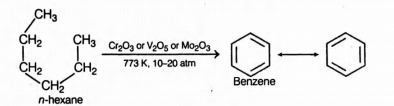
Conversion of hexane into benzene involves the reaction of
1
hydration
2
hydrolysis
3
hydrogenation
4
dehydrogenation
Official Solution
Correct Option: (4)
Hexane when heated to at pressure in the presence of or supported over alumina gel undergoes dehydrogenation. (i.e loss of hydrogen) and cyclised to give benzene and its homologous
08
PYQ 2019
medium
chemistryID: mht-cet-
How many isomers are possible for an alkane having molecular formula ?
1
2
3
4
Official Solution
Correct Option: (2)
There can be 3 possible isomers for an alkane having formula . These are as follows:
, ,
09
PYQ 2020
medium
chemistryID: mht-cet-
The number of possible monohalogen derivatives for the alkyl halide having molecular formula is
1
3
2
2
3
4
4
1
Official Solution
Correct Option: (3)
Step 1: Understand the given molecular formula. The molecular formula represents butyl halides, obtained by replacing one hydrogen atom of butane with a halogen atom.
Step 2: Write all possible structural isomers. Butane has two carbon skeletons: β n-Butane β Isobutane
Step 3: Possible monohalogen derivatives. From n-butane: 1. 1-Halobutane 2. 2-Halobutane From isobutane: 3. 1-Halo-2-methylpropane (isobutyl halide) 4. 2-Halo-2-methylpropane (tert-butyl halide)
Step 4: Count the derivatives. Total monohalogen derivatives .
Step 5: Conclusion. The number of possible monohalogen derivatives is .
10
PYQ 2020
medium
chemistryID: mht-cet-
What is the torsion angle in the staggered conformation of ethane?
1
45Β°
2
180Β°
3
60Β°
4
0Β°
Official Solution
Correct Option: (3)
Step 1: Understanding the staggered conformation. In the staggered conformation of ethane, the carbon-hydrogen bonds are as far apart as possible, with a torsion angle of 60Β°. This minimizes the steric repulsion between atoms, making it the most stable conformation. Step 2: Analyzing the options. (A) 45Β°: Incorrect. This is not the correct torsion angle for the staggered conformation. (B) 180Β°: Incorrect. This is the angle for the eclipsed conformation, not the staggered one. (C) 60Β°: Correct β The torsion angle in the staggered conformation of ethane is 60Β°. (D) 0Β°: Incorrect. This is the angle for the eclipsed conformation. Step 3: Conclusion. The correct answer is (C) 60Β°, which is the torsion angle in the staggered conformation of ethane.
11
PYQ 2020
medium
chemistryID: mht-cet-
Ξ±βhalogenation of carboxylic acid is called
1
HellβVolhardβZelinsky reaction
2
RiemerβTiemann reaction
3
Gattermann reaction
4
Sandmeyerβs reaction
Official Solution
Correct Option: (1)
Step 1: Understand Ξ±βhalogenation. Ξ±βHalogenation refers to substitution of a hydrogen atom at the Ξ±βcarbon of a carboxylic acid by a halogen atom. Step 2: Recall named reactions. The HellβVolhardβZelinsky (HVZ) reaction specifically involves halogenation at the Ξ±βposition of carboxylic acids in presence of red phosphorus and halogen. Step 3: Eliminate other options. RiemerβTiemann reaction is used for formylation of phenols. Gattermann reaction introduces βCHO or βCN groups. Sandmeyerβs reaction replaces diazonium groups with halogens. Step 4: Conclusion. Ξ±βHalogenation of carboxylic acid is known as the HellβVolhardβZelinsky reaction.
12
PYQ 2020
medium
chemistryID: mht-cet-
Compound A on reaction with chlorine in presence of UV light gives B, which when reacted with in the solvent N,N-dimethylformamide gives 2-nitrobutane. The compound A is
1
2
3
4
Official Solution
Correct Option: (1)
Step 1: First reaction analysis. Chlorination in presence of UV light indicates a free-radical substitution reaction. n-Butane undergoes chlorination to give a mixture of chlorinated products, mainly secondary butyl chloride.
Step 2: Second reaction analysis. Alkyl halides react with in polar aprotic solvent (DMF) to give nitroalkanes. Secondary butyl chloride gives 2-nitrobutane.
Step 3: Identify compound A. Since 2-nitrobutane is formed, the intermediate halide must be secondary butyl halide, which is obtained from chlorination of n-butane.
Step 4: Conclusion. Therefore, compound A is n-butane.
13
PYQ 2020
easy
chemistryID: mht-cet-
Identify the decreasing order of boiling point of alkanes (i) n-pentane (ii) Isopentane (iii) Neopentane
Official Solution
Correct Option: (1)
14
PYQ 2020
medium
chemistryID: mht-cet-
If a mixture of iodomethane and iodethane is treated with sodium metal in presence of dry ether, it forms:
1
Propane and ethane
2
Ethane and butane
3
Propane and butane
4
Ethane, propane and butane
Official Solution
Correct Option: (4)
Step 1: Understanding the Reaction. The reaction of iodomethane (CH I) and iodethane (C H I) with sodium metal in dry ether leads to the formation of a mixture of hydrocarbons due to the Wurtz reaction. This reaction results in the formation of alkanes by coupling two alkyl groups. Thus, a mixture of ethane, propane, and butane is formed.
Step 2: Analyzing the options. (A) Propane and ethane: Incorrect. While propane and ethane can form, butane is also formed in this reaction. (B) Ethane and butane: Incorrect. Propane is also formed in this reaction. (C) Propane and butane: Incorrect. Ethane is also formed in this reaction. (D) Ethane, propane and butane: Correct. This is the correct mixture formed from the Wurtz reaction.
Step 3: Conclusion. The correct answer is the formation of ethane, propane, and butane, corresponding to option (D).
15
PYQ 2020
medium
chemistryID: mht-cet-
How many isomers of monobromoderivatives are obtained on bromination of the following compound ?
1
2
3
4
Official Solution
Correct Option: (1)
Step 1: Identify the given hydrocarbon. The given structure represents isopentane (2-methylbutane). It contains different types of hydrogen atoms due to its branched structure.
Step 2: Identify distinct hydrogen positions. In isopentane, there are four nonequivalent types of hydrogen atoms: Primary hydrogens at two different positions, secondary hydrogen, and tertiary hydrogen.
Step 3: Effect of bromination. During monobromination, bromine can substitute hydrogen atoms at each nonequivalent position, leading to different structural isomers.
Step 4: Count of monobrominated products. Since there are four different types of hydrogen atoms, four different monobromoderivatives are formed.
Step 5: Conclusion. Therefore, the number of isomers of monobromoderivatives obtained is .
16
PYQ 2020
medium
chemistryID: mht-cet-
What is the number of carbon atoms in alkanes found in diesel?
1
to
2
to
3
to
4
to
Official Solution
Correct Option: (4)
Step 1: Composition of diesel. Diesel is a petroleum fraction consisting mainly of higher alkanes compared to petrol.
Step 2: Carbon chain length. The hydrocarbons present in diesel generally contain carbon atoms ranging from 15 to 18.
Step 3: Conclusion. Therefore, alkanes found in diesel lie in the range to }.
17
PYQ 2020
medium
chemistryID: mht-cet-
What is the total number of chain isomers exhibited by hexane?
1
2
3
4
Official Solution
Correct Option: (4)
Step 1: Write the molecular formula of hexane. Hexane has the molecular formula . Step 2: Understand chain isomerism. Chain isomerism arises due to different arrangements of the carbon skeleton while keeping the same molecular formula. Step 3: List all chain isomers of hexane. The five chain isomers of hexane are: 1. n-Hexane 2. 2-Methylpentane 3. 3-Methylpentane 4. 2,2-Dimethylbutane 5. 2,3-Dimethylbutane Step 4: Conclusion. Hexane exhibits a total of five chain isomers.
18
PYQ 2020
medium
chemistryID: mht-cet-
Identify the product X obtained in the following reaction:
1
2
3
4
Official Solution
Correct Option: (3)
Step 1: Identify the reactant and conditions. The given compound is n-hexane. The reaction is carried out at high temperature (773 K) and high pressure (10β20 atm) in the presence of chromium oxide ( ). These conditions are characteristic of dehydrocyclization (aromatization) reactions.
Step 2: Apply the concept of dehydrocyclization. Straight-chain alkanes with six carbon atoms undergo cyclization followed by dehydrogenation in the presence of catalysts like . Thus, n-hexane converts into benzene with the release of hydrogen gas.
Step 3: Write the balanced reaction.
Step 4: Analyze the options. (A) and (B) represent cracking reactions, not aromatization. (D) represents dehydrogenation to an alkene, which is incomplete under these conditions. (C) correctly represents the formation of benzene via dehydrocyclization.
Step 5: Conclusion. Therefore, the correct product is benzene along with four molecules of hydrogen.
19
PYQ 2022
easy
chemistryID: mht-cet-
Which among the following nitrogen bases of polynucleotides is NOT derived from pyrimidine?
1
Cytosine
2
Uracil
3
Thymine
4
Guanine
Official Solution
Correct Option: (4)
Solution: Understanding Pyrimidines and Purines - Identifying Guanine
Cytosine, uracil, and thymine are all nitrogenous bases derived from pyrimidine, while guanine is derived from purine. To fully understand this, it's important to first learn about the two main classes of nitrogenous bases: pyrimidines and purines. These bases play crucial roles in the structure of DNA and RNA, which are fundamental to life. Letβs break down the details:
Pyrimidines: Pyrimidines are a class of nitrogenous bases that include cytosine (C), uracil (U), and thymine (T). These bases are characterized by having a single six-membered ring structure. Pyrimidines are typically found in RNA and DNA. Uracil is found in RNA, while thymine is found in DNA, and cytosine is found in both.
Purines: Purines, on the other hand, have a two-ring structure that consists of a six-membered ring fused with a five-membered ring. Guanine (G) and adenine (A) are the two purines found in both RNA and DNA. Purines are larger in size compared to pyrimidines due to their two-ring structure.
Guanine: Guanine (G) is a purine, meaning it has a distinct structure compared to pyrimidines. Guanine contains two rings in its structure and plays an essential role in the genetic material of both DNA and RNA. It pairs with cytosine (C) in DNA through three hydrogen bonds, which contributes to the stability of the DNA double helix.
Conclusion: Based on the structural and chemical differences between pyrimidines and purines, we conclude that guanine belongs to the purine family due to its two-ring structure. Therefore, the correct answer is (D) Guanine.
20
PYQ 2022
easy
chemistryID: mht-cet-
Which of the following reactions does not match correctly with its name?
This reaction involves the conversion of an amide (RβCOβNH2) to an amine by removing the carbonyl group. It is known as the Hofmann degradation reaction, which is correctly matched here.
This reaction involves the alkylation of an amine (RβNH2) using an alkyl halide (RβX) in an excess amount. The reaction name Hofmann Exhaustive Alkylation is also correctly matched to this process.
This reaction involves the elimination of an amine group from an amine salt (RβCH2βN+). The process is known as the Hofmann elimination reaction, where an amine is removed, resulting in the formation of an alkene. However, this is a wrong match because Hofmann elimination typically involves the removal of the amine group from an amine salt under basic conditions, not with silver oxide (Ag2O) as described here.
This reaction involves the reduction of an amide (RβCOβNH2) to an amine using a strong reducing agent like lithium aluminum hydride (LiAlH4). The reaction is known as the Mendius reduction, which is a well-known reaction for reducing amides to amines. This is also correctly matched.
Conclusion:
The reaction in Option 3 does not correctly match with its name. The reaction is incorrectly labeled as Hofmann Elimination, but the reagents and conditions listed are not typical for this elimination process. Therefore, the correct answer is:
A hydrocarbon containing one double bond gave on reductive ozonolysis, ethanol and propanone. What is the name of the hydrocarbon?
1
Ethene
2
Propene
3
But-1-ene
4
2-Methylprop-1-ene
Official Solution
Correct Option: (4)
In reductive ozonolysis, the double bond in the hydrocarbon is cleaved, and oxygen atoms are inserted to form carbonyl compounds. The hydrocarbon provided yields ethanol ( ) and propanone ( ). To determine the original hydrocarbon: Draw the products and combine them by removing oxygen atoms. Reconnect the resulting fragments to form the hydrocarbon. The original hydrocarbon is identified as , which cleaves to give the specified products.
--- Final Answer:
22
PYQ 2024
medium
chemistryID: mht-cet-
What are the 4 types of hydrocarbons?
Official Solution
Correct Option: (1)
Step 1: Understanding hydrocarbons. Hydrocarbons are organic compounds consisting solely of hydrogen and carbon atoms. They are classified into four main types based on their structure and bonding.
Step 2: Types of hydrocarbons. The four types of hydrocarbons are:
Alkanes: Saturated hydrocarbons containing only single bonds between carbon atoms. Example: Methane ( ).
Alkenes: Unsaturated hydrocarbons containing at least one double bond between carbon atoms. Example: Ethene ( ).
Alkynes: Unsaturated hydrocarbons containing at least one triple bond between carbon atoms. Example: Ethyne ( ).
Aromatic hydrocarbons: Cyclic compounds containing conjugated -electron systems, typically with alternating single and double bonds. Example: Benzene ( ).
Conclusion: The 4 types of hydrocarbons are alkanes, alkenes, alkynes, and aromatic hydrocarbons.
23
PYQ 2025
medium
chemistryID: mht-cet-
Which of the following is an example of an alkene?
1
Ethane
2
Ethene
3
Ethyne
4
Benzene
Official Solution
Correct Option: (2)
Alkenes are unsaturated hydrocarbons that contain at least one carbon-carbon double bond. Ethene (C\textsubscript{2}H\textsubscript{4}) is the simplest alkene and contains a C=C double bond. Other options: (a) Ethane (C\textsubscript{2}H\textsubscript{6}) is an alkane with all single bonds. (c) Ethyne (C\textsubscript{2}H\textsubscript{2}) is an alkyne with a triple bond. (d) Benzene is an aromatic compound with alternating double bonds in a ring, not a straight-chain alkene.
24
PYQ 2026
medium
chemistryID: mht-cet-
Ozonolysis of 2-Methylbut-2-ene followed by reaction with Zn/H O gives:
1
Propanone and Ethanal
2
Propanal and Ethanal
3
Two moles of Propanone
4
Butanone and Methanal
Official Solution
Correct Option: (1)
Step 1: Understanding the Concept:
Ozonolysis is an organic reaction used to break double or triple bonds using ozone ( ).
When followed by , it undergoes reductive cleavage, converting the alkene into respective aldehydes or ketones without further oxidizing them to carboxylic acids. Step 2: Key Formula or Approach:
The simplest approach to predict products of reductive ozonolysis is to formally break the carbon-carbon double bond.
Then, cap both ends of the broken bond with a doubly-bonded oxygen atom ( ). Step 3: Detailed Explanation:
First, we must write down the structural formula for the starting material, 2-Methylbut-2-ene.
The structure is .
Next, we identify the exact location of the double bond to perform the cleavage.
We split the molecule into two fragments at the double bond.
The left fragment is .
The right fragment is .
Now, we attach an oxygen atom to the double bond of each fragment.
The left fragment becomes , which is a ketone known as Propanone (or acetone).
The right fragment becomes , which is an aldehyde known as Ethanal (or acetaldehyde).
Therefore, the final mixture of products consists of Propanone and Ethanal. Step 4: Final Answer:
The reaction gives Propanone and Ethanal.
25
PYQ 2026
hard
chemistryID: mht-cet-
What is the stability order of carbocations?
1
Primary Secondary Tertiary
2
Secondary Primary Tertiary
3
Tertiary Secondary Primary
4
Primary Tertiary Secondary
Official Solution
Correct Option: (3)
Concept:
Carbocations are positively charged carbon species formed during many organic reactions. Their stability depends mainly on the inductive effect and hyperconjugation provided by surrounding alkyl groups. Step 1: Understanding stabilization by alkyl groups. Alkyl groups donate electron density through the (inductive) effect and hyperconjugation, which helps stabilize the positive charge on carbon. Step 2: Comparison of carbocations. β’ Tertiary carbocation β attached to three alkyl groups (most stable).
β’ Secondary carbocation β attached to two alkyl groups.
β’ Primary carbocation β attached to one alkyl group (least stable). Step 3: Conclusion. Hence, the stability order of carbocations is:
26
PYQ 2026
easy
chemistryID: mht-cet-
What is the name of the hydrocarbon that yields ethanal and propanone upon reductive ozonolysis?
1
But-2-ene
2
2-Methylbut-2-ene
3
2-Methylbut-1-ene
4
Pent-2-ene
Official Solution
Correct Option: (2)
Concept:
Ozonolysis is a reaction in which an alkene reacts with ozone to break the carbonβcarbon double bond. The products formed depend on the substituents attached to the double-bonded carbon atoms. In reductive ozonolysis, the ozonide formed is reduced (usually using zinc and water or dimethyl sulfide), producing aldehydes or ketones. Step 1: Identify the products given.
The products of the reaction are:
β’ Ethanal
β’ Propanone Step 2: Reconstruct the original alkene.
Ethanal indicates that one carbon of the double bond had a methyl group and a hydrogen attached. Propanone indicates that the other carbon of the double bond had two methyl groups attached. Combining these fragments gives the alkene structure corresponding to 2-methylbut-2-ene. Step 3: Conclusion.
Thus, the hydrocarbon that produces ethanal and propanone on reductive ozonolysis is 2-Methylbut-2-ene.
27
PYQ 2026
medium
chemistryID: mht-cet-
Identify the most stable carbocation among primary, secondary, and tertiary.
1
Primary carbocation
2
Secondary carbocation
3
Tertiary carbocation
4
All are equally stable
Official Solution
Correct Option: (3)
Concept: Carbocation stability depends mainly on: β’ Inductive effect β’ Hyperconjugation Alkyl groups donate electron density and stabilize the positive charge. Step 1: Compare the types of carbocations. β’ Primary carbocation: one alkyl group β’ Secondary carbocation: two alkyl groups β’ Tertiary carbocation: three alkyl groups Step 2: Stability order. More alkyl groups provide stronger electron donation and hyperconjugation. Step 3: Conclusion. The tertiary carbocation is the most stable.
28
PYQ 2026
medium
chemistryID: mht-cet-
Which of the following reagents are used in FriedelβCrafts alkylation?
1
2
3
4
Official Solution
Correct Option: (1)
Concept:FriedelβCrafts alkylation is an electrophilic aromatic substitution reaction in which an alkyl group is introduced into an aromatic ring. The reaction generally uses: β’ An alkyl halide ( )
β’ A Lewis acid catalyst The most commonly used Lewis acid catalyst is . Step 1: Role of the Lewis acid catalyst. The Lewis acid catalyst helps generate the electrophile from the alkyl halide. Example: The carbocation then attacks the aromatic ring. Step 2: Examine the options. β’ : Lewis acid catalyst used in FriedelβCrafts alkylation.
β’ : Commonly used in halogenation of benzene.
β’ : Used in FriedelβCrafts acylation, not alkylation.
β’ : Used in nitration and sulfonation reactions. Step 3: Identify the correct reagent. Thus, the reagent used in FriedelβCrafts alkylation is
29
PYQ 2026
easy
chemistryID: mht-cet-
Identify the product formed when phenol reacts with bromine water.
1
Bromobenzene
2
-Bromophenol
3
-Tribromophenol
4
Chlorobenzene
Official Solution
Correct Option: (3)
Concept:
Phenol contains a hydroxyl group attached to a benzene ring. The group is a strongly activating and ortho/para directing group. It increases the electron density in the benzene ring through resonance. Because of this increased electron density, electrophilic substitution reactions occur very easily in phenol. Step 1: Understand the effect of the hydroxyl group. The group directs incoming electrophiles to the:
β’ Ortho position
β’ Para position Thus bromination tends to occur at the , , and positions of the benzene ring. Step 2: Reaction with bromine water. When phenol reacts with bromine water, bromine atoms substitute the hydrogen atoms at the ortho and para positions. The reaction is: Step 3: Observation of the reaction. During this reaction:
β’ Bromine water gets decolourised.
β’ A white precipitate of -tribromophenol is formed. Thus the product formed is
30
PYQ 2026
medium
chemistryID: mht-cet-
Predict the major product formed when an alkene reacts with a hydrogen halide (e.g., HCl or HBr).
1
Alkane
2
Alkyl halide
3
Alcohol
4
Ether
Official Solution
Correct Option: (2)
Concept: Alkenes undergo an electrophilic addition reaction with hydrogen halides (HX such as HCl or HBr).
The hydrogen atom adds to one carbon of the double bond, while the halogen attaches to the other carbon. This reaction usually follows Markovnikovβs rule: Step 1: Identify the reaction type. An alkene contains a double bond, which is reactive toward electrophiles such as . Step 2: Addition across the double bond. Hydrogen attaches to one carbon and the halide ( ) attaches to the other carbon. Step 3: Determine the product. The resulting compound is an alkyl halide.