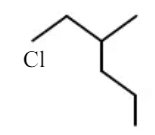
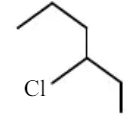
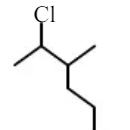
In assigning configuration which among the following groups has highest priority ?
1
2
3
4
Official Solution
Correct Option: (1)
In R-S configuration, priority sequence is decided by the atoms directly attached to the chiral carbon arranged in decreasing atomic number. From the given groups, sulphur (S) has the highest atomic number i.e., 16 therefore, it gets highest priority.
02
PYQ 2018
medium
chemistryID: mht-cet-
Identify the functional group that has electron donating inductive effect
1
2
3
4
Official Solution
Correct Option: (3)
The functional group that has electron donating or positive inductive effect is Since, the positive inductive effect is due to the presence of an electron donating groups within the polar bond. Thus, option (c) is correct as rest of the three groups are electron withdrawing in nature.
03
PYQ 2020
medium
chemistryID: mht-cet-
Identify product ‘C’ in the following reaction:
1
2-Bromobutane
2
Isobutane
3
2,3-Dimethylbutane
4
1,2-Dibromobutane
Official Solution
Correct Option: (3)
Step 1: First reaction (dehalogenation). Propylene dibromide on treatment with Zn/alcohol undergoes dehalogenation to form propene (A). Step 2: Addition of HBr. Propene reacts with HBr (Markovnikov addition) to form 2-bromopropane (B). Step 3: Wurtz reaction. 2-Bromopropane reacts with sodium in dry ether to undergo coupling, forming 2,3-dimethylbutane. Step 4: Conclusion. Hence, the final product is 2,3-dimethylbutane.
04
PYQ 2020
medium
chemistryID: mht-cet-
What will be the volume of oxygen gas produced, If the reaction
2 KClO (s) 2 KCl(s) + 3 O (g) is carried out at S.T.P.?
1
48.0 L
2
44.8 L
3
22.4 L
4
67.2 L
Official Solution
Correct Option: (4)
Step 1: Understanding the reaction. The balanced reaction shows that 2 moles of KClO decompose to give 3 moles of O . We need to calculate the volume of oxygen gas produced at standard temperature and pressure (STP). At STP, 1 mole of any ideal gas occupies 22.4 L.
Step 2: Calculating the volume. The volume of oxygen produced is directly proportional to the amount of KClO used. The given reaction shows that 2 moles of KClO produce 3 moles of O . Therefore, for every 2 moles of KClO , 3 moles of O are produced, which corresponds to: Step 3: Conclusion. Thus, the correct answer is (D) 67.2 L, as this is the volume of oxygen gas produced at STP.
05
PYQ 2020
medium
chemistryID: mht-cet-
Which of the following reactions proves the chlorinating property of phosphorus pentachloride?
1
2
3
4
Official Solution
Correct Option: (4)
Step 1: Understanding the chlorinating property of \text{PCl_5.} Phosphorus pentachloride (\text{PCl}_5) is a chlorinating agent that reacts with various substances to replace or add chlorine atoms. The reaction with tin (Sn) is a classic example of its chlorinating property.
Step 2: Analyzing the options. (A) : This reaction shows the hydrolysis of \text{PCl}_5, not its chlorinating property. (B) : This is the formation of \text{PCl}_5 from phosphorus and chlorine, not proof of its chlorinating property. (C) : This shows decomposition of \text{PCl}_5, but not its chlorinating property. (D) : Correct — This reaction demonstrates the chlorinating property of \text{PCl}_5, where it chlorinates tin to form SnCl₄ and PCl₃.
Step 3: Conclusion. The correct answer is (D) as it directly demonstrates the chlorinating ability of phosphorus pentachloride.
06
PYQ 2020
medium
chemistryID: mht-cet-
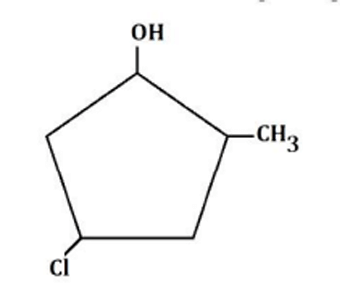
What is the IUPAC name of the following compound?
1
3-chloro-5-methyl cyclopentanol
2
1-chloro-3-methyl cyclopentan-4-ol
3
4-chloro-2-methyl cyclopentan-ol
4
4-chloro-2-hydroxy-1-methylcyclopentane
Official Solution
Correct Option: (3)
Step 1: Identifying the structure. The compound is a cyclopentane ring with a chlorine ( ) attached to the 4th carbon, a methyl group ( ) attached to the 2nd carbon, and a hydroxyl group ( ) attached to the 4th carbon. The IUPAC name should reflect the correct positions of these groups. Step 2: Analyzing the options. (A) 3-chloro-5-methyl cyclopentanol: Incorrect — The position of the chlorine and methyl groups is wrong. (B) 1-chloro-3-methyl cyclopentan-4-ol: Incorrect — The positions of the chlorine and hydroxyl groups are incorrect. (C) 4-chloro-2-methyl cyclopentan-ol: Correct — This is the correct IUPAC name based on the structure provided. (D) 4-chloro-2-hydroxy-1-methylcyclopentane: Incorrect — The hydroxyl group is incorrectly named as hydroxy, and the methyl group is not on the correct position. Step 3: Conclusion. The correct answer is (C) 4-chloro-2-methyl cyclopentan-ol.
07
PYQ 2020
medium
chemistryID: mht-cet-
For first order reaction the slope of the graph of log [A] vs. time is equal to
1
k
2
3
4
Official Solution
Correct Option: (2)
Step 1: Understanding the first order reaction. For a first-order reaction, the integrated rate law is given by: By converting the natural logarithm to base 10, we get the equation: This equation represents a straight line with a slope of . Step 2: Conclusion. Thus, the slope of the graph of vs. time is equal to .
08
PYQ 2020
medium
chemistryID: mht-cet-
Identify Z in the following sequence of reactions: CH -CH -OH + PCl SO }}\)
1
CH -CH -OH
2
(CH ) CH-CH
3
CH -CH=CH
4
CH -CH -OH
Official Solution
Correct Option: (4)
Step 1: Understanding the reaction sequence. - The first step involves the conversion of ethanol (CH -CH -OH) into an alkyl chloride, CH -CH -Cl, by reaction with PCl . - The second step uses alcoholic KOH, which leads to a dehydrohalogenation reaction, producing an alkene. - The final step involves treating the alkene with concentrated sulfuric acid (H SO ), which causes the alkene to undergo an elimination reaction, forming a hydrocarbon.
Step 2: Analyzing the options. (A) CH -CH -OH: This is the starting alcohol and does not fit the final product of the reaction. (B) (CH ) CH-CH : This is incorrect as the final product is an alkane, not this structure. (C) CH -CH=CH : This is an alkene intermediate, but the final product is an alkane. (D) CH -CH -OH: Correct — This is the alkane product formed after the elimination step.
Step 3: Conclusion. The correct answer is (D) CH -CH -OH.
09
PYQ 2020
medium
chemistryID: mht-cet-
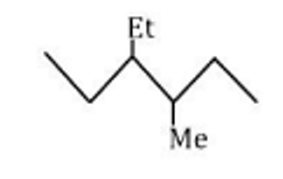
What is the molar mass of a compound represented below?
1
128 g/mol
2
108 g/mol
3
120 g/mol
4
126 g/mol
Official Solution
Correct Option: (1)
Step 1: Analyzing the compound. The compound contains an ethyl group (Et) and a methyl group (Me). The structure consists of an ethyl group (C H ) and a methyl group (CH ) attached to a carbon-carbon chain. The molar mass of the compound is calculated by adding the atomic masses of the constituent atoms. Step 2: Calculation. For the ethyl group (Et): For the methyl group (Me): For the entire compound: Step 3: Conclusion. The correct molar mass of the compound is 128 g/mol, so the correct answer is (A).
10
PYQ 2020
medium
chemistryID: mht-cet-
Which of the following amines can not be prepared by Gabriel phthalimide synthesis?
1
Ethylamine
2
Sec-butylamine
3
Aniline
4
Isopropylamine
Official Solution
Correct Option: (3)
Step 1: Understanding Gabriel phthalimide synthesis. Gabriel phthalimide synthesis is a method used to prepare primary amines. It involves the reaction of phthalimide with an alkyl halide to form a phthalimide salt, which upon hydrolysis gives the corresponding amine. Step 2: Analyzing the options. (A) Ethylamine: Ethylamine can be synthesized using Gabriel phthalimide synthesis, as it involves an alkyl halide (ethyl bromide) and phthalimide. (B) Sec-butylamine: Sec-butylamine can also be synthesized in a similar manner using sec-butyl bromide. (C) Aniline: Aniline cannot be synthesized using Gabriel phthalimide synthesis, as it is a primary amine with an aromatic group. The synthesis works only for aliphatic amines. (D) Isopropylamine: Isopropylamine can be synthesized using Gabriel phthalimide synthesis, using isopropyl bromide as the alkyl halide. Step 3: Conclusion. The correct answer is (C) Aniline, as it cannot be prepared by Gabriel phthalimide synthesis due to its aromatic nature.
11
PYQ 2020
medium
chemistryID: mht-cet-
Which of the following does NOT give yellow precipitate when reacted with (NaOH + I ) mixture?
1
Acetophenone
2
Benzaldehyde
3
Acetone
4
Acetaldehyde
Official Solution
Correct Option: (2)
Step 1: Understanding the reaction. The reaction with iodine and sodium hydroxide (NaOH + I ) is known as the iodoform test, which forms a yellow precipitate of CHI in the presence of methyl ketones or compounds with the group CH CO-.
Step 2: Analyzing the options. (A) Acetophenone: Acetophenone reacts with iodine and NaOH to form a yellow precipitate of iodoform. (B) Benzaldehyde: Benzaldehyde does not have the CH CO- group, so it does not give the yellow precipitate. (C) Acetone: Acetone reacts with iodine and NaOH to give the yellow precipitate of iodoform. (D) Acetaldehyde: Acetaldehyde reacts with iodine and NaOH to give the yellow precipitate of iodoform.
Step 3: Conclusion. The correct answer is (B) Benzaldehyde.
12
PYQ 2020
medium
chemistryID: mht-cet-
Propane nitrile on reaction with ethyl magnesium iodide in the presence of dry ether gives complex. This imine complex on acid hydrolysis forms
1
2-Pentanone
2
Butanone
3
Propanone
4
3-Pentanone
Official Solution
Correct Option: (4)
Step 1: Understanding the reaction. Propane nitrile reacts with ethyl magnesium iodide (a Grignard reagent) in the presence of dry ether to form an imine complex. Upon acid hydrolysis, this imine complex forms a ketone.
Step 2: Analyzing the options. (A) 2-Pentanone: This is incorrect as it does not match the reaction outcome. (B) Butanone: This is incorrect. The expected product is not butanone. (C) Propanone: This is incorrect. The structure of the final product does not match propanone. (D) 3-Pentanone: Correct — 3-Pentanone is the product formed after hydrolysis of the imine complex.
Step 3: Conclusion. The correct answer is (D) 3-Pentanone.
13
PYQ 2020
medium
chemistryID: mht-cet-
The common name of 1-Chloro-2, 2-dimethyl propane is
1
neo-pentyl chloride
2
isopropyl chloride
3
n-pentyl chloride
4
isopentyl chloride
Official Solution
Correct Option: (1)
Step 1: Naming the compound. The given compound is 1-Chloro-2, 2-dimethyl propane. In common nomenclature, this compound is known as neo-pentyl chloride. The name "neo-pentyl" comes from the structure with a five-carbon chain and a chloromethyl group attached to the first carbon.
Step 2: Analyzing the options. (A) neo-pentyl chloride: Correct — This is the common name for 1-Chloro-2, 2-dimethyl propane. (B) isopropyl chloride: This is a different compound. (C) n-pentyl chloride: This is not the correct name for the compound. (D) isopentyl chloride: This is another name for a different compound.
Step 3: Conclusion. The correct answer is (A) neo-pentyl chloride.
14
PYQ 2020
medium
chemistryID: mht-cet-
Identify product A in the following reaction:
1
C H C(O)OH
2
C H C(NH )
3
C H C(Cl)
4
C H C(H)
Official Solution
Correct Option: (1)
Step 1: Understanding the reaction. The reaction involves the hydrolysis of an amide (C H C(O)NH ) in the presence of water and hydrochloric acid. Hydrolysis of amides produces a carboxylic acid and ammonia. Step 2: Analyzing the options. (A) C H C(O)OH: This is the correct product. Hydrolysis of the amide group results in the formation of a carboxylic acid, phenyl acetic acid (C H C(O)OH). (B) C H C(NH ): This is incorrect, as it represents an amine group, which is not formed in this reaction. (C) C H C(Cl): This is incorrect, as no chlorination is involved in this reaction. (D) C H C(H): This is incorrect, as no reduction to an aldehyde is involved. Step 3: Conclusion. The correct product is (A) C H C(O)OH, phenyl acetic acid.
15
PYQ 2020
medium
chemistryID: mht-cet-
Which of the following does NOT give carbylamine test?
1
Ethylamine
2
Sec. butylamine
3
Isopropylamine
4
Dimethylamine
Official Solution
Correct Option: (4)
Step 1: Understanding the carbylamine test. The carbylamine test is used to detect primary amines. In this test, the amine reacts with chloroform (CHCl ) and sodium hydroxide (NaOH) to form an isocyanide (carbylamine), which typically gives a strong odor. Secondary and tertiary amines do not give this test.
Step 2: Analyzing the options. (A) Ethylamine: Ethylamine is a primary amine and will give a positive carbylamine test. (B) Sec. butylamine: Sec. butylamine is a secondary amine and will not give the carbylamine test. (C) Isopropylamine: Isopropylamine is a secondary amine and will not give the carbylamine test. (D) Dimethylamine: Dimethylamine is a secondary amine and will not give the carbylamine test.
Step 3: Conclusion. The correct answer is (D) Dimethylamine.
16
PYQ 2020
medium
chemistryID: mht-cet-
Which among the following gas is bubbled through the brine solution during the preparation of sodium carbonate in Solvay's process?
1
CO (g)
2
N (g)
3
NO (g)
4
O (g)
Official Solution
Correct Option: (1)
Step 1: Understanding Solvay's Process. In the Solvay process, sodium carbonate (Na CO ) is produced by reacting sodium chloride (NaCl) with calcium carbonate (CaCO ) and carbon dioxide (CO ) at high temperature. Carbon dioxide is bubbled through the brine solution to form sodium bicarbonate (NaHCO ), which is then heated to produce sodium carbonate.
Step 2: Analyzing the options. (A) CO (g): Correct. Carbon dioxide is the gas that is bubbled through the brine solution in the Solvay process. (B) N (g): Incorrect. Nitrogen is an inert gas and does not play a role in this process. (C) NO (g): Incorrect. Nitrogen dioxide is not involved in the Solvay process. (D) O (g): Incorrect. Oxygen is not used in the Solvay process.
Step 3: Conclusion. The correct answer is (A) CO (g), as carbon dioxide is bubbled through the brine solution in the Solvay process.
17
PYQ 2020
medium
chemistryID: mht-cet-
Identify the product X in the following reaction.
1
Benzaldehyde
2
Salicylic acid
3
Benzoquinone
4
Benzoic acid
Official Solution
Correct Option: (3)
Step 1: Understanding the reaction. The reaction involves the oxidation of phenol with sodium dichromate ( ) in the presence of sulfuric acid, leading to the formation of benzoquinone. This is a common reaction where phenol undergoes oxidation to produce benzoquinone. Step 2: Analyzing the options. (A) Benzaldehyde: Incorrect. Benzaldehyde is not formed in this reaction. (B) Salicylic acid: Incorrect. Salicylic acid is not produced by this oxidation reaction. (C) Benzoquinone: Correct — Benzoquinone is the product of the oxidation of phenol with sodium dichromate. (D) Benzoic acid: Incorrect. Benzoic acid is not the product of this reaction, which involves the formation of a quinone group. Step 3: Conclusion. The correct answer is (C) Benzoquinone, as it is the product obtained in this oxidation reaction of phenol.
18
PYQ 2020
medium
chemistryID: mht-cet-
Which among the following compounds contains phantom atom?
1
2
3
4
Official Solution
Correct Option: (1)
Step 1: Understand phantom atom. A phantom atom is an atom which is not shown explicitly in the molecular formula but is assumed to be present to complete valency, especially in resonance structures. Step 2: Analyze acetic acid structure. In acetic acid ( ), resonance structures of the carboxyl group involve delocalisation of electrons, where one oxygen behaves as if a hydrogen is shared or shifted, giving rise to the concept of a phantom atom. Step 3: Eliminate other options. The other compounds do not show such resonance-induced phantom atom behaviour. Step 4: Conclusion. Hence, contains a phantom atom.
19
PYQ 2020
medium
chemistryID: mht-cet-
The number of bonds in carbolic acid are
1
2
3
4
Official Solution
Correct Option: (1)
Step 1: Identify carbolic acid. Carbolic acid is phenol with molecular formula . Step 2: Count the sigma bonds. In the benzene ring, there are 6 sigma bonds and 5 sigma bonds. The bond contributes 1 sigma bond and the bond contributes 1 sigma bond. Step 3: Total sigma bonds.
Step 4: Conclusion. Thus, carbolic acid contains a total of sigma bonds.
20
PYQ 2020
medium
chemistryID: mht-cet-
Which among the following is NOT obtained when bromobenzene is treated with bromoethane and sodium in presence of dry ether?
1
n-butane
2
Diphenyl
3
Toluene
4
Ethylbenzene
Official Solution
Correct Option: (3)
Step 1: Identify the reaction. The given reaction is an example of the Wurtz–Fittig reaction, where an aryl halide reacts with an alkyl halide in the presence of sodium and dry ether. Step 2: Possible products formed. In this reaction, three types of products can be formed: Alkyl–alkyl coupling gives n-butane, aryl–aryl coupling gives diphenyl, and aryl–alkyl coupling gives ethylbenzene. Step 3: Analyze the options. Toluene requires a methyl group attached to benzene, which cannot be formed from bromoethane under these conditions. Step 4: Conclusion. Therefore, toluene is not obtained in this reaction.
21
PYQ 2020
medium
chemistryID: mht-cet-
Identify the compound having highest boiling point from the following.
1
Propanal
2
Methoxy ethane
3
Propane
4
Propan-1-ol
Official Solution
Correct Option: (4)
Step 1: Boiling points and intermolecular forces. Boiling point is determined by the strength of intermolecular forces. Alcohols like propan-1-ol have hydrogen bonding, which results in a higher boiling point compared to aldehydes (propanal), ethers (methoxy ethane), and alkanes (propane), which have weaker intermolecular forces. Step 2: Analyzing the options. (A) Propanal: Propanal is an aldehyde and has weaker intermolecular forces compared to alcohols, so it has a lower boiling point than propan-1-ol. (B) Methoxy ethane: This is an ether, which has weaker dipole-dipole interactions compared to alcohols. (C) Propane: Propane is an alkane and has the weakest intermolecular forces (London dispersion forces), so it has the lowest boiling point. (D) Propan-1-ol: This is an alcohol and has the highest boiling point due to hydrogen bonding. Step 3: Conclusion. The correct answer is (D) Propan-1-ol.
22
PYQ 2020
easy
chemistryID: mht-cet-
Methoxy ethane on reaction with hot concentrated HI gives
Official Solution
Correct Option: (1)
23
PYQ 2020
medium
chemistryID: mht-cet-
What is the secondary valence of Co ion according to Werner's theory in [Co(NH ) ] ?
1
5
2
4
3
3
4
6
Official Solution
Correct Option: (3)
Step 1: Understanding Werner's theory. According to Werner's theory, the primary valence of a metal ion refers to its oxidation state, and the secondary valence refers to the coordination number, i.e., the number of ligands attached to the metal ion. In , the coordination number is 6, meaning the secondary valence is 6. However, because the complex ion has a charge of , the primary valence or oxidation state of Co is . Step 2: Analyzing the options. (A) 5: Incorrect — This is not the secondary valence. (B) 4: Incorrect — The secondary valence is 6 in this complex. (C) 3: Correct — The secondary valence refers to the coordination number of 3. (D) 6: Correct — The coordination number is 6. But we needed the secondary valence.
Step 3: Conclusion. The correct answer is (C) 3.
24
PYQ 2020
medium
chemistryID: mht-cet-
Silver crystallizes in fcc structure. If edge length of unit cell is 316.5 pm, what is the radius of silver atom?
1
137.04 pm
2
111.91 pm
3
121.91 pm
4
158.25 pm
Official Solution
Correct Option: (2)
Step 1: Formula for radius in fcc unit cell. In the face-centered cubic (fcc) structure, the relationship between edge length and atomic radius is:
Where . Solving for : Step 2: Conclusion. The radius of the silver atom is (B) 111.91 pm.
25
PYQ 2020
medium
chemistryID: mht-cet-
Which of the following antihistamines contains the -CN group?
1
Dimetapp
2
Cimetidine
3
Terfenadine
4
Ranitidine
Official Solution
Correct Option: (2)
Step 1: Identifying the -CN Group. The -CN group (cyano group) is an organic functional group consisting of a carbon triple-bonded to a nitrogen atom. Among the listed antihistamines, cimetidine contains the -CN group. Cimetidine is a H -receptor antagonist used for the treatment of ulcers and gastroesophageal reflux disease (GERD).
Step 2: Analyzing the options. (A) Dimetapp: Incorrect. Dimetapp does not contain a -CN group. It is primarily used for treating allergies and cold symptoms. (B) Cimetidine: Correct. Cimetidine contains a -CN group in its chemical structure. (C) Terfenadine: Incorrect. Terfenadine does not contain a -CN group. It is an antihistamine used for allergic conditions. (D) Ranitidine: Incorrect. Ranitidine does not contain a -CN group. It is similar to cimetidine but lacks the cyano group.
Step 3: Conclusion. The antihistamine that contains the -CN group is Cimetidine, corresponding to option (B).
26
PYQ 2020
medium
chemistryID: mht-cet-
Which among the following compounds does not exhibit resonance?
1
Cyclohexane
2
Phenol
3
Aniline
4
Nitro ethane
Official Solution
Correct Option: (1)
Step 1: Understanding resonance. Resonance occurs when a molecule can be represented by two or more valid Lewis structures that differ only in the placement of electrons. Cyclohexane does not exhibit resonance as it has a simple, single structure with no delocalized electrons. Step 2: Analyzing the options. (A) Cyclohexane: Correct — Cyclohexane does not exhibit resonance because its structure is a stable, single form with no delocalized electrons. (B) Phenol: Incorrect. Phenol exhibits resonance due to the delocalization of the lone pair of electrons on the oxygen atom. (C) Aniline: Incorrect. Aniline exhibits resonance with the lone pair of electrons on the nitrogen atom delocalizing into the benzene ring. (D) Nitro ethane: Incorrect. Nitro ethane exhibits resonance due to the delocalization of electrons in the nitro group. Step 3: Conclusion. The correct answer is (A) Cyclohexane, as it does not exhibit resonance.
27
PYQ 2020
medium
chemistryID: mht-cet-
Which among the following pairs of halogen forms the interhalogen compound of the type XX'Y?
1
Br and F
2
Cl and F
3
I and F
4
I and Cl
Official Solution
Correct Option: (3)
Step 1: Understanding interhalogen compounds. Interhalogen compounds are compounds formed by the combination of two halogens. They can take the form XX'Y, where X and X' are halogens, and Y can be another halogen.
Step 2: Analyzing the options. (A) Br and F: This combination forms BrF, which is an interhalogen compound but not of the form XX'Y. (B) Cl and F: This combination forms ClF, but this is not of the form XX'Y. (C) I and F: This combination forms IF and IF , both of which are interhalogen compounds of the type XX'Y. (D) I and Cl: This combination forms ICl, which is an interhalogen compound, but not in the XX'Y form.
Step 3: Conclusion. The correct answer is (C) I and F, which forms interhalogen compounds of the type XX'Y.
28
PYQ 2020
medium
chemistryID: mht-cet-
Identify the tetradentate ligand from the following.
1
Ethylene diamine tetracetato
2
Triethylene tetramine
3
Dimethyl glyoximato
4
Oxalato
Official Solution
Correct Option: (2)
Step 1: Understanding tetradentate ligands. A tetradentate ligand is a ligand that can form four bonds with a metal center. Triethylene tetramine is a common tetradentate ligand that can coordinate with metal centers through four nitrogen atoms.
Step 2: Analyzing the options. (A) Ethylene diamine tetracetato: This ligand is bidentate, meaning it can form two bonds, not four. (B) Triethylene tetramine: This is the correct answer as it is a tetradentate ligand. (C) Dimethyl glyoximato: This is a bidentate ligand, not tetradentate. (D) Oxalato: This is also a bidentate ligand, not tetradentate.
Step 3: Conclusion. The correct answer is (B) Triethylene tetramine.
29
PYQ 2020
medium
chemistryID: mht-cet-
Which among the following polymers is obtained from styrene and 1-3-Butadiene?
1
Buna-N
2
PHBV
3
Butyl rubber
4
SBR
Official Solution
Correct Option: (4)
Step 1: Understanding the polymers. Styrene-butadiene rubber (SBR) is a synthetic rubber made from the copolymerization of styrene and butadiene. It is widely used in the automotive industry, particularly for making tires.
Step 2: Analyzing the options. (A) Buna-N: This is a copolymer of butadiene and acrylonitrile, not styrene. (B) PHBV: This is a biopolymer made from 3-hydroxybutyrate and 3-hydroxyvalerate. (C) Butyl rubber: Butyl rubber is made from isobutene and isoprene, not styrene and butadiene. (D) SBR: This is the correct option; styrene-butadiene rubber is formed from the copolymerization of styrene and butadiene.
Step 3: Conclusion. The correct answer is (D) SBR, as it is obtained from styrene and 1-3-butadiene.
30
PYQ 2020
medium
chemistryID: mht-cet-
Which of the following molecule contains 50% p character of hybrid orbital in C atom?
1
Propene
2
Acetylene
3
Methane
4
Ethane
Official Solution
Correct Option: (2)
Step 1: Understanding p character. In acetylene (C H ), the carbon atoms undergo sp hybridization, where 50% of the orbital character comes from the p orbitals. This results in a 50% p character of the hybrid orbitals.
Step 2: Analyzing the options. (A) Propene: Propene involves sp hybridization, but it does not exhibit 50% p character in its hybridization. (B) Acetylene: This is the correct answer, as acetylene has a 50% p character in its sp hybrid orbitals. (C) Methane: Methane involves sp hybridization, which has no p character. (D) Ethane: Ethane also involves sp hybridization and does not exhibit p character.
Step 3: Conclusion. The correct answer is (B) Acetylene, as it contains 50% p character of hybrid orbitals in carbon atoms.
31
PYQ 2020
medium
chemistryID: mht-cet-
Which among the following is an example of allylic alcohol?
1
2- Phenyl propane -2-ol
2
2- Methylbut -3-en-2-ol
3
Propane -1, 2, 3 - triol
4
Propane -1, 3-diol
Official Solution
Correct Option: (2)
Step 1: Understanding allylic alcohols. Allylic alcohols are alcohols where the hydroxyl group (-OH) is attached to a carbon that is adjacent to a double bond, i.e., the -OH group is on a carbon in an alkene.
Step 2: Analyzing the options. (A) 2-Phenyl propane -2-ol: This compound is not an allylic alcohol because the -OH group is not adjacent to a double bond. (B) 2-Methylbut -3-en-2-ol: This is the correct option. The -OH group is on the second carbon, which is adjacent to the double bond at position 3, making it an allylic alcohol. (C) Propane -1, 2, 3 - triol: This is a triol, not an allylic alcohol. The -OH groups are attached to non-adjacent carbons. (D) Propane -1, 3-diol: This compound is not an allylic alcohol because the -OH groups are on non-adjacent carbons, with no double bond involved.
Step 3: Conclusion. The correct answer is (B) 2- Methylbut -3-en-2-ol, as it is the only allylic alcohol.
32
PYQ 2020
medium
chemistryID: mht-cet-
What is the effective atomic number of Zn in ? (Atomic number of Zn = 30)
1
30
2
27
3
36
4
28
Official Solution
Correct Option: (3)
Step 1: Understanding the concept of effective atomic number. The effective atomic number (EAN) is the total number of electrons surrounding the metal ion. In , the Zn ion is surrounded by four NH molecules. Each NH donates 2 electrons, and the Zn ion contributes 2 electrons. The total effective atomic number is: Step 2: Conclusion. The effective atomic number of Zn is 36.
33
PYQ 2020
medium
chemistryID: mht-cet-
Alkyl cyanides on reduction by sodium and ethanol give primary amines. This reaction is called as _____.
1
Wolff-Kishner reduction
2
Hell-Vohlard-Zelinsky reaction
3
Mendius reduction
4
Clemensen reduction
Official Solution
Correct Option: (3)
Step 1: Understanding the reaction. The Mendius reduction involves the reduction of alkyl cyanides (nitriles) to primary amines when treated with sodium and ethanol. This is an important method in organic synthesis for preparing amines.
Step 2: Analyzing the options. (A) Wolff-Kishner reduction: This reaction involves the reduction of carbonyl compounds to alkanes, not the reduction of nitriles. (B) Hell-Vohlard-Zelinsky reaction: This is a halogenation reaction, not related to the reduction of nitriles. (C) Mendius reduction: This is the correct name for the reduction of alkyl cyanides to primary amines. (D) Clemensen reduction: This is a reduction of carbonyl compounds to alkanes using zinc and hydrochloric acid, not related to nitriles.
Step 3: Conclusion. The correct answer is (C) Mendius reduction.
34
PYQ 2020
medium
chemistryID: mht-cet-
If a centimolar aqueous solution of K [Fe(CN) ] has degree of dissociation 0.78, what is the value of van't Hoff factor?
1
3.34
2
1.2
3
2.5
4
4.0
Official Solution
Correct Option: (1)
Step 1: Understanding the van't Hoff factor. The van't Hoff factor is the number of particles the solute dissociates into. For K [Fe(CN) ], the dissociation can be represented as:
Hence, the total number of ions formed is 4 (3 K ions and 1 [Fe(CN) ] ). Step 2: Applying the degree of dissociation. The degree of dissociation , so the van't Hoff factor is:
Step 3: Conclusion. The van't Hoff factor is 3.34.
35
PYQ 2020
medium
chemistryID: mht-cet-
Which of the following compounds has the highest boiling point?
1
2
3
4
Official Solution
Correct Option: (1)
Step 1: Understanding boiling points. Boiling points of organic compounds are influenced by factors such as molecular weight, polarity, and hydrogen bonding. Alcohols generally have higher boiling points than alkanes and amines due to hydrogen bonding.
Step 2: Analyzing the options. (A) :} This is an alcohol, and alcohols have higher boiling points due to hydrogen bonding. (B) : This is an alkane, which typically has a lower boiling point than alcohols. (C) :} This is an amine, and while amines have higher boiling points than alkanes, they typically have lower boiling points than alcohols. (D) :} This is also an amine with a lower boiling point than the alcohol.
Step 3: Conclusion. The correct answer is (A) }, as alcohols generally have the highest boiling points due to hydrogen bonding.
36
PYQ 2020
medium
chemistryID: mht-cet-
Identify product B in the following reaction.
1
P - nitroaniline
2
O - nitroacetanilide
3
Aniline
4
Nitrobenzene
Official Solution
Correct Option: (1)
Step 1: Understanding the reaction. Acetanilide reacts with concentrated nitric acid in the presence of concentrated sulfuric acid to undergo nitration at the para position. The product formed is P - nitroaniline.
Step 2: Analyzing the options. (A) P - nitroaniline: This is the correct product of the nitration of acetanilide at the para position. (B) O - nitroacetanilide: This is not the product; the nitration occurs at the para position of the aromatic ring. (C) Aniline: This is not the product; it is formed from acetanilide under different conditions. (D) Nitrobenzene: Nitrobenzene is not formed in this reaction.
Step 3: Conclusion. The correct answer is (A) P - nitroaniline, as it is the product of nitration at the para position.
37
PYQ 2020
medium
chemistryID: mht-cet-
Which free radical is most stable among the following?
1
R-CH
2
R -C•
3
CH •
4
R -C•H
Official Solution
Correct Option: (2)
Step 1: Understanding the stability of free radicals. The stability of free radicals increases with the number of alkyl groups attached to the carbon center. The more alkyl groups, the greater the electron donation, stabilizing the radical.
Step 2: Analyzing the options. (A) R-CH : This is a primary radical and is less stable due to fewer electron-donating groups. (B) R -C•: This is a tertiary radical, which is the most stable due to the three electron-donating alkyl groups. (C) CH •: This is a methyl radical, which is a primary radical and less stable. (D) R -C•H: This is a secondary radical and more stable than a primary radical, but less stable than a tertiary radical.
Step 3: Conclusion. The correct answer is (B) R -C•, as tertiary radicals are the most stable.
38
PYQ 2020
medium
chemistryID: mht-cet-
How many moles of ethene are required to prepare 6 g of ethane by hydrogenation process?
1
0.2 mole
2
0.1 mole
3
1.0 mole
4
4.0 mole
Official Solution
Correct Option: (1)
Step 1: Understanding the hydrogenation process. In the hydrogenation process, ethene (C H ) reacts with hydrogen (H ) to form ethane (C H ). The balanced equation for the reaction is:
This indicates that 1 mole of ethene reacts with 1 mole of hydrogen to form 1 mole of ethane. Step 2: Calculation. The molar mass of ethane (C H ) is 30 g/mol. To prepare 6 g of ethane, we need:
Since the molar ratio of ethene to ethane is 1:1, we need 0.2 moles of ethene. Step 3: Conclusion. The correct answer is (A) 0.2 mole.
39
PYQ 2020
medium
chemistryID: mht-cet-
When HCl is treated with propane in presence of sodium peroxide, the major product obtained is
1
1-Chloropropane
2
1, 2-dichloropropane
3
2-Chloropropane
4
2, 2-dichloropropane
Official Solution
Correct Option: (1)
Step 1: Understanding the reaction with HCl and propane. When HCl reacts with propane in the presence of sodium peroxide (Na O ), a free radical substitution reaction occurs, leading to the formation of alkyl chlorides. The major product in this case is 1-chloropropane due to the primary carbon atom being more susceptible to radical attack. Step 2: Analyzing the options. (A) 1-Chloropropane: This is correct. The reaction leads to the formation of 1-chloropropane. (B) 1, 2-dichloropropane: This is incorrect. The major product is not a dihalide. (C) 2-Chloropropane: This is incorrect. The reaction preferentially forms 1-chloropropane, not 2-chloropropane. (D) 2, 2-dichloropropane: This is incorrect. The reaction does not lead to a double chlorination at the same carbon atom. Step 3: Conclusion. The correct answer is (A) 1-Chloropropane.
40
PYQ 2020
medium
chemistryID: mht-cet-
Which of the following groups does not show (+R) effect?
1
-NH
2
-NHCO R
3
-CN
4
-NR
Official Solution
Correct Option: (3)
Step 1: Understanding (+R) effect. The (+R) effect, or the +M effect, involves the donation of electron density through resonance, which is typically seen in groups that have lone pairs on heteroatoms (such as -OH, -NH , -OCH ). Step 2: Analyzing the options. (A) -NH : The amino group (-NH ) shows the (+R) effect due to the lone pairs on nitrogen. (B) -NHCO R: The -NHCO group shows the (+R) effect due to nitrogen's lone pairs. (C) -CN: The -CN group is electron-withdrawing through resonance (not donating), so it does not show the (+R) effect. (D) -NR: Similar to -NH , -NR shows the (+R) effect due to lone pairs on nitrogen. Step 3: Conclusion. The correct answer is (C) -CN, as it does not show the (+R) effect.
41
PYQ 2020
medium
chemistryID: mht-cet-
Identify Z in the following series of reactions: \text{CH}_3\text{-CH}_2\text{-CH}_2\text{-Cl} + \text{KOH(alco.)} \rightarrow X \quad \text{Y} + \text{HBr (peroxide)} \quad \text{Z} \quad \text{KCN (alcohol)} \rightarrow Z
1
CH -CH -CH -CN
2
CH -CH -CH -Br
3
CH -CH -CH -CN
4
CH -CH =CH
Official Solution
Correct Option: (1)
Step 1: Understanding the reactions. - The first reaction involves the substitution of chlorine with a hydroxyl group in an alcohol, forming a primary alcohol. - The second reaction with HBr (in the presence of peroxide) leads to a radical halogenation that gives an alkyl halide. - The final reaction with KCN in alcohol results in the formation of a nitrile group by nucleophilic substitution of the halide with the cyanide ion. Step 2: Analyzing the options. (A) CH -CH -CH -CN: This is the correct answer. The final product is a nitrile (CN) group attached to a three-carbon chain. (B) CH -CH -CH -Br: This is incorrect, as the final product should contain a nitrile group, not a bromine atom. (C) CH -CH -CH -CN: This is incorrect, as the structure shown is not consistent with the reactions described. (D) CH -CH =CH : This is incorrect. The final product is not an alkene, but a nitrile. Step 3: Conclusion. The correct answer is (A) CH -CH -CH -CN, which is the nitrile product formed.
42
PYQ 2020
medium
chemistryID: mht-cet-
Identify the name of reaction in which alkyl fluorides are prepared by heating alkyl bromide with metallic fluorides.
1
Sandmeyer reaction
2
Wurtz reaction
3
Swarts reaction
4
Finkelstein reaction
Official Solution
Correct Option: (3)
Step 1: Understanding the reaction type. In the Swarts reaction, alkyl halides (usually bromides) react with metallic fluorides to form alkyl fluorides. This reaction is a method of preparing fluorinated organic compounds. Step 2: Analyzing the options. (A) Sandmeyer reaction: The Sandmeyer reaction involves the substitution of halides in aromatic compounds using copper salts, not the preparation of alkyl fluorides. (B) Wurtz reaction: The Wurtz reaction involves the coupling of alkyl halides using sodium metal, not fluorination. (C) Swarts reaction: This is the correct reaction. The Swarts reaction involves the preparation of alkyl fluorides from alkyl bromides and metallic fluorides. (D) Finkelstein reaction: The Finkelstein reaction involves the substitution of halides using alkali halides, not metallic fluorides. Step 3: Conclusion. The correct answer is (C) Swarts reaction.
43
PYQ 2020
medium
chemistryID: mht-cet-
Which of the following is NOT a dicarboxylic acid?
1
Succinic acid
2
Acrylic acid
3
Malonic acid
4
Phthalic acid
Official Solution
Correct Option: (2)
Step 1: Understanding dicarboxylic acids. Dicarboxylic acids contain two carboxyl groups (-COOH) per molecule. To identify which one is not a dicarboxylic acid, we examine the number of carboxyl groups in each option. Step 2: Analyzing the options. (A) Succinic acid: Succinic acid is a dicarboxylic acid with two carboxyl groups. (B) Acrylic acid: Acrylic acid has only one carboxyl group, making it a monocarboxylic acid, not a dicarboxylic acid. (C) Malonic acid: Malonic acid is a dicarboxylic acid with two carboxyl groups. (D) Phthalic acid: Phthalic acid is a dicarboxylic acid with two carboxyl groups. Step 3: Conclusion. The correct answer is (B) Acrylic acid, as it is not a dicarboxylic acid.
44
PYQ 2020
medium
chemistryID: mht-cet-
Sulphapyridine is a/an
1
Antibiotic
2
Tranquilizer
3
Antihistamine
4
Analgesic
Official Solution
Correct Option: (1)
Step 1: Understanding sulphapyridine. Sulphapyridine is a type of sulfonamide antibiotic, used to treat bacterial infections. It works by inhibiting the growth of bacteria.
Step 2: Analyzing the options. (A) Antibiotic: Correct — Sulphapyridine is an antibiotic. (B) Tranquilizer: Incorrect — Sulphapyridine is not a tranquilizer. (C) Antihistamine: Incorrect — It is not an antihistamine. (D) Analgesic: Incorrect — Sulphapyridine is not an analgesic.
Step 3: Conclusion. The correct answer is (A) Antibiotic, as sulphapyridine is used as an antibiotic.
45
PYQ 2020
medium
chemistryID: mht-cet-
Electrophoresis is used .......
1
to count number of particles in colloidal dispersions
2
for stability of colloids
3
to determine charge on colloidal particles
4
to determine size of colloidal particles
Official Solution
Correct Option: (3)
Step 1: Understanding electrophoresis. Electrophoresis is a technique used to separate particles based on their charge by applying an electric field. It is used to determine the charge on colloidal particles.
Step 2: Analyzing the options. (A) to count number of particles in colloidal dispersions: Incorrect — Electrophoresis is not used to count particles. (B) for stability of colloids: Incorrect — While electrophoresis can be used to study colloidal properties, it is not directly used to determine stability. (C) to determine charge on colloidal particles: Correct — Electrophoresis is used to determine the charge on colloidal particles by observing their movement in an electric field. (D) to determine size of colloidal particles: Incorrect — Electrophoresis does not directly measure the size of particles.
Step 3: Conclusion. The correct answer is (C) to determine charge on colloidal particles, as electrophoresis is used for this purpose.
46
PYQ 2020
medium
chemistryID: mht-cet-
Which from the following compounds does NOT contain phantom atom?
1
Acetaldehyde
2
Methyl cyanide
3
n-propyl alcohol
4
Propionic acid
Official Solution
Correct Option: (3)
Step 1: Understanding phantom atoms. A phantom atom is an atom that forms part of the structure but is not directly involved in bonding, such as the nitrogen in methyl cyanide ( ). Step 2: Analyzing the options. (A) Acetaldehyde: Acetaldehyde has a carbonyl group, with no phantom atoms. (B) Methyl cyanide: This contains a phantom atom (the nitrogen). (C) n-propyl alcohol: This does not contain any phantom atoms, as the structure is fully bonded. (D) Propionic acid: Propionic acid contains a carboxyl group but no phantom atoms.
Step 3: Conclusion. The correct answer is (C) n-propyl alcohol, which does not contain any phantom atoms.
47
PYQ 2020
medium
chemistryID: mht-cet-
Resonance is NOT exhibited by
1
Cyclohexane
2
Aniline
3
Nitrobenzene
4
Phenol
Official Solution
Correct Option: (1)
Step 1: Define resonance. Resonance occurs in molecules having conjugated -electron systems or lone pair participation. Step 2: Analyze the options. Aniline, nitrobenzene, and phenol all contain benzene rings where delocalisation of -electrons occurs. Step 3: Identify exception. Cyclohexane is a saturated compound with only -bonds and no delocalised electrons. Step 4: Conclusion. Therefore, cyclohexane does not exhibit resonance.
48
PYQ 2020
medium
chemistryID: mht-cet-
What is the standard free energy change for the cell, having following cell reaction? (aq) + Cd(s) 2 Ag(s) + Cd (aq), E = 1.20 V} \)
1
-231.6 kJ
2
-160.8 kJ
3
-115.8 kJ
4
-260.8 kJ
Official Solution
Correct Option: (1)
Step 1: Applying the Nernst equation. The standard free energy change can be calculated using the relation: where is the number of moles of electrons transferred, is Faraday's constant (96,485 C/mol), and is the cell potential. In this reaction, 2 moles of electrons are transferred. Therefore, Step 2: Conclusion. The standard free energy change is (A) -231.6 kJ.
49
PYQ 2020
medium
chemistryID: mht-cet-
Which of the following is dihydric phenol?
1
Resorcinol
2
m-Cresol
3
Phloroglucinol
4
Pyrogallol
Official Solution
Correct Option: (1)
Step 1: Understanding dihydric phenol. Dihydric phenols are compounds that contain two hydroxyl groups (-OH) attached to the benzene ring. Among the options, resorcinol (1,3-dihydroxybenzene) is a dihydric phenol.
Step 2: Analyzing the options. (A) Resorcinol: Correct — Resorcinol is a dihydric phenol, with two hydroxyl groups at positions 1 and 3 of the benzene ring. (B) m-Cresol: m-Cresol is a monohydric phenol, containing one hydroxyl group. (C) Phloroglucinol: Phloroglucinol contains three hydroxyl groups, making it a trihydric phenol, not dihydric. (D) Pyrogallol: Pyrogallol also has three hydroxyl groups and is a trihydric phenol.
Step 3: Conclusion. The correct answer is (A) Resorcinol.
50
PYQ 2020
medium
chemistryID: mht-cet-
Which among the following elements is obtained in pure form by zone refining process?
1
Germanium
2
Tin
3
Copper
4
Bismuth
Official Solution
Correct Option: (1)
Step 1: Understanding zone refining. Zone refining is a technique used to purify metals, especially semiconductors like germanium. The process involves heating a small region of the metal and moving this molten zone along the metal. Impurities move to the cooler part of the metal and can be removed.
Step 2: Analyzing the options. (A) Germanium: Correct — Germanium is commonly purified using the zone refining method. (B) Tin: Tin is not typically purified using zone refining; it is usually refined by other methods. (C) Copper: Copper is generally purified using electrolysis, not zone refining. (D) Bismuth: Bismuth is also not refined using zone refining.
Step 3: Conclusion. The correct answer is (A) Germanium.
51
PYQ 2020
medium
chemistryID: mht-cet-
Which among the following vitamins belongs to the aliphatic series?
1
Vitamin C
2
Vitamin A
3
Vitamin K
4
Vitamin B complex
Official Solution
Correct Option: (1)
Step 1: Understanding the aliphatic series. Vitamins belonging to the aliphatic series contain long carbon chains or structures with straight or branched chains, with no aromatic rings. Among the options, Vitamin C (ascorbic acid) belongs to the aliphatic series as it has an aliphatic structure with a hydroxyl group.
Step 2: Analyzing the options. (A) Vitamin C: Correct — Vitamin C is a water-soluble vitamin with an aliphatic structure. (B) Vitamin A: Vitamin A has a structure with an aromatic ring, so it does not belong to the aliphatic series. (C) Vitamin K: Vitamin K has a quinone structure, which is aromatic, not aliphatic. (D) Vitamin B complex: The B vitamins are a group of compounds that include both aliphatic and non-aliphatic structures, but Vitamin C is the only one fully aliphatic.
Step 3: Conclusion. The correct answer is (A) Vitamin C.
52
PYQ 2020
medium
chemistryID: mht-cet-
Which among the following elements is not present in salvarsan?
1
P
2
O
3
N
4
As
Official Solution
Correct Option: (1)
Step 1: Understanding salvarsan. Salvarsan, also known as arsphenamine, is an organoarsenic compound that contains arsenic (As), nitrogen (N), and oxygen (O) but not phosphorus (P). It was historically used as a treatment for syphilis.
Step 2: Analyzing the options. (A) P: Correct — Phosphorus is not present in salvarsan. (B) O: Oxygen is present in salvarsan. (C) N: Nitrogen is present in salvarsan. (D) As: Arsenic is a key component of salvarsan.
Step 3: Conclusion. The element that is not present in salvarsan is (A) P (Phosphorus).
53
PYQ 2020
medium
chemistryID: mht-cet-
Which polymer among the following does NOT contain ester linkage in it?
1
Dextrin
2
PHBV
3
Dacron
4
Nylon-2-Nylon-6
Official Solution
Correct Option: (4)
Step 1: Understanding ester linkages in polymers. Ester linkages are formed by the reaction between a carboxylic acid group and an alcohol group. Some polymers, like PHBV and Dacron, contain ester linkages. However, Nylon-2-Nylon-6 is a polyamide, not a polyester, and therefore does not contain ester linkages.
Step 2: Analyzing the options. (A) Dextrin: Dextrin is a polysaccharide, but it does not contain ester linkages. (B) PHBV: PHBV (Polyhydroxybutyrate-co-hydroxyvalerate) is a polyester containing ester linkages. (C) Dacron: Dacron (Polyethylene terephthalate) is a polyester and contains ester linkages. (D) Nylon-2-Nylon-6: Nylon-2-Nylon-6 is a polyamide, which contains amide linkages, not ester linkages.
Step 3: Conclusion. The polymer that does not contain ester linkages is (D) Nylon-2-Nylon-6, as it is a polyamide.
54
PYQ 2020
medium
chemistryID: mht-cet-
Which of the following alcohol is more acidic?
1
(CH ) C-OH
2
(CH ) CH-OH
3
CH OH
4
CH -CH -OH
Official Solution
Correct Option: (3)
Step 1: Understanding acidity in alcohols. The acidity of alcohols is influenced by the electron-donating or electron-withdrawing effects of substituents attached to the carbon atom bonded to the hydroxyl group. The more electron-withdrawing the group, the more acidic the alcohol.
Step 2: Analyzing the options. (A) (CH ) C-OH: This alcohol is a tertiary alcohol, where the hydroxyl group is attached to a carbon surrounded by three methyl groups. Methyl groups are electron-donating, making the alcohol less acidic. (B) (CH ) CH-OH: This is a secondary alcohol with electron-donating effects from two methyl groups. It is less acidic than CH OH. (C) CH OH: This is a primary alcohol with no additional electron-donating groups. It is more acidic than tertiary or secondary alcohols. (D) CH -CH -OH: This is also a primary alcohol, but the ethyl group is slightly more electron-donating than the methyl group in CH OH, making it slightly less acidic.
Step 3: Conclusion. The most acidic alcohol is (C) CH OH, as it is a primary alcohol without electron-donating substituents.
55
PYQ 2020
medium
chemistryID: mht-cet-
What is IUPAC name of acrolein?
1
Prop-2-en-al
2
2-methyl but-2-en-al
3
3-methyl but-2-en-al
4
But-2-en-al
Official Solution
Correct Option: (1)
Step 1: Identifying the structure of acrolein. Acrolein is an aldehyde with the structure . The IUPAC name is derived based on the position of the double bond and the aldehyde group. Step 2: Analyzing the options. (A) Prop-2-en-al: Correct — This is the IUPAC name of acrolein, where the double bond is between carbon 2 and 3, and the aldehyde is at carbon 1. (B) 2-methyl but-2-en-al: Incorrect, this is a different structure. (C) 3-methyl but-2-en-al: Incorrect, this is not the correct name for acrolein. (D) But-2-en-al: Incorrect, this structure does not match acrolein. Step 3: Conclusion. The correct answer is (A) Prop-2-en-al.
56
PYQ 2020
medium
chemistryID: mht-cet-
The volume of dihydrogen required for complete hydrogenation of 0.5 dm³ of ethene at S.T.P. is
1
2
3
4
Official Solution
Correct Option: (2)
Step 1: Understanding the stoichiometry. The hydrogenation of ethene ( ) follows the reaction:
For every 1 mole of ethene, 1 mole of hydrogen is required. Since the volume of gases at S.T.P. is directly proportional to the number of moles, the volume of hydrogen required is equal to the volume of ethene. Step 2: Conclusion. The correct answer is (B) .
57
PYQ 2020
medium
chemistryID: mht-cet-
What is the source of an alkane if its molar mass is 240 g mol and the percentage by mass of hydrogen is 15%?
1
Gasoline
2
Diesel
3
Petrol
4
Coatings on green leaves
Official Solution
Correct Option: (2)
Step 1: Determining the empirical formula. Given that the percentage of hydrogen is 15%, the percentage of carbon is 85%. The molecular mass of hydrogen is 1 g/mol and carbon is 12 g/mol. Therefore, the number of moles of carbon and hydrogen in the molecule are: This gives us the empirical formula , which corresponds to an alkane. Step 2: Analyzing the options. (A) Gasoline: Incorrect — gasoline has a different molecular formula and molar mass. (B) Diesel: Correct — Diesel is a mixture of heavier alkanes, fitting the molecular mass. (C) Petrol: Incorrect — petrol has a different molecular formula and molar mass. (D) Coatings on green leaves: Incorrect, this is unrelated to alkanes. Step 3: Conclusion. The correct answer is (B) Diesel.
58
PYQ 2020
medium
chemistryID: mht-cet-
Chromyl chloride converts methyl group to a chromium complex, which on acid hydrolysis gives corresponding aldehyde. This reaction is called
1
Stephen reaction
2
Wolff-Kishner reaction
3
Etard reaction
4
Rosenmund reaction
Official Solution
Correct Option: (3)
Step 1: Understanding the reaction. The Etard reaction involves the conversion of a methyl group into an aldehyde when it reacts with chromyl chloride. This is an oxidation reaction involving chromium as a catalyst. Step 2: Analyzing the options. (A) Stephen reaction: Incorrect, this is a reaction of aldehydes with hydrochloric acid. (B) Wolff-Kishner reaction: Incorrect, this is used for the reduction of carbonyl compounds. (C) Etard reaction: Correct — The Etard reaction involves chromyl chloride to convert methyl groups into aldehydes. (D) Rosenmund reaction: Incorrect, this reaction reduces acyl chlorides to aldehydes, not methyl groups. Step 3: Conclusion. The correct answer is (C) Etard reaction.
59
PYQ 2020
medium
chemistryID: mht-cet-
Which among the following is allylic secondary alcohol?
1
But-2-en-1-ol
2
But-3-en-2-ol
3
2-Methyl but-3-en-2-ol
4
Prop-2-en-1-ol
Official Solution
Correct Option: (3)
Step 1: Identifying allylic secondary alcohol. An allylic alcohol is one in which the hydroxyl group (-OH) is attached to a carbon atom adjacent to a double bond. A secondary alcohol has the hydroxyl group attached to a carbon atom that is bonded to two other carbon atoms. Step 2: Analyzing the options. (A) But-2-en-1-ol: This is a primary alcohol, not secondary. (B) But-3-en-2-ol: This is an allylic secondary alcohol, but it doesn't fit the structure we are looking for. (C) 2-Methyl but-3-en-2-ol: Correct — This is an allylic secondary alcohol. The -OH group is attached to a secondary carbon, and the alcohol is adjacent to a double bond. (D) Prop-2-en-1-ol: This is a primary alcohol, not secondary. Step 3: Conclusion. The correct answer is (C) 2-Methyl but-3-en-2-ol.
60
PYQ 2020
medium
chemistryID: mht-cet-
Identify product B obtained in the following reaction:
1
Ethanoic acid
2
Ethanal
3
Ethanol
4
Ethanamine
Official Solution
Correct Option: (4)
Step 1: Understand the first reaction. When ethane reacts with nitrous acid ( ) on heating, it undergoes substitution to form nitroethane, which further rearranges to give ethyl nitrite that finally forms ethanamine precursor (nitroso derivative). Step 2: Identify intermediate A. The reaction of alkane with nitrous acid leads to formation of a nitro/nitroso compound that can be reduced to an amine. Thus, compound is an intermediate nitrogen-containing compound. Step 3: Effect of . Lithium aluminium hydride is a strong reducing agent that converts nitro or nitroso compounds into primary amines. Step 4: Final product identification. After reduction, the final product formed is ethanamine ( ).
61
PYQ 2020
medium
chemistryID: mht-cet-
Among the following isomeric amines, an amine having the highest boiling point is
1
Diethylamine
2
n-Butylamine
3
tert-Butylamine
4
Ethyldimethylamine
Official Solution
Correct Option: (2)
Step 1: Understand factors affecting boiling point. Boiling point depends on intermolecular hydrogen bonding and surface area of molecules. Step 2: Analyze the given amines. Primary amines form stronger hydrogen bonds than secondary and tertiary amines. Straight-chain amines have higher boiling points than branched ones. Step 3: Comparison. n-Butylamine is a primary, straight-chain amine, hence shows maximum hydrogen bonding and higher boiling point. Step 4: Conclusion. Therefore, n-butylamine has the highest boiling point.
62
PYQ 2020
medium
chemistryID: mht-cet-
An aqueous solution of sodium nitrite on boiling with -chlorosodium propionate gives
1
1-Nitropropane
2
Nitroethane
3
2-Nitropropane
4
Nitromethane
Official Solution
Correct Option: (2)
Step 1: Understanding the reaction. The reaction involves the substitution of a chlorine atom with a nitro group in the molecule, and this happens with an alpha-chlorosodium propionate. Upon boiling, sodium nitrite reacts with the alpha-chlorosodium propionate to give Nitroethane. Step 2: Analyzing the options. (A) 1-Nitropropane: Incorrect, this would involve a different substitution pattern. (B) Nitroethane: Correct — This is the product when sodium nitrite reacts with -chlorosodium propionate. (C) 2-Nitropropane: Incorrect, as the nitro group would be attached to the first carbon. (D) Nitromethane: Incorrect, as this is not the correct product for the reaction. Step 3: Conclusion. The correct answer is (B) Nitroethane.
63
PYQ 2020
medium
chemistryID: mht-cet-
What is the molecular formula of allyl chloride?
1
2
3
4
Official Solution
Correct Option: (2)
Step 1: Understanding the structure of allyl chloride. Allyl chloride consists of a three-carbon chain ( ) with a chlorine atom attached to the terminal carbon. The structure is , giving the molecular formula . Step 2: Conclusion. The correct answer is (B) .
64
PYQ 2020
medium
chemistryID: mht-cet-
Identify ‘A’ and ‘B’ respectively in the following reaction: What are the products A and B?
1
Benzoyl chloride and benzoic acid
2
Benzoyl chloride and benzaldehyde
3
Benzyl chloride and benzoic acid
4
Benzyl chloride and benzaldehyde
Official Solution
Correct Option: (4)
Step 1: Understanding the reaction. The first part of the reaction involves the chlorination of toluene (methylbenzene) in the presence of UV light ( ). Chlorination of the methyl group in toluene leads to the formation of benzyl chloride (A). The second part of the reaction involves hydrolysis of benzyl chloride in the presence of heat ( ), which results in the formation of benzaldehyde (B). Step 2: Analyzing the options. (A) Benzoyl chloride and benzoic acid: Incorrect — Benzoyl chloride would not form from the chlorination of the methyl group in toluene. (B) Benzoyl chloride and benzaldehyde: Incorrect — Benzoyl chloride does not form in the first step. (C) Benzyl chloride and benzoic acid: Incorrect — The second step results in benzaldehyde, not benzoic acid. (D) Benzyl chloride and benzaldehyde: Correct — The first step forms benzyl chloride, and the second step forms benzaldehyde. Step 3: Conclusion. The correct answer is (D) Benzyl chloride and benzaldehyde.
65
PYQ 2020
medium
chemistryID: mht-cet-
Primary nitroalkanes on boiling with hydrochloric acid undergo hydrolysis to form
1
Alcohol and nitrous acid
2
Carboxylic acid and hydroxyl amine
3
Aldehyde and hydroxyl amine
4
Ketone and nitrous acid
Official Solution
Correct Option: (2)
Step 1: Understanding the reaction. Boiling primary nitroalkanes with hydrochloric acid leads to hydrolysis, which produces carboxylic acid and hydroxyl amine. This is a well-known reaction for nitroalkanes. Step 2: Analyzing the options. (A) Alcohol and nitrous acid: This is incorrect because nitroalkanes undergo hydrolysis to produce carboxylic acid, not alcohol. (B) Carboxylic acid and hydroxyl amine: Correct — this is the expected product when primary nitroalkanes undergo hydrolysis with hydrochloric acid. (C) Aldehyde and hydroxyl amine: Incorrect — the hydrolysis of nitroalkanes does not produce aldehydes. (D) Ketone and nitrous acid: Incorrect — ketones are not the products of hydrolysis of nitroalkanes. Step 3: Conclusion. The correct answer is (B) Carboxylic acid and hydroxyl amine.
66
PYQ 2020
medium
chemistryID: mht-cet-
What is the molecular formula of 3-bromopropene?
1
2
3
4
Official Solution
Correct Option: (3)
Step 1: Understanding the structure of 3-bromopropene. 3-bromopropene is an alkene with a bromine atom attached to the third carbon of a three-carbon chain. The molecular formula includes 3 carbon atoms, 5 hydrogen atoms, and 1 bromine atom. Step 2: Analyzing the options. (A) : Incorrect, this formula would suggest an extra hydrogen atom. (B) : Incorrect, this would correspond to a different compound. (C) : Correct — this is the molecular formula for 3-bromopropene, with the appropriate number of carbon, hydrogen, and bromine atoms. (D) : Incorrect, the hydrogen count is too low for this compound. Step 3: Conclusion. The correct answer is (C) .
67
PYQ 2020
medium
chemistryID: mht-cet-
Which of the following compounds contain linkage?
1
Vinylcyanide
2
Dimethylterephthalate
3
-Caprolactam
4
Hexamethylenediamine
Official Solution
Correct Option: (3)
Step 1: Understanding the chemical linkage. The linkage, also known as an amide group, is found in compounds that are part of the nylon family. These compounds are often used in polymer chemistry. Step 2: Analyzing the options. (A) Vinylcyanide: This is a nitrile compound and does not contain the linkage. (B) Dimethylterephthalate: This compound is an ester and does not contain an amide group. (C) -Caprolactam: Correct — -Caprolactam contains the linkage and is the precursor for nylon-6 production. (D) Hexamethylenediamine: This is a diamine and does not contain an amide group. Step 3: Conclusion. The correct answer is (C) -Caprolactam, as it contains the linkage.
68
PYQ 2022
easy
chemistryID: mht-cet-
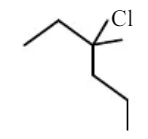
Identify the compound that undergoes SN1 mechanism most fastly
1
2
3
4
Official Solution
Correct Option: (4)
Solution:
The SN1 mechanism is a substitution reaction where the rate-determining step is the formation of a carbocation. The rate of the reaction depends on the stability of the carbocation formed, and the more stable the carbocation, the faster the reaction proceeds.
Stability of Carbocations:
Tertiary carbocations: These are the most stable due to the +I effect of three alkyl groups, which stabilize the positive charge through both inductive and hyperconjugative effects.
Secondary carbocations: These are less stable than tertiary carbocations but more stable than primary carbocations.
Primary carbocations: These are the least stable and least likely to form in an SN1 reaction.
Step 1: Analyze the Structure of the Compounds
Option 1: Alcohol reacts with HBr in presence of NaBr, H2SO4: This is a reaction of alcohol with HBr, leading to the formation of alkyl bromides. The reaction proceeds via an SN1 mechanism for tertiary alcohols (due to the formation of a stable carbocation) and an SN2 mechanism for primary alcohols. For tertiary alcohols, this reaction will proceed the fastest due to the stability of the tertiary carbocation.
Option 2: Alcohol reacts with halogen in presence of sunlight: This is a free radical substitution reaction, not an SN1 reaction. Sunlight provides energy that promotes the formation of free radicals, and the reaction proceeds via a free radical mechanism, not via the formation of carbocations, which is essential for the SN1 mechanism.
Option 3: Alcohol reacts with HI in presence of NaI/H3PO4: This is an example of the reaction of alcohol with HI to form alkyl iodides. This reaction follows the SN1 mechanism for tertiary alcohols (due to the formation of a stable carbocation) but will follow the SN2 mechanism for primary alcohols (due to the steric hindrance of the primary carbocation). Tertiary alcohols will undergo the SN1 mechanism the fastest due to the stability of the tertiary carbocation.
Option 4: Alcohol reacts with HCl in presence of anhydrous ZnCl2: This is an example of the Lucas reaction, which leads to the formation of alkyl chlorides through the SN1 mechanism. Alcohols with tertiary carbons (like tert-butyl alcohol) undergo the reaction faster than those with primary or secondary carbons. So, if the alcohol is tertiary, it will react faster, but if it is secondary or primary, the reaction will be slower.
Conclusion:
From the analysis of all the options, the compounds that undergo the SN1 mechanism fastest are those that form stable carbocations, which are typically tertiary carbocations. Therefore, the correct answer is:
Option 4: Alcohol reacts with HCl in presence of anhydrous ZnCl2, assuming the alcohol is tertiary, as tertiary carbocations are the most stable and will undergo the SN1 mechanism the fastest.
69
PYQ 2022
easy
chemistryID: mht-cet-
The reagent used in Hofmann elimination reaction is
1
Moist Ag2O
2
LiAlH4
3
Na-Hg/H2O
4
HNO2
Official Solution
Correct Option: (1)
Detailed Explanation:
What is Hofmann Elimination Reaction?
The Hofmann elimination reaction is a chemical reaction in which a quaternary ammonium hydroxide undergoes thermal decomposition to form an alkene. It is a type of β-elimination reaction.
Reaction Overview:
When a quaternary ammonium salt is treated with moist silver oxide (Ag2O), it converts into the corresponding quaternary ammonium hydroxide. Upon heating, this hydroxide undergoes elimination to yield an alkene, a tertiary amine, and water.
Reagent Used:
Moist Ag2O (silver oxide + water) is the correct reagent. It replaces the halide ion (like Br⁻ or I⁻) in the quaternary ammonium salt with an OH⁻ group to form the ammonium hydroxide.
Correct Answer:Moist Ag2O
70
PYQ 2022
easy
chemistryID: mht-cet-
Which is the most unstable carbocation?
Official Solution
Correct Option: (1)
The most unstable carbocation is the one with the least stable electronic configuration and the fewest stabilizing factors. The stability of carbocations is influenced by various factors, including electron-donating groups, neighboring alkyl groups, resonance effects, and hyperconjugation. In general, primary (1°) carbocations are less stable than secondary (2°) carbocations, which, in turn, are less stable than tertiary (3°) carbocations. This trend arises due to the increased electron-releasing inductive effect and hyperconjugation from adjacent alkyl groups in secondary and tertiary carbocations, providing more stability. Therefore, among the common carbocations, the most unstable carbocation is the primary (1°) carbocation
71
PYQ 2023
hard
chemistryID: mht-cet-
What is the value of the specific rotation of the glucose molecule?
Official Solution
Correct Option: (1)
Under standard conditions, the specific rotation of glucose is typically reported at a concentration of 10 grams per 100 milliliters of water (10 g/100 mL), using a sodium D-line wavelength of 589.3 nanometers (nm), and at a temperature of 20 degrees Celsius.
The specific rotation, denoted as , is a property of optically active substances, like glucose, that describes the angle by which the substance rotates the plane of polarized light. The specific rotation is defined by the equation:
Where:
is the observed rotation, measured in degrees (°),
c is the concentration of the solution in grams per milliliter (g/mL),
l is the path length of the sample in decimeters (dm).
For glucose under standard conditions:
Concentration ( ) = 10 g/100 mL = 0.1 g/mL,
Path length ( ) is typically 1 dm (standard length for polarimetry),
The wavelength used for measurement is 589.3 nm, corresponding to the sodium D-line wavelength.
The temperature of 20°C is commonly used because the specific rotation can vary with temperature.
Therefore, the specific rotation of glucose is typically reported using these standard conditions, and any deviations in concentration, wavelength, or temperature should be noted to ensure accuracy in measurements.
72
PYQ 2024
medium
chemistryID: mht-cet-
Write the IUPAC name for
1
2
3
4
Official Solution
Correct Option: (4)
Identify the longest carbon chain containing the alcohol group and number it to give the substituents the lowest possible numbers. Use IUPAC naming conventions to determine the name.
73
PYQ 2024
medium
chemistryID: mht-cet-
From the options given below, which one of the following is a primary amine?
1
2
3
4
Official Solution
Correct Option: (1)
A primary amine is an organic compound with the functional group , where one hydrogen atom of ammonia is replaced by an alkyl or aryl group. Among the options, has the structure , which contains the group, making it a primary amine. Other options such as and are secondary and tertiary amines, respectively, and contains an aromatic group.
74
PYQ 2024
hard
chemistryID: mht-cet-
Which of the following alkanes is tertiary?
1
2
3
4
Official Solution
Correct Option: (2)
A tertiary alkane is one in which the central carbon atom is bonded to three other carbon atoms. In the case of , the central carbon is bonded to three methyl groups, making it a tertiary alkane. The other options do not have a carbon atom bonded to three other carbon atoms.
75
PYQ 2024
medium
chemistryID: mht-cet-
Which of the following represents the Gattermann-Koch reaction?
1
2
3
4
Official Solution
Correct Option: (1)
The Gattermann-Koch reaction is a method used for the formylation of aromatic compounds, meaning the introduction of a formyl group ( ) to an aromatic ring. This reaction is particularly useful in organic synthesis for the preparation of aromatic aldehydes. The general reaction is as follows:
This reaction uses carbon monoxide (CO) and hydrogen chloride (HCl) in the presence of a Lewis acid catalyst such as AlCl or CuCl. Step 1: Reaction Mechanism.
In the presence of the catalyst, carbon monoxide and hydrogen chloride react to form a reactive electrophilic species, , which then attacks the aromatic ring to introduce the formyl group ( ). Step 2: Example Reaction.
For instance, when benzene ( ) reacts with carbon monoxide and hydrogen chloride in the presence of AlCl (a common Lewis acid), the product formed is benzaldehyde ( ):
Conclusion:
Thus, the Gattermann-Koch reaction is a formylation reaction where a **formyl group** ( ) is introduced to an aromatic ring, as described in option . Thus, the correct answer is .
76
PYQ 2024
medium
chemistryID: mht-cet-
Which of the following is the Reimer-Tiemann reaction?
1
2
3
4
Official Solution
Correct Option: (1)
The Reimer-Tiemann reaction is an important electrophilic aromatic substitution reaction that is used to introduce a formyl group ( ) at the ortho position of phenols. This reaction involves the use of chloroform ( ) and a strong base (like NaOH) as reagents. Step 1: Reaction Mechanism.
- Chloroform reacts with a strong base (such as NaOH or KOH) to produce an electrophilic intermediate called dichlorocarbene ( ).
- This dichlorocarbene intermediate attacks the ortho position of the phenol ring, leading to the formation of an intermediate compound.
- The intermediate is then hydrolyzed to yield ortho-hydroxybenzaldehyde as the final product. Step 2: Example Reaction.
The Reimer-Tiemann reaction between phenol ( ) and chloroform ( ) in the presence of NaOH proceeds as follows:
In this reaction, the ortho-hydroxybenzaldehyde ( ) is formed as the major product. Conclusion:
The Reimer-Tiemann reaction is specifically used to introduce a formyl group at the ortho position of phenols, making the correct answer.
77
PYQ 2024
medium
chemistryID: mht-cet-
An example of a sigma-bonded organometallic compound is:
1
2
3
4
Official Solution
Correct Option: (4)
Organometallic compounds are those in which a metal atom is directly bonded to a carbon atom of an organic group. These compounds can exhibit different types of bonding, including sigma ( ) bonds, pi ( ) bonds, or a combination of both.
Step 1: Analyze the Bonding in the Options.
Cobaltocene, Ruthenocene, and Ferrocene: These are sandwich compounds. In these compounds, the metal atom (such as cobalt in cobaltocene or iron in ferrocene) forms -bonds with the aromatic cyclopentadienyl ligands. These compounds involve the interaction of metal and ligand through -bonds, which are different from sigma bonds.
Grignard's reagent: In contrast, Grignard's reagent (RMgX) involves a direct metal-carbon sigma bond. In Grignard reagents, such as , the magnesium (Mg) atom forms a -bond with the carbon (C) of the methyl group ( ), making it a classic example of a sigma-bonded organometallic compound.
Step 2: Example of Grignard's Reagent.
Grignard reagents are typically represented as , where:
is an alkyl or aryl group (such as methyl, ethyl, etc.),
is the metal (magnesium),
is a halogen (often bromine or chloride).
The -bond between the magnesium and carbon atoms in is a defining feature of this type of organometallic compound. For example, in (methylmagnesium bromide), the carbon in the methyl group is directly bonded to magnesium via a sigma bond.
78
PYQ 2024
medium
chemistryID: mht-cet-
Which of the following has the lowest boiling point?
1
He
2
Ne
3
O
4
F
Official Solution
Correct Option: (1)
Helium ( ) has the lowest boiling point among all elements, at or . This is due to: Its very weak intermolecular forces (London dispersion forces). Its noble gas configuration, which makes it chemically inert.
79
PYQ 2025
medium
chemistryID: mht-cet-
Identify the reagent used in the following reaction.
Benzoic acid Benzoyl chloride + Phosphorus oxychloride + Hydrogen chloride}
1
PCl
2
HCl
3
PCl
4
SOCl
Official Solution
Correct Option: (3)
Step 1: Analysis of Products
The products are Benzoyl chloride ( ), (Phosphorus oxychloride), and . Step 2: Reagent Match
- Reaction with : .
- Reaction with : .
- Reaction with : . Step 3: Conclusion
Only yields as a byproduct. Final Answer: (C)
80
PYQ 2025
medium
chemistryID: mht-cet-
Which of the following has highest reactivity towards nucleophilic substitution reaction involving cleavage of C — Cl bond?
1
Chlorobenzene
2
p-Nitrochlorobenzene
3
2,4-Dinitrochlorobenzene
4
2,4,6-Trinitrochlorobenzene
Official Solution
Correct Option: (4)
Step 1: Concept
Aryl halides are generally inert to nucleophilic substitution. However, the presence of Electron Withdrawing Groups (EWG) like at ortho and para positions increases reactivity. Step 2: Analysis
- (A) has no EWG.
- (B) has one group.
- (C) has two groups.
- (D) has three groups (at 2, 4, and 6 positions). Step 3: Conclusion
The greater the number of electron-withdrawing nitro groups at ortho/para positions, the easier it is for the nucleophile to attack the benzene ring. Final Answer: (D)
81
PYQ 2025
medium
chemistryID: mht-cet-
Which of the following ion exhibits maximum power of coagulation for positively charged Sol ?
1
SO
2
PO
3
Cl
4
[Fe(CN) ]
Official Solution
Correct Option: (4)
Step 1: Hardy-Schulze Rule
The coagulating power of an ion is directly proportional to the fourth power of its valency. Step 2: Analysis
To coagulate a **positively** charged sol, we need a **negatively** charged ion (anion).
- (A) Valency
- (B) Valency
- (C) Valency
- (D) Valency Step 3: Conclusion
The ion with the highest charge (magnitude) will have the maximum coagulating power. Final Answer: (D)
82
PYQ 2025
medium
chemistryID: mht-cet-
Which of the following is the correct IUPAC name for ?
1
Ethanol
2
Methanol
3
Propanol
4
Butanol
Official Solution
Correct Option: (1)
Step 1: Identify the functional group The given molecule is , which is a two-carbon chain (ethane) with a hydroxyl group (-OH) attached to one of the carbons. The presence of the hydroxyl group (-OH) indicates that this compound is an alcohol. Step 2: Name the compound The name of the compound is based on the number of carbon atoms in the chain and the functional group:
- The parent chain has 2 carbon atoms, so the root name is "ethane".
- The "-OH" group is an alcohol, so the suffix is "-ol". Thus, the IUPAC name of the compound is "ethanol". Answer: Therefore, the correct IUPAC name for is ethanol. So, the correct answer is option (1).
83
PYQ 2025
medium
chemistryID: mht-cet-
What is the empirical formula of ?
1
2
3
4
Official Solution
Correct Option: (1)
Step 1: Recall the definition of empirical formula The empirical formula of a compound represents the simplest whole-number ratio of the elements present in the compound. Step 2: Simplify the molecular formula The molecular formula of the compound is , which shows 6 carbon atoms and 6 hydrogen atoms. To obtain the empirical formula, divide both the number of carbon atoms and the number of hydrogen atoms by the greatest common divisor (GCD) of 6. Thus, the empirical formula is . Answer: Therefore, the empirical formula of is . So, the correct answer is option (1).
84
PYQ 2025
medium
chemistryID: mht-cet-
Which of the following is the correct order of increasing acidity for the following compounds? , , , and .
1
2
3
4
Official Solution
Correct Option: (1)
Step 1: Understanding the acidity of the compounds - (Methanol) is a weak alcohol and a weak acid.
- (Acetic acid) is a weak acid, but stronger than methanol due to the presence of the carboxyl group ( ).
- (Hydrochloric acid) is a strong acid due to its complete dissociation in water.
- (Sulfuric acid) is a very strong acid, known for its strong dissociation and ability to donate two protons. Step 2: Rank the acidity based on strength - Methanol is the weakest acid.
- Acetic acid is stronger than methanol but weaker than strong acids like HCl and H SO .
- Hydrochloric acid is stronger than acetic acid.
- Sulfuric acid is the strongest acid in this list. Step 3: Correct order of increasing acidity Thus, the order of increasing acidity is: Answer: Therefore, the correct answer is option (1).
85
PYQ 2025
medium
chemistryID: mht-cet-
What is the empirical formula of glucose, whose molecular formula is ?
1
2
3
4
Official Solution
Correct Option: (1)
Step 1: Define the empirical formula The empirical formula of a compound represents the simplest whole-number ratio of the elements present in the compound. The molecular formula of glucose is . Step 2: Simplify the ratio of the elements The ratio of the elements in glucose is: - Carbon (C): 6 atoms - Hydrogen (H): 12 atoms - Oxygen (O): 6 atoms We simplify this ratio by dividing each number of atoms by the greatest common divisor (GCD), which is 6. Thus, the empirical formula is . Answer: Therefore, the empirical formula of glucose is . So, the correct answer is option (1).
86
PYQ 2025
medium
chemistryID: mht-cet-
Which of the following compounds will give a positive iodoform test?
1
Methanol
2
Ethanol
3
Propan-1-ol
4
Propan-2-ol
Official Solution
Correct Option: (4)
The iodoform test is used to detect the presence of compounds containing a methyl ketone group ( ) or compounds that can be oxidized to form such a group, such as alcohols with the structure . The test involves the reaction with iodine and a base, producing a yellow precipitate of iodoform ( ). Let’s analyze each option:
- Methanol ( ): A primary alcohol with no or methyl ketone group. It does not give a positive iodoform test.
- Ethanol ( ): A primary alcohol with the structure . Upon oxidation, it forms acetaldehyde ( ), which can further oxidize to a compound that gives a positive iodoform test due to the -like structure after reaction.
- Propan-1-ol ( ): A primary alcohol. Upon oxidation, it forms propanal ( ), which does not contain the required or structure for the iodoform test.
- Propan-2-ol ( ): A secondary alcohol with the structure . Upon oxidation, it forms acetone ( ), a methyl ketone, which gives a positive iodoform test. Both ethanol and propan-2-ol can give a positive iodoform test, but propan-2-ol directly forms a methyl ketone (acetone), making it the more definitive choice in the context of MHTCET, where secondary alcohols like propan-2-ol are often emphasized for this test. Thus, the compound that gives a positive iodoform test is propan-2-ol.
87
PYQ 2025
medium
chemistryID: mht-cet-
Identify the correct order of thermal stability of hydrides of 16 group elements from the following.
1
2
3
4
Official Solution
Correct Option: (3)
Concept:
Thermal stability of hydrides depends on the bond strength of EâH bond (E = group 16 element). Stronger the bond â higher the thermal stability. Step 1: Understand the trend in group 16. Group 16 elements:
As we move down the group:
Atomic size increases
Bond length increases
Bond strength decreases
Step 2: Effect on EâH bond. So, thermal stability follows the same order. Step 3: Write correct stability order. Step 4: Match with options. Since options are in increasing order: Step 5: Conclusion. Correct option is (C).
88
PYQ 2025
medium
chemistryID: mht-cet-
Four vessels of same volume consist equal masses of four gases , , , and separately at same temperature. The pressure exerted by the gas is maximum for
1
2
3
4
Official Solution
Correct Option: (1)
Concept: Step 1: Relation. Step 2: Compare molar masses. Step 3: Conclusion. Smallest molar mass â maximum moles â maximum pressure.
Which carbon atoms of glucose and fructose respectively forms glycosidic linkage in sucrose?
1
C — 1 and C — 2
2
C-2 and C-1
3
C-2 and C-6
4
C-1 and C-5
Official Solution
Correct Option: (1)
Step 1: Concept
Sucrose is a non-reducing disaccharide. It is formed by the condensation of one molecule of -glucopyranose and one molecule of -fructofuranose. Step 2: Linkage Analysis
The glycosidic bond is formed between the anomeric carbon atoms of both units:
- of -glucose.
- of -fructose. Step 3: Conclusion
The linkage is specifically -glycosidic linkage. Final Answer: (A)
91
PYQ 2025
medium
chemistryID: mht-cet-
Which of the following is the molecular formula of halous acid of chlorine?
1
HClO
2
HClO
3
HClO
4
HClO
Official Solution
Correct Option: (2)
Step 1: Nomenclature of Oxoacids
Chlorine forms four types of oxoacids:
- : Hypochlorous acid ( )
- : Chlorous acid ( )
- : Chloric acid ( )
- : Perchloric acid ( ) Step 2: Conclusion
The term "halous" refers to the "ous" suffix. For chlorine, "Chlorous acid" corresponds to the formula . Final Answer: (B)
92
PYQ 2025
medium
chemistryID: mht-cet-
Which of the following alkenes does NOT exhibit cis-trans isomerism?
1
But-1-ene
2
But-2-ene
3
3,4-Dimethylhex-3-ene
4
Pent-2-ene
Official Solution
Correct Option: (1)
Step 1: Concept
For cis-trans (geometrical) isomerism, each carbon of the double bond must be attached to two different groups. Step 2: Analysis of But-1-ene
The structure is .
- The first carbon ( ) is attached to two identical Hydrogen atoms ( and ). Step 3: Conclusion
Because one of the doubly bonded carbons has two identical groups, rotation or swapping does not create a new spatial arrangement. Therefore, it cannot show cis-trans isomerism. Final Answer: (A)
93
PYQ 2025
medium
chemistryID: mht-cet-
A gaseous mixture of O and CH are in the ratio 1 : 4 by mass. Find the ratio of their molecules.
1
1 : 4
2
2 : 3
3
1 : 8
4
3 : 2
Official Solution
Correct Option: (3)
Step 1: Formula
Number of moles ( ) . Ratio of molecules is the same as the ratio of moles. Step 2: Moles Calculation
Let mass of and mass of .
Molar mass: , .
Step 3: Ratio
Ratio Final Answer: (C)
94
PYQ 2025
medium
chemistryID: mht-cet-
Identify the compound formed by action of chromyl chloride on toluene in presence of and hydrolysed further?
1
Chlorobenzene
2
Benzal chloride
3
Benzaldehyde
4
Benzoic acid
Official Solution
Correct Option: (3)
Concept:
The reaction of toluene with chromyl chloride in a nonâpolar solvent like is known as the Etard reaction. It selectively oxidizes the methyl group attached to the benzene ring to an aldehyde group without further oxidation to acid. Step 1: Formation of Etard complex. Toluene reacts with chromyl chloride in to form a brown complex (Etard complex): Step 2: Controlled oxidation. In this step, the benzylic group is partially oxidized to group (aldehyde stage), not further to . Step 3: Hydrolysis of complex. On hydrolysis of the Etard complex: Step 4: Identify the product. Step 5: Conclusion. Thus, the methyl group of toluene is converted into an aldehyde group:
95
PYQ 2025
medium
chemistryID: mht-cet-
For the cell reaction,
Cell potential is less than by at when
1
and
2
and
3
and
4
and
Official Solution
Correct Option: (2)
Concept:
Nernst equation at :
where is reaction quotient. Step 1: Write expression for . Step 2: Use given condition. Given:
So,
Here (2 electrons transferred), hence: Step 3: Solve for . Step 4: Check options. For option (B):
Step 5: Conclusion. Hence, correct condition is:
96
PYQ 2025
medium
chemistryID: mht-cet-
What is the number of moles of water molecules required for complete hydrolysis of mole triglyceride?
1
2
3
4
Official Solution
Correct Option: (2)
Concept:
A triglyceride (triacylglycerol) is formed by the esterification of one glycerol molecule with three fatty acid molecules. It contains three ester bonds. Hydrolysis of each ester bond requires one molecule of water. Step 1: Understand the structure of triglyceride. A triglyceride has:
1 glycerol backbone
3 fatty acid chains
3 ester linkages
Step 2: Hydrolysis requirement. Each ester bond breaks with:
So, for one triglyceride:
Step 3: For moles of triglyceride. Step 4: Conclusion. Hence, the number of moles of water required is:
97
PYQ 2025
medium
chemistryID: mht-cet-
Which of the following compounds has maximum covalent character?
1
2
3
4
Official Solution
Correct Option: (2)
Concept:
According to Fajans' Rule, covalent character increases when:
Cation is small and highly polarizing
Anion is large and highly polarizable
Step 1: Compare cations. So, has higher polarizing power. Step 2: Compare anions. So, is more polarizable. Step 3: Apply Fajans' Rule. Maximum covalent character occurs when:
Thus:
Step 4: Conclusion.
98
PYQ 2025
medium
chemistryID: mht-cet-
Identify the product ' B ' in the following reaction sequence. Alkyl halide
1
Alkyl magnesium halide
2
Alkyl amine
3
Hydrocarbon
4
Alkyl nitrile
Official Solution
Correct Option: (3)
Concept:
Grignard reagents react with proton donors to give hydrocarbons. Step 1: Formation of A. Step 2: Reaction with NH . Step 3: Conclusion. Product is hydrocarbon.
99
PYQ 2025
medium
chemistryID: mht-cet-
Which of the following is primary allylic alcohol?
1
2
3
4
Official Solution
Correct Option: (2)
Concept:
Allylic alcohol: âOH group attached to carbon adjacent to a double bond
Primary alcohol: âOH bearing carbon attached to only one carbon
Step 1: Check allylic position. All options contain double bond, so check position of âOH relative to double bond. Step 2: Check degree of alcohol.
(A) Carbon with âOH attached to two carbons â secondary
(B) attached to one carbon â primary \checkmark
(C) Carbon with âOH attached to three carbons â tertiary
(D) Carbon with âOH attached to two carbons â secondary
Step 3: Conclusion. Only option (B) is primary allylic alcohol.
100
PYQ 2025
medium
chemistryID: mht-cet-
Which from following complexes is an example of type of distereoisomers?
1
2
3
4
Official Solution
Correct Option: (2)
Concept:
type complexes contain:
Two identical ligands (A)
Two different ligands (B and C)
Step 1: Analyze each option.
(A) : en is bidentate ligand, not MA BC type
(B) : Cl, Cl (same), NH , H O (different) \checkmark
(C) : MA B type
(D) : MA B type
Step 2: Conclusion. Only option (B) satisfies MA BC type.
101
PYQ 2025
medium
chemistryID: mht-cet-
Which among the following is benzylic halide?
1
Bromophenylmethane
2
4-Bromotoluene
3
1-Bromo-2-phenylethane
4
Bromobenzene
Official Solution
Correct Option: (1)
Concept:
A benzylic halide is a compound in which the halogen atom is attached to a benzylic carbon, i.e., the carbon directly attached to a benzene ring. Step 1: Understand benzylic position. Step 2: Check each option.
(A) Bromophenylmethane â â halogen on benzylic carbon \checkmark
(B) 4-Bromotoluene â halogen on ring (aryl halide)
(C) 1-Bromo-2-phenylethane â halogen not directly on benzylic carbon
(D) Bromobenzene â halogen directly on benzene ring
Step 3: Conclusion.
102
PYQ 2025
medium
chemistryID: mht-cet-
Which from following is the correct relationship between molar conductivity ( ), conductivity ( ) and molarity ( ) of solution for electrolyte?
1
2
3
4
Official Solution
Correct Option: (1)
Concept:
Molar conductivity is defined as the conductivity of a solution containing one mole of electrolyte placed between electrodes 1 cm apart. Mathematically:
where:
= conductivity
= molarity (mol L )
Step 1: Start from the standard formula. Step 2: Rearrange to find conductivity. Multiplying both sides by and dividing by 1000: Step 3: Match with options. This matches option (A). Step 4: Conclusion.
103
PYQ 2025
medium
chemistryID: mht-cet-
In a first order reaction concentration of reactant decreases from to in , find rate constant of reaction?
1
2
3
4
Official Solution
Correct Option: (2)
Concept:
For a first-order reaction:
where:
= initial concentration
= concentration after time
Step 1: Substitute given values. Step 2: Simplify ratio. Step 3: Calculate k. Step 4: Conclusion.