Cell Cycle And Cell Division
50 previous year questions.
High-Yield Trend
Chapter Questions 50 MCQs
If a diploid cell is treated with colchicine then it becomes
What is true for cleavage
these are much longer in size
these are easy to stain
these are fused
they have endoreduplicated chromosomes
During entire prophase
During telophase
During S-phase
During G2 stage of prophase
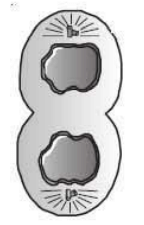
| (1) | Telephase | Nuclear envelop reforms, golgi complex reforms. |
| (2) | Late Anaphase | Chromosomes move away from equatorial plate, golgi complex not present. |
| (3) | Cytokinesis | Cell plate formed, mitochondria distributed between two daughter cells. |
| (4) | Telophase | Endoplasmic reticulum and nucleolus not reformed yet. |
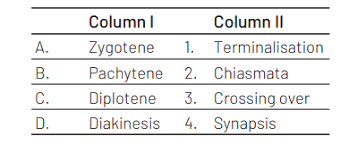
| a | Zygotene | i | Terminalization |
| b | Pachytene | ii | Chiasmata |
| c | Diplotene | iii | Crossing over |
| d | Diakinesis | iv | Synapsis |
Select the correct option from the following:
Which of the following is not an application of PCR (Polymerase Chain Reaction)?
Detection of gene mutation
Molecular diagnosis
Gene amplification
Purification of isolated protein
Pachytene
Leptotene
Zygotene
Diakinesis
Statement I: The primary CO2 acceptor in C4 plants is phosphoenolpyruvate and is found in the mesophyll cells.
Statement II: Mesophyll cells of C4 plants lack enzyme.
In the light of the above statements, choose the correct answer from the options given below:
Given below are two statements:
Statement I: During G0 phase of cell cycle, the cell is metabolically inactive.
Statement II: The centrosome undergoes duplication during S phase of interphase.
In the light of the above statements, choose the most appropriate answer from the options given below:
Which of the following stages of meiosis involves division of centromere?
Metaphase II
Anaphase II
Telophase
Metaphase I
Match List I with List II: List I List II
List I | List II | ||
| A. | M Phase | I. | Proteins are synthesized |
| B. | G2 Phase | II. | Inactive phase |
| C. | Quiescent stage | III. | Interval between mitosis and initiation of DNA replication |
| D. | G1 Phase | IV | Equational division |
Choose the correct answer from the options given below
A-IV, B-II, C-I, D-III
A-IV, B-I, C-II, D-III
A-II, B-IV, C-I, D-III
A-III, B-II, C-IV, D-I
Select the correct statements.
- Tetrad formation is seen during Leptotene.
- During Anaphase, the centromeres split and chromatids separate.
- Terminalization takes place during Pachytene.
- Nucleolus, Golgi complex and ER are reformed during Telophase.
- Crossing over takes place between sister chromatids of homologous chromosome.
Choose the correct answer from the options given below:
Among eukaryotes, replication of DNA takes place in:
S phase
G1 phase
G2 phase
M Phase
Statement I : Chromosomes become gradually visible under light microscope during leptotene stage.
Statement II : The begining of diplotene stage is recognized by dissolution of synaptonemal complex.
In the light of the above statements, choose the correct answer from the options given below:
| List - I | List – II | ||
| A. | Cells are metabolically active and proliferate | i. | |
| B. | DNA replication takes place | ii. | |
| C. | Proteins are synthesised | iii. | |
| D. | Quiescent stage with metabolically active cells | iv. | S phase |
| List - I | List – II | ||
| A. | Chiasmata formation | i. | Pachytene |
| B. | Crossing over | ii. | Diakinesis |
| C. | Synaptonemal complex formation | iii. | Diplotene |
| D. | Terminalisation of chiasmata | iv. | Zygotene |
About Cell Cycle And Cell Division - NEET-UG
Cell Cycle And Cell Division is a vital chapter for NEET-UG aspirants. Mastering the concepts covered in this chapter is essential for securing a top rank.
By rigorously practicing the previous year questions associated with this chapter, you can identify high-yield topics, understand the examiner's perspective, and boost your confidence during the actual exam.
Frequently Asked Questions
Why focus on Cell Cycle And Cell Division PYQs?
Analyzing PYQs for this specific chapter reveals the most frequently tested concepts and the typical complexity of questions, allowing you to tailor your study plan efficiently.
How to best use this analysis?
Review the topic breakdown to see which sub-topics within Cell Cycle And Cell Division carry the most weight. Then, tackle the questions iteratively to solidify your understanding.