NEET-UG SERIES Biology
Human Body
9 previous year questions.
Volume: 9 Ques
Yield: Medium
High-Yield Trend
2
2024 1
2020 3
2018 3
2017 Chapter Questions 9 MCQs
01
PYQ 2017
medium
biology ID: neet-ug-
Out of 'X' pairs of ribs in humans only 'Y' pairs are true ribs. Select the option that correctly represents values of X and Y and provides their explanation :
1
X = 12, Y = 7; True ribs are attached dorsally to vertebral column and ventrally to the sternum
2
X = 12, Y = 5; True ribs are attached dorsally to vertebral column and sternum on the two ends
3
X = 24, Y = 7; True ribs are dorsally attached to vertebral column but are free on ventral side.
4
X = 24, Y = 12; True ribs are dorsally attached to vertebral column but are free on ventral side.
02
PYQ 2017
medium
biology ID: neet-ug-
Lungs are made up of air-filled sacs the alveoli. They do not collapse even after forceful expiration, because of:
1
Residual Volume
2
Inspiratory Reserve Volume
3
Tidal Volume
4
Expiratory Reserve Volume
03
PYQ 2017
medium
biology ID: neet-ug-
A temporary endocrine gland in the human body is
1
Pineal gland
2
Corpus cardiacum
3
Corpus luteum
4
Corpus allatum
04
PYQ 2018
medium
biology ID: neet-ug-
The transparent lens in the human eye is held in its place by
1
ligaments attached to the ciliary body
2
smooth muscles attached to the iris
3
ligaments attached to the iris
4
smooth muscles attached to the ciliary body
05
PYQ 2018
medium
biology ID: neet-ug-
The similarity of bone structure in the forelimbs of many vertebrates is an example of
1
Homology
2
Convergent evolution
3
Analogy
4
Adaptive radiation
06
PYQ 2018
medium
biology ID: neet-ug-
Which of the following terms describe human dentition ?
1
Thecodont, Diphyodont, Homodont
2
Pleurodont, Monophyodont, Homodont
3
Thecodont, Diphyodont, Heterodont
4
Pleurodont, Diphyodont, Heterodont
07
PYQ 2020
medium
biology ID: neet-ug-
Match the following columns and select the correct option.
Column I | Column II | ||
| A | Floating Ribs | I | Located between second and seventh ribs |
| B | Acromion | II | Head of the Humerus |
| C | Scapula | III | Clavicle |
| D | Glenoid cavity | IV | Do not connect with the sternum |
1
a-(ii) b-(iv) c-(i) d-(iii)
2
a-(i)b-(iii) c-(ii) d-(iv)
3
a-(iii)b- (ii) c-(iv) d-(i)
4
a-(iv) b- (iii)c- (i)d- (ii)
08
PYQ 2024
easy
biology ID: neet-ug-
Given below are two statements:
Statement I: The cerebral hemispheres are connected by nerve tract known as corpus callosum.
Statement II: The brain stem consists of the medulla oblongata, pons and cerebrum.
In the light of the above statements, choose the most appropriate answer from the options given below:
Statement I: The cerebral hemispheres are connected by nerve tract known as corpus callosum.
Statement II: The brain stem consists of the medulla oblongata, pons and cerebrum.
In the light of the above statements, choose the most appropriate answer from the options given below:
1
Both Statement I and Statement II are correct.
2
Both Statement I and Statement II are incorrect
3
Statement I is correct but Statement II is incorrect
4
Statement I is incorrect but Statement II is correct
09
PYQ 2024
medium
biology ID: neet-ug-
Three types of muscles are given as a, b and c. Identify the correct matching pair along with their location in human body :
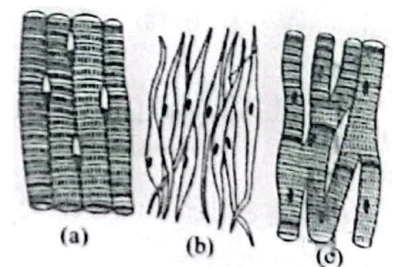
1
(a) Smooth - Toes
(b) Skeletal – Legs
(c) Cardiac – Heart
(b) Skeletal – Legs
(c) Cardiac – Heart
2
(a) Skeletal - Triceps
(b) Smooth – Stomach
(c) Cardiac – Heart
(b) Smooth – Stomach
(c) Cardiac – Heart
3
(a) Skeletal - Biceps
(b) Involuntary – Intestine
(c) Smooth – Heart
(b) Involuntary – Intestine
(c) Smooth – Heart
4
(a) Involuntary – Nose tip
(b) Skeletal – Bone
(c) Cardiac – Heart
(b) Skeletal – Bone
(c) Cardiac – Heart
About Human Body - NEET-UG
Human Body is a vital chapter for NEET-UG aspirants. Mastering the concepts covered in this chapter is essential for securing a top rank.
By rigorously practicing the previous year questions associated with this chapter, you can identify high-yield topics, understand the examiner's perspective, and boost your confidence during the actual exam.
Frequently Asked Questions
Why focus on Human Body PYQs?
Analyzing PYQs for this specific chapter reveals the most frequently tested concepts and the typical complexity of questions, allowing you to tailor your study plan efficiently.
How to best use this analysis?
Review the topic breakdown to see which sub-topics within Human Body carry the most weight. Then, tackle the questions iteratively to solidify your understanding.