The ventricles consist of four hollow, fluid filled spaces inside the brain. The third ventricle is also known as diacoel. The third ventricle consists of a narrow channel between the hemispheres through the area of the thalamus. It is connected by the cerebral aqueduct or aqueduct of Sylvius or iter in the midbrain portion of the brainstem to the fourth ventricle in the pons and medulla. Metacoel is the IV ventricle, rhinocoel is the I ventricle and paracoel are the II ventricles.
02
PYQ 1992
medium
biologyID: neet-ug-
Afferent nerve fibre carries impulses from
1
effector to central neural system
2
receptor to central neural system
3
central neural system to muscle
4
central neural system to receptors
Official Solution
Correct Option: (2)
The sensory nerves that carry impulses from the receptors to are called afferent nerve fibres
03
PYQ 1993
medium
biologyID: neet-ug-
Retina is most sensitive at
1
optic disc
2
periphery
3
macula lutea
4
fovea centralis.
Official Solution
Correct Option: (4)
A small area of the optical part of the retina lying exactly opposite to the centre of the cornea is called the macula lutea, or yellow spot which has a yellow pigment (xanthophyll). The macula lutea has at its middle a shallow depression, the fovea centralis. The fovea has cone cells only, and is the place of most distinct vision. Away form the fovea, the rod and cone cells occur in equal numbers, and at the periphery of the retina, the rods are more numerous than the cones. This is why we see better in dimlight by looking out of the corner of the eye. The point on the retina from where the optic nerve starts is called the blind spot, or optic disc, as it lacks the receptor cells and is insensitive to light.
04
PYQ 1993
medium
biologyID: neet-ug-
Iris is part of
1
sclerotic
2
choroid
3
choroid and retina
4
sclerotic and choroid.
Official Solution
Correct Option: (4)
Sclera is the external layer of eye that maintains its shape and also protects it. Choroid is the middle layer of eye. Uvea is the pigmented layer of eye that lies beneath sclera and cornea. It comprises of choroid, iris and ciliary body. Retina is the inner layer of eye that contain photoreceptor cells.
05
PYQ 1993
medium
biologyID: neet-ug-
Light rays entering the eye is controlled by
1
pupil
2
iris
3
cornea
4
lens.
Official Solution
Correct Option: (1)
Pupil is the opening which controls the amount of light entering in eye. When light intensity is high, it decrease in size and when light intensity is low it dilates to allow more light in the eye to make eye enable to see the object.
06
PYQ 1993
medium
biologyID: neet-ug-
Function of iris is to
1
move lens forward and backward
2
refract light rays
3
bring about movements of eye lids
4
alter the size of pupil.
Official Solution
Correct Option: (4)
At the junction of the sclera and the cornea, the vascular coat sharply bends into the cavity of the eyeball to form a thin, coloured partition. This partition is called iris. It is perforated at the middle by an aperture called pupil. The iris contains two sets of smooth muscles: sphincters and dilators. These muscles regulate the amount of light entering the eyeball by varying the size of the pupil. The sphincter muscles are arranged in rings. Their contraction makes the pupil smaller in bright light so that less light enters the eye. The dilator muscles are arranged in a radial manner. Their contraction widens the pupil in dim light to let in more light. Iris, by regulating the size of the pupil, allows light to pass only through the centre of the lens, which is optically the most effective part.
07
PYQ 1995
medium
biologyID: neet-ug-
The sympathetic nerves, in mammals, arise from
1
sacral nerves
2
3rd, 7th, 9th and 10th cranial nerves
3
thoraco-lumbar nerves
4
cervical nerves.
Official Solution
Correct Option: (3)
Sympathetic nervous system forms a part of autonomic nervous system that consists of nerves which connect the visceral receptors and effectors with the central nervous system through the crania and spinal nerves. Sympathetic nerves arise from thoracolumbar nerves.
08
PYQ 1999
medium
biologyID: neet-ug-
Which of the following is regarded as a unit of nervous tissue?
1
neurons
2
myelin sheath
3
axons
4
dendrites.
Official Solution
Correct Option: (1)
Neurons or nerve cells are the structural and functional unit of nervous system. These have a special structure but vary greatly in size and shape. Each neuron has a cell body which encloses cytoplasm and has a nucleus. A number of processes arise from the cell body. There is usually a single axon and a variable number of dendrites. The medullated nerve fibres is composed of a shining, white, fatty substance called myelin.
09
PYQ 2000
medium
biologyID: neet-ug-
Depolarization of axolemma during nerve conduction takes place because of:
1
Equal amount of Na+ & K+ move out across axolemma
2
Na+ move inside and K+ move more out side
3
More Na+ outside
4
None
Official Solution
Correct Option: (2)
Depolarization of axolemma during nerve conduction takes place because more Na+ ions move inside the axon while K+ ions move more outside. This movement of ions is essential for generating action potentials, which are the electrical signals that transmit nerve impulses along neurons.
So, the correct option is (B): Na+ move inside and K+ move more out side.
10
PYQ 2001
medium
biologyID: neet-ug-
Characteristics character of human cornea
1
Secreted by conjuctiva and glandular
2
It has lacrimal gland which secrete tears
3
Blood circulation is absent in cornea
4
In old age it become harden and white layer deposite on it which causes the cataract
Official Solution
Correct Option: (3)
The characteristic features of the human cornea are as follows:
(C) Blood circulation is absent in the cornea.
The human cornea is avascular, meaning it lacks blood vessels. It obtains its nutrients and oxygen from the tear fluid on the outside and the aqueous humor on the inside of the eye. This avascularity is essential for maintaining the transparency of the cornea.
Option (A) is incorrect because the cornea is not secreted by the conjunctiva or glandular structures.
Option (B) is incorrect because the lacrimal gland primarily secretes tears, but it is not a specific characteristic of the cornea.
Option (D) is incorrect because the hardening and white layer deposition that leads to cataracts primarily affect the eye's lens, not the cornea. Cataracts involve changes in the lens structure, not the cornea.
11
PYQ 2001
medium
biologyID: neet-ug-
When we migrate from dark to light, we fail to see for sometimes but after a time visibility becomes normal. It is example of
1
Accomodation
2
Adaptation
3
Mutation
4
Photoperiodism
Official Solution
Correct Option: (4)
The phenomenon you described, where vision is initially impaired when transitioning from darkness to light but gradually improves, is an example of Adaptation.
Adaptation in the context of vision refers to the adjustment of the eyes to changes in light intensity. When you move from a dark environment to a well-lit one, your eyes need some time to adapt to the increased light, which is why you experience temporary impairment in vision before it returns to normal.
So, the correct option is (B): Adaptation
12
PYQ 2001
medium
biologyID: neet-ug-
Types of RNA polymerase required in nucleus for RNA synthesis
1
1
2
2
3
3
4
4
Official Solution
Correct Option: (3)
In eukaryotic cells, there are multiple types of RNA polymerase enzymes responsible for different types of RNA synthesis. The RNA polymerase required in the nucleus for RNA synthesis includes 3.
RNA polymerase I is responsible for the synthesis of ribosomal RNA (rRNA), RNA polymerase II is responsible for the synthesis of mRNA (messenger RNA), and RNA polymerase III is responsible for the synthesis of small RNA molecules, including transfer RNA (tRNA) and some small nuclear RNAs (snRNAs). These three RNA polymerases are primarily responsible for RNA synthesis in the nucleus of eukaryotic cells.
So, the correct option is (C): 3
13
PYQ 2003
medium
biologyID: neet-ug-
What used to be described as Nissl granules in a nerve cell are now identified as:
1
Cell metabolites
2
Fat granules
3
Ribosomes
4
Mitochondria
Official Solution
Correct Option: (3)
Nissl granules were originally thought to be unique structures in nerve cells, but they are now recognized as clusters of ribosomes, which are cellular organelles involved in protein synthesis. These ribosomes play a crucial role in producing proteins necessary for the neuron's function.
So, the correct option is (C): Ribosomes
14
PYQ 2003
medium
biologyID: neet-ug-
What used to be described as Nissel granules in a nerve cell are now identified as
1
Cell metabolites
2
Fat granules
3
Ribosomes
4
Mitochondria
Official Solution
Correct Option: (3)
Cell body of a nerve cell contains basophilic granules called Nissl's granules. These granules appear to be cisternae of rough endoplasmic reticulum with numerous attached and free ribosomes. They probably synthesize proteins for the cell.
15
PYQ 2004
medium
biologyID: neet-ug-
Injury to vagus nerve in human is not likely to affect
1
tongue movements
2
gastrointestinal movements
3
pancreatic secretion
4
cardiac movements
Official Solution
Correct Option: (1)
Vagus nerve is a mixed cranial nerve, controlling much of the gut, ventilatory system and heart. It does not affect tongue movements. Tongue movement is controlled by glossopharyngeal nerve.
16
PYQ 2005
medium
biologyID: neet-ug-
Four healthy people in their twenties got involved in injuries resulting in damage and death of a few cells of the following. Which of the cells are least likely to be replaced by new cells?
1
Osteocytes
2
Malpighian layer of the skin
3
Liver cells
4
Neurons
Official Solution
Correct Option: (4)
Neurons have the lowest likelihood of being replaced by new cells. Neurons, which are specialized nerve cells, generally lack significant regenerative capabilities, especially in most areas of the adult human brain and spinal cord. In contrast:
Osteocytes, responsible for bone maintenance, can be replaced over time, particularly in response to bone injuries or changes.
Malpighian layer of the skin have a relatively fast turnover rate, as new skin cells continually replace old or damaged ones.
Liver cells, residing in the liver, possess impressive regenerative potential, allowing the liver to recover from various forms of injury or cell loss.
In summary, neurons are the least likely to be replaced by new cells, while the other cell types mentioned exhibit varying degrees of replacement and regeneration mechanisms. ∴The correct option is (D): Neurons.
17
PYQ 2005
medium
biologyID: neet-ug-
One of the examples of the action of the autonomous nervous system is :
1
knee-jerk response
2
pupillary reflex
3
swallowing of food
4
peristalsis of the intestines
Official Solution
Correct Option: (4)
One of the examples of the action of the autonomic nervous system is peristalsis of the intestines. The autonomic nervous system controls involuntary processes in the body, such as the contraction of smooth muscles in the intestines to produce peristalsis. The other options, while involving reflexes and involuntary actions, are typically associated with the somatic nervous system or cranial nerves.
So, the correct option is (D): peristalsis of the intestines
18
PYQ 2005
easy
biologyID: neet-ug-
In a man, abducens nerve is injured. Which one of the following functions will be affected ?
1
Movement of the eye ball
2
Swallowing
3
Movement of the tongue
4
Movement of the neck
Official Solution
Correct Option: (1)
Injury to the abducens nerve can lead to difficulties in moving the affected eye laterally (outward), which can result in strabismus (crossed eyes) and difficulty in coordinating eye movements. It does not directly impact swallowing, tongue movement, or neck movement.
So, the correct option is (A): Movement of the eye ball
19
PYQ 2006
medium
biologyID: neet-ug-
A person showing unpredictable moods, outbursts of emotion, quarrelsome behaviour and conflicts with others is suffering from:
1
schizophrenia
2
borderline personality disorder (BPD)
3
mood disorders
4
addictive disorders
Official Solution
Correct Option: (2)
Borderline personality disorder is characterized by unstable moods, behavior, and relationships. People with BPD often struggle with regulating their emotions, have difficulties with interpersonal relationships, and may engage in impulsive and self-destructive behaviors. It's important to note that a proper diagnosis should be made by a mental health professional based on a thorough evaluation.
So, the correct option is (B): borderline personality disorder (BPD).
20
PYQ 2007
medium
biologyID: neet-ug-
Bowman's glands are located in the
1
Olfactory epithelium of our nose
2
Proximal end of uriniferous tubules
3
Anterior pituitary
4
Female reproductive system of cockroach
Official Solution
Correct Option: (1)
The correct answer is A:Olfactory epithelium of our nose Bowmans glands are found in olfactory epithelium. The cortical nephrons lie in the renal cortex and have very short loops of Henie that extend only little into the medulla. Juxtamedullary nephrons present in only birds and mammals, they regulate the plasma volume when water is of short supply.
21
PYQ 2008
medium
biologyID: neet-ug-
Which one of the following is the correct difference between rod cells and cone cells of our retina ?
1
Overall function Vision in poor light Colour vision and detailed vision in bright light
2
Distribution More concentrated in centre of retina Evenly distributed all over retina
3
Visual activity high low
4
Visual pigment contained lodopsin Rhodopsin
Official Solution
Correct Option: (1)
Rod cell is a type of light-sensitive receptor cell present in the retina of vertebrates. Rods contain the pigment rhodopsin and are essential for vision in dim light. They are not evenly distributed on the retina, being absent in the fovea and occupying all of the retinal margin. Cone cell is a type of light-sensitive receptor cell, found in the retina of all diurnal vertebrates. Cones are specialized to transmit information about colour and are responsible for the visual acuity of the eye. They function best in bright light. They contain pigment iodopsin. They are not evenly distributed on the retina.
22
PYQ 2009
medium
biologyID: neet-ug-
Alzheimer disease in humans is associated with the deficiency of
1
Glutamic acid
2
Dopamine
3
Gama aminobutyric acid (GABA)
4
Acetylcholine
Official Solution
Correct Option: (4)
Alzheimer's disease is a neurological disease characterized by progressive loss of intellectual ability. The disease, which is named after German physician Alois Alzheimer (1864-1915), is associated with general shrinkage of the brain tissue, with deposits of (3-amyloid protein and abnormal filaments composed of tau protein in the brain, and changes in the neurotransmitter systems within the brain that include a loss in the activity of cholinergic neurons (neurons releasing acetylcholine). Some inherited forms are associated with a genetic locus on chromosome 21. 18 (c) : Hypothalamus is the thermoregulatory center of the body. It keeps body temperature at 37�C by means of a complex thermostat system.
23
PYQ 2012
medium
biologyID: neet-ug-
Which part of the human ear plays no role in hearing as such but is otherwise very much required?
1
Eustachian tube
2
Organ of Corti
3
Vestibular apparatus
4
Ear ossicles
Official Solution
Correct Option: (3)
Vestibular apparatus is a part of inner ear which is located above the choclea. It consists of three semicircular canals, which detect movements of the head, and the utriculus and sacculus which detect the position of head. It does not play any role in hearing but is responsible for maintaining the balance of the body and posture, thus necessary.
24
PYQ 2013
medium
biologyID: neet-ug-
A diagram showing axon terminal and synapse is given. Identify correctly at least two of A-D.
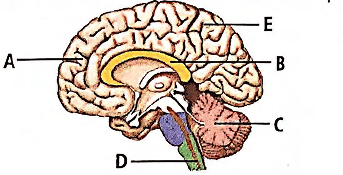
A sagittal section of human brain is shown here. Identify at least two labels from A-D.
1
C-Mid brain, D-Cerebellum
2
A-Cerebrum, C-Pons
3
B-Corpus callosum, D-Medulla
4
A-Cerebral hemispheres, B-Cerebellum
Official Solution
Correct Option: (2)
A - Cerebral hemisphere. B - Thalamus. C - Pons varolii. D - Cerebellum.
26
PYQ 2014
medium
biologyID: neet-ug-
Which one of the following statements is not correct?
1
In retina the rods have the photopigment rhodopsin while cones have three different photopigments.
2
Retinal is a derivative of vitamin C.
3
Rhodopsin is the purplish red protein present in rods only.
4
Retinal is the light absorbing portion of visual photo pigments.
Official Solution
Correct Option: (2)
The correct option (B): Retinal is a derivative of vitamin C.
27
PYQ 2014
medium
biologyID: neet-ug-
Stimulation of a muscle fibre by a motor neuron occurs at
1
The transverse tubules
2
The myofibril
3
The sacroplasmic reticulum
4
The neuromuscular junction
Official Solution
Correct Option: (4)
The correct option (D): The neuromuscular junction.
28
PYQ 2014
medium
biologyID: neet-ug-
How do parasympathetic neural signals affect the working of the heart?
1
Heart rate is increased without affecting the cardiac output
2
Both heart rate and cardiac output increase
3
Heart rate decreases but cardiac output increases
4
Reduce both heart rate and cardiac output
Official Solution
Correct Option: (4)
The correct option (D): Reduce both heart rate and cardiac output.
29
PYQ 2014
medium
biologyID: neet-ug-
Injury localized to the hypothalamus would most likely disrupt
1
short - term memory
2
co-ordination during locomotion
3
executive functions, such as decision making
4
regulation of body temperature.
Official Solution
Correct Option: (4)
Hypothalamus lies at the base of the thalamus. It provides anatomical connection between the nervous and endocrine systems by its relationship to the pituitary gland. Hypothalamus is thermoregulatory centre. Hence, it is called 'thermostat' of the body. It keeps body temperature at roughly 37?C by means of a complex thermostat system. Any localised injury to hypothalamus will, hence, disrupt regulation of body temperature.
30
PYQ 2015
medium
biologyID: neet-ug-
A gymnast is able to balance his body upside down even in the total darkness because of
1
tectorial membrane
2
organ of corti
3
cochlea
4
vestibular apparatus.
Official Solution
Correct Option: (4)
Vestibular apparatus is a part of inner ear which is located above the cochlea. It consists of three semicircular canals, which detect movements of the head, and the utriculus and sacculus which detect the position of head. It does not play any role in hearing, but is responsible for maintaining the balance of the body and posture.
31
PYQ 2015
medium
biologyID: neet-ug-
Destruction of the anterior horn cells of the spinal cord would result in loss of
1
commissural impulses
2
integrating impulses
3
sensory impulses
4
voluntary motor impulses.
Official Solution
Correct Option: (4)
The anterior horns of spinal cord contains cells with fibres that form the anterior (motor) root end and are essential for the voluntary and reflex activity of muscles they innervate. If the anterior horn motor cells are destroyed, the nerves cannot regenerate and muscles are never useful again.
32
PYQ 2017
medium
biologyID: neet-ug-
Myelin sheath is produced by
1
Astrocytes and Schwann cells
2
Oligodendrocytes and Osteoclasts
3
Osteoclasts and Astrocytes
4
Schwann cells and Oligodendrocytes
Official Solution
Correct Option: (4)
Myelin sheath is an extended and modified plasma membrane that is wrapped around the nerve axon in a spiral mode. Myelin membranes originate from and are a part of the Schwann cells in the peripheral nervous system (PNS) and the oligodendroglial cells in central nervous system (CNS). Osteoclasts are a large multinucleate bone cell that absorbs bone tissue during growth and healing. Astrocytes are star-shaped glial cells of the central nervous system.
Thus, the correct answer is D Schwann cells and Oligodendrocytes.
33
PYQ 2017
medium
biologyID: neet-ug-
Good vision depends on adequate intake of carotene rich food : Select the best option from the following statements : (a) Vitamin A derivatives are formed from carotene (b) The photopigments are embedded in the membrane discs of the inner segment (c) Retinal is a derivative of Vitamin A (d) Retinal is a light absorbing part of all the visual photopigments
1
(a), (c) and (d)
2
(a) and (c)
3
(b), (c) and (d)
4
(a) and (b)
Official Solution
Correct Option: (1)
Carotene is the source of retinal which is involved in formation of rhodopsin of rod cells. Retinal, a derivative of vitamin , is the light-absorbing part of all visual photopigments.
34
PYQ 2017
medium
biologyID: neet-ug-
Receptor sites for neurotransmitters are present on :
1
Pre-synaptic membrane
2
Tips of axons
3
Post-synaptic membrane
4
Membrane of synaptic vesicles
Official Solution
Correct Option: (3)
Pre-synaptic membrane is involved in the release of neurotransmitter in the chemical synapse. The receptors sites for neurotransmitters are present on post-synaptic membrane.
35
PYQ 2018
medium
biologyID: neet-ug-
The transparent lens in the human eye is held in its place by
1
smooth muscles attached to the ciliary body
2
ligaments attached to the ciliary body
3
smooth muscles attached to the iris
4
ligaments attached to the iris
Official Solution
Correct Option: (2)
Lens in the human eye is held in its place by suspensory ligaments attached to the ciliary body.
36
PYQ 2019
medium
biologyID: neet-ug-
Which of the following statements is correct?
1
Cornea is an external, transparent and protective proteinacious covering of the eye-ball.
2
Cornea consists of dense connective tissue of elastin and can repair itself.
3
Cornea is convex, transparent layer which is highly vascularised.
4
Cornea consists of dense matrix of collagen and is the most sensitive portion of the eye.
Official Solution
Correct Option: (4)
The correct option is (D) :
37
PYQ 2019
medium
biologyID: neet-ug-
Which part of the brain is responsible for thermoregulation ?
1
Corpus callosum
2
Medulla oblongata
3
Cerebrum
4
Hypothalamus
Official Solution
Correct Option: (4)
The correct answer is D:Hypothalamus Hypothalamus in the thermoregulatory centre of our brain. It is responsible for maintaining constant body temperature.
38
PYQ 2019
hard
biologyID: neet-ug-
The given figure shown lateral view of the human brain. identify the parts labelled as to and select the correct option
1
a
2
b
3
c
4
d
Official Solution
Correct Option: (4)
Answer (d) d
39
PYQ 2019
medium
biologyID: neet-ug-
Which of the following statements is correct?
1
Cornea is convex, transparent layer which is highly vascularised.
2
Cornea consists of dense matrix of collagen and is the most sensitive portion of the eye.
3
Cornea is an external, transparent and protective proteinacious covering of the eye-ball.
4
Cornea consists of dense connective tissue of elastin and can repair itself.
Official Solution
Correct Option: (2)
Cornea consists of dense matrix of collagen, it is the transparent continuation of the sclera, that covers the iris and lens. It protects the eye ball from damage and prevents entry of micro-organisms into the eye
40
PYQ 2022
medium
biologyID: neet-ug-
Select the incorrect statement regarding synapses:
1
The membranes of presynaptic and postsynaptic neurons are in close proximity in an electrical synapse.
2
Electrical current can flow directly from one neuron into the other across the electrical synapse.
3
Chemical synapse use neurotransmitters
4
Impulse transmission across a chemical synapse is always faster than that across an electrical synapse
Official Solution
Correct Option: (4)
The correct answer to the given question is:
Impulse transmission across a chemical synapse is always faster than that across an electrical synapse
.
This statement is incorrect. To understand why, let's explore the nature and function of synapses:
Electrical Synapses: These synapses allow direct flow of electrical current from one neuron to another through gap junctions. The presynaptic and postsynaptic neuron membranes are very close together, and the transmission is extremely fast.
Chemical Synapses: In these synapses, neurotransmitters are released from the presynaptic neuron and then bind to receptors on the postsynaptic neuron. This process is slower compared to electrical synapse transmission because it involves multiple steps like neurotransmitter release, diffusion across the synaptic cleft, and receptor binding.
Therefore, the correct observation is that impulse transmission across an electrical synapse is typically faster than transmission across a chemical synapse.
Synapse Type
Transmission Method
Speed Comparison
Electrical Synapse
Direct electrical current flow via gap junctions
Faster
Chemical Synapse
Neurotransmitter release and receptor binding
Slower
41
PYQ 2023
medium
biologyID: neet-ug-
Match List I with List II with respect in human eye.
List I
List II
A
Fovea
I
Visible coloured portion of eye that regulates diameter of pupi
B
Iris
II
External layer of eye formed of dense connective tissue.
C
Blind spot
III
Point of greatest visual acuity or resolution
D
Sclera
IV
Point where optic nerve leaves the eyeball and photoreceptor cells are absent
Choose the correct answer from the options given below:
1
A-IV, B-III, C-II, D-I
2
A-I, B-IV, C-III, D-II
3
A-II, B-I, C-III, D-IV
4
A-III, B-I, C-IV, D-II
Official Solution
Correct Option: (4)
To match List I with List II regarding parts of the human eye, let us evaluate the options provided:
List I
Description (List II)
Fovea
Point of greatest visual acuity or resolution
Iris
Visible coloured portion of eye that regulates diameter of pupil
Blind spot
Point where optic nerve leaves the eyeball and photoreceptor cells are absent
Sclera
External layer of eye formed of dense connective tissue
Explanation:
Fovea is known for its role in providing high visual acuity and resolution. Thus, it matches with "Point of greatest visual acuity or resolution." (III)
Iris is the colored part of the eye responsible for adjusting the pupil size. This description aligns with "Visible coloured portion of eye that regulates diameter of pupil." (I)
Blind spot is the point where the optic nerve exits the eye, and no photoreceptor cells are present, making it match "Point where optic nerve leaves the eyeball and photoreceptor cells are absent." (IV)
Sclera is the tough, external layer of the eye, which corresponds to "External layer of eye formed of dense connective tissue." (II)
Based on the analysis, the correct matches are:
A-III: Fovea - Point of greatest visual acuity or resolution
B-I: Iris - Visible coloured portion of eye that regulates diameter of pupil
C-IV: Blind spot - Point where optic nerve leaves the eyeball and photoreceptor cells are absent
D-II: Sclera - External layer of eye formed of dense connective tissue