Choose the correct answer from the options given below :
1
A-III, B-IV, C-II, D-I
2
A-II, B-I, C-IV, D-III
3
A-II, B-III, C-I, D-IV
4
A-IV, B-I, C-III, D-II
Official Solution
Correct Option:
(2)
A. Incomplete dominance - II. Flower colour in Antirrhinum: In incomplete dominance, the heterozygote shows an intermediate phenotype (e.g., pink flowers from red and white parents).
B. Co-dominance - I. Blood groups in humans: In co-dominance, both alleles are expressed in the heterozygote (e.g., AB blood type).
C. Pleiotropy - IV. Phenylketonuria: Pleiotropy refers to a single gene affecting multiple traits or symptoms.
D. Polygenic inheritance - III. Skin colour in humans: Polygenic inheritance involves multiple genes contributing to a single trait. Skin color is a classic example of polygenic inheritance.
Therefore, the correct matches are: A-II, B-I, C-IV, and D-III. This corresponds to option (2).
02
PYQ 2024
medium
biologyID: neet-ug-
Match List-I with List-II:
List-I
List-II
A. Metacentric chromosome
I. Chromosome has a terminal centromere
B. Sub-metacentric chromosome
II. Middle centromere forming two equal arms of chromosome
C. Acrocentric chromosome
III. Centromere is slightly away from the middle of chromosome resulting into two unequal arms
D. Telocentric chromosome
IV. Centromere is situated close to its end forming one extremely short and one very long arm
Choose the correct answer from the options given below:
1
A-II, B-I, C-IV, D-III
2
A-IV, B-I, C-II, D-III
3
A-I, B-II, C-III, D-IV
4
A-II, B-III, C-IV, D-I
Official Solution
Correct Option:
(4)
The correct matches are: A. Metacentric chromosome - II. Middle centromere forming two equal arms of chromosome. B. Sub-metacentric chromosome - III. Centromere is slightly away from the middle of chromosome resulting into two unequal arms. C. Acrocentric chromosome - IV. Centromere is situated close to its end forming one extremely short and one very long arm. D. Telocentric chromosome - I. Chromosome has a terminal . Therefore, the correct option is (4): A-II, B-III, C-IV, D-I.
03
PYQ 2024
medium
biologyID: neet-ug-
Recombination between homologous chromosomes is completed by the end of
1
Diakinesis
2
Zygotene
3
Diplotene
4
Pachytene
Official Solution
Correct Option:
(4)
Recombination between homologous chromosomes is completed by the end of the pachytene stage of meiosis I.
04
PYQ 2024
hard
biologyID: neet-ug-
Given below are two statements: Statement I: Failure of segregation of chromatids during cell cycle resulting in the gain or loss of whole set of chromosome in an organism is known as aneuploidy. Statement II: Failure of cytokinesis after anaphase stage of cell division results in the gain or loss of a chromosome is called polyploidy. In the light of the above statements, choose the correct answer from the options given below:
1
Statement I is true but Statement II is false
2
Statement I is false but Statement II is true
3
Both Statement I and Statement II are true
4
Both Statement I and Statement II are false
Official Solution
Correct Option:
(4)
Statement I is incorrect. Aneuploidy is the gain or loss of one or a few chromosomes, not a whole set. Polyploidy is the gain of a whole set of chromosomes. Statement II is also incorrect. Failure of cytokinesis after anaphase leads to polyploidy (a change in the number of chromosome sets), not aneuploidy (a change in the number of individual chromosomes within a set).
05
PYQ 2024
medium
biologyID: neet-ug-
Match List-I with List-II:
List-I
List-II
A. Histones
III. Positively charged basic proteins
B. Nucleosome
IV. DNA wrapped around histone octamer
C. Euchromatin
I. Loosely packed chromatin
D. Heterochromatin
II. Densely packed Chromatin
Choose the correct answer from the options given below:
1
A-IV, B-III, C-II, D-I
2
A-III, B-I, C-IV, D-II
3
A-II, B-III, C-IV, D-I
4
A-III, B-IV, C-I, D-II
Official Solution
Correct Option:
(4)
The correct matches are: A. Histones - III. Positively charged basic proteins: Histones are positively charged proteins that are crucial for DNA packaging in eukaryotes. B. Nucleosome - IV. DNA wrapped around histone octamer: A nucleosome is the basic structural unit of chromatin, consisting of DNA wrapped around a histone octamer. C. Euchromatin - I. Loosely packed chromatin: Euchromatin is the less condensed form of chromatin, which is transcriptionally active. D. Heterochromatin - II. Densely packed chromatin: Heterochromatin is the highly condensed form of chromatin, which is transcriptionally inactive. Therefore, the correct option is (4): A-III, B-IV, C-I, D-II.
06
PYQ 2024
medium
biologyID: neet-ug-
Aneuploidy is a chromosomal disorder where chromosome number is not the exact copy of its haploid set of chromosomes, due to : (a) Substitution (b) Addition (c) Deletion (d) Translocation (e) Inversion Choose the most appropriate answer from the options given below
1
(c) and (d) only
2
(d) and (e) only
3
(a) and (b) only
4
(b) and (c) only
Official Solution
Correct Option:
(4)
Aneuploidy refers to an abnormal number of chromosomes, which is not a multiple of the haploid set. This arises due to errors during chromosome segregation in meiosis. Addition (B) and Deletion (C): These directly lead to aneuploidy. Nondisjunction, where chromosomes fail to separate correctly, can result in the addition or deletion of chromosomes in gametes. Substitution (A): Involves replacing one nucleotide with another and does not change the chromosome number. Translocation (D): Involves the transfer of a segment of a chromosome to a nonhomologous chromosome. While potentially causing other genetic disorders, balanced translocations do not directly cause aneuploidy because the total number of chromosomes remains the same. Inversion (E): A segment of the chromosome is reversed end-to-end. This doesn’t change the chromosome number.
07
PYQ 2025
hard
biologyID: neet-ug-
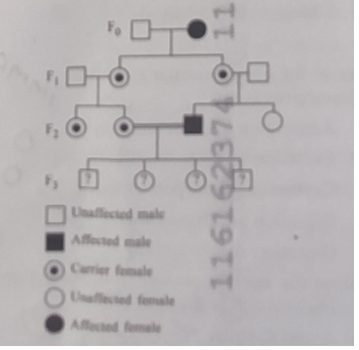
With the help of the given pedigree, find out the probability for the birth of a child having no disease and being a carrier (has the disease mutation in one allele of the gene) in the F3 generation.
1
1/2
2
1/8
3
Zero
4
1/4
Official Solution
Correct Option:
(4)
Step 1: Genotypes of the F2 Generation
The affected male (shaded square) has the genotype aa because the disease is autosomal recessive. An individual with the "aa" genotype will show the disease, as two copies of the recessive allele are needed to express the trait.
The female is a carrier, so her genotype must be Aa, meaning she carries one allele for the disease (a) but has one normal allele (A), making her asymptomatic but capable of passing the "a" allele to her children.
Step 2: Genotypes of F3 Generation (Offspring)
Let's consider the possible genotypes of their children (F3 generation). We can use a Punnett square to predict the potential outcomes of the offspring's genotypes.
Punnett Square: The father with genotype aa can only pass on the a allele to his children, while the mother with genotype Aa can pass on either the A or the a allele. The following genotypes are possible for their children:
Aa (carrier, no disease) — if the child inherits the A allele from the mother and the a allele from the father.
aa (affected, has the disease) — if the child inherits the a allele from both parents.
Therefore, the probability of an offspring being a carrier (Aa) is 1/2, and the probability of an offspring being affected (aa) is also 1/2.
Step 3: Probability of a Carrier in F3
The question asks for the probability that a child from this couple (F3 generation) will be a carrier (Aa).
From the analysis above, we can see that the offspring have a 50% chance of being a carrier (Aa), which means the probability of a child being a carrier is 1/2.
Step 4: If the Question Asks About Gender-Specific Probabilities
If the question specifically asks about the probability of having a daughter who is a carrier, the probability remains the same at 1/2 for that particular child. The gender of the child does not affect the autosomal inheritance pattern in this case because the trait is autosomal (not linked to sex chromosomes).
However, if the question asked for a more specific scenario, such as the probability of a daughter being a carrier and eventually becoming affected (with multiple conditions), the calculation might change, but the basic principle would remain the same.
Final Answer
The probability of any child being a carrier (Aa) is 1/2.
If the question asks specifically about a daughter, the probability of her being a carrier is still 1/2 for that child.
08
PYQ 2025
easy
biologyID: neet-ug-
Twins are born to a family that lives next door to you. The twins are a boy and a girl. Which of the following must be true?
1
They are fraternal twins.
2
They were conceived through in vitro fertilization.
3
They have 75\% identical genetic content.
4
They are monozygotic twins.
Official Solution
Correct Option:
(1)
Monozygotic (identical) twins develop from a single fertilized egg that splits into two embryos. Since they originate from the same zygote, they are always the same sex. Dizygotic (fraternal) twins develop from two separate eggs fertilized by two different sperm. Because they are from separate zygotes, they can be different sexes and have different genetic makeup (like any siblings). A boy and a girl twin pair can only be fraternal twins. In vitro fertilization doesn't determine whether twins are monozygotic or dizygotic. 75\% genetic similarity is not a standard measure for twins.
09
PYQ 2025
medium
biologyID: neet-ug-
Genes R and Y follow independent assortment. If RRYY produce round yellow seeds and rryy produce wrinkled green seeds, what will be the phenotypic ratio of the F2 generation?
1
Phenotypic ratio – 3:1
2
Phenotypic ratio – 9:3:3:1
3
Phenotypic ratio – 9:7
4
Phenotypic ratio – 1:2:1
Official Solution
Correct Option:
(2)
This is a classic dihybrid cross. Independent assortment of two genes with dominant/recessive alleles (R/r and Y/y) results in a 9:3:3:1 phenotypic ratio in the F2 generation: 9: Round, Yellow (R\_Y\_) 3: Round, Green (R\_yy) 3: Wrinkled, Yellow (rrY\_) 1: Wrinkled, Green (rryy)
About Genetics - NEET-UG
Genetics is a vital chapter for NEET-UG aspirants. Mastering the concepts covered in this chapter is essential for securing a top rank.
By rigorously practicing the previous year questions associated with this chapter, you can identify high-yield topics, understand the examiner's perspective, and boost your confidence during the actual exam.
Frequently Asked Questions
Why focus on Genetics PYQs?
Analyzing PYQs for this specific chapter reveals the most frequently tested concepts and the typical complexity of questions, allowing you to tailor your study plan efficiently.
How to best use this analysis?
Review the topic breakdown to see which sub-topics within Genetics carry the most weight. Then, tackle the questions iteratively to solidify your understanding.